
Things you always wanted to know the answer to [Vol. 2]
Discussion


CRA2Y said:
Suppose you could make a huge circular "tunnel" several billion miles long, attached huge rockets to it and accelerated it to half the speed of light - would you be able to fire a rocket inside the tunnel at slightly above the same speed (so when launched it is stationary relative to the tunnel, which is itself travelling half light, and thus exceed the speed of light?
No.goldblum said:
Ayahuasca said:
The amount of water on earth is negligible compared to its overall mass. The pic shows what all the earth's water would look like if collected together.

I find that hard to believe. I mean if you spread the water in that ball over the globe it wouldn't even cover the pacific! Some artistic license (no pun) going on there.USGS said:
All Earth's water in a bubble
This drawing shows various blue spheres representing relative amounts of Earth's water in comparison to the size of the Earth. Are you surprised that these water spheres look so small? They are only small in relation to the size of the Earth. This image attempts to show three dimensions, so each sphere represents "volume." The volume of the largest sphere, representing all water on, in, and above the Earth, would be about 332,500,000 cubic miles (mi3) (1,386,000,000 cubic kilometers (km3)), and be about 860 miles (about 1,385 kilometers) in diameter.
The smaller sphere over Kentucky represents Earth's liquid fresh water in groundwater, swamp water, rivers, and lakes. The volume of this sphere would be about 2,551,000 mi3 (10,633,450 km3) and form a sphere about 169.5 miles (272.8 kilometers) in diameter. Yes, all of this water is fresh water, which we all need every day, but much of it is deep in the ground, unavailable to humans.
Do you notice that "tiny" bubble over Atlanta, Georgia? That one represents fresh water in all the lakes and rivers on the planet, and most of the water people and life of earth need every day comes from these surface-water sources. The volume of this sphere is about 22,339 mi3 (93,113 km3). The diameter of this sphere is about 34.9 miles (56.2 kilometers). Yes, Lake Michigan looks way bigger than this sphere, but you have to try to imagine a bubble almost 35 miles high—whereas the average depth of Lake Michigan is less than 300 feet (91 meters).
This drawing shows various blue spheres representing relative amounts of Earth's water in comparison to the size of the Earth. Are you surprised that these water spheres look so small? They are only small in relation to the size of the Earth. This image attempts to show three dimensions, so each sphere represents "volume." The volume of the largest sphere, representing all water on, in, and above the Earth, would be about 332,500,000 cubic miles (mi3) (1,386,000,000 cubic kilometers (km3)), and be about 860 miles (about 1,385 kilometers) in diameter.
The smaller sphere over Kentucky represents Earth's liquid fresh water in groundwater, swamp water, rivers, and lakes. The volume of this sphere would be about 2,551,000 mi3 (10,633,450 km3) and form a sphere about 169.5 miles (272.8 kilometers) in diameter. Yes, all of this water is fresh water, which we all need every day, but much of it is deep in the ground, unavailable to humans.
Do you notice that "tiny" bubble over Atlanta, Georgia? That one represents fresh water in all the lakes and rivers on the planet, and most of the water people and life of earth need every day comes from these surface-water sources. The volume of this sphere is about 22,339 mi3 (93,113 km3). The diameter of this sphere is about 34.9 miles (56.2 kilometers). Yes, Lake Michigan looks way bigger than this sphere, but you have to try to imagine a bubble almost 35 miles high—whereas the average depth of Lake Michigan is less than 300 feet (91 meters).
Justin Cyder said:
CRA2Y said:
Suppose you could make a huge circular "tunnel" several billion miles long, attached huge rockets to it and accelerated it to half the speed of light - would you be able to fire a rocket inside the tunnel at slightly above the same speed (so when launched it is stationary relative to the tunnel, which is itself travelling half light, and thus exceed the speed of light?
No.besides all the relativity business, all matter, molecules and atoms, are all governed by the same laws
you can't push the next atom in line out of the way at more then the speed of light either
even a magic faster-than-light rocket engine would collapse all the matter in front of it and push its way through the rest of the rocket
JuniorD said:
Justayellowbadge said:
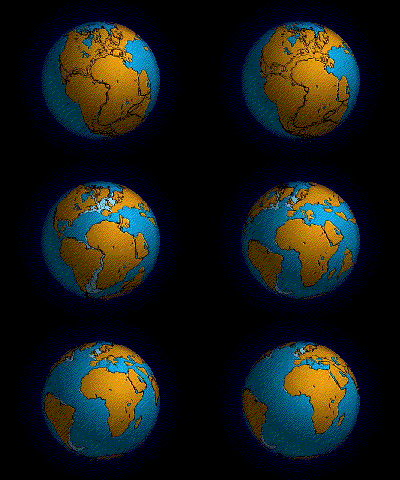
If the water was absent, you'd be looking at a sea of rock moving around. The only thing about that gif which makes it easier to understand is that the stuff below sea level is a different colour than the stuff above sea level.
It there was no "arbitrary sea level" shown, it'd look like the top of a simmering pan of liquid, because that's what the crust (of the earth) is anyway.
C


Re the talk of Earth's continents, Pangea etc.
Isn't it now thought that all of Earth's water was delivered in the form of comet impacts over time? Wouldn't that mean that a great deal of cooling would have happened without the seas/oceans existing meaning that the water, as it arrived by comet would always head to the low points ie. Where the oceans currently lie?
Isn't it now thought that all of Earth's water was delivered in the form of comet impacts over time? Wouldn't that mean that a great deal of cooling would have happened without the seas/oceans existing meaning that the water, as it arrived by comet would always head to the low points ie. Where the oceans currently lie?
benjj said:
Re the talk of Earth's continents, Pangea etc.
Isn't it now thought that all of Earth's water was delivered in the form of comet impacts over time? Wouldn't that mean that a great deal of cooling would have happened without the seas/oceans existing meaning that the water, as it arrived by comet would always head to the low points ie. Where the oceans currently lie?
Errr, no?Isn't it now thought that all of Earth's water was delivered in the form of comet impacts over time? Wouldn't that mean that a great deal of cooling would have happened without the seas/oceans existing meaning that the water, as it arrived by comet would always head to the low points ie. Where the oceans currently lie?
Some of the water MAY have come from extra terrestrial origins in the early formation of the Earth, but the likelihood is that most of it was here in some form or other to start with.
Not sure what you mean by cooling in realation to that?
The water doens't really have muchof a bearing onthe primary topography of the planet. The Continents are "higher" because they are less dense andesitic rock. This rock has deep roots into the mantle, and so the continental masses are bouyed up.This process is called isostacy and is one of the best pieces of evidence we have for a plastic mantle beneath the crust. The UK is still "rebounding" after unloading the ice from the last ice age,for example.
The basaltic rock forming oceanic crust is denser and much thinner, and so is not boyed up. This is why we have ocean basins.
Waters action is very important in all this because it is the most powerful erosive force on the planet. It erodes higher land masses and returns material to depositional basins which are overwhelmingly in the sea. This material over time is subducted back into the mantle, cooked up, then spat back out as magma to form new rock. It's a big cycle. However, the presence of ocean basins is not down to the action of water.
Gassing Station | The Lounge | Top of Page | What's New | My Stuff