
The pocket jump-starter
Smartphone-sized battery pack costing £40 claims to be able to jump start your car

Jumpr is potentially one of the most useful motoring gizmos invented – it's a portable charger not much bigger than a smartphone that's claimed to pack enough power to jump-start a dead car. No more lugging that boat-anchor of a Halfords charger from the garage, only to discover it's out of charge too.
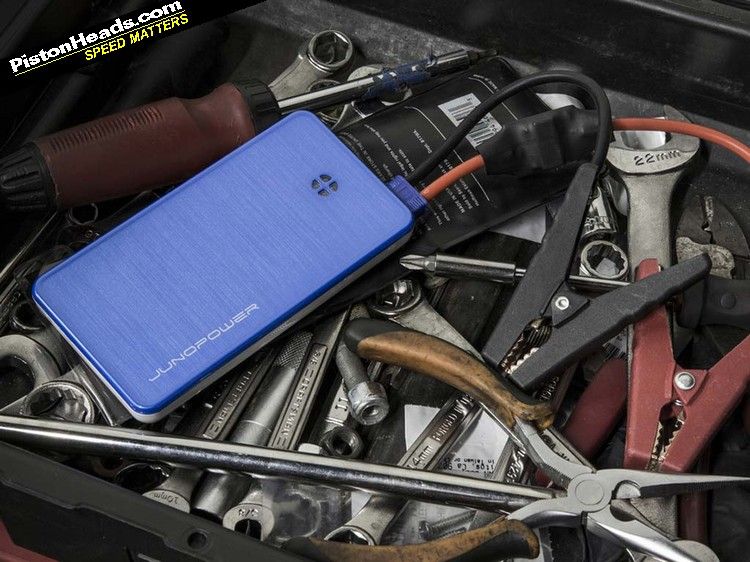
Up to 300 amps possible with a 6Ah capacity
The maker claims it'll deliver up to 300 amps to a 12-volt battery, with a storage capacity of 6Ah (amp hours). Looking at the specs of the Halfords device, that's well down on Halfords claimed 17Ah, but Juno reckon it'll be good to power up four and six-cylinder engines with no size limit, while Halfords says its model is good for up to an engine size of 2.0 only.
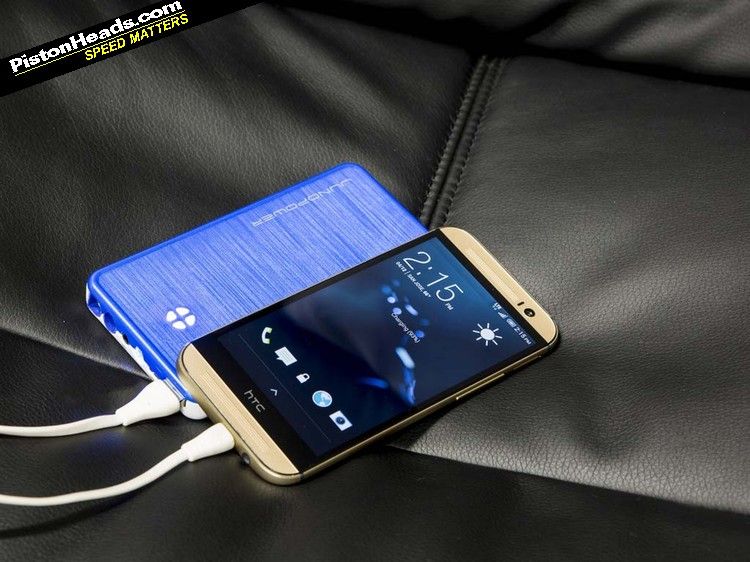
And it can charge your phone!
The price is pretty good, with the company currently offering it an introductory $69.99 (£41.50). That's almost half what Halfords charges for its Power Pack, albeit without the extra gadgets like the invertor and tyre compressor.
The big question remains: does it work? We've put in a request to test one, so we'll get back to you on that. If the answer's yes, the AA should offer these half-price to members. Imagine the call-outs they'd save.


For example you can already buy a LiPo battery for an RC car which has a 5.3Ah capacity and a discharge rate (burst) of 689A.
They are quite expensive though, compared to this.
But if this can deliver 300Amps for a minute or so as its specs suggest, and the leads are kept nice and short, why not?
Might not start the biggest of cars, not sure what bigger cars require in terms of cranking amps.
I'm sure that the spec for the LiPos includes a theoretical 300A SHORT CIRCUIT current for the cells, but that is into a ZERO OHM load, not another battery, and not via a couple of poxy small wires.
Now, if you have a "low" voltage lead acid battery, in otherwise good conditions, you might get lucky, and indeed, that extra battery will provide just enough power to keep the system voltage high enough to enable a warm engine to be started (say >6.5V). But you ain't going to see AA and RAC (wo)men chucking out their massive truck sized jump batteries just yet!
if there is something with almost no demand on the electronics such as :
small lcd readout
no radio
no fans (or fans driven off the engine)
then yes
I am also totally unsure it would work. The battery has a 6Ah capacity. A small engine takes 300 amps to start it. At that current the battery would last less than a minute.
Add in a cold engine, one that is tricky to start, a less than full battery then it won't contain enough power.
Furthermore, I don't believe that a small lithium battery could deliver the needed current. Just look how think jump and battery cables are!
Try and turn over a 4.0L 6 pot with 8.5:1 CR and then go turn over a 1.9TDI....

Regarding energy density Amicell seem to make 250Wh/kg batteries: 12.6Ah at 3.7V and <200g, for example.
So this does seem believable, actually. The key is the discharge rate - I didn't know you could empty the charge out of a LiPo battery that rapidly.
To the previous poster who said "it will last less than a minute" - how on earth long do you normally crank your engine over for? ;-)
This all begs the question, why don't mobile phone manufacturers realise I'd buy something 4mm thicker and 100g heavier in a heartbeat, if the battery normally lasted five days?
This value also depends upon the effective capacitance of the battery cells, because the chemical reactions that generate the electrons are NOT instantaneous, and so for a "small" area cell, where there is limited space along the electrodes where the chemical reaction can generate the electricity, you will see the peak discharge current fall incredibly rapidly with time (unlike for a massive Lead Acid battery, which has a HUGE "plate" or electrode area, and hence can develop and sustain massive discharge currents, which is why we use them for starting cars!) Without the actual discharge curve being shown for this system any of the numbers are completely meaningless!
Gassing Station | General Gassing | Top of Page | What's New | My Stuff