
Crash Course
Andrew Noakes reveals the untold story behind the Euro NCAP crash test ratings.
Brussels may be the centre of much Euro-absurdity but it's also the headquarters of an independent European body which has been doing a lot of good over the past few years. Since 1996 Euro NCAP – the European New Car Assessment Programme – has been subjecting new cars to crash tests and publishing the results in the form of star ratings. The most recent results were announced at the end of June. Two good things result from all this destruction: car buyers can make more informed choices, and car makers are encouraged to design cars that better protect us in accidents.
How it works
 Mercedes SLK  Mercedes A-Class  BMW Mini 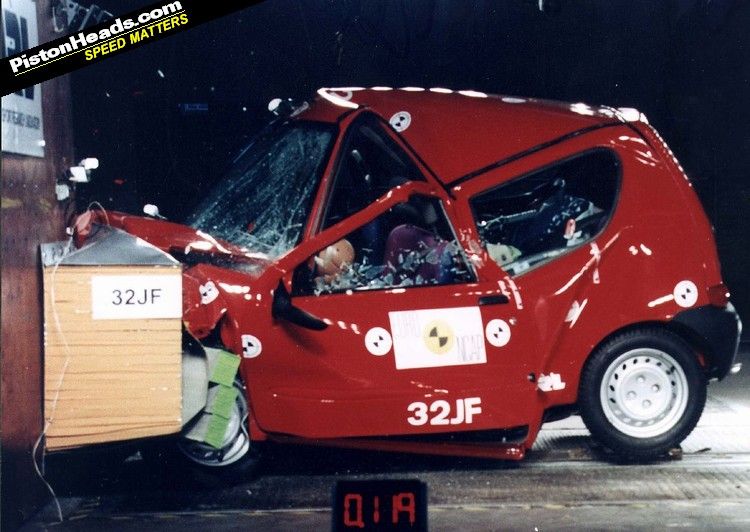 Fiat Seicento (one of the worst)  Renault Modus |
There are four Euro NCAP tests, which are carried out by a number of European crash test labs including BAST in Germany, UTAC in France, TNO in the Netherlands and TRL, the Transport Research Laboratory, in Berkshire. The first test is an offset frontal impact at 40mph, where the car hits a deformable aluminium barrier with a 40 per cent overlap on the driver's side. That's roughly the equivalent of two identical cars colliding at 34mph. Next come a pair of side-impact tests: a trolley with a deformable front end is towed into the car at 30mph, and the car is propelled sideways into a rigid pole at 18mph to simulate an impact with a tree or telegraph pole. Finally, pedestrian safety is assessed in a 25mph collision with the front of the car. Where appropriate the car will be tested with manufacturer-approved child seats fitted, one for an 18-month-old and another for a three-year-old.
'Injuries' sustained by the crash test dummies are translated into a points score, and the front and side impact scores (out of a possible 34) are added together. Extra points are awarded for approved types of seat belt reminder systems. Provided the scoring is reasonably even between front and side tests, the total is then turned into a star rating: 33 points or more wins five stars, 25 to 32 points gets four stars, and so on. Star ratings are awarded in a similar way for pedestrian safety and child safety.
Interpreting the results
But while the star ratings may look like an easy way to tell whether one car is safer than another, they don't tell the whole story and they need to be interpreted with care.
For a start, the cars tested by Euro NCAP are divided into nine groups by size and type – superminis, small family cars, large family cars and so on. The star ratings are only comparable within each group. Bigger, heavier cars will always survive better in any given accident than smaller, lighter ones, so while the Mini Cooper and old-shape BMW 5-series both score 25 in the front and side crash tests, the 5-series will cope better in most real-world accidents. The highest-scoring car so far tested is the Peugeot 1007, but it's likely that several big saloons and MPVs would be safer places to sit simply because there's more metal between you and the accident. There are more limitations when it comes to child safety: the Euro NCAP ratings apply only to the single specific combination of vehicle and child seat tested. A different child seat, or the same seat in a different vehicle, could produce very different results.
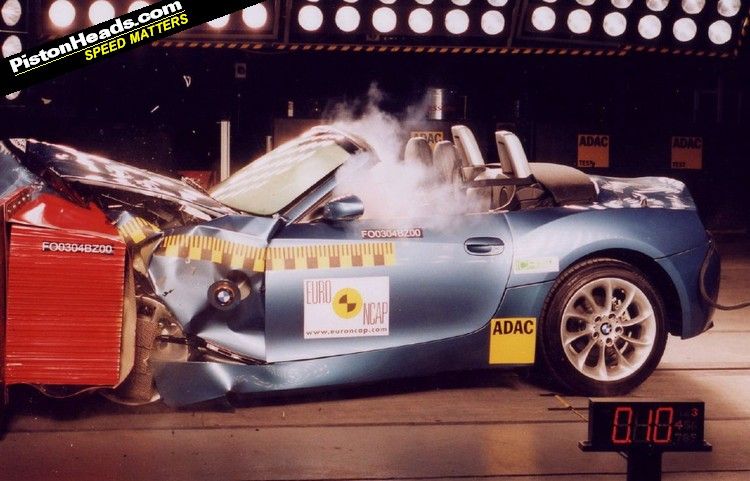 BMW Z4 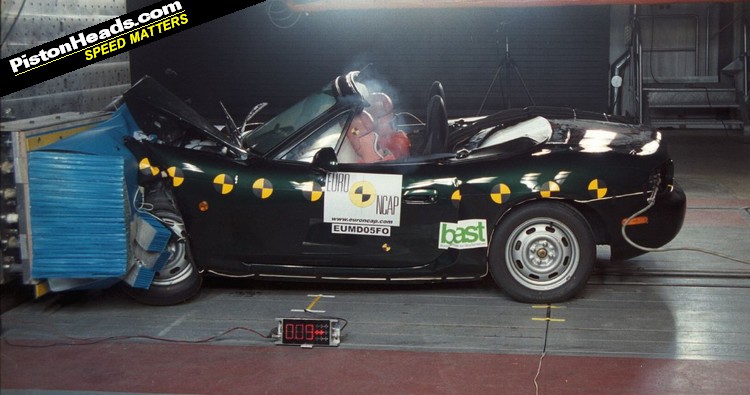 Mazda MX5 (pre-facelift) |
The simplistic star rating can also distort the relative merits of different cars. For instance, two cars with the same star rating can offer different crash performance: both BMW's Z4 and the now-superseded Mazda MX-5 are 'four star' cars, but the Z4's front/side impact score of 31 comfortably beats the older MX-5's score of 25. Conversely, two cars with different star ratings can offer quite similar protection. Mercedes added a seat belt reminder to its C-class which bumped it from four stars to five, even though the actual crash performance of the vehicle didn't change. The BMW 1-series and new VW Golf are two more cars to benefit from seat belt reminders, both achieving five stars instead of four as a result.
Another problem, and one which can only get worse, is that the tests are evolving all the time. New tests have been added since the programme began, and methodology has changed as the cars and the tests develop. So some older results, particularly those for pedestrian safety, are difficult to compare with the latest round of tests.
The newer, the safer
Even so, the Euro NCAP results are the best available way of assessing new car safety. Studies in Sweden have shown that, in general, cars with higher Euro NCAP ratings offer a better chance of avoiding serious injury, so it certainly makes sense to consider the ratings when you're choosing your next car. Better still, look at the points scores – all of which are published on the Euro NCAP website – to see the real differences.
Whether you consider the data or not, the good news is that the Euro NCAP programme is encouraging car makers to design safer cars. Look through the results and you can see clear improvements between older cars and the new generations have superseded them, all of which is the result of careful safety engineering rather than simply building stronger cars.
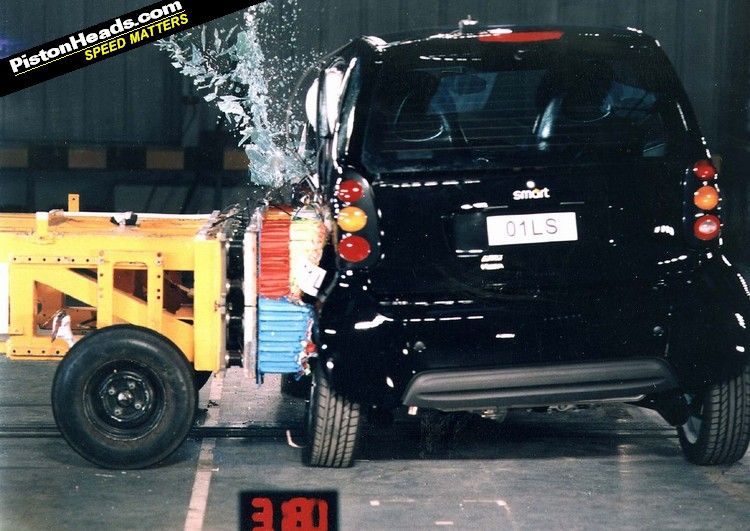
Smart car
Euro NCAP is now extending its advice into the field of accident avoidance, recently recommending that consumers choose cars fitted with electronic stability control. That's likely to become a more common standard-fit now that it has such high-profile backing.
Whether or not you take any notice of the tests (which in any case only cover the most popular models) or listen to the recommendations issuing from Brussels, you're likely to benefit from the work of Euro NCAP. All cars are safer than they were, and future cars are likely to be even safer still. And that has to be good for all of us.
Links
Copyright © Andrew Noakes 2005


Note, too, that some older car models from manufacturers that have done real-life safety research over decades, still have well-above average scores in a field of NCAP-era cars.
The question is - are we doing road safety a real favour by reducing the complex issue of crashworthiness to three standard tests from literally thousands of ways to have an accident, or does a good NCAP result tell little more than that the manufacturer, driven by the media hype around NCAP, has concentrated its safety engineering on merely passing the NCAP test with as good a result as possible, in all probability compromising the car's crash performance in areas not tested?
For instance, one can build a structure 'hard' enough pass the frontal impact test at the NCAP-prescribed 64 km/h quite well, but collapses quite suddendly at speeds above that, whilst one could also build a safety cell of which the crash performance starts to fall off from a lower speed (say 55 km/h), but gradually so it still offers some useful protection at 65,66,70 km/h. The latter will have a lower NCAP score - but in reality, which would you rather have (this is not entirely hypothetical, BTW, but what I've been told from safety engineers of a manufacturer with an enviable safety record)?
>> Edited by 900T-R on Thursday 28th July 11:33
>> Edited by 900T-R on Thursday 28th July 16:57
Apart from that, everbody knows that safety is much more complicated than a simple star rating after 4 different tests.
However, it is a start, .....
>> Edited by Lutz on Thursday 28th July 11:16
Lutz said:
Wouldn t it be fun to have two Smarts Crash? Both rigid and without crumple zones...That will teach those bastards to rely on the passive safety features of MY car...
Apart from that, everbody knows that safety is much more complicated than a simple star rating after 4 different tests.
However, it is a start, .....
>> Edited by Lutz on Thursday 28th July 11:16
Did you see the fifth gear where they ran a smart into a concrete wall at 50mph. The car didn't look too bad but the experts said the driver would definitely not survive.
The Rover P5 and Range Rover subscribe to "the other car will crumple" point of view.
What I fail to understand is this ever-increasing reliance on technology to reduce casualties. Why is it that the powers-that-be will never consider "tightening the nut-behind-the-wheel" and providing the average driver with the ability to understand how to avoid the crash in the first place?
Nah! That's too simple and would rob the insurance companies and the manufacturers' bodyshops of their main source of profit

In recent weeks I've had the misfortune of driving up and down the A1/A14/M11 ad nauseam on family business and I've lost count of the number of totally avoidable near-misses that Mr and Mrs Numpty seem to encounter on a regular basis. They just don't seem capable of looking further forward than the end of their bonnets

Sevener


 ing annoying "bing bing bing" sound added to it...
cdp said:
Did you see the fifth gear where they ran a smart into a concrete wall at 50mph. The car didn't look too bad but the experts said the driver would definitely not survive.
With a direct impact at 70 mph you wouldn't survive in any car. The human body cannot go from 70 to 0 in 1 second.
The smarts safety cell is like a roll cage.
My mate had a head on with an Audi A4. Both cars were written off. He walked away from his smashed up smart. The audi driver had an engine on his legs and ended up in hospital.
Being so small the smart was designed with safety in mind from day one.
mcflurry said:
The human body cannot go from 70 to 0 in 1 second.
When David Purley crashed his LEC F1 car at Silverstone in 1977 the car hit the Becketts sleepers at 108mph and stopped in about 18 inches (and much less than a second), subjecting Purley to nearly 180G deceleration. He survived, and even went back to racing F1 cars.
I'm a cynical engineer. If the spec says "it must survive crashing into a 1m^3 concrete block at x mph" then that's exactly what the car I make will do.
Great - so I get my tick in the box (or in this case a star or two) and I've met the aim.
Of course, if you crash into anything other than a 1m^3 concrete block at a different speed to x mph, don't come crying to me that something went wrong...
Of course, for the most part, the tests are a good thing. The problem is publishing them so manufacturers can engineer solutions to them that don't take account of the real world.
Andrew Noakes said:
When David Purley crashed his LEC F1 car at Silverstone in 1977 the car hit the Becketts sleepers at 108mph and stopped in about 18 inches (and much less than a second), subjecting Purley to nearly 180G deceleration. He survived, and even went back to racing F1 cars.
Yikes, we can go from 0-70 in a second in drag cars, aircraft lauch catapults etc, so why are they not dead?
G forces are all to do with duration, we can survive huge forces for tiny instants, but any longer and things break/snap and then we are buggered!
Even jumping onto the floor from a few feet up exerts quite large decelleration onto you for the tiniest duration.
Dave
Heavier cars cause more damage to others when then crash. It's the sod you, I'm alraight mentality. Heavier cars are also more likely to crash as braking distances are longer and they are more likely to go off the road on corners. You can't ignore the environmental impact of heavier cars.
Are we all safer if everyone is in a large 4x4? I think not. If everyone drove paper thin cars, they would all drive more safely. Pedestrians motorcyclists and cyclists would get equal respect on the road.
I'm all for lightweight cars! Mine is 400Kg:
www.btinternet.com/~robert.collingridge/kitcar/
Rob
Seems to me that the best safety feature a car can have is a competent on the ball driver.... sadly those are few and far between!
MilnerR said:
Wasn't there a report a while ago about high NCAP rated cars being safer but more likely to be involved in a smash? The idea being that the high star rating cars had much thicker A and B pillars and so reduced visibility in some of the most important areas. Therefore when pulling out of a junction or overtaking it was possible for an oncoming car to disappear in your A pillar blind spot with predictable consequences.....
Seems to me that the best safety feature a car can have is a competent on the ball driver.... sadly those are few and far between!
Yes we talked about the deterioration in visibility past the modern thicker A posts some time ago, mainly in relation to spotting bikers at roundabouts IIRC.
The cars may be stronger in the event of a collision, but it seems as if the risk of collisions is increasing - well at least it now needs more care to avoid them.
Totally agree about your driver quality comment, that is still the best answer.

Best wishes all,
Dave.
cdp said:
Did you see the fifth gear where they ran a smart into a concrete wall at 50mph. The car didn't look too bad but the experts said the driver would definitely not survive.
The Rover P5 and Range Rover subscribe to "the other car will crumple" point of view.
The concrete barrier penetrated all the way into the driver’s footwell of the Smart in that test. In the unlikely event of the driver surviving the accident they wouldn't have had the use of their legs. In this respect the Smart didn't perform as well as the Corsa where the foot well had some survival space in it.
The reason you wouldn't have survived the impact they subjected the cars to in that test was because hitting the barrier at that speed and that angle would result in the left hand occupant hitting the a pillar with their head. On the slow motion you could actually see the passenger head rest take out the side window, imagine where the passengers head would have been in relation to the head rest.
I heard at my local garage that the NCAP tests are carried out on the best selling car of a particular range, for most European cars that will be a LHD version. Could that mean that an untested RHD version have a lower real world score than for a version which was tested? Are type aprovals done on bothe RHD and LHD versions. Could an RHD car have undetected problems?
Any thoughts?
Possible garage bias of course as MG-Rover cars were always tested in RHD versions as no one but us Brits bought them!
Cheers
Spunagain
Gassing Station | General Gassing | Top of Page | What's New | My Stuff