
RE: Land Rover unveils electric Defender
Thursday 28th February 2013
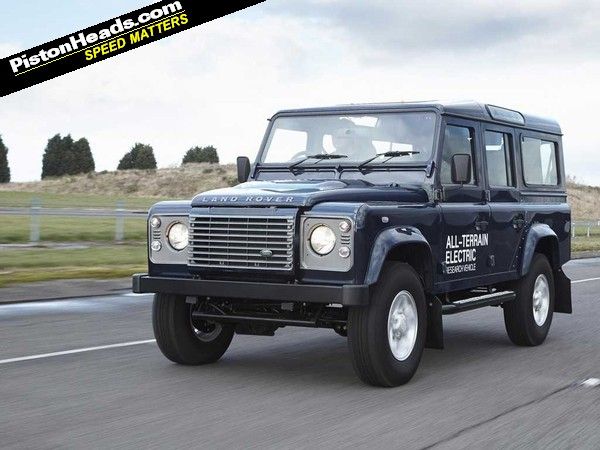
Land Rover has announced that it’ll be bringing seven electric Defenders to the Geneva motor show.
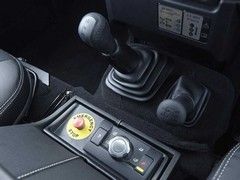
Electric drive suits off-road, says L-RThe EVs have all been developed from Land Rover’s first electric Defender, Leopard 1. Each will feature a 95hp electric motor that packs a whopping 243lb ft torque, and drive comes courtesy of a single-speed, 2.7:1 reduction gearbox. Weight is up 100kg over the standard diesel-powered Defender. Nevertheless, Land Rover claims that the electric Defender will give a range of over 50 miles, and also says that the battery will allow up to eight hours’ low-speed off-road use before recharging. Regenerative braking helps to achieve those figures, to the extent that just using the Hill Descent Control can generate up to 30kW. Once the battery is depleted, though, a full charge can be had in four hours with the aid of a fast charger, or in 10 hours with the aid of a portable 3kW charger.
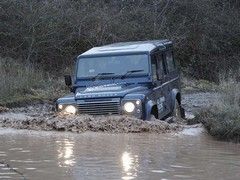
Legendary mud-plugging abilities remainLand Rover has confirmed that these Defenders will act as a “rolling laboratory” to aid in the development of future all-terrain electric vehicles, and will enter “specialist real-world trials” later this year. Leopard 1 has already been subject to some fairly strenuous testing, including hauling a 12-tonne “road train” up a 13 per cent incline.
Land Rover unveils electric Defender
Not for series production - yet - but Defender EV shows even old dogs can learn new tricks
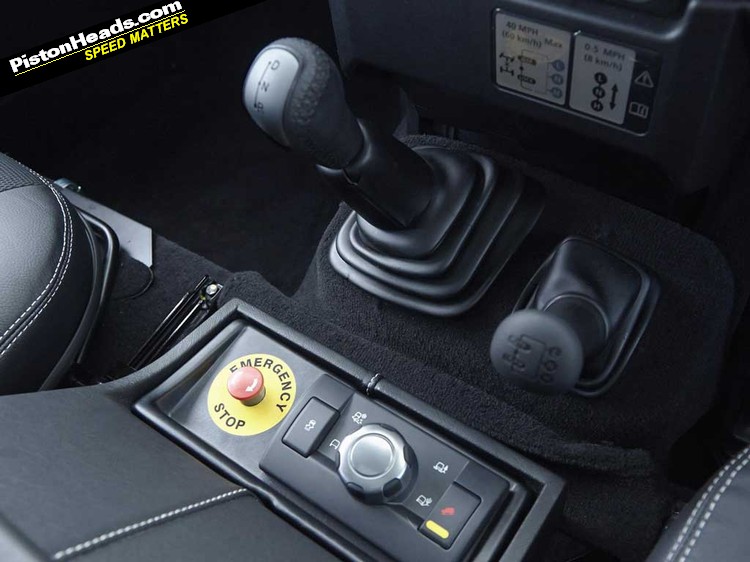
Electric drive suits off-road, says L-R
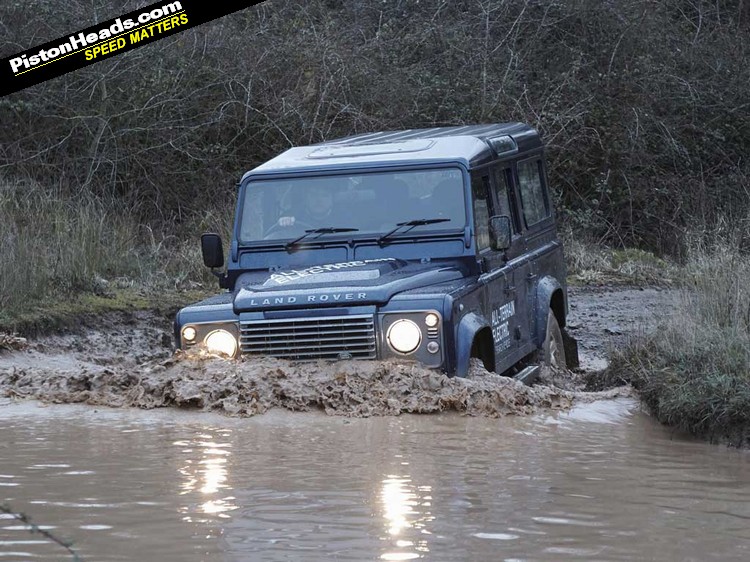
Legendary mud-plugging abilities remain
While these seven EVs won’t make production, Land Rover reckons the instant torque characteristics of an electric motor make them well-suited to off-road use, and the company can see a case for an electrically-powered version within its future ranges - including, potentially, the Defender's replacement. “The smooth, low-speed capability of the electric drivetrain makes the electric Defenders especially well-suited to climbing obstacles without damaging the ground unnecessarily,” it says.
Discussion


That seems like a good idea, although towing could destroy the range. I wonder how many miles the average farmer drives in a day. Even the school-run folks might put up with it. The Queen needs to get one to help "convince" people.
They could be onto a winner. It seems much more sensible to use batteries for off-roaders than for sports cars, at least for the time being.
They could be onto a winner. It seems much more sensible to use batteries for off-roaders than for sports cars, at least for the time being.
I do not think that purely electric/battery powered vehicles are the way forward, not for heavy tanks like defenders, as the story mentioned these are runnign labs, so hopefully they can produce a hybris diesel and part electric power as in Lexus, best of both worlds being able to sit in traffic stop start using electric and be able to drive further than 50miles on the diesel.
Also maybe WIGHT saving is the way forward for Landrover for better economy etc
Also maybe WIGHT saving is the way forward for Landrover for better economy etc
 ...exactly my thoughts.
I thought current thinking for off road electric vehicles was to fit a motor in each hub. Pretty sure there is a company already offering this on the Range Rover.
That removes the need for gearbox, propshafts, transfer box etc reducing weight and allowing for each wheel to be controlled indivdually giving much better offroad performance. This sounds like a bit of a bodge being done on the cheap to me.
That removes the need for gearbox, propshafts, transfer box etc reducing weight and allowing for each wheel to be controlled indivdually giving much better offroad performance. This sounds like a bit of a bodge being done on the cheap to me.
A couple of points in this press release seem to be clutching at straws.
Quite how an electric motor rather than a diesel one would cause less damage to the surface when climbing hills is unclear to me,surely the tyres,diffs and any electronic traction control are not affected by how the power that comes from the gearbox is generated?
The other thing is that an electric Defender has pulled a 'road train' ( I'm guessing not the Australian multi trailered 200 ton behemoth we all think of when the term is mentioned) weighing 12 tonnes up a 13% gradient. I'm sure a Nissan Leaf could ,with a rolling start pull 12 tonnes up a 1:8 hill on a good surface.
I'm not a total Luddite,I even bought a Gaylander for the wife,and almost accept its a real Land Rover , but realistically hybrid D4's and Range Rover's are far more important than this to compete with the Lexus and Porsches already on the market.
Quite how an electric motor rather than a diesel one would cause less damage to the surface when climbing hills is unclear to me,surely the tyres,diffs and any electronic traction control are not affected by how the power that comes from the gearbox is generated?
The other thing is that an electric Defender has pulled a 'road train' ( I'm guessing not the Australian multi trailered 200 ton behemoth we all think of when the term is mentioned) weighing 12 tonnes up a 13% gradient. I'm sure a Nissan Leaf could ,with a rolling start pull 12 tonnes up a 1:8 hill on a good surface.
I'm not a total Luddite,I even bought a Gaylander for the wife,and almost accept its a real Land Rover , but realistically hybrid D4's and Range Rover's are far more important than this to compete with the Lexus and Porsches already on the market.
kooky guy said:
I thought current thinking for off road electric vehicles was to fit a motor in each hub. Pretty sure there is a company already offering this on the Range Rover.
That removes the need for gearbox, propshafts, transfer box etc reducing weight and allowing for each wheel to be controlled indivdually giving much better offroad performance. This sounds like a bit of a bodge being done on the cheap to me.
Yep, but necessitates a complete redesign of the drivetrain and complex electronics to go with it. This way you've only got one motor to manage and a (relatively) reliable and proven drivetrain to cope with the mud etc. It also moves the most expensive bit further away from the rocks and mud etc, motors in the hub are very vulnerable.That removes the need for gearbox, propshafts, transfer box etc reducing weight and allowing for each wheel to be controlled indivdually giving much better offroad performance. This sounds like a bit of a bodge being done on the cheap to me.
infradig said:
Quite how an electric motor rather than a diesel one would cause less damage to the surface when climbing hills is unclear to me.
Electric motors generate maximum torque at zero RPM, so you can pull from literally nothing.Even with very low 'crawler' gearing, a petrol/diesel engine needs to have some engine speed - hence forward motion - before it is generating enough torque to move the vehicle, so unless you're continually slipping the clutch, the chances are you'll be getting more wheelspin on low-grip surfaces which will be more likely to break the surface up.
infradig said:
Quite how an electric motor rather than a diesel one would cause less damage to the surface when climbing hills is unclear to me,surely the tyres,diffs and any electronic traction control are not affected by how the power that comes from the gearbox is generated?
If you go for the motor per wheel arrangement mentioned earlier, you can fit per-wheel traction control so you don't get the churning of the ground from a spinning wheel, that would cut damage. You can also do clever tricks like sending each wheel exactly the amount of power it can cope with. Heavy freight locos have had something like this for the last 20 or so years (ok, motor per axle rather than wheel) - means you can get vast loads moving on slippery rails, even if one axle breaks away.Think how useful a zero emmissions Landy would be when used in underground mining work where a build up of carcinogenic diesel fumes aren't exactly pleasant.
This technology could be used for buses and inner city delivery vehicles (TNT run a very stealthy 7.5 tonner which has nearly run me over a few times...) to cut the noxious gases.
As one PH wag once said on here
"Diesel is like a modern day asbestos. We know they are both carninogenic, but until something else comes along, we readily put up with it..."
This technology could be used for buses and inner city delivery vehicles (TNT run a very stealthy 7.5 tonner which has nearly run me over a few times...) to cut the noxious gases.
As one PH wag once said on here
"Diesel is like a modern day asbestos. We know they are both carninogenic, but until something else comes along, we readily put up with it..."
Its a bit crap really
Now this is damn clever
http://www.viamotors.com/powertrain/
A V6 engine driving a generator which feeds a battery bank. The battery bank then drives a 400Bhp electric motor.
however it has a few party tricks
You can recharge the battery bank using the mains which is nothing new however the truck has a socket on the side which you can plug power tools into which run off the battery bank or generator which gives you onsite power
http://www.youtube.com/watch?v=p5STy6HRZEQ
Now this is damn clever
http://www.viamotors.com/powertrain/
A V6 engine driving a generator which feeds a battery bank. The battery bank then drives a 400Bhp electric motor.
however it has a few party tricks
You can recharge the battery bank using the mains which is nothing new however the truck has a socket on the side which you can plug power tools into which run off the battery bank or generator which gives you onsite power
http://www.youtube.com/watch?v=p5STy6HRZEQ
TheLastPost said:
Electric motors generate maximum torque at zero RPM, so you can pull from literally nothing.
Even with very low 'crawler' gearing, a petrol/diesel engine needs to have some engine speed - hence forward motion - before it is generating enough torque to move the vehicle, so unless you're continually slipping the clutch, the chances are you'll be getting more wheelspin on low-grip surfaces which will be more likely to break the surface up.
But with modern traction control systems would it matter how the torque was generated? In fact,could the instant nature of the electric power be a disadvantage in low speed manoeuvres ,in that there's no gradual creep effect? I've driven a couple of hybrid Lexus' and was impressed with the torque and power but less so with the smoothness at low speeds when on full electric. Am I just clinging on to the days when a modicum of skill was needed to drive,at all, not just off road?Even with very low 'crawler' gearing, a petrol/diesel engine needs to have some engine speed - hence forward motion - before it is generating enough torque to move the vehicle, so unless you're continually slipping the clutch, the chances are you'll be getting more wheelspin on low-grip surfaces which will be more likely to break the surface up.
Gassing Station | General Gassing | Top of Page | What's New | My Stuff