
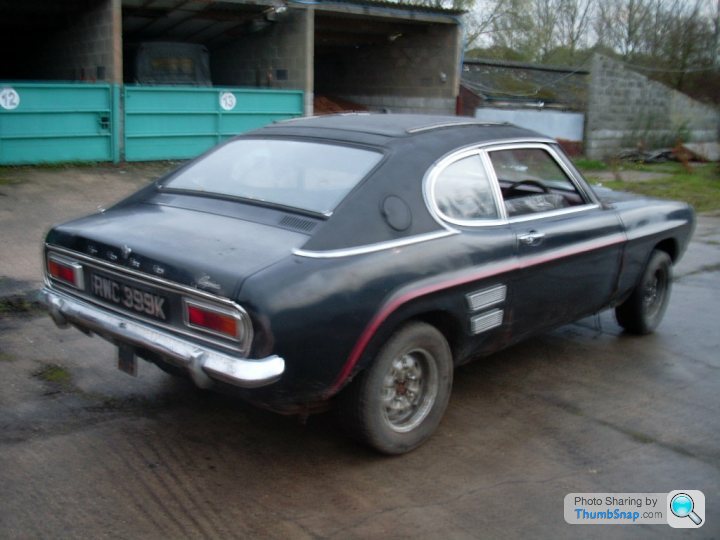
MK1 3 Litre Capris, How Many Survive ?
Discussion


This is the Extra Trim panel that was fitted to the rear panel of the 3000E ( Executive) models .
The E Did have a slightly better dash and centre console, both had a Black Vinle Insert, with the GT Models makeing do with Fake wood effect trim .
"XLR" was the top Spec of Options , but i dont recall ever seeing a GT Fitted with the Trim Panel around the rear lights.

neutral 3 said:
DBSV8 , it Looks a good read , will order a copy.
Anyone know the reg no of Gordon Spices Yellow 3000GT that he used on the 73 Avon Tour ? I beleive it was K registered, RPU maybe ? an Essex series . What became of it ?
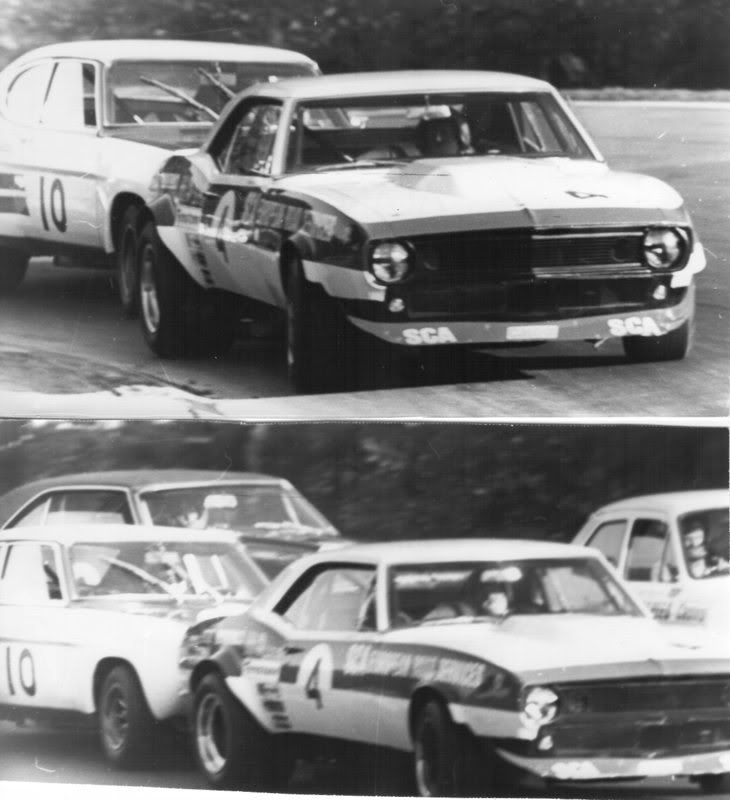
Great footage of him on You Tube chaseing James Hunts Monster Camaro at Brands .
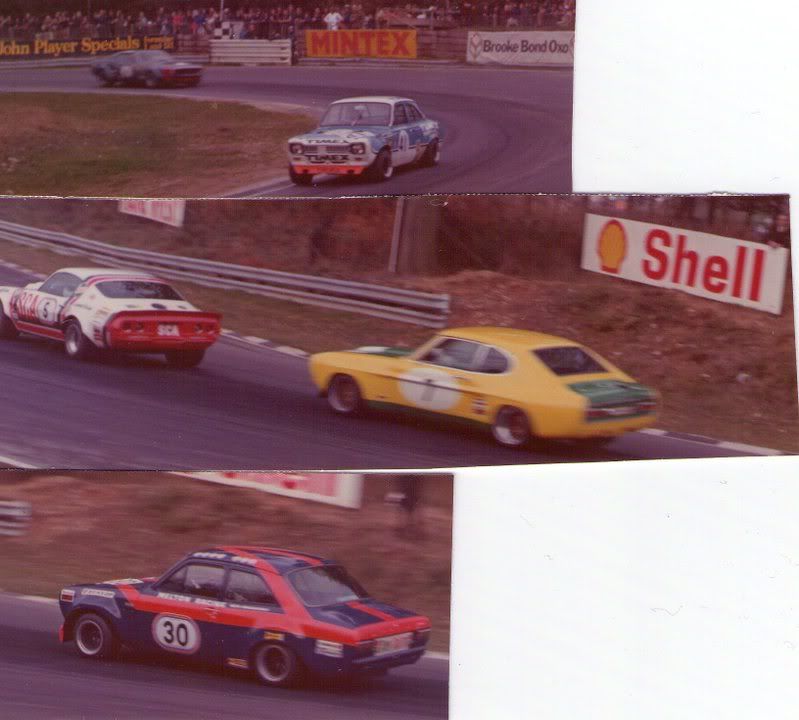
Would this be gordon spice,s yellow capri behind the camaro here at brands? also luton motors race capri. Anyone know the reg no of Gordon Spices Yellow 3000GT that he used on the 73 Avon Tour ? I beleive it was K registered, RPU maybe ? an Essex series . What became of it ?
Great footage of him on You Tube chaseing James Hunts Monster Camaro at Brands .
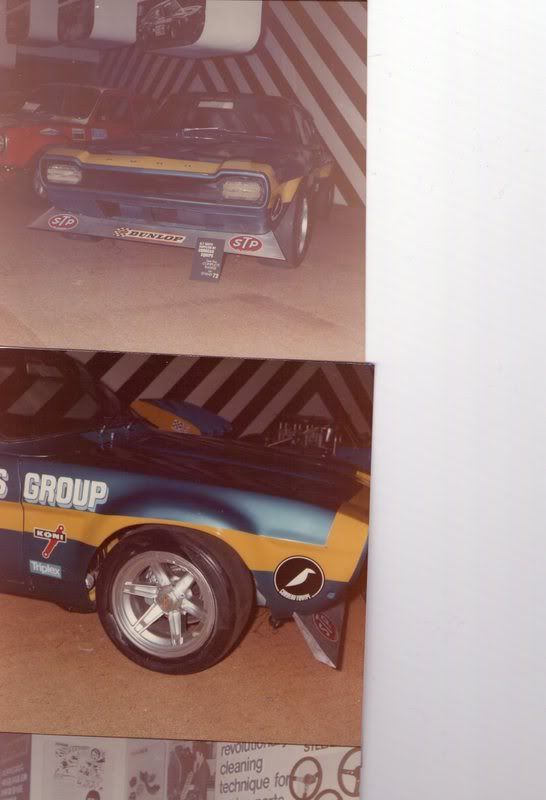
NHK and BOYZEE interesting replys. The Weslake Article makes interesting reading. Quite fancy 230 bhp.
Apparently the best Money per pound mod is a Swaymar Modified Inlet Manifold and Holley Carb.
The Rebuilt Engine that is going into RWC has a V-62 Kent Cam and with Swaymar and A holley, should go quite well. Anyone have these ?
Re Spices Yellow 3000GT , ime not sure that is the Avon Tour car ? Go on to YOU TUBE and look at the Avon Tour 1973 . Spices Capri was almost completely standard looking, complete with Vinle Roof and narrow steel wheels. How he kept Hunts Camaro in sight is anyones guess !
Apparently the best Money per pound mod is a Swaymar Modified Inlet Manifold and Holley Carb.
The Rebuilt Engine that is going into RWC has a V-62 Kent Cam and with Swaymar and A holley, should go quite well. Anyone have these ?
Re Spices Yellow 3000GT , ime not sure that is the Avon Tour car ? Go on to YOU TUBE and look at the Avon Tour 1973 . Spices Capri was almost completely standard looking, complete with Vinle Roof and narrow steel wheels. How he kept Hunts Camaro in sight is anyones guess !
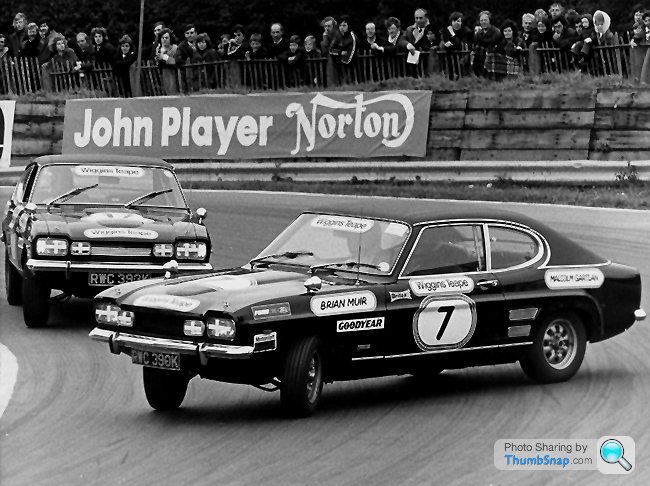
one of the best modified early racing capris was the basil green v8 peranas
Bob Olthoff lapped the old Kyalami circuit at 1 minute 36 seconds, only 15 seconds slower than Formula 1 cars of the era. It was timed at over 270 km/h (170 MPH) at the end of the straight. By comparison Basil Green driving a somewhat modified Perana Capri V8 road car did 223 km/h (139 MPH) on the same straight.


http://perana.org/z181.php
1971 TEAM GUNSTON B.G. CAPRI PERANA
Built in late 1970 to replace the Group 5 specification Team Gunston Capri, namely Z181 as new rules for 1971 proposed a Production Saloon Car Championship with limited modifications allowed, and was to comply with Group 2 rules of the time.
Ford once again commissioned Basil Green to build a race winning combination as he had done in 1970 with Z181, the original Gunston Capri Perana.
Production cylinder heads, crankshaft, conrods and block were to be used and no suspension mounting points were to be moved. Suspension, intake manifold and carburettor were also to be of production origin. Allowable modifications were two inches of flare past the widest point of the car on each side covering at least thirty percent of the wheel opening. Brakes could be upgraded in the interest of safety along with increased wheel size and diameter. These were sourced from the Ford GT40, which had much success in sports car racing in the 1960's. Suspension modifications were entrusted to Eddie Pinto and Corrie Potgieter. Single leaf springs shaped in a "C" cleverly allowed the fitment of 14.5-inch rims at the rear.
In 1971 the B.G. Capri Perana, namely A2, in the hands of Bob Olthoff, won Class-A of the Star Production Saloon Car Championship. It set a new lap record at Kyalami of 1min 34.5 sec. Basil Van Rooyen equalled this lap record in October 1971 in a similar Capri Perana. Bob Olthoff retired at the end of 1971. This Capri Perana was to be the last works car driven by Olthoff.
In 1972 the B.G. Capri Perana was driven by Koos Swanepoel and was sponsored by Grosvenor Motors. It was painted white and blue using the same layout design as the year before. Tyre size was reduced at the rear to rims of 12-inch width in order to slow the Perana down. In this form A2 finished runner up to Basil Van Rooyen in Class A of the Star Production Saloon Car Championship. Basil had Gunston sponsorship in 1972 for his Superformance Perana and A2 is not to be confused with this car as is so often the case.
In 1973 A2 was sold to Ron Lupson in the then Rhodesia, who raced it for a number of years with varying degrees of success. Dave Charlton co-piloted with Ron in a Three Hour race in Bulawayo in 1974. In 1975 Trevor Ansley purchased the Perana from Ron and entrusted Ray Yeo to drive the car in Rhodesia, and the Perana was again winning races.
It was then sold to Ray Yeo who raced it successfully for a number of years, winning the Rhodesian Championship several times before laying it to rest in the early eighties. During Ray's ownership the body was flared even more and this had to be rectified during the following restoration.
In 1994 Nick Sheward who had searched for the car for a lengthy period of time acquired the B.G. Perana. A total nut and bolt restoration ensued. The car had been his dream since he saw it win both heats first time out in 1971, as a ten-year-old boy. The car retains the original body, engine, gearbox, differential, suspension and brakes. All have been faithfully restored with a view of preservation rather than replacement. The camshaft is an exact copy of the grind used by Olthoff and Van Rooyen all those years ago and was duplicated by Ritchie Jute. The headers are the originals and side pipes have been duplicated. The original colour chart was acquired from Rembrandt Tobacco and paints exactly matched to duplicate the Gunston colours.


perana capri road car
http://perana.org/capriv8.php
Capri Perana V8
After the Cortina Perana, and the rare Capri Perana V6, Capri Perana V8 was the next, and probably the most iconic, in Basil Green's range of performance Fords. Production started in 1970 and continued until Ford South Africa discontinued the Mk1 Capri in 1972.
Although no definitive records exist it is generally accepted that somewhere between 500 and 550 Capri Perana V8 cars were produced.
In 1970 the Capri Perana V8's performance eclipsed 'normal' cars and was more in the league of exotic machines such as the Ferrari. Fourteen years later when the Alfa Romeo GTV (224.2 km/h) beat the BMW (535i 220.7 km/h) which was at the time South Africa's fastest locally produced car, both were still slower than the Perana in both acceleration and top speed. Even by today's standards the Capri Perana is still a very rapid car.
The Capri Perana V8 is unique in that it is the only V8 Ford Capri ever officially sanctioned by Ford. It was available from all South African Ford dealers with a full Ford warranty. Ford was closely involved and Capri Peranas were built as such at the Ford plant in Port Elizabeth and were shipped minus engines and gearboxes to Basil Green Motors where the manufacture was completed.
The car was based on the Mk1 Ford Capri 3000 XL. It was powered by an up-rated Ford Mustang 5 litre V8 (Windsor Small Block Ford) engine. Power was fed through a four speed close ratio Mustang 'top loader' gearbox to a custom limited slip rear axle derived from the Australian Ford Falcon XW rear end. Automatic transmission was an option where the Ford C4 automatic was used.
The suspension was lowered by 40mm (1.5 inches), with stronger springs and revised valves in the front Macpherson struts. The car was fitted with 185-70 x 13 radial tyres on chromed wide RoStyle steel wheels. Standard Capri 3000 brakes were retained, but with up-rated pad material at the front.
To accommodate the V8 engine's larger sump the steering rack was changed for an inverted left hand drive rack mounted on the back of a modified front cross member. The front struts were swapped from side to side to relocate the steering arms.
Remarkably the Capri Perana was only 9 kilograms (20 pounds) heavier than a standard Capri 3000. This was possible through the use of an aluminium inlet manifold and aluminium bell housing.
Bright Yellow or Peri Peri Red were officially the only colour options, but a handful of cars were produced in other colours including gold and mustard. The twin black stripes running either side of the bonnet and sweeping up the curve of the rear side windows and the chromed RoStyle wheels were the defining external features. In addition the car had Perana badges below the XL badges on the front fenders and V8 badges on the bonnet and boot. Most cars had a black boot lid. Many cars were equipped with the optional Perana louver on the back window.
All cars had a black interior and in the Basil Green tradition the interior was standard Capri XL except for an alloy spoked steering wheel.
The Capri Perana was priced at R4450 (approximately £2200 in 1970)
Towards the end of South African Ford Capri production Basil Green announced the R Pack Perana which was based on the four cylinder XLR shell, presumably because six cylinder shells were no longer available. The R Pack had a flat bonnet and high back seats. The bonnet was painted black, and the car had different stripes


Bob Olthoff lapped the old Kyalami circuit at 1 minute 36 seconds, only 15 seconds slower than Formula 1 cars of the era. It was timed at over 270 km/h (170 MPH) at the end of the straight. By comparison Basil Green driving a somewhat modified Perana Capri V8 road car did 223 km/h (139 MPH) on the same straight.
http://perana.org/z181.php
1971 TEAM GUNSTON B.G. CAPRI PERANA
Built in late 1970 to replace the Group 5 specification Team Gunston Capri, namely Z181 as new rules for 1971 proposed a Production Saloon Car Championship with limited modifications allowed, and was to comply with Group 2 rules of the time.
Ford once again commissioned Basil Green to build a race winning combination as he had done in 1970 with Z181, the original Gunston Capri Perana.
Production cylinder heads, crankshaft, conrods and block were to be used and no suspension mounting points were to be moved. Suspension, intake manifold and carburettor were also to be of production origin. Allowable modifications were two inches of flare past the widest point of the car on each side covering at least thirty percent of the wheel opening. Brakes could be upgraded in the interest of safety along with increased wheel size and diameter. These were sourced from the Ford GT40, which had much success in sports car racing in the 1960's. Suspension modifications were entrusted to Eddie Pinto and Corrie Potgieter. Single leaf springs shaped in a "C" cleverly allowed the fitment of 14.5-inch rims at the rear.
In 1971 the B.G. Capri Perana, namely A2, in the hands of Bob Olthoff, won Class-A of the Star Production Saloon Car Championship. It set a new lap record at Kyalami of 1min 34.5 sec. Basil Van Rooyen equalled this lap record in October 1971 in a similar Capri Perana. Bob Olthoff retired at the end of 1971. This Capri Perana was to be the last works car driven by Olthoff.
In 1972 the B.G. Capri Perana was driven by Koos Swanepoel and was sponsored by Grosvenor Motors. It was painted white and blue using the same layout design as the year before. Tyre size was reduced at the rear to rims of 12-inch width in order to slow the Perana down. In this form A2 finished runner up to Basil Van Rooyen in Class A of the Star Production Saloon Car Championship. Basil had Gunston sponsorship in 1972 for his Superformance Perana and A2 is not to be confused with this car as is so often the case.
In 1973 A2 was sold to Ron Lupson in the then Rhodesia, who raced it for a number of years with varying degrees of success. Dave Charlton co-piloted with Ron in a Three Hour race in Bulawayo in 1974. In 1975 Trevor Ansley purchased the Perana from Ron and entrusted Ray Yeo to drive the car in Rhodesia, and the Perana was again winning races.
It was then sold to Ray Yeo who raced it successfully for a number of years, winning the Rhodesian Championship several times before laying it to rest in the early eighties. During Ray's ownership the body was flared even more and this had to be rectified during the following restoration.
In 1994 Nick Sheward who had searched for the car for a lengthy period of time acquired the B.G. Perana. A total nut and bolt restoration ensued. The car had been his dream since he saw it win both heats first time out in 1971, as a ten-year-old boy. The car retains the original body, engine, gearbox, differential, suspension and brakes. All have been faithfully restored with a view of preservation rather than replacement. The camshaft is an exact copy of the grind used by Olthoff and Van Rooyen all those years ago and was duplicated by Ritchie Jute. The headers are the originals and side pipes have been duplicated. The original colour chart was acquired from Rembrandt Tobacco and paints exactly matched to duplicate the Gunston colours.
perana capri road car
http://perana.org/capriv8.php
Capri Perana V8
After the Cortina Perana, and the rare Capri Perana V6, Capri Perana V8 was the next, and probably the most iconic, in Basil Green's range of performance Fords. Production started in 1970 and continued until Ford South Africa discontinued the Mk1 Capri in 1972.
Although no definitive records exist it is generally accepted that somewhere between 500 and 550 Capri Perana V8 cars were produced.
In 1970 the Capri Perana V8's performance eclipsed 'normal' cars and was more in the league of exotic machines such as the Ferrari. Fourteen years later when the Alfa Romeo GTV (224.2 km/h) beat the BMW (535i 220.7 km/h) which was at the time South Africa's fastest locally produced car, both were still slower than the Perana in both acceleration and top speed. Even by today's standards the Capri Perana is still a very rapid car.
The Capri Perana V8 is unique in that it is the only V8 Ford Capri ever officially sanctioned by Ford. It was available from all South African Ford dealers with a full Ford warranty. Ford was closely involved and Capri Peranas were built as such at the Ford plant in Port Elizabeth and were shipped minus engines and gearboxes to Basil Green Motors where the manufacture was completed.
The car was based on the Mk1 Ford Capri 3000 XL. It was powered by an up-rated Ford Mustang 5 litre V8 (Windsor Small Block Ford) engine. Power was fed through a four speed close ratio Mustang 'top loader' gearbox to a custom limited slip rear axle derived from the Australian Ford Falcon XW rear end. Automatic transmission was an option where the Ford C4 automatic was used.
The suspension was lowered by 40mm (1.5 inches), with stronger springs and revised valves in the front Macpherson struts. The car was fitted with 185-70 x 13 radial tyres on chromed wide RoStyle steel wheels. Standard Capri 3000 brakes were retained, but with up-rated pad material at the front.
To accommodate the V8 engine's larger sump the steering rack was changed for an inverted left hand drive rack mounted on the back of a modified front cross member. The front struts were swapped from side to side to relocate the steering arms.
Remarkably the Capri Perana was only 9 kilograms (20 pounds) heavier than a standard Capri 3000. This was possible through the use of an aluminium inlet manifold and aluminium bell housing.
Bright Yellow or Peri Peri Red were officially the only colour options, but a handful of cars were produced in other colours including gold and mustard. The twin black stripes running either side of the bonnet and sweeping up the curve of the rear side windows and the chromed RoStyle wheels were the defining external features. In addition the car had Perana badges below the XL badges on the front fenders and V8 badges on the bonnet and boot. Most cars had a black boot lid. Many cars were equipped with the optional Perana louver on the back window.
All cars had a black interior and in the Basil Green tradition the interior was standard Capri XL except for an alloy spoked steering wheel.
The Capri Perana was priced at R4450 (approximately £2200 in 1970)
Towards the end of South African Ford Capri production Basil Green announced the R Pack Perana which was based on the four cylinder XLR shell, presumably because six cylinder shells were no longer available. The R Pack had a flat bonnet and high back seats. The bonnet was painted black, and the car had different stripes
Edited by DBSV8 on Tuesday 14th December 03:30
neutral 3 said:
NHK and BOYZEE interesting replys. The Weslake Article makes interesting reading. Quite fancy 230 bhp.
Apparently the best Money per pound mod is a Swaymar Modified Inlet Manifold and Holley Carb.
The Rebuilt Engine that is going into RWC has a V-62 Kent Cam and with Swaymar and A holley, should go quite well. Anyone have these ?
Heads are key. What spec are they?Apparently the best Money per pound mod is a Swaymar Modified Inlet Manifold and Holley Carb.
The Rebuilt Engine that is going into RWC has a V-62 Kent Cam and with Swaymar and A holley, should go quite well. Anyone have these ?
Any of you Mk1 fans happened across our old one, owned by my dad, then me between 72 and 89, shows as being untaxed
so may well be dead but it was taxed last in 2008 so may be being restored or laid up.
Here si the details, would love to hear of it, qualifies for this thread as 3 litre, but was a 1600 GT-XLR last time I saw it !
The enquiry is complete
The vehicle details for OJA 375G are:
Date of Liability 01 09 2008
Date of First Registration 23 06 1969
Year of Manufacture 1969
Cylinder Capacity (cc) 2994CC
CO2 Emissions Not Available
Fuel Type Petrol
Export Marker Not Applicable
Vehicle Status Unlicensed
Vehicle Colour SILVER
Vehicle Type Approval
so may well be dead but it was taxed last in 2008 so may be being restored or laid up.
Here si the details, would love to hear of it, qualifies for this thread as 3 litre, but was a 1600 GT-XLR last time I saw it !
The enquiry is complete
The vehicle details for OJA 375G are:
Date of Liability 01 09 2008
Date of First Registration 23 06 1969
Year of Manufacture 1969
Cylinder Capacity (cc) 2994CC
CO2 Emissions Not Available
Fuel Type Petrol
Export Marker Not Applicable
Vehicle Status Unlicensed
Vehicle Colour SILVER
Vehicle Type Approval

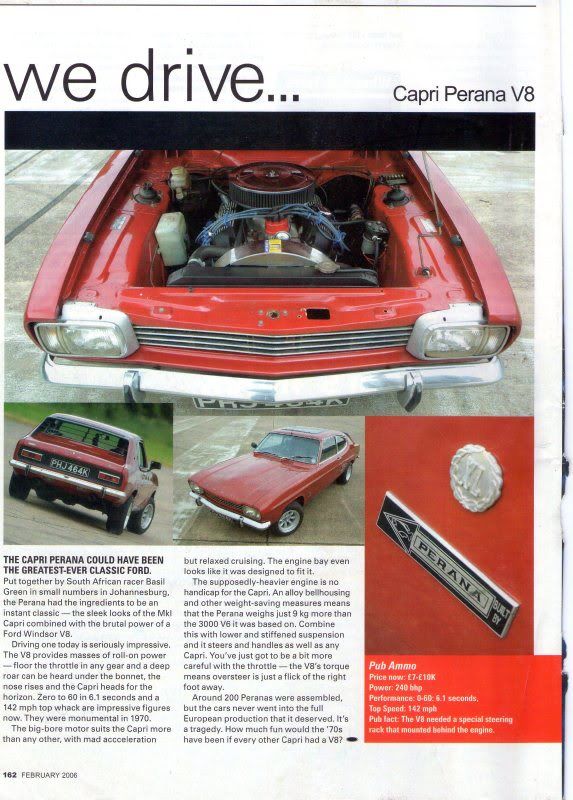
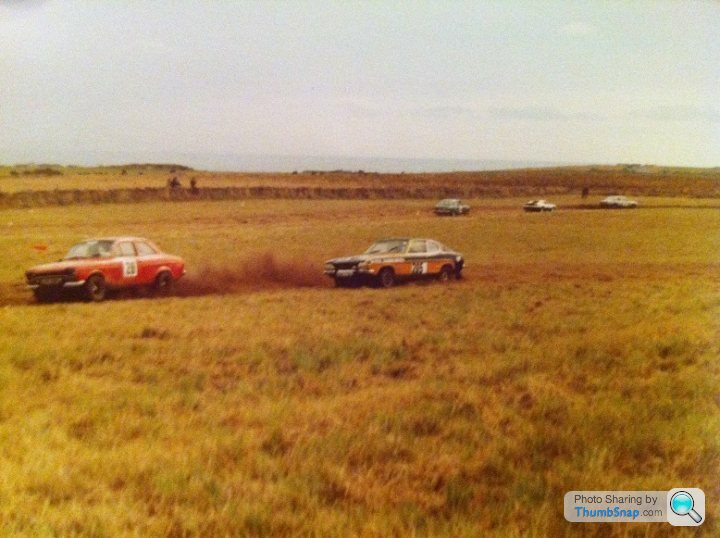
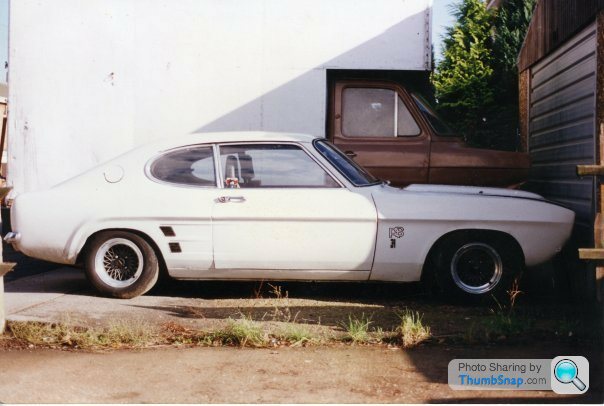
This one still exists... sort of. It's my old 3L GXL, that I had in the late 80's. Originally a 'hearing aid' (Sahara) beige/ vinyl top/ automatic that was sold new in Tunbridge Wells well into 1973 when the Mk2 was already out, it must have been heavily discounted to shift it. It belonged to my neighbour's son who eventually ended up giving it to me, which speaks volumes about the condition it was in. By that time it was minus the engine which had been a +60 bore, mad V6 which ate £60 pairs of head gaskets every couple of weeks. Briefly, I welded 8 square feet of metal into it rebuilding the front of the car, most of which was filler/paper/chicken wire or just not there anymore, so I had to use my imagination. At first I put another V6 in it but then swapped in a 350ci Chevy and 5-speed. It was wonderfully entertaining to drive with either engine, but usually broken for some reason, and in a moment of weakness I sold it to my friend, himself a Capri nut. He still owns it to this day, sitting in a lock up. He unfortunately 'asset stripped' it of it's engine, genuine RS wings etc, but has promised to sell it back to me one day...
Edited by TiMopar on Wednesday 15th December 18:28
rallycross said:
a 4wd capri! ford built a couple of 4wd capri for rallycross used by Roger Clark and his brother Stan, would that capri have been one of those?
Rod Chapman used one as well IIRC, which may or may not have been a Boreham built one.There were actually 17 FF Capri 4x4's made IIRC.
I believe the Ford Heritage Collection has one of the road car conversions in it's collection, a Modena Green one IIRC...??
Gassing Station | Classic Cars and Yesterday's Heroes | Top of Page | What's New | My Stuff