
Stopping my pictures from looking soft
Discussion


Hello,
I was out having a play with my camera last night and I was excited to get set up and take some pictures like the one I have attached below:
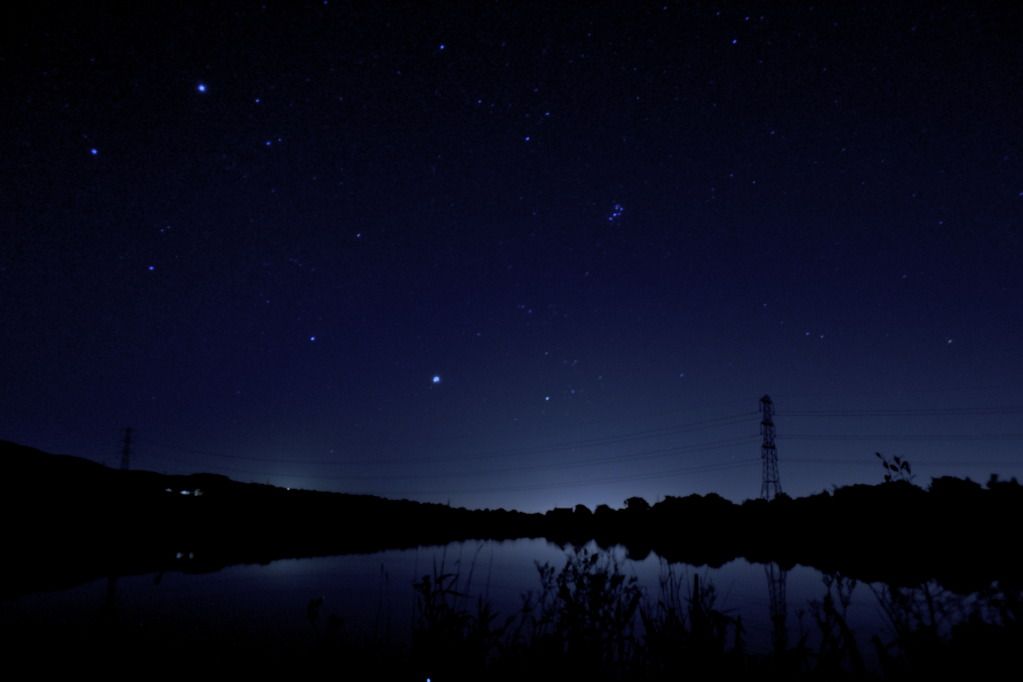
I am gutted to find that the majority of the pictures that I took look really soft, despite looking sharp on the LCD screen on the camera at the time.
The camera was on a tripod which was untouched , and the shutter was fired using a remote shutter cable so I am ruling out any camera shake.
My camera is a Nikon D3100 and I was using the kit 18-55vr lens. Camera was in manual mode with manual focus due to the darkness, with the focus set to infinity (ring turned all the way to the right). The above picture was a 30 sec exposure at f6.3.
Any ideas or pointers? Would it be at all possible for the viewfinder focus to be slightly out? Im just really disappointed at missing out on some really cracking pictures last night and I don't know how to remedy this!
David
I was out having a play with my camera last night and I was excited to get set up and take some pictures like the one I have attached below:
I am gutted to find that the majority of the pictures that I took look really soft, despite looking sharp on the LCD screen on the camera at the time.
The camera was on a tripod which was untouched , and the shutter was fired using a remote shutter cable so I am ruling out any camera shake.
My camera is a Nikon D3100 and I was using the kit 18-55vr lens. Camera was in manual mode with manual focus due to the darkness, with the focus set to infinity (ring turned all the way to the right). The above picture was a 30 sec exposure at f6.3.
Any ideas or pointers? Would it be at all possible for the viewfinder focus to be slightly out? Im just really disappointed at missing out on some really cracking pictures last night and I don't know how to remedy this!
David
daveskerr82 said:
Hello,
My camera is a Nikon D3100 and I was using the kit 18-55vr lens. Camera was in manual mode with manual focus due to the darkness, with the focus set to infinity (ring turned all the way to the right). The above picture was a 30 sec exposure at f6.3.
Was the VR turned off ? If not, it can get a bit confused when it's on a tripod - the manual for my 70-200 VR recommends turning VR off when using a tripod, so I suspect the 18-55 is no different.My camera is a Nikon D3100 and I was using the kit 18-55vr lens. Camera was in manual mode with manual focus due to the darkness, with the focus set to infinity (ring turned all the way to the right). The above picture was a 30 sec exposure at f6.3.
Secondly, infinity isn't always right at the end of the focus travel - some lenses (and again, my 70-200 exhibits this) can overshoot infinity and be slightly soft when the focus ring is turned all the way to the end. Ideally you need to test this in daylight through the view-finder and then make a note of whether the lens suffers from this or not.
Finally, for lenses which still have some distance markings, you could try hyperfocal focusing to ensure as much of the image is in focus as possible.
Manual focusing can be made more accurate with a right-angle finder:

That's a cheap one, or if feeling wealthy you can try the Nikon DR-6 which is about £150.
www.nphotomag.com/2012/08/22/nikon-dr-6-dr-5-how-t...
That's a cheap one, or if feeling wealthy you can try the Nikon DR-6 which is about £150.
www.nphotomag.com/2012/08/22/nikon-dr-6-dr-5-how-t...
Mirror lock was definitely off so that is something that I will try firstly.
VR was switched off on the lens.
Photos were taken in RAW.
Not sure if the lens goes soft at the far right end of the focus ring, I will give that a try. Problem was last night, I was in the moment (ie darkness) and I had nothing to focus on as a reference. Images looked sharp on the LCD screen so I had no reason to think this wasn't the case.
Cheers
David
VR was switched off on the lens.
Photos were taken in RAW.
Not sure if the lens goes soft at the far right end of the focus ring, I will give that a try. Problem was last night, I was in the moment (ie darkness) and I had nothing to focus on as a reference. Images looked sharp on the LCD screen so I had no reason to think this wasn't the case.
Cheers
David
My first few efforts at star shots looked like this so I can sympathise. Best advice I can give is to focus the lens on a distant-ish object before you go out and then stick it on manual focus and leave it. See http://www.dofmaster.com/ to check your pre-focussing distance but if you are shooting at a wide-ish angle it wont need to be that far off (eg indoors will probably work).
Once you're out and have taken a shot zoom right in on your camera screen to check it has focussed ok. This is one of the trickiest things on star shots so don't be too down on yourself
Once you're out and have taken a shot zoom right in on your camera screen to check it has focussed ok. This is one of the trickiest things on star shots so don't be too down on yourself
Did you focus on something, or just wind the focus ring round to infinity? Best bet is always the former.
Can be tough at times, but if it means the difference between bringing soft or sharp shots home, it's worth it. Read up about hyperfocal distances & depth of field and it'll give you an insight into how far into the frame you can focus for any given focal length/ aperture pairing. Armed with this info you can make a judgement on about focusing on location. The wider angle your lens, the closer to the camera you can focus and still get the whole scene sharp. That makes it easy in that you can just shine a torch at the given range and focus where the torchlight hits. Longer lenses need greater focal distance so you might need to pick out the moon or a distant streetlight.
Can be tough at times, but if it means the difference between bringing soft or sharp shots home, it's worth it. Read up about hyperfocal distances & depth of field and it'll give you an insight into how far into the frame you can focus for any given focal length/ aperture pairing. Armed with this info you can make a judgement on about focusing on location. The wider angle your lens, the closer to the camera you can focus and still get the whole scene sharp. That makes it easy in that you can just shine a torch at the given range and focus where the torchlight hits. Longer lenses need greater focal distance so you might need to pick out the moon or a distant streetlight.
rxtx said:
For night sky photography I find the best focus point is in fact just before infinity. I use live view while pointed at a bright star/planet and zoom in (digitally, using the LCD screen) and adjust focus that way.
This. On my 24-105 it tends to be on the "stick" of the L before the infinity mark, a bit like this but more to the right (as we look at the pic): 
I once had a very interesting link that explained the exact point of infinity changes slightly, due to temperature/humidity etc. Alas I can't find it
If there is something (like a tree) some distance away I've shone a LED light at it, got autofocus and then left it there. Failing that you need to manual focus.
daveskerr82 said:
Any ideas or pointers? Would it be at all possible for the viewfinder focus to be slightly out? Im just really disappointed at missing out on some really cracking pictures last night and I don't know how to remedy this!
Focus manually and use a torch to read the lens itself to make sure you are on infinity. You can try and focus manually through the viewfinder....I did a 7 minute exposure on an Italian mountain last year - looked great on the lcd, but it's only when you zoom in do you appreciate how far off focus was.
Also, set the ISO to 100. It's not like the sky is going anywhere and there is way too much noise at 1600.
For what it's worth though - it's a good shot.
Actually - thinking about it again 30 seconds is long enough to get star trails shooting at 18mm on a crop sensor I think.
600/18*1.5 = 22ish (ie max exposure time before trails) so that's also going to be an issue
That's literally true but we (ie the earth) are going somewhere! I assume the OP did not want a star trail shot so a high ISO is necessary.
600/18*1.5 = 22ish (ie max exposure time before trails) so that's also going to be an issue
JDRoest said:
It's not like the sky is going anywhere
That's literally true but we (ie the earth) are going somewhere! I assume the OP did not want a star trail shot so a high ISO is necessary.
JDRoest said:
Focus manually and use a torch to read the lens itself to make sure you are on infinity. You can try and focus manually through the viewfinder....
I did a 7 minute exposure on an Italian mountain last year - looked great on the lcd, but it's only when you zoom in do you appreciate how far off focus was.
Disagree- AF is the way. It should either be spot on or way off. Focus manually and you can be a little bit off yet it'll look fine on the LCD... as you seem to have found out.I did a 7 minute exposure on an Italian mountain last year - looked great on the lcd, but it's only when you zoom in do you appreciate how far off focus was.
Gassing Station | Photography & Video | Top of Page | What's New | My Stuff