
Odd intake manifold
Discussion


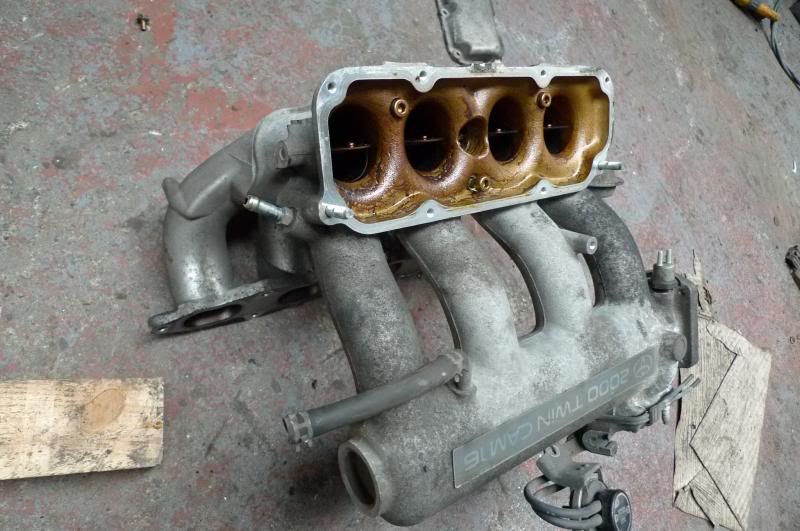

I think it's called ACIS - Acoustic Control Induction System, but I can't understand how it works.
When I first looked at it I thought the same as you, that it was a variable induction system whereby the air was directed over two different lengths by the butterflies.
However looking closer it doesn't seem to work like that, the butterflies open up to a closed sealed chamber so can only assume it's noise suppression - bloody complicated way of doing it if it is!
Whether the butterflies are open or closed the air still gets drawn in through the same route.
I did ponder over Homologation, but it's an N/A motor so not sure that's relevant. I don't think they ever rallied an MR2 either....
Kind of get the feeling that Garagewidow is closest at the moment.....
When I first looked at it I thought the same as you, that it was a variable induction system whereby the air was directed over two different lengths by the butterflies.
However looking closer it doesn't seem to work like that, the butterflies open up to a closed sealed chamber so can only assume it's noise suppression - bloody complicated way of doing it if it is!
Whether the butterflies are open or closed the air still gets drawn in through the same route.
I did ponder over Homologation, but it's an N/A motor so not sure that's relevant. I don't think they ever rallied an MR2 either....
Kind of get the feeling that Garagewidow is closest at the moment.....
Edited by Evoluzione on Tuesday 26th March 21:58
It switches at quite high revs IIRC, 5100? But don't hold me to that! I remember going out with it unplugged to see what the difference was and IIRC you could feel the difference.
Toyota had a few different variable intake manifolds around, there was another system called TVIS where half the ports were blocked off at lower speeds. I believe BMW call these 'swirl flaps' nowadays.
Toyota had a few different variable intake manifolds around, there was another system called TVIS where half the ports were blocked off at lower speeds. I believe BMW call these 'swirl flaps' nowadays.
Yes I know about TVIS, it doesn't block the ports, they work as normal.
It has 8 manifold runners (4 cylinder motor) and the TVIS blocks off one per cylinder at the plenum end so you just have 50% of the available manifold runner CSA per cylinder until a certain RPM, this must increase velocity. I wonder if the idea fell down where the runners end and in between there and the separate ports there is a huge open cavernous area.
Toyota seem to have tried all sorts of weird and wonderful intake ideas over the years, not sure how successful they've been as they just seem to leave them behind and move onto something new....
Still can't understand exactly how the one I pictured above works though.
It has 8 manifold runners (4 cylinder motor) and the TVIS blocks off one per cylinder at the plenum end so you just have 50% of the available manifold runner CSA per cylinder until a certain RPM, this must increase velocity. I wonder if the idea fell down where the runners end and in between there and the separate ports there is a huge open cavernous area.
Toyota seem to have tried all sorts of weird and wonderful intake ideas over the years, not sure how successful they've been as they just seem to leave them behind and move onto something new....
Still can't understand exactly how the one I pictured above works though.
The Rover KV6 manifold has a very similar (but more complex) system, with a set of six butterflies that simply open into a sealed plenum to increase the volume, and a second valve to either divide the main plenum into two halves, each feeding three cylinders, or as a single plenum feeding all six cylinders.
If either or both of the actuators fail (common fault) it has a significant and very noticeable impact on performance and economy.
If either or both of the actuators fail (common fault) it has a significant and very noticeable impact on performance and economy.
I remember playing around on the MR2 with that manifold, the intake ducting came quite a long way down to a bell mouth, but I noticed it looked a bit small and was literally only a couple of cm away from a flat surface.
So I thought I'd be clever and try it with that part off, yep, again, it was slower..
So I thought I'd be clever and try it with that part off, yep, again, it was slower..
Gassing Station | Engines & Drivetrain | Top of Page | What's New | My Stuff