
Connector for full vacuum.
Discussion


Dougal9887 said:
Hi, can anyone suggest a source for a vacuum pipe hose adapter to one of the plenum tappings? What thread are these tappings?
Thanks.
Not sure of the size of the thread but these suggestions any good ? More choice further down the page in "related" products.Thanks.
https://www.carbuildersolutions.com/uk/14-npt-gold...
Something like this should work just drill and tap a new hole in the plenum low down at the front where it will not be obvious.
https://www.carbuildersolutions.com/uk/hosetail-18...
Steve
https://www.carbuildersolutions.com/uk/hosetail-18...
Steve
Is this any good if not a wee bit expensive.
https://rimmerbros.com/Item--i-ADU1402
I found it here
https://rimmerbros.com/Item--i-GRID800056
https://rimmerbros.com/Item--i-ADU1402
I found it here
https://rimmerbros.com/Item--i-GRID800056
TJC46 said:
Is this any good if not a wee bit expensive.
https://rimmerbros.com/Item--i-ADU1402
I found it here
https://rimmerbros.com/Item--i-GRID800056
That's a non-return valve!https://rimmerbros.com/Item--i-ADU1402
I found it here
https://rimmerbros.com/Item--i-GRID800056
Great for a brake servo, useless for most other vacuum related tasks like vac advance ect.
If this is for applying full vacuum to the vac advance unit you can just 'T' off the vac hose used for the fuel pressure regulator.
Thanks for the replies.
The Car Builder part looks right but 1/8NPT? Surely not NPT and if NPT 3/8 more like. 3/8 BSP doesn't fit and I thought NPT thread was very close to BSP. It's not metric either.
Not sure about teeing off the fuel regulator pipe as I tried this for a MAP sensor on another car with poor result, although that is on individual throttle bodies all tee'd together and a fairly poor vacuum signal anyway. Is it a tried and tested method on the RV8?
The Car Builder part looks right but 1/8NPT? Surely not NPT and if NPT 3/8 more like. 3/8 BSP doesn't fit and I thought NPT thread was very close to BSP. It's not metric either.
Not sure about teeing off the fuel regulator pipe as I tried this for a MAP sensor on another car with poor result, although that is on individual throttle bodies all tee'd together and a fairly poor vacuum signal anyway. Is it a tried and tested method on the RV8?
Dougal9887 said:
Thanks for the replies.
The Car Builder part looks right but 1/8NPT? Surely not NPT and if NPT 3/8 more like. 3/8 BSP doesn't fit and I thought NPT thread was very close to BSP. It's not metric either.
Not sure about teeing off the fuel regulator pipe as I tried this for a MAP sensor on another car with poor result, although that is on individual throttle bodies all tee'd together and a fairly poor vacuum signal anyway. Is it a tried and tested method on the RV8?
1/8NPT is the most common thread for sensors and gauges. The taper thread means that you don't need a machined surface for a sealing washer to sit against. A little PTFE tape on the thread and wind it in until tight.The Car Builder part looks right but 1/8NPT? Surely not NPT and if NPT 3/8 more like. 3/8 BSP doesn't fit and I thought NPT thread was very close to BSP. It's not metric either.
Not sure about teeing off the fuel regulator pipe as I tried this for a MAP sensor on another car with poor result, although that is on individual throttle bodies all tee'd together and a fairly poor vacuum signal anyway. Is it a tried and tested method on the RV8?
If you plan to use it for a MAP sensor then the back of the plenum would hide it nicely. But then just teeing into the fuel reg line would be even easier.
Steve
This is the original part that Rover used on SD1s with EFI. Rimmer Brothers are out of stock as I bought the last one they had. It fits in the spare blanked off hole in the plenum base, driver's side. The Rover part number is ERC 4626 and although listed as obsolete, a call to Brit part may get you one.
http://www.brit-car.co.uk/product.php/144351/4818/...
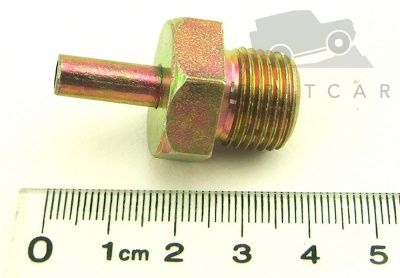
http://www.brit-car.co.uk/product.php/144351/4818/...
Edited by N7GTX on Friday 2nd March 08:12

Dougal9887 said:
Not sure about teeing off the fuel regulator pipe as I tried this for a MAP sensor on another car with poor result, although that is on individual throttle bodies all tee'd together and a fairly poor vacuum signal anyway.
Throttle bodies are notorious for providing a weak vacuum signal because basically you have a throttle butterfly per cylinder, we have a single throttle butterfly and a great big plenum which is the perfect recipe for a nice strong vacuum signal, actually you could argue it's too strong for effective low oil consumption crank case ventilation which is why Land Rover were forced to use that little small bore brass collar to restrict the suck a bit. Dougal9887 said:
Is it a tried and tested method on the RV8?
Vacuum is vacuum, creating a new point for your vacuum signal or sharing it with another component that references vacuum (like the fuel pressure regulator) shouldn't make a blind bit of difference. All Lloyd Specialist Developments Canems installations T the MAP sensor to the FPR vac reference hose, which as we know is taken from the the nipple set in the stepper motor mounting plate at the back of the plenum chamber.
This little port goes directly to full manifold vacuum inside the plenum.

My Canems system has always shown a strong and reliable vac signal with it's MAP sensor plumbed in this way, and don't forget a MAP sensor is just a more sophisticated electronic version of a vac advance unit mounted on the side of a distributor, we even use MAP to advance our ignition timing on light load cruise just as we do with the vac advance unit.
Both a distributor vac advance unit and a MAP sensor use the well trodden principle of manifold depression to determine engine load, it's just with a MAP sensor you can see the real time depression measured in kPa on your laptop screen, and with a MAP sensor we use this data for a lot more that just advancing ignition timing at light load cruise.
To be honest the vac advance unit is the closest thing people still running a distributor have to three dimensional engine load dependent adaptive ignition timing management, I cannot over-stress it's importance enough, people who disconnect it are deluded. People still on the distributor should make sure their vac advance unit is working correctly as failures normally linked to a split diaphragm are common, apply vacuum and not only make sure it's holding that vacuum but also be sure to observe the distributor base plate is moving as base plate seize ups are common too.
Once everything checks out as working correctly they should then ditch the dreadful emissions based ported vacuum nonsense and go to full manifold vacuum, as proven by the tests conducted by StuVT you will enjoy a far smoother drive and improved idle quality, you should also get better throttle response off the line, a small fuel economy improvement and lower exhaust manifold tempts that will in-turn mean your ignition components last longer. Be aware all these benefits do not come for free, because the other thing that happens will this advanced timing strategy is your emissions at idle will go up too, if that doesn't bother you there are further idle quality, throttle response and power improvements to be had by getting shot of all three catalytic converters.
Finding a friendly MoT tester who's happy to overlook all the emissions b
 ks closes the circle perfectly, you're just left with a car that quite simply drives much much better and uses less fuel.... all for very little investment indeed
Ok thanks. So I'll probably just tee into the fuel regulator vacuum pipe. It will save me remounting the PAS reservoir.
I have no idle or other problems but do agree with all the full vacuum arguments.
It was my plan to Megasquirt it this winter but ended up blowing the budget on a respray, new windscreen, powdercoating and superflexing suspension, Accord/Mondeo droplink mod, wheel bearings and a gearbox rebuild kit. Now looking forward to driving it again!
I have no idle or other problems but do agree with all the full vacuum arguments.
It was my plan to Megasquirt it this winter but ended up blowing the budget on a respray, new windscreen, powdercoating and superflexing suspension, Accord/Mondeo droplink mod, wheel bearings and a gearbox rebuild kit. Now looking forward to driving it again!
Dougal
I bought 5 of these 5mm hose tails with M5 threads for 63p each and drilled & tapped a 5mm thread by hand into a plenum plug.
https://www.ebay.co.uk/itm/LOT-5-Hose-tail-Barb-I-...
I have 4 of the connectors left so if you want one free of charge PM me your address. You can buy cheap screw thread tap kits on ebay.

I bought 5 of these 5mm hose tails with M5 threads for 63p each and drilled & tapped a 5mm thread by hand into a plenum plug.
https://www.ebay.co.uk/itm/LOT-5-Hose-tail-Barb-I-...
I have 4 of the connectors left so if you want one free of charge PM me your address. You can buy cheap screw thread tap kits on ebay.
stevesprint said:
Dougal
I bought 5 of these 5mm hose tails with M5 threads for 63p each and drilled & tapped a 5mm thread by hand into a plenum plug.
https://www.ebay.co.uk/itm/LOT-5-Hose-tail-Barb-I-...
I have 4 of the connectors left so if you want one free of charge PM me your address. You can buy cheap screw thread tap kits on ebay.
Hi Steve, as you will have seen I've made a big play of how it really shouldn't make any difference if you T into the fuel pressure regulator hose to obtain the full manifold vacuum signal, but the truth is I haven't actually tested the theory.I bought 5 of these 5mm hose tails with M5 threads for 63p each and drilled & tapped a 5mm thread by hand into a plenum plug.
https://www.ebay.co.uk/itm/LOT-5-Hose-tail-Barb-I-...
I have 4 of the connectors left so if you want one free of charge PM me your address. You can buy cheap screw thread tap kits on ebay.
If you would be so kind as to send me one of your connectors for the plenum I will test it to see if my MAP signal stability is improved or stays the same, this would be the only way to definitively prove if a dedicated connector is better or the same as splicing into the FPR hose as per all Lloyd Specialist Development Canems installations.
Once I've tested the two different setups I'll report the results back on the forum, if there is a stability improvement it'll be easy to observe and record using my Canems software.
PM sent with my address, thanks in advance.
Dave.

ChimpOnGas said:
stevesprint said:
Dougal
I bought 5 of these 5mm hose tails with M5 threads for 63p each and drilled & tapped a 5mm thread by hand into a plenum plug.
https://www.ebay.co.uk/itm/LOT-5-Hose-tail-Barb-I-...
I have 4 of the connectors left so if you want one free of charge PM me your address. You can buy cheap screw thread tap kits on ebay.
Hi Steve, as you will have seen I've made a big play of how it really shouldn't make any difference if you T into the fuel pressure regulator hose to obtain the full manifold vacuum signal, but the truth is I haven't actually tested the theory.I bought 5 of these 5mm hose tails with M5 threads for 63p each and drilled & tapped a 5mm thread by hand into a plenum plug.
https://www.ebay.co.uk/itm/LOT-5-Hose-tail-Barb-I-...
I have 4 of the connectors left so if you want one free of charge PM me your address. You can buy cheap screw thread tap kits on ebay.
If you would be so kind as to send me one of your connectors for the plenum I will test it to see if my MAP signal stability is improved or stays the same, this would be the only way to definitively prove if a dedicated connector is better or the same as splicing into the FPR hose as per all Lloyd Specialist Development Canems installations.
Once I've tested the two different setups I'll report the results back on the forum, if there is a stability improvement it'll be easy to observe and record using my Canems software.
PM sent with my address, thanks in advance.
Dave.
 also trumpet stand off fuel/oil residue congregates around those ports due to their location so low on the trumpet base so I would leave you map wire T'ed into the FPR take off on the stepper housing if I was you this is higher up and sees a cleaner environment, you dont want liquids finding there way into your vac ref pipe or you may experience fueling difficulties
 Sardonicus said:
ave it wont make a any difference to your map vacuum signal also trumpet stand off fuel/oil residue congregates around those ports due to their location so low on the trumpet base so I would leave you map wire T'ed into the FPR take off on the stepper housing if I was you this is higher up and sees a cleaner environment, you dont want liquids finding there way into your vac ref pipe or you may experience fueling difficulties
also trumpet stand off fuel/oil residue congregates around those ports due to their location so low on the trumpet base so I would leave you map wire T'ed into the FPR take off on the stepper housing if I was you this is higher up and sees a cleaner environment, you dont want liquids finding there way into your vac ref pipe or you may experience fueling difficulties As per my previous 'Vacuum is Vacuum' statement.... I'm in agreement, but I see no harm proving the theory.
I get your point about oil contamination, most plenum bases on our cars have a layer of engine oil sitting in/on them, in my opinion this is a function of the overly aggressive and unvalved passive crankcase ventilation system used by Land Rover. Rather crudely LR tuned the standard system with a brass restrictor collar, if you think about it choosing the right size orifice of such a restrictor is always going to be a compromise because level of vacuum varies with engine speed and throttle position, this is what I mean by crude.
I've tuned by crankcase ventilation in a different way, using a PCV valve full manifold vacuum is no longer directly linked to atmosphere at the throttle body, the valve is responding and is adaptive to the amount of vacuum rather than crankcase ventilation system simply relying on the fixed orifice size in the restrictor collar. At WOT where there's little or no vacuum in the plenum so venturi vacuum at the throttle butterfly becomes the stronger force, like this my engine is still inhaling the crank case gasses just not from the plenum but from the atmosphere side of the throttle butterfly. When I come away from WOT and start to close the throttle, vacuum once more increases in the plenum and so opens the plenum circuit and closes the atmosphere circuit, the crankcase gasses are now exclusively drawn into the plenum, unlike the standard unvalved arrangement manifold vacuum can't suck against the atmosphere circuit at the throttle body because the vacuum itself has pulled the valve shut closing that path.
The result of my setup has been less oil in the plenum, lower overall oil consumption and a smoother idle because the original arrangement is basically a vacuum leak, all this with no increase in oil leaks indicating my crankcase pressures are still being properly managed. I have also implemented an oil catch tank which I check every six months, but have found it remains as oil free as the plenum so has proved to be largely unnecessary. Because my plenum is now oil free I dont foresee any contamination issues with my MAP sensor if I do fit the connector to the plenum.
But like you say, I doubt there will be any MAP stability benefits to come from it, it's just I always like to see these things for myself to prove the point

I found t-ing into the fuel regulator line too weak.
I used the connector at the base of the plenum where the fuel fume purge was connected. Its not needed anyway and is probably broken. So since you probably have a vacuum leak there you might a ell use it!
Just sleeve it down at the distributor end.
I used the connector at the base of the plenum where the fuel fume purge was connected. Its not needed anyway and is probably broken. So since you probably have a vacuum leak there you might a ell use it!
Just sleeve it down at the distributor end.
StuVT said:
I found t-ing into the fuel regulator line too weak.
I used the connector at the base of the plenum where the fuel fume purge was connected. Its not needed anyway and is probably broken. So since you probably have a vacuum leak there you might a ell use it!
Just sleeve it down at the distributor end.
Interesting, my MAP sensor is just a tiny diaphragm attached to a delicate potentiometer, so I can easily see how it would need a lot less vacuum than physically moving the distributor base plate against spring tension.When you move the base plate manually to check it hasn't seized the force required is not inconsiderable, so as you've proved choosing a good strong vacuum signal is whats needed here. I used the connector at the base of the plenum where the fuel fume purge was connected. Its not needed anyway and is probably broken. So since you probably have a vacuum leak there you might a ell use it!
Just sleeve it down at the distributor end.
Another option would be to T off the crankcase ventilation pipe at the base of the plenum, vacuum is super strong in that hose hence Range Rover needing to fit the brass restrictor collar, it's also close the the distributor so the run to the vac advance unit will be the shortest you could possibly achieve.
Message Board | Chimaera | Top of Page | What's New | My Stuff