
Post amazingly cool pictures of aircraft (Volume 3)
Discussion


I thought there was something odd with the photo but it seems to be true!
https://www.youtube.com/watch?v=UWQ8DGNDvic
https://www.youtube.com/watch?v=UWQ8DGNDvic
DodgyGeezer said:

yellowjack said:
DodgyGeezer said:
some bod on the roof posted this on FB reels,
https://www.facebook.com/share/v/1Dnj3RvMfg/
DodgyGeezer said:
Apparently, each of the planes was crewed by senior captains/pilots
some bod on the roof posted this on FB reels,
https://www.facebook.com/share/v/1Dnj3RvMfg/
The seniority and "hours on type" of the captains will hold no sway in the event of an investigation being opened. It will hinge on facts, like safety distances Above Ground Level, between aircraft and structures, and between the two aircraft. It may be that the pass was entirely within the limits agreed in advance by the South African aviation regulator. If so, someone should make an official statement to confirm that position and that there's no requirement for an investigation. If the agreed safe limits for this display were exceeded, I'd expect an open and fully transparent investigation to identify any learning points, with a full report published in due course. We'll see. But I can't see the UK CAA approving any kind of similar display/flypast within UK airspace. I'm a huge fan of skilled pilots displaying their aircraft well, but that, to my layman's eyes, was definitely "too close for comfort." I can't begin to imagine the conversation we'd be having right now if either of those aeroplanes had collided with a packed out sports stadium in the name of spectacle. It doesn't bear thinking about. some bod on the roof posted this on FB reels,
https://www.facebook.com/share/v/1Dnj3RvMfg/
Simpo Two said:
MartG said:
Finnish PM-1 'Hurricane'
'Finnish Hurricane' was a nickname but that's near enough. 'The VL Pyörremyrsky was a Finnish prototype fighter designed by Torsti Verkkola in the mid-1940s. Development of the aircraft began in 1942 by orders of the Finnish Air Force, who was in need of a new locally produced fighter powered by the German DB 605AC engine. The first prototype of the aircraft had its maiden flight on November 1945, and was praised for its outstanding performance, however by then WW2 was over, and thus the FAF lost interest on the fighter and the project was cancelled in 1947.'
https://en.wikipedia.org/wiki/VL_Py%C3%B6rremyrsky
I first saw it in the photo here https://en.wikipedia.org/wiki/Finnish_Air_Force_Mu... and thought 'what the heck is that?'
My favourite piece of Finnish aviation lore can also be found in the same museum:
The Tiira series of aircraft. These were homebuilt aircraft built by a farmer with no license or aviation knowledge. Something would occasionally show up on local radar and by the time the police got close to investigate, there was nothing to be found. the farmer, Raimo Päätalo flew over 70 hours in his first creation, before being caught and heavily fined. However Finnish farmers being Finnish farmers, he built a second aircraft, only for the authorities to catch wind of it and confiscate the propellor that had taken him two months to make, as well as give him a 4 month suspended prison sentence.
Now a full-on criminal, he refined his aircraft and eventually built a third, Tiira III. In 2010 he was convicted again and the aircraft was confiscated.
Then in 2014, the radar returnes came back. Police investigated and traced it back to your guy Raimo. All in all it's estimated that Päätalo flew a total of 800 hours in his homebuilt planes with no license, no fear, and no respect for the strong hand of the law.
yellowjack said:
The seniority and "hours on type" of the captains will hold no sway in the event of an investigation being opened. It will hinge on facts, like safety distances Above Ground Level, between aircraft and structures, and between the two aircraft. It may be that the pass was entirely within the limits agreed in advance by the South African aviation regulator. If so, someone should make an official statement to confirm that position and that there's no requirement for an investigation. If the agreed safe limits for this display were exceeded, I'd expect an open and fully transparent investigation to identify any learning points, with a full report published in due course. We'll see. But I can't see the UK CAA approving any kind of similar display/flypast within UK airspace. I'm a huge fan of skilled pilots displaying their aircraft well, but that, to my layman's eyes, was definitely "too close for comfort." I can't begin to imagine the conversation we'd be having right now if either of those aeroplanes had collided with a packed out sports stadium in the name of spectacle. It doesn't bear thinking about.
Claims that flight recorder data has been handed over to SACAA. https://www.walesonline.co.uk/sport/rugby/rugby-ne...Oh, and https://www.flappylink.com/
In one day, two-thirds of America's intercontinental bomber force was knocked out of commission, but not by any enemy.
On Labor Day, 1 September 1952, a violent storm struck Carswell Air Force Base in Fort Worth, Texas, cutting across the B-36 Peacemaker flightline and maintenance areas.
All 82 B-36 Peacemakers on the base were damaged, temporarily putting the entire 19th Air Division out of operation. At the time, Carswell's 7th and 11th Bomb Wings represented roughly two-thirds of Strategic Air Command's intercontinental bomber force. Additional B-36s at Convair's adjoining Fort Worth factory were also damaged.
The response, dubbed Project FIXIT, began at dawn the next day. Carswell maintenance crews handled the least-damaged aircraft, specialists from the San Antonio Air Materiel Area tackled more extensive repairs, and the worst cases went across the field to Convair. The first B-36 returned to service within a week and nine more followed during the second week. Within a month, 51 bombers had been restored, and both Carswell wings were operational again. Repairs continued until 11 May 1953, when the last repairable storm-damaged B-36 returned to flying status.
( From Commemorative Air Force on Facebook )
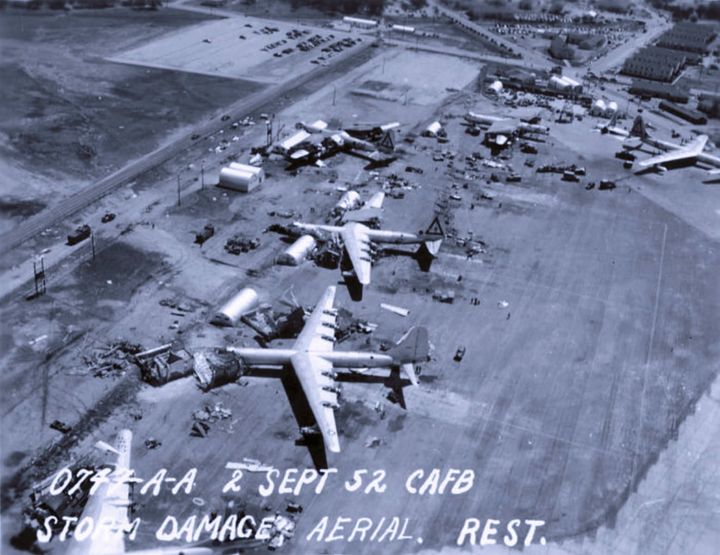
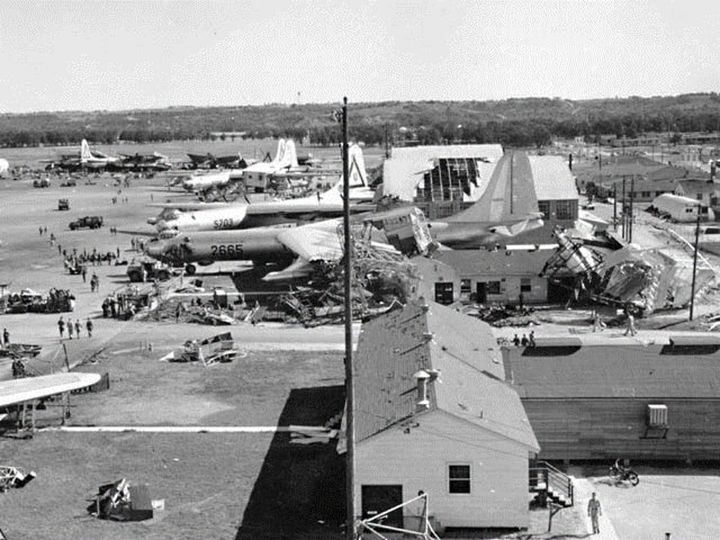
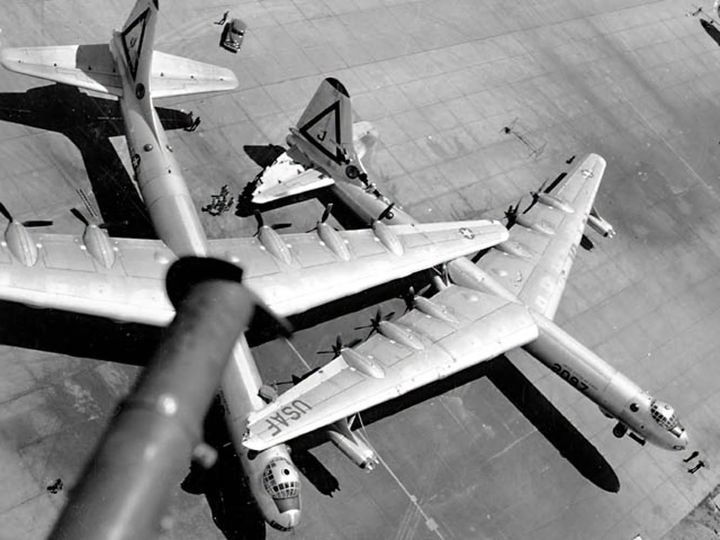
On Labor Day, 1 September 1952, a violent storm struck Carswell Air Force Base in Fort Worth, Texas, cutting across the B-36 Peacemaker flightline and maintenance areas.
All 82 B-36 Peacemakers on the base were damaged, temporarily putting the entire 19th Air Division out of operation. At the time, Carswell's 7th and 11th Bomb Wings represented roughly two-thirds of Strategic Air Command's intercontinental bomber force. Additional B-36s at Convair's adjoining Fort Worth factory were also damaged.
The response, dubbed Project FIXIT, began at dawn the next day. Carswell maintenance crews handled the least-damaged aircraft, specialists from the San Antonio Air Materiel Area tackled more extensive repairs, and the worst cases went across the field to Convair. The first B-36 returned to service within a week and nine more followed during the second week. Within a month, 51 bombers had been restored, and both Carswell wings were operational again. Repairs continued until 11 May 1953, when the last repairable storm-damaged B-36 returned to flying status.
( From Commemorative Air Force on Facebook )
Gassing Station | Boats, Planes & Trains | Top of Page | What's New | My Stuff