
A Blackbird is missing
Discussion


Arnold Cunningham said:
But Eric is, IIRC, an accountant. So through a finance lens, he's absolutely right. Bit like the concorde return to flight crowd - yes it was all technically possible, but actual costs of doing so (even ignoring design authority approval and so forth) were always going to make it impossible.
Ultimately, if the US is prepared to pay whatever it costs to do it, it's possible.
Hee hee - not so much the accountant talking but more from reading a lot about the history of the A-12 Oxcart, YF-12 and SR-71 programmes over the years.Ultimately, if the US is prepared to pay whatever it costs to do it, it's possible.
I also went to a talk a couple of years ago by the author of this book who was very clear as to why the SR-71 was no longer viable as a reconaissance asset. He's also written a whole host of books on the entire Blackbird family. So he does know what he is talking about.

Money can counter a lot, but the suggestion is bonkers!
The airframes are very old, we dont know the flying miles and have been sat now for 25 plus years in the desert sun, I seriously doubt one is being bought back to flying staus, there are enough research aircraft known about, and probably a few we don't that could do research of that kind.
Unless of course this is like the F14 thing and they want one ro restore and use at airshow to drive recruitment and interest.
NASA were the last operators, but surely the thing is too far gone now.
I know they still have a small unit of 117s at the test ranges, but that is for drone and detection research is it not.
I think it's either a smokescreen or the thing is just being removed for a paint refresh.
I don't think it is a far fetched as people might think. The first question is why would NASA want or need an aircraft with the SR-71's capabilities at this moment in time.
I expect there are many reasons why the ability to fly above Mach 3 for a reasonable amount of time is still something that can provide useful scientific and engineering data. When NASA was flying this aircraft 30 odd years ago, it was essentially being used as a test mule with all sorts of features being bolted on to the airframe to see how they behaved at high Mach numbers. I expect that in the intervening 30 years new materials and new ideas have emerged that might benefit in being tested in these flight regimes.
The bottom line will be benefit versus cost. Is it worthwhile going to the extent of essentially rebuilding this aeroplane to make it flight worthy again versus what knowledge could be gained. That's always a hard thing to predict as testing often proves something DOESN'T work as much as it proves something DOES work.
The SR-71 was always a tricky and costly aircraft to run, even in its prime.
One story I've read is that Rockwell, when designing the Shuttle Orbiter in the 1970s, paid a visit to Kelly Johnson and his Skunk Works team to ask about the feasibility of using titanium as the main structure for the Orbiter (the A-12/SR-71 family made extensive use of titanium). Johnson said "Don't bother. Titanium causes all sorts of problems. Stick to aluminium".
But there MUST be secret stuff already doing this surely. And there must be reams of data from the time about the thing.
The 71 is entirely analogue, the frames are about 60 years old, already all done a lot of hard hours, it would cost hundreds of millions surely to basically rebuild one, and it would take a bloody long time.
Unless that frame is in very good nick and can be bought back to status quickly which might be the best reason, as doing that would cost less than a new project.
That story BTW is nonsense, no way would guys working on this be allowed to talk to the press surely? They might have been asked questions or advice yes.
But it is interesting why it has been removed.
If I was a trillionaure I would hire a crack team to get the Valkyrie and TSR2 flying lol. Would probably cost more!
Nah. If I was a trillionaire I'd do Concorde, kitted out as my private jet. Or one of the Martin Mars. Perhaps a Short Sunderland. Or all of them
The Valkyrie is absolutely amazing, but the survivor is the first prototype. I'd say the same of the TSR2. Especially the Valkyrie, I would say the entire airframe is no longer possible to be made fit for flight - it was a stainless honeycomb, their first attempt at it, and was delaminating even when it was still flying IIRC.
The Valkyrie is absolutely amazing, but the survivor is the first prototype. I'd say the same of the TSR2. Especially the Valkyrie, I would say the entire airframe is no longer possible to be made fit for flight - it was a stainless honeycomb, their first attempt at it, and was delaminating even when it was still flying IIRC.
Edited by Arnold Cunningham on Wednesday 30th September 12:21
bergclimber34 said:
But there MUST be secret stuff already doing this surely. And there must be reams of data from the time about the thing.
The 71 is entirely analogue, the frames are about 60 years old, already all done a lot of hard hours, it would cost hundreds of millions surely to basically rebuild one, and it would take a bloody long time.
Unless that frame is in very good nick and can be bought back to status quickly which might be the best reason, as doing that would cost less than a new project.
That story BTW is nonsense, no way would guys working on this be allowed to talk to the press surely? They might have been asked questions or advice yes.
But it is interesting why it has been removed.
If I was a trillionaure I would hire a crack team to get the Valkyrie and TSR2 flying lol. Would probably cost more!
NASA is not the CIA or even the USAF. They are ostensibly a civilian organisation and therefore do not operate in the ultra-secret world of many US government agencies. In fact, NASA prides itself on its public openess.The 71 is entirely analogue, the frames are about 60 years old, already all done a lot of hard hours, it would cost hundreds of millions surely to basically rebuild one, and it would take a bloody long time.
Unless that frame is in very good nick and can be bought back to status quickly which might be the best reason, as doing that would cost less than a new project.
That story BTW is nonsense, no way would guys working on this be allowed to talk to the press surely? They might have been asked questions or advice yes.
But it is interesting why it has been removed.
If I was a trillionaure I would hire a crack team to get the Valkyrie and TSR2 flying lol. Would probably cost more!
This machine, which I understand is numbered NASA 844, was originally allocated USAF serial 61-7955. This means that funding for its build was authorised by Congress in 1961. That is not the year it was actually built, which is most likely 1962 or 1963. If that is the case, the airframe is 63/64 years old.
Although it received a NASA registration, it was only ever on loan to NASA and remained the property of the Department of Defence. So, for all we know, it's the DoD who want a look at it now rather than NASA as the DoD still owns it.
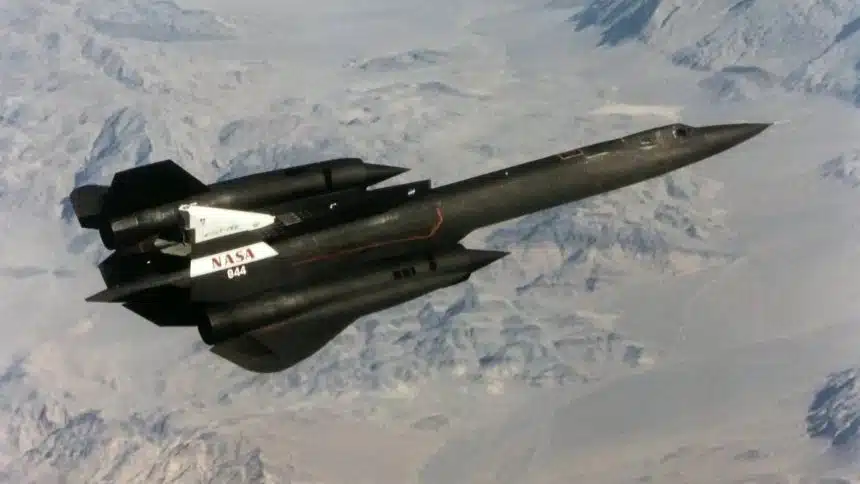
Despite its age, there is, in fact, no current aerial vehicle (manned or unmanned) capable of replicating the type of flight profile that an SR-71 could do. However, the question is, as I said, whether it is worth the massive effort required to get this particular example back in the air.
If there was a real effort being made to make an SR-71 airworthy again, then this one would be the most likely as it was the last flying example when it was retired.
I've been reading around a bit on this. I don't think getting the airframe, the avionics, fuel, or all that side of things would be the primary issue. I think the engines would be.
I'd guess the airframe could be refurbished and repaired, but there are no engines in existence, or spares for them, that appear even close to runnable, let alone flight worthy. And these engines need to be frequently rotated and run to keep them operational. On top of that, you wouldn't tool up to build a new J58, it'd be crazy, you'd tool up to design and build a new generation of engine.
So. Personal opinion, I think they are taking it apart, looking at it all, drawing on knowledge from it & people that worked on it, but not actually going to return this one to flight. You just wouldn't build a new J58 production line, you'd design a new engine instead.
There is a faint possibility that a cache of spares were kept in case it was decided to revive it. But I agree it's probably a case of just examining it, maybe ground running at a pinch. Or of course just partially restoring it to put it back outside with no intention of any technical or test work at all.
Rusty Old-Banger said:
What's in the big long bit of tube between the pilots and the wings? Fuel?
Sensors... lots and lots of sensors.The camera technology for its time was almost as impressive as the airframe and often get little mention.
The SR71 could basically provide you with very very good data over a massive area.
As for the posts above about it being the fastest we have - I doubt it, I really do.
Speed wins fights, and having the ability to go faster than the next guy is always high on the "must have" list.
Suppose there might be an issue of who wants it - if its NASA who want to do mach 3 then the SR71 might be their only option these days.
Also its my belief that NASA was not always quite as "public" as they made out - they are much less involved these days but I think back when the NRO was a big part of their work there was some spooky stuff going on for sure.
gotoPzero said:
Sensors... lots and lots of sensors.
The camera technology for its time was almost as impressive as the airframe and often get little mention.
The SR71 could basically provide you with very very good data over a massive area.
As for the posts above about it being the fastest we have - I doubt it, I really do.
Speed wins fights, and having the ability to go faster than the next guy is always high on the "must have" list.
Suppose there might be an issue of who wants it - if its NASA who want to do mach 3 then the SR71 might be their only option these days.
Also its my belief that NASA was not always quite as "public" as they made out - they are much less involved these days but I think back when the NRO was a big part of their work there was some spooky stuff going on for sure.
The NASA WB57s do have a habit of turning up to do 'atmospheric research' close to where the US would benefit from some reconnaissance assets.The camera technology for its time was almost as impressive as the airframe and often get little mention.
The SR71 could basically provide you with very very good data over a massive area.
As for the posts above about it being the fastest we have - I doubt it, I really do.
Speed wins fights, and having the ability to go faster than the next guy is always high on the "must have" list.
Suppose there might be an issue of who wants it - if its NASA who want to do mach 3 then the SR71 might be their only option these days.
Also its my belief that NASA was not always quite as "public" as they made out - they are much less involved these days but I think back when the NRO was a big part of their work there was some spooky stuff going on for sure.
gotoPzero said:
Rusty Old-Banger said:
What's in the big long bit of tube between the pilots and the wings? Fuel?
Sensors... lots and lots of sensors.The camera technology for its time was almost as impressive as the airframe and often get little mention.
The SR71 could basically provide you with very very good data over a massive area.
As for the posts above about it being the fastest we have - I doubt it, I really do.
Speed wins fights, and having the ability to go faster than the next guy is always high on the "must have" list.
Suppose there might be an issue of who wants it - if its NASA who want to do mach 3 then the SR71 might be their only option these days.
Also its my belief that NASA was not always quite as "public" as they made out - they are much less involved these days but I think back when the NRO was a big part of their work there was some spooky stuff going on for sure.
The F15 is faster than the F22.
The SU35 is faster than the SU57.
The F18 is faster than the F35.
It depends on tg1e job.
The B58 and 70 came, the Russians built the 25, a giant truck that had no fighting ability and ruined it's engines if it maxed them, but to compete and ciz they were scared, the Yanks built the F15 and the Tomcat, with insane radar and tech to shoot the damn thing down if necessary, out maneuvers it, then the Ruskys did the 29, the 31 and the Flanker after that, yadda yadda. It's the game.
As Eric says, rebuilding a 71 might be cheaper than building a new thing, the task might be super specific.
More exciting that the Burmese Spitfres from a few years back...
..Not sure they will achieve, but as an engineering challenge its fascinating. We often hear that the barinpower to make it doesnt exist anymore (same with the Apollo rockets- and that the know how has been lost).
A fascinating project to redicvoer how they did achieve it, and what lessons they can use in the future. There is a knowledge gap. What better way to fill that gap then to try and re-do what was dont before.
Leon R said:
Is speed a must have?
The F15 is faster than the F22.
The SU35 is faster than the SU57.
The F18 is faster than the F35.
It depends on the task, P47 Thunderbolt is faster than an A10 Thunderbolt 2. But if you want to go through hostile airspace it's either very low or very high and fast.The F15 is faster than the F22.
The SU35 is faster than the SU57.
The F18 is faster than the F35.
I very much doubt that there are atmospheric vehicles running much above Mach 3 (manned or unmanned) at the moment. The problems are heat and control.
The control issue is solveable these days by having very,very quick thinking software in charge. The SR-71 was notoriously difficult to keep in trim at above Mach 3 and a few were lost due to aerodynamic upsets. Modern computer systems could keep a high Mach number aircraft stable with more reliability than a human pilot.
Heat is the main issue. Airframes get very hot once you go past Mach 2. Even today, there are very few metals than can cope with high heat loads over long periods of time (by long, I mean more than 10 minutes). That was the reason why titanium was chosen for the SR-71 but the use of titanium came with massive downsides.
The X-15 used a high heat resistant metal called Inconel X which was good up to Mach 4 but failed as they approached Mach 5 - even after they had tried a spray on ablative coating.
The Shuttle Orbiter used ceramic tiles which do work but which are very, very vulnerable to damage and impractical for a normal aeroplane that needs to be ready at a moment's notice.
As for whether there are current Mach 5/6 aicraft whizzing about at the moment, I expect there aren't because they would be spotted by various radar systems etc - and possibly by people on the ground too. Also, when something is shifting at these types of speeds, they cover a lot of ground very quickly so trying to test them in the confines of even a large security zone like Area 51 is very difficult.
Gassing Station | Boats, Planes & Trains | Top of Page | What's New | My Stuff