
Post Amazingly Cool Pictures Of Ships or Boats!
Discussion


Well if you want to start a threat on amazing cool pictures of gazeebos... or maybe it's one for he camping thread 
I think that the one where there were some crew trapped onboard and they cut a hole in the hull to get them out so I guess there was quite a bit of work being done on the side and someone wanted some shade.
I think that the one where there were some crew trapped onboard and they cut a hole in the hull to get them out so I guess there was quite a bit of work being done on the side and someone wanted some shade.


Just happened across this on FB - the steel-balls these men had beggars belief ( https://www.facebook.com/share/p/18rShgYukn/ )
In case you're not on FB , the majority is below...
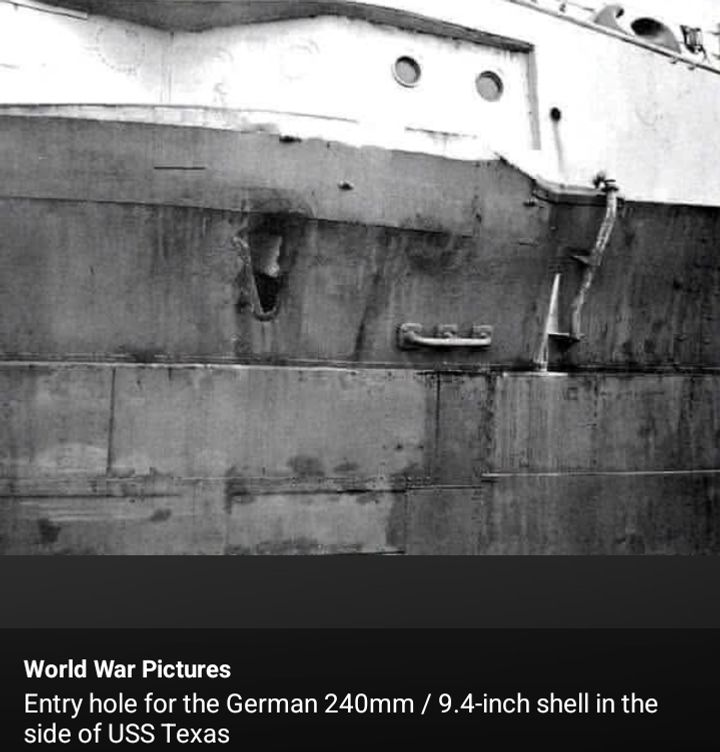
Bomb Disposal Officer Stephen Sturdevant was awakened in the early morning hours of June 26, 1944; USS Texas was coming into Portland Harbour at Weymouth England with an unexploded German shell onboard, one of two shells fired by Battery Hamburg which had hit her the day before during action off of Cherbourg France.
Sturdevant met USS Texas at the dock and went onboard, where he was met by Lt Ford, the ship's Bomb Disposal Officer. Escorted below decks to a Warrant Officers quarters, he found an unexploded 240mm / 9.4-inch shell resting on the deck.
Neither Bomb Disposal Officer had any information on that particular shell, and both concluded that the shell had richoceted on the water, then tumbled through the side of the ship sideways, and that this motion had probably caused the base fuze to malfunction.
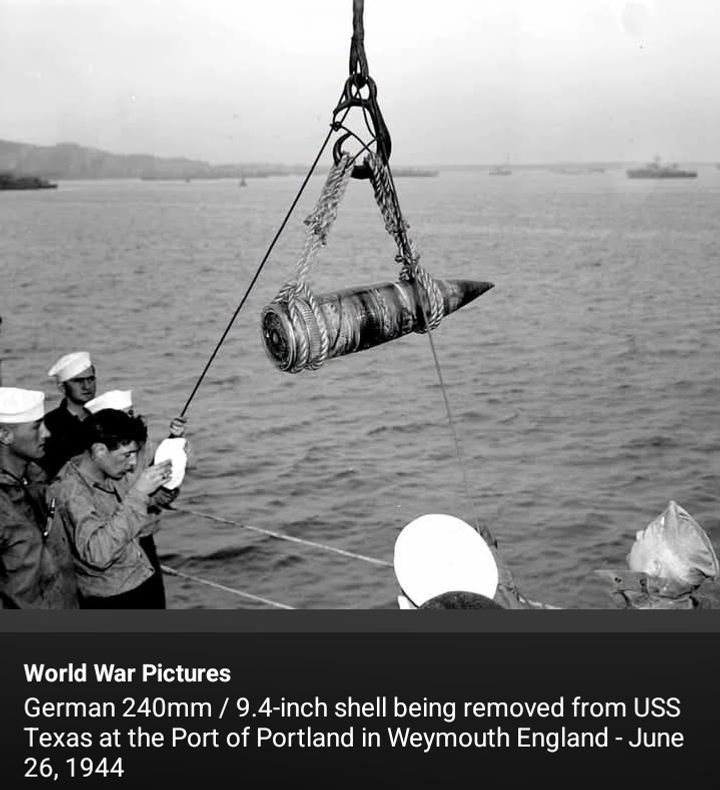
It was decided to maintain the shell in a stable horizontal position while it was removed from the ship. A sling was carefully placed around the shell and it was muscled into the passageway, under a hatchway where it was carefully hoisted up to the main deck. The shell was then lowered carefully into a small boat alongside with the objective to take it past the breakwater and sink it in deep water.
Enroute with the shell to the breakwater, they discovered that the fuze was loose in the base plug fuse “pocket” and were able to carefully remove the fuse without difficulty.
With the fuze removed the shell was much less dangerous and they returned with it to USS Texas. Sturdevant had a spanner bar made which fit the base plug on the 240mm shell so it could be removed. Taking the shell onshore he was able to steam out the explosive filler with the base plug removed without any issues.
In the meantime USS Texas sailed to Plymouth for repairs, later on, Lt Ford was sent to retrieve the shell and it remains on USS Texas to this day.
The base fuze was disassembled for Intelligence purposes and it was found that the striker had hit the primer at some point but the fuse had failed to detonate.
The guns at Battery Hamburg consisted of four 240mm / 9.4-inch /40 SK L/40 naval guns that were originally mounted in pre-WW1 warships.
The shells used were 240mm Spr gr L/4,1 Bdz HE with base fuzes, with most of the ammunition dated to WW1 or earlier.
Account of the disarming of the shell by Stephen A Sturdevant.
In case you're not on FB , the majority is below...
Bomb Disposal Officer Stephen Sturdevant was awakened in the early morning hours of June 26, 1944; USS Texas was coming into Portland Harbour at Weymouth England with an unexploded German shell onboard, one of two shells fired by Battery Hamburg which had hit her the day before during action off of Cherbourg France.
Sturdevant met USS Texas at the dock and went onboard, where he was met by Lt Ford, the ship's Bomb Disposal Officer. Escorted below decks to a Warrant Officers quarters, he found an unexploded 240mm / 9.4-inch shell resting on the deck.
Neither Bomb Disposal Officer had any information on that particular shell, and both concluded that the shell had richoceted on the water, then tumbled through the side of the ship sideways, and that this motion had probably caused the base fuze to malfunction.
It was decided to maintain the shell in a stable horizontal position while it was removed from the ship. A sling was carefully placed around the shell and it was muscled into the passageway, under a hatchway where it was carefully hoisted up to the main deck. The shell was then lowered carefully into a small boat alongside with the objective to take it past the breakwater and sink it in deep water.
Enroute with the shell to the breakwater, they discovered that the fuze was loose in the base plug fuse “pocket” and were able to carefully remove the fuse without difficulty.
With the fuze removed the shell was much less dangerous and they returned with it to USS Texas. Sturdevant had a spanner bar made which fit the base plug on the 240mm shell so it could be removed. Taking the shell onshore he was able to steam out the explosive filler with the base plug removed without any issues.
In the meantime USS Texas sailed to Plymouth for repairs, later on, Lt Ford was sent to retrieve the shell and it remains on USS Texas to this day.
The base fuze was disassembled for Intelligence purposes and it was found that the striker had hit the primer at some point but the fuse had failed to detonate.
The guns at Battery Hamburg consisted of four 240mm / 9.4-inch /40 SK L/40 naval guns that were originally mounted in pre-WW1 warships.
The shells used were 240mm Spr gr L/4,1 Bdz HE with base fuzes, with most of the ammunition dated to WW1 or earlier.
Account of the disarming of the shell by Stephen A Sturdevant.
Tuggy said:
s p a c e m a n said:
I work on one of that tugs sistershipsVoldemort said:
Tuggy said:
Username checks out.

Gassing Station | Boats, Planes & Trains | Top of Page | What's New | My Stuff