
SpaceX (Vol. 2)
Discussion


Talksteer said:
Hill92 said:
98elise said:
LivLL said:
Mmm, anyone fancy some international salvage. Presumably it's fair game for anyone to get out there and take the floating remains for themselves?
You would have to find it first. The sea is very big, and the rocket relatively small.Can also track it with commercial Space Synthetic Aperture Radar imagery: https://spacefromspace.com/spaceport-images/spacex...
And I think you underestimate just how deep some bits of the ocean are!
ChatGPT said:
Based on the location of SpaceX's Indian Ocean landing corridor used for recent Starship flights, the seabed in that region is typically 4,000 to 6,000 metres deep (about 2.5 to 3.7 miles). The central eastern Indian Ocean contains extensive abyssal plains in this depth range. This means that if Ship 40 eventually sank after floating, it would likely come to rest several kilometres below the surface.
It really wouldn't be cost effective to recover pretty much anything at those depths.How deep is the Indian ocean where Starship 'lands' ? Maybe the cost of trying to recover something from that depth is more challenging and expensive than any perceived benefit that might be gained from inspecting the remains? 
Edited to add: Yeah, what he said ^^^ (great minds etc...)
Edited to add: Yeah, what he said ^^^
(great minds etc...)loudlashadjuster said:
It really wouldn't be cost effective to recover pretty much anything at those depths.
You are kidding, it costs about a million to hire a support ship and ROV for a few months.Lifting a mostly intact Raptor from the seabed would save years of engine development and tens to hundreds millions of design effort and materials development.
dukeboy749r said:
Well, since China has recently launched and then landed its own rocket, I m not sure that they would be particularly interested.
And their version gives a lot more room for error as the cables can move quickly for the catch not the booster itself. Seems a much better solution. Buzz84 said:
They recover sections of the booster so I am sure if they are able to they will recover parts of starship as well?
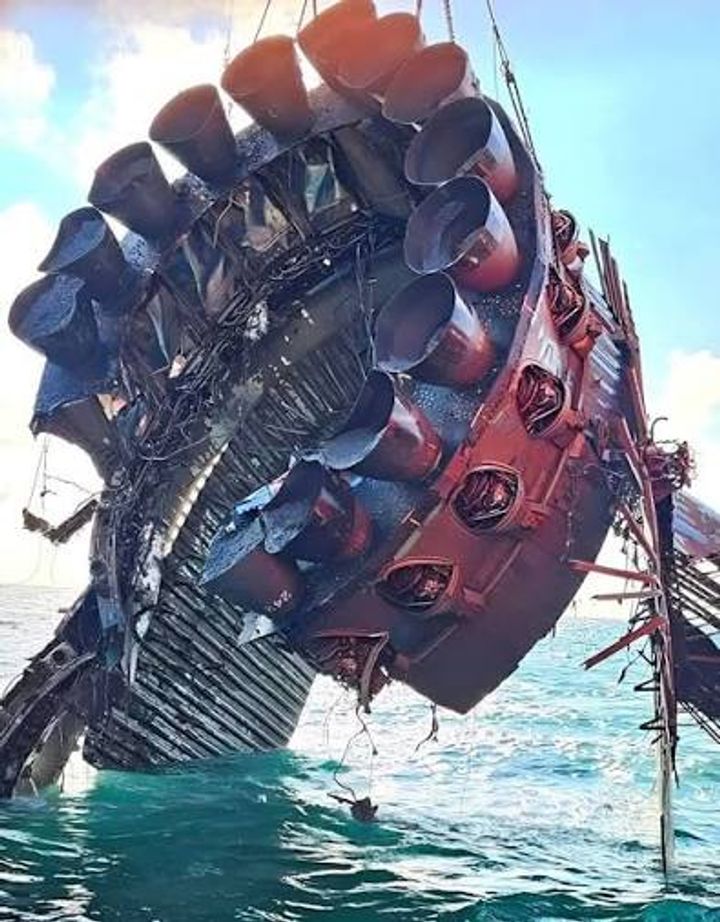
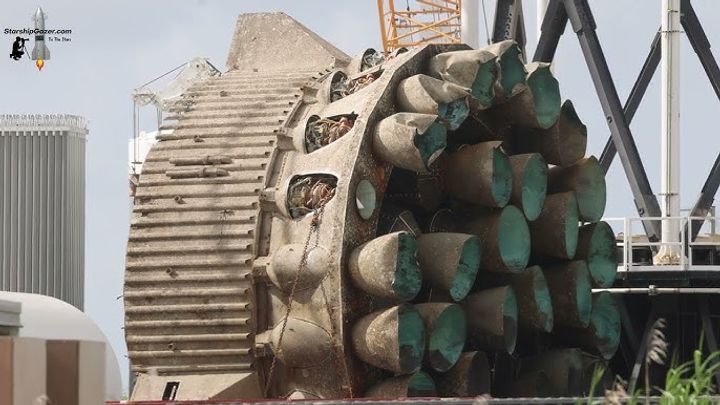
From what I've been reading they'll probably just monitor the ship and let it sink and they don't have a means to recover it from the sea on location currently (the vessel that is there can't do it) and they intend to catch the next ship in less than a month which means it'll already be where they want it and it won't need recovery, just trucking to an inspection bay.dukeboy749r said:
Well, since China has recently launched and then landed its own rocket, I m not sure that they would be particularly interested.
Landing a booster can be achieved with very modest performance engines.The Raptor is a full flow staged combustion engine, that is significantly beyond what the Chinese have done.
When moving to a new architecture you learn a lot by trial and error and getting someone’s working engine means you avoid many of their errors.
Rockets are not a mature as jet engines so we aren’t in the same position where 1% performance difference equals a non commercial product. That plus continuous development is why the Chinese haven’t cracked jet engines yet, they could make an adequate turbofan today, it just wouldn’t be competitive at the current margins.
They will probably stand a chance of entering when we see the next major architectural shakeup of aircraft much as how they entered the global car markets when cars went electric.

lost in espace said:
Share price up 9% last night, Musk laughing at short sellers on X.
But down 11% this morning. This is also despite better than predicted earnings in yesterdays earnings call. The original investors can sell from tomorrow, so bascially the whole retail market has no interest in buying due to the likely mass sell off of shares by early investors.
Pincher said:
loudlashadjuster said:
I don't think the moon cares
Maybe not but it's not really a regular occurrence is it?Equivalent to 3 tonnes of TNT exploding, supposedly.
The moon has been smacked many times by tons of man made hardware since the late 1950s.
During the Apollo missions, a number of the upper stages of the Saturn V (the SIVB stage) were deliberately aimed at the moon in order to obtain some scientific data on lunar material etc.
The top stage of a Falcon 9 is smaller than an SIVB.
During the Apollo missions, a number of the upper stages of the Saturn V (the SIVB stage) were deliberately aimed at the moon in order to obtain some scientific data on lunar material etc.
The top stage of a Falcon 9 is smaller than an SIVB.
RacerMike said:
lost in espace said:
Share price up 9% last night, Musk laughing at short sellers on X.
But down 11% this morning. This is also despite better than predicted earnings in yesterdays earnings call. The original investors can sell from tomorrow, so bascially the whole retail market has no interest in buying due to the likely mass sell off of shares by early investors.
It's weird how often someone with money to burn creates a gamma squeeze on some stocks.
Gassing Station | Science! | Top of Page | What's New | My Stuff