
RE: EV sales falter despite new car market growth
Discussion


DonkeyApple said:
Hungrymc said:
Uk manufacturing jobs were about 10% of the total population in 1990, it s down to about 3% today. And it s a similar ratio in Automotive manufacturing to wider manufacturing. But it s inevitable in a relatively high Labour cost country and a global economy without some serious market restrictions and if that s healthy or sustainable is another discussion.
I guess we ll see something similar with AI in the service sector soon enough. The employment market is very complex now.
Yup. People ted to conflate manufacturing with high factory employment. But the reality is that in the 21st century the two are no longer related. Any growth in manufacturing has no need to impact employment. I guess we ll see something similar with AI in the service sector soon enough. The employment market is very complex now.
This hinders the debate on how we, the U.K., find enough jobs for the people who benefit the most from that 20th century style local employment. We need those jobs, they're essential for a healthy society but they're never going to come from 20th century, low value manufacturing.
For example, even if car manufacturing were to return to the U.K. it wouldn't employ any factory workers.
As an aside, I'd ban chain stores from using automated tills those till jobs are absolutely crucial for a local economy. I'd just levy a big tax on each automated till for any business above a certain size so that it was cheaper for them to hire local people.
Tiglon said:
CMTMB said:
Tiglon said:
Thought the Honda Super N looks great, range is enough for my commute... Maybe I'll have a look at them when I want to move on from the Mini SE...
Oh. 15 seconds to 60. No thank you.
It's got pretty much the same battery capacity as the Mini, weighs a few 100kg less, similar range, but twice as slow to 60. How is that possible?
It is a bit of a strange one. It's like it defaults to a restricted 'efficiency' mode and you need to press the boost button to get the actual performance. I think Carwow timed it at a respectable 8.5 seconds when you do that. Oh. 15 seconds to 60. No thank you.
It's got pretty much the same battery capacity as the Mini, weighs a few 100kg less, similar range, but twice as slow to 60. How is that possible?
Still seems a bit slow considering how light they are, perhaps it's just a choice as to the kidn of customer they're targeting.
In boost mode, it is as quick the the turbocharged versions of those cars.
You get the option of using either mode, depending on your mood, at a very reasonable price.
I tried one. It's not perfect, but it's a valid alternative to a Picanto or Aygo.
The deal-breaker for me was the fake engine noise in Boost mode, nowhere to sensibly put your phone, and the lack of V2L.
cliffords said:
FeelingLucky said:
That says Diesel sales went up , contrary to my understanding. Petrol went down, in place of EV that makes sense. Hybrid up again, I am both surprised and confused. I did not think that was the trend.Not disputing the data, but really surprised at the diesel growth?
PBCD said:
DonkeyApple said:
As an aside, I'd ban chain stores from using automated tills those till jobs are absolutely crucial for a local economy. I'd just levy a big tax on each automated till for any business above a certain size so that it was cheaper for them to hire local people.


I've been thinking about our cars recently, we have one EV and a 3 litre discovery. EV is our first all electric, a Kia Nero and really impressed by it. I was looking at autotrader at the "main players", Teslas and Polestar and was surprised how cheap second hand ones are. A lot of ads have battery condition, usually 90% plus on cars even on the 100k mile mark.
Is there a downside to buying one (ignoring the convenience arguments)? Do they have reliability/quality issues? That seems like a huge depreciation up front and now making them a really good buy?
Is there a downside to buying one (ignoring the convenience arguments)? Do they have reliability/quality issues? That seems like a huge depreciation up front and now making them a really good buy?
Tom8 said:
Is there a downside to buying one (ignoring the convenience arguments)? Do they have reliability/quality issues? That seems like a huge depreciation up front and now making them a really good buy?
Basically, yes - the 'catastrophic' depreciation that EV naysayers harp on about is actuallya good thing for anyone looking for a 3+ year old electric car, especially a larger vehicle.
PBCD said:
Tom8 said:
Is there a downside to buying one (ignoring the convenience arguments)? Do they have reliability/quality issues? That seems like a huge depreciation up front and now making them a really good buy?
Basically, yes - the 'catastrophic' depreciation that EV naysayers harp on about is actuallya good thing for anyone looking for a 3+ year old electric car, especially a larger vehicle.
Tom8 said:
I've been thinking about our cars recently, we have one EV and a 3 litre discovery. EV is our first all electric, a Kia Nero and really impressed by it. I was looking at autotrader at the "main players", Teslas and Polestar and was surprised how cheap second hand ones are. A lot of ads have battery condition, usually 90% plus on cars even on the 100k mile mark.
Is there a downside to buying one (ignoring the convenience arguments)? Do they have reliability/quality issues? That seems like a huge depreciation up front and now making them a really good buy?
It really depends on your budget. The price drop in the first years because can get really good monthly on a PCP, so why not paying £10-20 a month more. A 100K EV like any car may well have tired suspension.Is there a downside to buying one (ignoring the convenience arguments)? Do they have reliability/quality issues? That seems like a huge depreciation up front and now making them a really good buy?
Tom8 said:
I've been thinking about our cars recently, we have one EV and a 3 litre discovery. EV is our first all electric, a Kia Nero and really impressed by it. I was looking at autotrader at the "main players", Teslas and Polestar and was surprised how cheap second hand ones are. A lot of ads have battery condition, usually 90% plus on cars even on the 100k mile mark.
Is there a downside to buying one (ignoring the convenience arguments)? Do they have reliability/quality issues? That seems like a huge depreciation up front and now making them a really good buy?
I think the risk with the oldest stuff is that when the batteries do finally start to capitulate then they go quite quickly. Is there a downside to buying one (ignoring the convenience arguments)? Do they have reliability/quality issues? That seems like a huge depreciation up front and now making them a really good buy?
My personal choice would be to grab one at around 3-5 years old with normal mileage for the age and then factor in it lasting 10 years being usable before binning. Assume zero final value and divide the price by 120 to see the rough monthly capex cost. I'd imagine that you would end up doing things like shocks, bushes etc over that ten year period just as you would with an ICE.
There's amazing value to be had with EVs but only for folks who buy and hold, flippers probably don't see any logic?
Tom8 said:
I've been thinking about our cars recently, we have one EV and a 3 litre discovery. EV is our first all electric, a Kia Nero and really impressed by it. I was looking at autotrader at the "main players", Teslas and Polestar and was surprised how cheap second hand ones are. A lot of ads have battery condition, usually 90% plus on cars even on the 100k mile mark.
Is there a downside to buying one (ignoring the convenience arguments)? Do they have reliability/quality issues? That seems like a huge depreciation up front and now making them a really good buy?
It's like any car, there are loads of different makes and models, some of which will be more reliable than others. In general though, no, there is no overriding reliability concern about a used EV. A Jag I-pace is more risky move than a Tesla Model Y though so still do your research on a model-by-model basis.Is there a downside to buying one (ignoring the convenience arguments)? Do they have reliability/quality issues? That seems like a huge depreciation up front and now making them a really good buy?
I think the huge depreciation up front is at least partly caused by the subsidised new cars through salary sacrifice, which puts downward pressure on the price of cars coming off those lease deals at 3 years old, hence they can be a relative bargain. If you are in the market that makes them a pretty good buy IMHO.
nickfrog said:
Yes the way to look at it is that the high RRPs reflect the fiscal incentive. As soon as you remove the fiscal incentive, the real market price appears. But thankfully you don't have to wait for 3 years for that to happen.
The motivation at the government level was to get as many cars into the parc as quickly as possible. So the vast majority of the incentives are aimed at the new car chooser, as they're the people who determine the make-up of the whole market into the future.A side-effect has been people who would normally have a 520d got to have a Porsche! A flupping PORSCHE!
So there's a bubble of 6 figure cars out there which haven't cost anything like as much as a normal 6-figure car costs. As there's an unusual amount of cars, there isn't the presence of sufficient second-owner buyers at £90k that you'd hope your 6 figure car to be waiting to find. Sufficient numbers of those people only exist at the c.£60k level.
Hence the marked early depreciation.
Now those cars have fallen into the normal pattern and last year's £35k early Taycan is now a £29k early Taycan and everyone is comfortable enough with that kind of cost to drive that kind of car.
nickfrog said:
Yes the way to look at it is that the high RRPs reflect the fiscal incentive. As soon as you remove the fiscal incentive, the real market price appears. But thankfully you don't have to wait for 3 years for that to happen.
Yup. There's also the finance hidden in the RRP and the VAT on the fake RRP. So a lot of fat that evaporates the second the deal is signed and it's much larger than usual with EVs due to the incentives you highlight.
Frankly, it really quite depressing to see a society that has become scared of depreciation instead of craving it. Depreciation is brilliant and there should be as much as possible.
ajm_ph said:
Clad-Hach said:
Something to take into the account is the massive tax incentives on offer to fleet and business buyers for the various types of EV's.
This will skew the sales figures somewhat.
2025 figures.
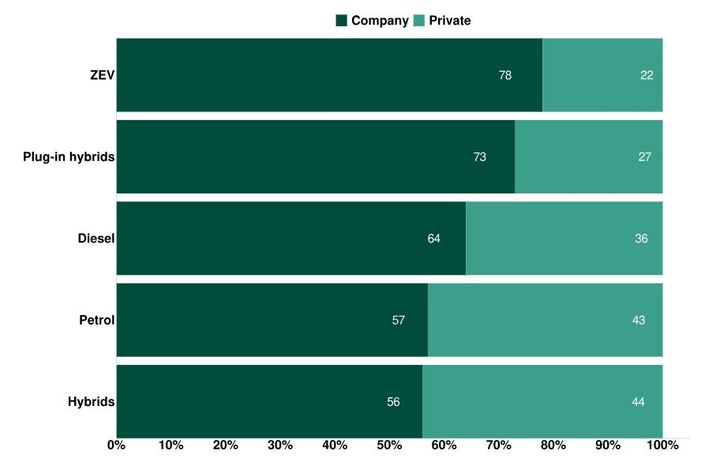
Where would a privately held but leased vehicle come on that? I know lots of people who have EVs as their personal car but almost all of them are leased. Since a leased vehicle is owned by the leasing company it would presumably show up in the top bar.This will skew the sales figures somewhat.
2025 figures.
That's not to try and disprove your point of course, the tax incentives offered to business buyers for EVs will be driving extra sales - that is literally what the tax incentives are designed to do.
Wouldn't private just be a private sale whether its leased, PCP or a cash, all the rest are made up from business, fleet and Motability...as far as I could make out anyway.
DonkeyApple said:
Hungrymc said:
Uk manufacturing jobs were about 10% of the total population in 1990, it s down to about 3% today. And it s a similar ratio in Automotive manufacturing to wider manufacturing. But it s inevitable in a relatively high Labour cost country and a global economy without some serious market restrictions and if that s healthy or sustainable is another discussion.
I guess we ll see something similar with AI in the service sector soon enough. The employment market is very complex now.
As an aside, I'd ban chain stores from using automated tills those till jobs are absolutely crucial for a local economy. I'd just levy a big tax on each automated till for any business above a certain size so that it was cheaper for them to hire local people. I guess we ll see something similar with AI in the service sector soon enough. The employment market is very complex now.
When an Asda opened in the town near by most of the shops in our village closed very soon after...and they had been there for decades.
Clad-Hach said:
ajm_ph said:
Clad-Hach said:
Something to take into the account is the massive tax incentives on offer to fleet and business buyers for the various types of EV's.
This will skew the sales figures somewhat.
2025 figures.
Where would a privately held but leased vehicle come on that? I know lots of people who have EVs as their personal car but almost all of them are leased. Since a leased vehicle is owned by the leasing company it would presumably show up in the top bar.This will skew the sales figures somewhat.
2025 figures.
That's not to try and disprove your point of course, the tax incentives offered to business buyers for EVs will be driving extra sales - that is literally what the tax incentives are designed to do.
Wouldn't private just be a private sale whether its leased, PCP or a cash, all the rest are made up from business, fleet and Motability...as far as I could make out anyway.
Clad-Hach said:
ajm_ph said:
Clad-Hach said:
Something to take into the account is the massive tax incentives on offer to fleet and business buyers for the various types of EV's.
This will skew the sales figures somewhat.
2025 figures.
Where would a privately held but leased vehicle come on that? I know lots of people who have EVs as their personal car but almost all of them are leased. Since a leased vehicle is owned by the leasing company it would presumably show up in the top bar.This will skew the sales figures somewhat.
2025 figures.
That's not to try and disprove your point of course, the tax incentives offered to business buyers for EVs will be driving extra sales - that is literally what the tax incentives are designed to do.
Wouldn't private just be a private sale whether its leased, PCP or a cash, all the rest are made up from business, fleet and Motability...as far as I could make out anyway.
I'm a private EV buyer but will be in the fleet or business category, so will thousands of others
Clad-Hach said:
DonkeyApple said:
Hungrymc said:
Uk manufacturing jobs were about 10% of the total population in 1990, it s down to about 3% today. And it s a similar ratio in Automotive manufacturing to wider manufacturing. But it s inevitable in a relatively high Labour cost country and a global economy without some serious market restrictions and if that s healthy or sustainable is another discussion.
I guess we ll see something similar with AI in the service sector soon enough. The employment market is very complex now.
As an aside, I'd ban chain stores from using automated tills those till jobs are absolutely crucial for a local economy. I'd just levy a big tax on each automated till for any business above a certain size so that it was cheaper for them to hire local people. I guess we ll see something similar with AI in the service sector soon enough. The employment market is very complex now.
When an Asda opened in the town near by most of the shops in our village closed very soon after...and they had been there for decades.
 king love rocking up, waddling in and bailing with a trolly full of lard.
But that doesn't mean government doesn't have a responsibility for ensuring a business acts in the best interests of the community it wishes to harvest. And part of that ought to probably ensure that they employ as many locals as possible to help counter the enormous wealth removal from a community through the tills.
The benefit of local shops for local people is that they're labour inefficient and much more of the revenue remains in the local community via staff and owner wages. The downside is that they're evil capitalist b
ds who rob the people blind by overcharging for lard and fags and must die as supermarkets and chains are cheaper so better. An unfortunate viscous circle of f
kwittery. ajm_ph said:
Leasing isn't a sale though. Lease means you are essentially hiring the car from the lease company; that's why all the lease adverts end with the disclaimer "you will not own the car". As I understand it, legally, for the entirety of the lease period, the car is the property of the leasing company.
Even with PCP the asset sits on the vendors balance sheet for the duration of the term and is another form of rental. Basic rule of thumb is that if a bailiff can come and take it away when you stop paying for something then it's a rental of some form.

Gassing Station | General Gassing | Top of Page | What's New | My Stuff