
RE: Diesel prices hit record high ahead of budget
Discussion


EV8 said:
CT05 Nose Cone said:
Ray_Aber said:
This one lands squarely at the door of the White House, and the Mango Mogul's warmongering.
For all who are having to cope with extortionate fuelling charges, worry about interest rate hikes, and general inflation, look no further than the Tangerine Palpatine and consider this: should you be continuing to buy US produce / goods given the impact that said nation has had on your personal finances?
Just a thought. Anyway, Irn Bru kicks the @rse of Coke every day of the week ;-)
Well, them and the Iranians for funding terrorist organisations that target said countries, murdering tens of thousands of their own citizens for the crime of protesting, and firing missiles and drones at civilians ships.For all who are having to cope with extortionate fuelling charges, worry about interest rate hikes, and general inflation, look no further than the Tangerine Palpatine and consider this: should you be continuing to buy US produce / goods given the impact that said nation has had on your personal finances?
Just a thought. Anyway, Irn Bru kicks the @rse of Coke every day of the week ;-)
With successive governments chasing the green folly we closed our refineries which used to (I’m lead to believe) produce around 95% of our own diesel. So, throw the chase for net zero out of the window open the oil fields and start up production again. Oh and any surplus sell it and get the revenue from that rather than us car users? I know that it’s a little simplistic but I’m so irked it’s what I’m thinking!
Kipsrs said:
With successive governments chasing the green folly we closed our refineries which used to (I m lead to believe) produce around 95% of our own diesel. So, throw the chase for net zero out of the window open the oil fields and start up production again. Oh and any surplus sell it and get the revenue from that rather than us car users? I know that it s a little simplistic but I m so irked it s what I m thinking!
The fields are spent. There is precious little to extract.A key concept is the 'crack spread' - how much more petrol and diesel cost than the crude oil they're made from, or in other words, the cost of doing the refining.
Diesel is expensive because both the underlying crude oil and the refining capacity to turn that crude into diesel are in short supply.
The crude shortage is due to (a) oil can't be shipped through Hormuz and (b) the Houthis have blown up the Saudi pipeline which was bypassing Hormuz (having about half the peacetime capacity of the straits).
The shortage of diesel refinery capacity is because (a) many refineries are in the Gulf so their output is inaccessible and (b) many other refineries are in Russia, and have been destroyed as Putin enters the 'Find Out' phase of his FAFO venture in Ukraine.
Additionally, diesel demand is less price-sensitive as it tends to be less discretionary than petrol use, so a given supply shortfall of diesel results in a greater price rise before demand is reduced accordingly.
Tax reductions sound good, but are in essence a 'race to the bottom'. Ultimately there's a 5-10% shortfall in supply vs demand. So the price must rise until diesel consumption falls by that amount - ie some people have to do without some diesel because they can't afford it / alternatives are now cheaper.
If all governments cut taxes by the same amount worldwide, the diesel pre-tax price would simply rise by the equivalent amount as the tax cuts, in order to bring the consumer price back up to the level that cuts demand by 5%. So the only way tax cuts can work is if the UK out-cuts other countries, thus redirecting more of the demand reduction overseas. I.e. it's not a very sustainable policy.
Probably the best approach is to support a permanent re-direction of demand away from diesel with support for
- replacing oil boilers with heat pumps where feasible (heating oil is basically diesel by another name)
- public authorities replacing diesel buses with electric
- loans for companies to replace diesel trucks with electric for shorter distance use
- replacing diesel cars with EVs for most use-cases
this can potentially offset the overall negative effect of rising diesel prices on the economy overall, more effectively than putting the same government money into tax cuts - and the above will be permanent savings for the country, rather than merely a temporary transfer from the government to consumers.
Clad-Hach said:
A question for all who say its Israel and the US that's the problem, I am not saying they don't have a hand in some of it.
But would you concede that this has caused our current situation...a huge drop in refining capacity, the UK become a net importer of diesel in the early 2010's.
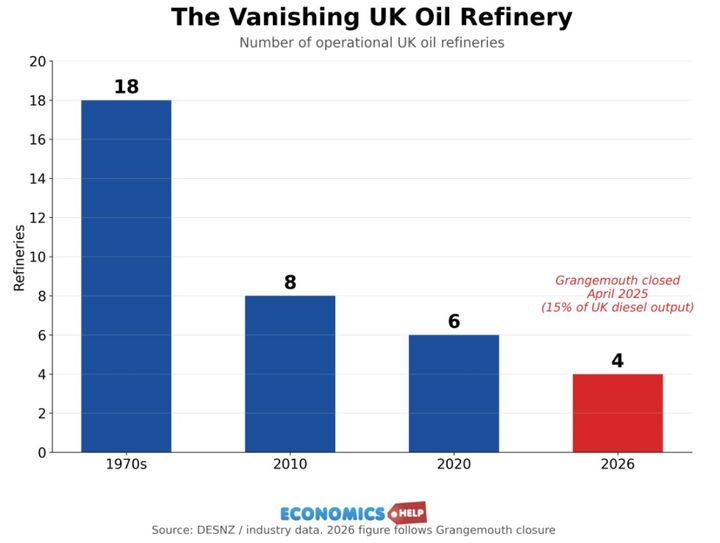
What a ridiculous graph. The scale on the x axis is massively skewed. But would you concede that this has caused our current situation...a huge drop in refining capacity, the UK become a net importer of diesel in the early 2010's.
You’ve tried to go for a dramatic drop in bar 1 to bar 2 whilst masking the 40 year timeframe between 1970 and 2010. The reduction is actually fairly consistent over the whole 50 years based on the (very limited) information in your graph.
samoht said:
A key concept is the 'crack spread' - how much more petrol and diesel cost than the crude oil they're made from, or in other words, the cost of doing the refining.
Diesel is expensive because both the underlying crude oil and the refining capacity to turn that crude into diesel are in short supply.
The crude shortage is due to (a) oil can't be shipped through Hormuz and (b) the Houthis have blown up the Saudi pipeline which was bypassing Hormuz (having about half the peacetime capacity of the straits).
The shortage of diesel refinery capacity is because (a) many refineries are in the Gulf so their output is inaccessible and (b) many other refineries are in Russia, and have been destroyed as Putin enters the 'Find Out' phase of his FAFO venture in Ukraine.
Additionally, diesel demand is less price-sensitive as it tends to be less discretionary than petrol use, so a given supply shortfall of diesel results in a greater price rise before demand is reduced accordingly.
Tax reductions sound good, but are in essence a 'race to the bottom'. Ultimately there's a 5-10% shortfall in supply vs demand. So the price must rise until diesel consumption falls by that amount - ie some people have to do without some diesel because they can't afford it / alternatives are now cheaper.
If all governments cut taxes by the same amount worldwide, the diesel pre-tax price would simply rise by the equivalent amount as the tax cuts, in order to bring the consumer price back up to the level that cuts demand by 5%. So the only way tax cuts can work is if the UK out-cuts other countries, thus redirecting more of the demand reduction overseas. I.e. it's not a very sustainable policy.
Probably the best approach is to support a permanent re-direction of demand away from diesel with support for
- replacing oil boilers with heat pumps where feasible (heating oil is basically diesel by another name)
- public authorities replacing diesel buses with electric
- loans for companies to replace diesel trucks with electric for shorter distance use
- replacing diesel cars with EVs for most use-cases
this can potentially offset the overall negative effect of rising diesel prices on the economy overall, more effectively than putting the same government money into tax cuts - and the above will be permanent savings for the country, rather than merely a temporary transfer from the government to consumers.
Some people will have to do without .. well that's ok then Diesel is expensive because both the underlying crude oil and the refining capacity to turn that crude into diesel are in short supply.
The crude shortage is due to (a) oil can't be shipped through Hormuz and (b) the Houthis have blown up the Saudi pipeline which was bypassing Hormuz (having about half the peacetime capacity of the straits).
The shortage of diesel refinery capacity is because (a) many refineries are in the Gulf so their output is inaccessible and (b) many other refineries are in Russia, and have been destroyed as Putin enters the 'Find Out' phase of his FAFO venture in Ukraine.
Additionally, diesel demand is less price-sensitive as it tends to be less discretionary than petrol use, so a given supply shortfall of diesel results in a greater price rise before demand is reduced accordingly.
Tax reductions sound good, but are in essence a 'race to the bottom'. Ultimately there's a 5-10% shortfall in supply vs demand. So the price must rise until diesel consumption falls by that amount - ie some people have to do without some diesel because they can't afford it / alternatives are now cheaper.
If all governments cut taxes by the same amount worldwide, the diesel pre-tax price would simply rise by the equivalent amount as the tax cuts, in order to bring the consumer price back up to the level that cuts demand by 5%. So the only way tax cuts can work is if the UK out-cuts other countries, thus redirecting more of the demand reduction overseas. I.e. it's not a very sustainable policy.
Probably the best approach is to support a permanent re-direction of demand away from diesel with support for
- replacing oil boilers with heat pumps where feasible (heating oil is basically diesel by another name)
- public authorities replacing diesel buses with electric
- loans for companies to replace diesel trucks with electric for shorter distance use
- replacing diesel cars with EVs for most use-cases
this can potentially offset the overall negative effect of rising diesel prices on the economy overall, more effectively than putting the same government money into tax cuts - and the above will be permanent savings for the country, rather than merely a temporary transfer from the government to consumers.
What's your plan for the 1.5 million homes that might not be able to heat this winter ?
Or for Mr MclMcdonald who works in a fish factory in the west of Scotland and has a 100 mile commute ?
EV buses .. where are councils getting the money from at half a million quid each ?
Who's loaning company's money to buy EV trucks ?
Bearing in mind the country is broke
Or is it just pie in the sky ?
Kipsrs said:
With successive governments chasing the green folly we closed our refineries which used to (I m lead to believe) produce around 95% of our own diesel. So, throw the chase for net zero out of the window open the oil fields and start up production again. Oh and any surplus sell it and get the revenue from that rather than us car users? I know that it s a little simplistic but I m so irked it s what I m thinking!
Private companies own North Sea Oil. The country doesn’t own any of it. It’s not the government’s to drill for, produce or sell. It was all sold off a long, long time ago. Britain isn’t Norway. If it were, you’d be having a meltdown over the socialist arrangement in place there. Earthdweller said:
Who's loaning company's money to buy EV trucks ?
Bearing in mind the country is broke
The banks aren't broke, and they are largely decoupled from the country.Bearing in mind the country is broke
Mid scale haulage (and in fact most car drivers) would probably benefit from some lessons on economical driving (smooth acceleration, right gear, good observation ahead to reduce brake/accelerate and anticipate traffic, keeping to speed limit or just below (if it is clear) etc. I suspect most drivers could get 10% more economy...
vaud said:
Earthdweller said:
Who's loaning company's money to buy EV trucks ?
Bearing in mind the country is broke
The banks aren't broke, and they are largely decoupled from the country.Bearing in mind the country is broke
Mid scale haulage (and in fact most car drivers) would probably benefit from some lessons on economical driving (smooth acceleration, right gear, good observation ahead to reduce brake/accelerate and anticipate traffic, keeping to speed limit or just below (if it is clear) etc. I suspect most drivers could get 10% more economy...
So that would presumably mean subsidy and cheap finance
Are banks going to lend money at a loss ?
Are businesses already struggling with the cost of doing business/increased taxation suddenly going to ditch perfectly good and serviceable vehicles at significant cost to themselves ?
What @samoht says is pretty much spot on. What we're seeing is the net on globalisation over the last 30 years unravelling and hitting our wallets. He's right that to a certain extent, spend on transport fields is partly discretionary - people will sell thirsty cars, car share, demand WFH etc. Perhaps govt will have to step in for public transport. Thing is, if you think this is bad, wait till it hits food bills! Fertiliser is made from fossil fuels, mainly in the middle east, so will be extortionate, farm machinery runs on diesel as does whatever transports the food, greenhouses are heated by gas... Plus we've got a monster el niño coming that'll probably give poor crops. IMO government should save up to keep people fed rather than fill their cars (also remembering that the poorest who will struggle the most to feed themselves are the least likely to own their own cars)
Earthdweller said:
Some people will have to do without .. well that's ok then
Apologies if this sounded heartless.What I'm trying to say is
- the global population want 30 million barrels of diesel this year
- the available refineries can only make 27 million barrels (discounting those in the Gulf and Russia which can't be used)
therefore 'some people will have to do without' is just a mathematical fact, in that 27 is less than 30.
The question is not whether some people will have to do without, the question is which people - that's the only thing open for discussion. Because you can't build a new refinery overnight.
Earthdweller said:
What's your plan for the 1.5 million homes that might not be able to heat this winter ?
Or for Mr MclMcdonald who works in a fish factory in the west of Scotland and has a 100 mile commute ?
As I say, global diesel consumption has to reduce because it's a physical impossibility for it to exceed production, the question is which areas are reduced. Hence my suggestions. To your examples, many of those 1.5m homes could have heat pumps put in before it gets really cold. Mr McDonald could have taken up the Scottish government 0% loan scheme to buy a used EV; I would suggest this scheme be reinstated.Or for Mr MclMcdonald who works in a fish factory in the west of Scotland and has a 100 mile commute ?
Earthdweller said:
EV buses .. where are councils getting the money from at half a million quid each ?
Who's loaning company's money to buy EV trucks ?
Bearing in mind the country is broke
Or is it just pie in the sky ?
The "Lower fuel duty" called for in the article's sub-heading would also cost the government money. Where is this money coming from?Who's loaning company's money to buy EV trucks ?
Bearing in mind the country is broke
Or is it just pie in the sky ?
I'm suggesting that this same money that's being proposed to be spent on lowering fuel taxes could possibly be better spent on subsidising changes which would permanently reduce the UK's diesel demand, rather than subsidising our ongoing 'habit', which bill will keep recurring every month.
vaud said:
The banks aren't broke, and they are largely decoupled from the country.
Mid scale haulage (and in fact most car drivers) would probably benefit from some lessons on economical driving (smooth acceleration, right gear, good observation ahead to reduce brake/accelerate and anticipate traffic, keeping to speed limit or just below (if it is clear) etc. I suspect most drivers could get 10% more economy...
Whilst I agree that driving styles could improve to improve fuel economy, a 10% improvement would still be a fraction of the overall increase businesses and individuals are facing. Individuals are far more likely to simply not drive as frequently and combine trips where possible, obviously that’s not an option for most businesses. Mid scale haulage (and in fact most car drivers) would probably benefit from some lessons on economical driving (smooth acceleration, right gear, good observation ahead to reduce brake/accelerate and anticipate traffic, keeping to speed limit or just below (if it is clear) etc. I suspect most drivers could get 10% more economy...
Opapayer said:
Kipsrs said:
With successive governments...
Private companies own North Sea Oil. The country doesn't own any of it. It s not the government s to drill for, produce or sell. It was all sold off a long, long time ago. Britain isn t Norway. If it were, you d be having a meltdown over the socialist arrangement in place there. So, instead of taking a royalty (cut of the sale), the state takes a tax on the oil sold. This is different to most other countries of the world where the state takes royalties from production (so maybe 30% of the sale revenues) but has much lower taxation.
The media story of the UK government "selling off North Sea Oil to private companies" is quite inaccurate, what the UK state did is agree to not charge royalties on sold oil but instead charge higher tax.
This is quite different to a country like Angola where the state charges a Royalty (Imposto sobre a Produção de Petróleo) of 20% at the wellhead then a lower 25% tax on the profit of the oil company.
Edited by Matt_T on Monday 28th September 18:25
Opapayer said:
Whilst I agree that driving styles could improve to improve fuel economy, a 10% improvement would still be a fraction of the overall increase businesses and individuals are facing. Individuals are far more likely to simply not drive as frequently and combine trips where possible, obviously that s not an option for most businesses.
Thanks. I didn't mean to say it was a solution, but if you are cutting costs then it could be a minor factor.Employees dont care as they don't see the costs (ignoring Amazon vans as they are mostly private) - but if someone could persuade teh Royal Mail to train their drivers not to thrash the crap out of their vans, that would be great. On a big fleet it would be meaningful.
We have apps that can track driving behaviour for new drivers for reduced insurance - let's apply them to big fleets as well... OK, we might need to reduce some of the drops, but I'm pretty sure that the difference in time is marginal in a 30 zone...
samoht said:
The "Lower fuel duty" called for in the article's sub-heading would also cost the government money. Where is this money coming from?
I'm suggesting that this same money that's being proposed to be spent on lowering fuel taxes could possibly be better spent on subsidising changes which would permanently reduce the UK's diesel demand, rather than subsidising our ongoing 'habit', which bill will keep recurring every month.
What you are suggesting is already happening and is long term planning I'm suggesting that this same money that's being proposed to be spent on lowering fuel taxes could possibly be better spent on subsidising changes which would permanently reduce the UK's diesel demand, rather than subsidising our ongoing 'habit', which bill will keep recurring every month.
Bus and commercial fleets are already transitioning as are private cars. Order a new bus today and it could take upto two years to be delivered that's assuming every bus company doesn't decide they want one
But none of that helps people get to work this winter, heat their homes this winter, stops food and all goods price inflation this winter caused by higher production and transportation costs which leads to more inflation, more expensive mortgages etc etc
Over 40 countries have acted to help their citizens this winter, the UK Gov hasn't done anything
valiant said:
Kipsrs said:
With successive governments chasing the green folly we closed our refineries which used to (I m lead to believe) produce around 95% of our own diesel. So, throw the chase for net zero out of the window open the oil fields and start up production again. Oh and any surplus sell it and get the revenue from that rather than us car users? I know that it s a little simplistic but I m so irked it s what I m thinking!
The fields are spent. There is precious little to extract.jenkosrugby said:
If you genuinely think that Iran is the victim in all of this, then I would suggest you may want to do your own digging using credible sources. Its just so easy to blame everything on Trump, and I am by no means agreeing with all of his policies, but I suspect you, nor anyone else wants Iran to develop nuclear weapons, and on the balance of probability, I suspect this is what they are / were doing.
Which is worse, a nation with a history of genocidal colonialism that’s run by fanatical zealots, which already has nuclear weapons, or a regional neighbour run by fanatical zealots that wants to be similarly equipped?Simple solution: Israel allows the UN s weapon inspectors unlimited access to confirm it does not have a nuclear arsenal, and then Iran will cease its nuclear program.
It seems a tad unreasonable for Team Israel-USA to think they can play without rules, but everyone else has to partake with their hands tied behind their back.
And as for history, perhaps we shouldn't ignore the UK and the USA’s meddling in pre-Islamic revolution Persia?
Edited by NGK210 on Monday 28th September 18:51
Gassing Station | General Gassing | Top of Page | What's New | My Stuff