
World's largest offshore windfarm starts generating
Discussion


tamore said:
PushedDover said:
Windmills grind grain as I often remind myself;)
This is famciful stuff and not actually delivering anything of meaningful output, and a 10th of a size of the current day in terms of capacity.
but pretty much constant output?This is famciful stuff and not actually delivering anything of meaningful output, and a 10th of a size of the current day in terms of capacity.
PushedDover said:
Windmills grind grain as I often remind myself;)
This is famciful stuff and not actually delivering anything of meaningful output, and a 10th of a size of the current day in terms of capacity.
I'm not saying I think they can work, I don't know enough to have an opinion on that either way.This is famciful stuff and not actually delivering anything of meaningful output, and a 10th of a size of the current day in terms of capacity.
You seem to have far greater knowledge - why not explain the physical barriers that make it impossible at a more useful scale.
You already raised the weight of the ground link tether/cable, which is an obvious first thing to raise an eyebrow at - but we know the Chinese prototype worked at 2000m including tether weight. The real problem would be fatigue.
Second problem is helium containment and reactivity. Hydrogen would be cheaper, lighter and easier to maintain. So long as there was a failsafe to vent the gas below a certain altitude I don't see a safety issue with hydrogen - if it blows up at operational height somehow that would suck but no one's getting harmed. Not unless they're standing near the tether anchor point..

The tether longevity under realm world forces and fatigu has to be the only potentially unsolvable issue? It wouldn't surprise me if that was unsolvable but also wouldn't amaze me if there was a solution.
Do you have any knowledge of what has been tried or suggested to solve that problem?
The USAF operate tethered aerostats carrying radars around the Gulf of Mexico.
https://en.wikipedia.org/wiki/Tethered_Aerostat_Ra...
The way to think about these is probably to see them as equivalent of 40 foot container-sized generators to offshore wind's CCGTs. Ideal for small remote locations, disaster relief and other situations where a 15 MW offshore turbine is the wrong tool.
TheDeuce said:
Do you have any knowledge of what has been tried or suggested to solve that problem?
not directly no, but see them often touted at the exhibitions and in the industry journals. Year on Year. And never having reached market.
There are lots of bonkers stuff out there of people, teams, firms, looking to solve a problem - but create five or more doing so with it. Another is a self-installing turbine called Sensewind : https://sensewind.com/
I've a good industry (well respected) friend ploughing into this and I can't help but shake my head at how ridiculous it is.
From the first link, I think the whopper shown said 12 separate turbines spinning for 100KW? i.e. 1.2 MW total output.
Today you would be looking at c. 7MW onshore, or 15MW offshore as the minimum capacity conventional turbine.
i.e. you need 10x the number of units and appurtenances such as anchoring, distribution and alike, and one would assume 10x the area to spread across, and then cover 10x the area to provide the 25yrs life maintenance. Assuming the inflatable would last 25yrs....... I fear that that is unlikely when one looks at the sun damage caused to fabrics. materials and such (we have some ships in the indian ocean, and the degradation due to heat and sun of things like the RIBS and HydHoses versus the UK sun is extraordinary)
So in simple matters, the quantity of units is disproportionate to conventional.
We have seen over the years size increase reduces costs. (hence why the size continues to grow year on year in an OEM arms race).Further to this, the power needs to get ground level with the floating turbines as indicated earlier and I do see that, and the weight of, a significant easy to comprehend barrier to viability. (3kg per meter, at 300m equals 1 Tonne to cable to suspend beneath the floater before anything else goes in to the unit !)
Where would these be installed ? We know already that the power is best placed nearest the user, so would these be over the mainland, near cities? I just can't see this.
https://www.youtube.com/watch?v=NqORBETo9TM
Another Youtuber discussing the airborne wind energy systems.
PushedDover said:
TheDeuce said:
Do you have any knowledge of what has been tried or suggested to solve that problem?
not directly no, but see them often touted at the exhibitions and in the industry journals. Year on Year. And never having reached market.
There are lots of bonkers stuff out there of people, teams, firms, looking to solve a problem - but create five or more doing so with it. Another is a self-installing turbine called Sensewind : https://sensewind.com/
I've a good industry (well respected) friend ploughing into this and I can't help but shake my head at how ridiculous it is.
From the first link, I think the whopper shown said 12 separate turbines spinning for 100KW? i.e. 1.2 MW total output.
Today you would be looking at c. 7MW onshore, or 15MW offshore as the minimum capacity conventional turbine.
i.e. you need 10x the number of units and appurtenances such as anchoring, distribution and alike, and one would assume 10x the area to spread across, and then cover 10x the area to provide the 25yrs life maintenance. Assuming the inflatable would last 25yrs....... I fear that that is unlikely when one looks at the sun damage caused to fabrics. materials and such (we have some ships in the indian ocean, and the degradation due to heat and sun of things like the RIBS and HydHoses versus the UK sun is extraordinary)
So in simple matters, the quantity of units is disproportionate to conventional.
We have seen over the years size increase reduces costs. (hence why the size continues to grow year on year in an OEM arms race).Further to this, the power needs to get ground level with the floating turbines as indicated earlier and I do see that, and the weight of, a significant easy to comprehend barrier to viability. (3kg per meter, at 300m equals 1 Tonne to cable to suspend beneath the floater before anything else goes in to the unit !)
Where would these be installed ? We know already that the power is best placed nearest the user, so would these be over the mainland, near cities? I just can't see this.
https://www.youtube.com/watch?v=NqORBETo9TM
Another Youtuber discussing the airborne wind energy systems.
As for the cable, the Chinese test demonstrated a unit tethered with a cable sufficient to carry the power generated by that unit. A far heavier cable would be required for a higher output unit, but then the unit and internal volume of lighter than air gas would increase too.
I already mentioned degradation of the vessel, tbh my hunch would be that solving that problem and the problem of making a cable/tether that's strong enough to resist the dynamic forces yet light enough and with sufficient conduction properties would rely on hi tech material fabrication. The obvious answer to best solve problems relating to weight, durability and chemical reactivity would be carbon nanotube material and conductor cores. That could well be a technology that makes the unlikely, quite possible.
Possible, not easy and certainly not cheap. I wouldn't apply those latter adjectives to the job of installing a 15mw turbine at sea either...
I'm just musing why this can't work, not trying to promote or get swept away by a fanciful notion

PushedDover said:
Ok - but why ?
What s the Hannover the existing technologies, wrt cost, reliability, lifetime, dependability in performance etc ?
To answer that would require full costing of both solutions for the same total lifetime power generation.What s the Hannover the existing technologies, wrt cost, reliability, lifetime, dependability in performance etc ?
I don't have that data, I expect you don't either. We can't conclude that something isn't potentially a better solution simply because 'we don't know' however.
The known benefits that appear to be driving research and testing is that there's more wind and more consistent wind if you reach far higher than conventional mast turbines. The latter benefit may well be the most valuable as it goes some way to solving storage costs and/or wastage. But known benefits without known cost obviously don't justify anything other than continued research to establish what actually works and subsequently, what it will cost to scale up.
Would you argue that because mast based turbines work well enough to make sense already, that a floating solution never can?
TheDeuce said:
Would you argue that because mast based turbines work well enough to make sense already, that a floating solution never can?
Rabbithole incoming.when you say Floating, do you mean as in 'floating offshore windfarms' akin to :
https://guidetofloatingoffshorewind.com/
https://greenvoltoffshorewind.com/
there are, as always, pro's vs con's.
Seen to be on the whole far more expensive than fixed bottomed (as the thread title of Doggerbank windfarm), but has a far greater use case, applications to the worlds coastlines that rapidly increase waterdepth and need power (California, Japan, Portugal etc)
as above, some upsides, several downsides in practival, deployment and technical terms.

DBA will be overtaken by DBB on the Robin Hawkes site at this rate! Still only showing 14% of potential even with a near 21 m/s windspeed. Surely this must be a reporting error on the RH site, can't actually be producing that little still?!
Hornsea 1 and 2 are both sitting at 97% and 93% of capacity respectively in similar conditions.
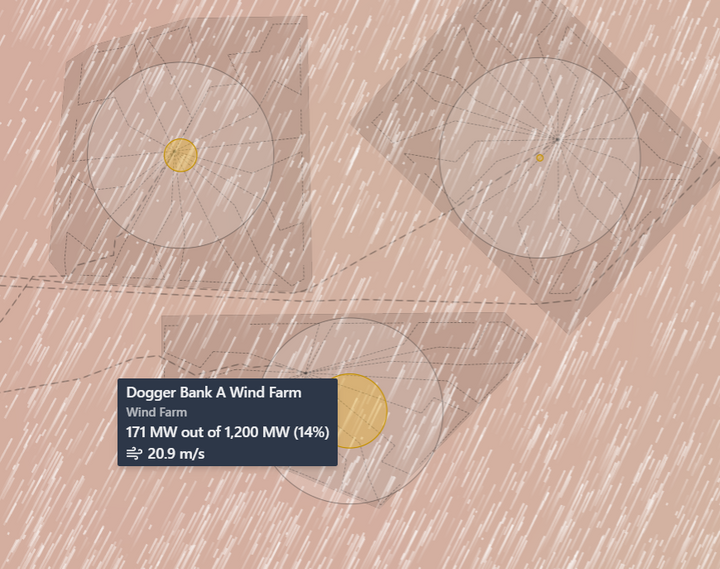
Hornsea 1 and 2 are both sitting at 97% and 93% of capacity respectively in similar conditions.
tamore said:
reckon 100GW/h was curtailed yesterday. that's a lot of power going unused.
Would be interesting to know how much of that is due to demand or just infrastructure.Still haven't seen the zero-gas instances we were expecting in 2025, any insight what changed there?
tamore said:
saw an interesting FC video about using disused mines to store energy gravitationally. interesting option as part of a wide portfolio of storage.
Unless they're using the mine workings as a reservoir, which has massive issues in terms of water contamination, it's a somewhat pointless exercise. Like most non-water gravity storage solutions.Gassing Station | EV and Alternative Fuels | Top of Page | What's New | My Stuff