
Van speed limits
Discussion


Is there any point in having goods vehicles below 3.5 tonne (excluding car-derived vans, of course) having a speed limit of 60mph on dual carriageways, and 50 mph on single carriageways? Most do passenger car speeds here, and I have never seen one stopped for exceeding their (lower than passenger car) limits. Yes I know the limit applies to up to 7.5 tonnes, but 3.5 tonnes having passenger car limits seems more sensible.
On the rare occasions that vans do keep to 50mph on a fast single carriageway, they seem more of a nuisance, and people are itching to overtake.
On the rare occasions that vans do keep to 50mph on a fast single carriageway, they seem more of a nuisance, and people are itching to overtake.
That and the fact that increasing speed limits for commercial vehicles is practically an automated bad-headline generator.
Can't imagine any politician will be prepared to increase speed limits let alone for those reckless white vans, they go too fast as it is, sit an inch off your bumper, think the road's a racetrack, etc.
It is a stupid distinction, not least because the average van has brakes more than capable of stopping it when it's loaded to 3.5T and very rarely are loaded to the maximum - arguably many vans are more capable of stopping in a hurry than many / most average cars.
Can't imagine any politician will be prepared to increase speed limits let alone for those reckless white vans, they go too fast as it is, sit an inch off your bumper, think the road's a racetrack, etc.
It is a stupid distinction, not least because the average van has brakes more than capable of stopping it when it's loaded to 3.5T and very rarely are loaded to the maximum - arguably many vans are more capable of stopping in a hurry than many / most average cars.
A friend of mine can confirm that some of them can top 100mph with a fair wind.
re: speed limit increases, the HGV speed limit increases on single- and dual-carriageways in 2015 saw only marginal increases in speed but realised other benefits with no accident increases, despite the predictable handwringing from the Guardian etc.:
Before:
https://www.theguardian.com/world/2014/aug/02/high...
https://www.telegraph.co.uk/news/uknews/road-and-r...
After:
https://www.gov.uk/government/news/speed-limit-cha...
re: speed limit increases, the HGV speed limit increases on single- and dual-carriageways in 2015 saw only marginal increases in speed but realised other benefits with no accident increases, despite the predictable handwringing from the Guardian etc.:
Before:
https://www.theguardian.com/world/2014/aug/02/high...
https://www.telegraph.co.uk/news/uknews/road-and-r...
After:
https://www.gov.uk/government/news/speed-limit-cha...
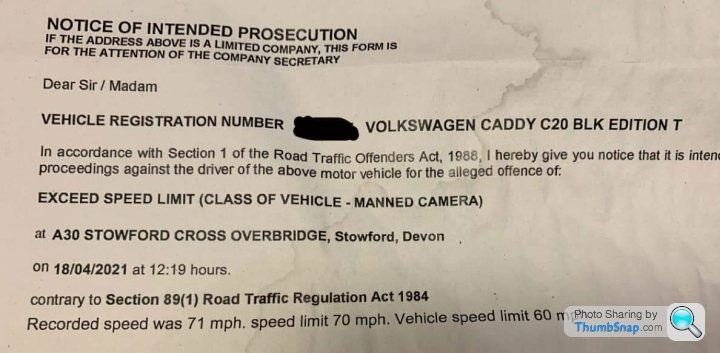
AlwynMike said:
Probably a distinct attempt at targeting vans, I suspect.Additionally, I have never seen big RRs towing a trailer being stopped doing 70 on a dual carriageway, I have seen plenty do that speed.

RSTurboPaul said:
To ask a question that is confusing me - if, say, someone has a VW T5 (or whatever) as a commercial van, and there is an identical vehicle but with seats in it as a personal vehicle, are they subject to the same speed limits?
If it's a van it has to stick to van speed limits. The exceptions are car-derived vans, of which there are very few and the transporter is not one of them. That's the only reason I have a Fiesta Van instead of a Transit Courier, I do hundreds of miles a week on A roads and I couldn't stand the 50/60 limit.Some examples of car-derived vans are the Fiesta, Corsa, Discovery and Mitsi Outlander. All of which were designed as cars and then were turned into vans by removing the rear seats and boarding up the back windows. What the logical difference is between a car-derived van and a van-derived car like a VW T5 I'm not sure.
SamR380 said:
If it's a van it has to stick to van speed limits. The exceptions are car-derived vans, of which there are very few and the transporter is not one of them. That's the only reason I have a Fiesta Van instead of a Transit Courier, I do hundreds of miles a week on A roads and I couldn't stand the 50/60 limit.
Some examples of car-derived vans are the Fiesta, Corsa, Discovery and Mitsi Outlander. All of which were designed as cars and then were turned into vans by removing the rear seats and boarding up the back windows. What the logical difference is between a car-derived van and a van-derived car like a VW T5 I'm not sure.
A modified Transporter which satisfied the definition of say dual-purpose vehicle or motor caravan would not be subject to special speed limits for its class.Some examples of car-derived vans are the Fiesta, Corsa, Discovery and Mitsi Outlander. All of which were designed as cars and then were turned into vans by removing the rear seats and boarding up the back windows. What the logical difference is between a car-derived van and a van-derived car like a VW T5 I'm not sure.
SS2. said:
A modified Transporter which satisfied the definition of say dual-purpose vehicle or motor caravan would not be subject to special speed limits for its class.
This comes up a lot on the T6 forum, especially with the T32 lwb variant. All the drivers caught doing car speeds have had their convictions quashed when appealing that their vehicles are dual purpose Kombi vehicles, no good for panel vans though I’m afraid. )
)Insert Coin said:
SS2. said:
A modified Transporter which satisfied the definition of say dual-purpose vehicle or motor caravan would not be subject to special speed limits for its class.
This comes up a lot on the T6 forum, especially with the T32 lwb variant. All the drivers caught doing car speeds have had their convictions quashed when appealing that their vehicles are dual purpose Kombi vehicles, no good for panel vans though I’m afraid.It's the same vehicle underneath, and arguably a Kombi or similar fully loaded with chubby folks would weigh just as much as a fully loaded van... lol
Forums | Speed, Plod & the Law | Top of Page | What's New | My Stuff