
Caterham buyers guide
Discussion


Hi
Am looking to get a fun car second car and have been sniffing around TVRs though I'm rapidly cooling from them despite the intoxicating sound track due to running costs.
Odd shift maybe but am now looking at Caterhams and Elise S1s.
Can anyone recommend an online buyers guide? I've searched and oddly cannot find one. I'm finding the choice of engines some what confusing!
Budget is £12k tops and so far think I'm looking at a Roadsport. But what engine? Should I avoid certain engines?
Cheers
Am looking to get a fun car second car and have been sniffing around TVRs though I'm rapidly cooling from them despite the intoxicating sound track due to running costs.
Odd shift maybe but am now looking at Caterhams and Elise S1s.
Can anyone recommend an online buyers guide? I've searched and oddly cannot find one. I'm finding the choice of engines some what confusing!
Budget is £12k tops and so far think I'm looking at a Roadsport. But what engine? Should I avoid certain engines?
Cheers
Have a read through this article, lots of useful info... http://www.warwickshire7s.co.uk/Buying-A-7-Advice....

Some clarification on the "Classic" Sevens.
The term has been used on a number of quite different Sevens that were produced from the early 1990s to the early 2000s. In fact, they may still have a version called the Classic in the range.
The idea behind the Classic was that Caterham felt the base level Sevens were too expensive and were deterring some buyers - who were going for other, cheaper Seven inspired designs, such as the Westfield.
The original Classic came out in 1994 and was powered be a single carb Ford XFlow and featured an old style solid rear axle. It also came with no hood and Brooklands screens.
A Classic Special Edition also came out around the same time which had an uprated XFlow with Twin Weber Carbs, full screen, hood etc. The bulk of these early classic sere SEs. This is the type of Seven I own and even after 16 years I still enjoy driving it.
Xflow engines began to disappear in the late 1990s and a short production run of Vauxhall GTE engined Classics were built. They are quite rare.
Eventually, the Classic designation was switched to the lower powered Rover K engine Sevens - although by now the solid rear axle had also been abandoned (due to lack of supply) and the standard DeDion used instead.
The term has been used on a number of quite different Sevens that were produced from the early 1990s to the early 2000s. In fact, they may still have a version called the Classic in the range.
The idea behind the Classic was that Caterham felt the base level Sevens were too expensive and were deterring some buyers - who were going for other, cheaper Seven inspired designs, such as the Westfield.
The original Classic came out in 1994 and was powered be a single carb Ford XFlow and featured an old style solid rear axle. It also came with no hood and Brooklands screens.
A Classic Special Edition also came out around the same time which had an uprated XFlow with Twin Weber Carbs, full screen, hood etc. The bulk of these early classic sere SEs. This is the type of Seven I own and even after 16 years I still enjoy driving it.
Xflow engines began to disappear in the late 1990s and a short production run of Vauxhall GTE engined Classics were built. They are quite rare.
Eventually, the Classic designation was switched to the lower powered Rover K engine Sevens - although by now the solid rear axle had also been abandoned (due to lack of supply) and the standard DeDion used instead.
Are you sure?
The original 1957 Series 1 Lotus 7 didn't have a fuel gauge. But I am pretty sure that by 1994 or so, when the Classic line was launched, fuel gauges were installed as they are a legal requirement. Mine is 1996 and most definitely has a fuel gauge. Indeed, it has the standard Caterham instrument lay out.
What it DOES have is the passeenger footwell hand brake.
The original 1957 Series 1 Lotus 7 didn't have a fuel gauge. But I am pretty sure that by 1994 or so, when the Classic line was launched, fuel gauges were installed as they are a legal requirement. Mine is 1996 and most definitely has a fuel gauge. Indeed, it has the standard Caterham instrument lay out.
What it DOES have is the passeenger footwell hand brake.
TheLastPost said:
Eric Mc said:
...fuel gauges were installed as they are a legal requirement.
Fuel gauges are not a legal requirement (even under current IVA regulations).The only instrumentation required by law is a speedometer (of specified accuracy).
I'll have to re-read the reviews I have somewhere on the original Classics.
Thanks for some very informative posts Eric MC. I have only a little information to add which some people might find useful.
Firstly, the later live (or 'solid') axle cars had long-cockpit chassis of the same dimensions as the S3 de-dion axle car.
Secondly, live axles were of two types; Ford Escort and latterly Moris Ital, when supply of the Ford axle dried up. The Ford unit is considered tougher but heavier, The Ital has a couple of problems which can surface when driven hard. Ital-axled cars were available right up until the 'Beaulieu' special edition, with some being registered as late as 2002!
Firstly, the later live (or 'solid') axle cars had long-cockpit chassis of the same dimensions as the S3 de-dion axle car.
Secondly, live axles were of two types; Ford Escort and latterly Moris Ital, when supply of the Ford axle dried up. The Ford unit is considered tougher but heavier, The Ital has a couple of problems which can surface when driven hard. Ital-axled cars were available right up until the 'Beaulieu' special edition, with some being registered as late as 2002!
I didn't buy it new - although it was ALMOST new. It was only six months old when I bought it.
In the mid 1990s, Caterham ran a scheme where, if you bought a Caterham as a kit, if you wanted to, you could sell it back to Caterham within 12 months after assembly and get your full purchase price back. That's what the previous owner did.
Mine's a Classic SE which was the (then) higher spec Classic so would have come with all the standard fittings.
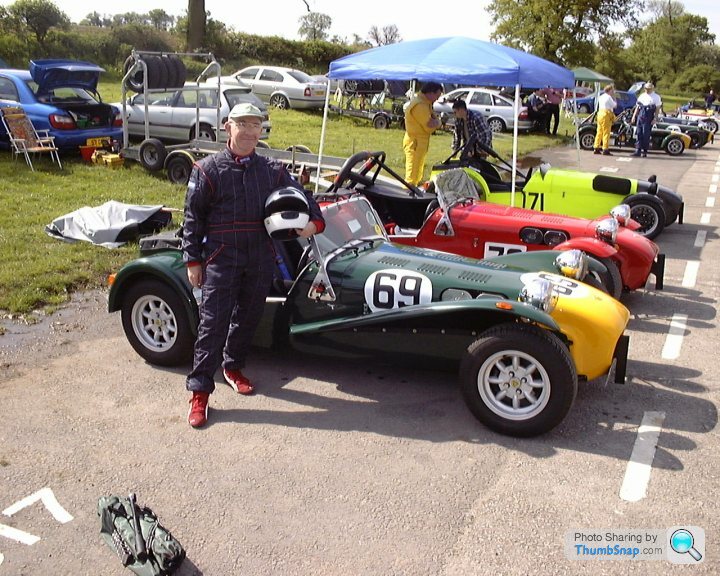
In the mid 1990s, Caterham ran a scheme where, if you bought a Caterham as a kit, if you wanted to, you could sell it back to Caterham within 12 months after assembly and get your full purchase price back. That's what the previous owner did.
Mine's a Classic SE which was the (then) higher spec Classic so would have come with all the standard fittings.
kenny.R400 said:
Eric, did you buy yours new? The fuel gauge was an option, albeit most people went for it......... but it was an extra and not included in kit price unless specced.
Correct, according to Chris Rees' book "The Magnificent Seven", the Classic was re-introduced in 1992 with aero screens, no carpet, no rev counter, no fuel gauge, no spare wheel, no heater and no weather equipment (no surprise with aero screens!). The engine was the 1600GT with a down-draught carburettor and 84BHP (as first seen in 1968), steel wheels and bench seat - all for a mere £7,450  The "SE" (Special Equipment) package added the screen, weather equipment, instruments, carpets and alloy wheels (including a spare). The Sprint-spec engine was also an option, twin side-draught Webers and 100BHP. Apparently more than 100 Classic SE models were sold before the first basic Classic was delivered
Edited for spelling
Edited by Caterhamfan on Thursday 4th October 10:33
Buying a 7 advise from the L7 Club http://7faq.com/owbase/ow.asp?BuyingA%5FSeven
Hints and tips http://7faq.com/owbase/ow.asp?GeneralHintsAndTips
As others http://www.lotussevenclub.com/Home.aspx and look for the local area meets and check out the cars and advise
Hints and tips http://7faq.com/owbase/ow.asp?GeneralHintsAndTips
As others http://www.lotussevenclub.com/Home.aspx and look for the local area meets and check out the cars and advise
Forums | Caterham | Top of Page | What's New | My Stuff