
Fuel Pump and Ignition fuse melting
Discussion


I had a problem a few months ago with the engine cutting out. Eventually I found that the fuel pump fuse was melted but not blown. Thinking that the pump may be on the way out I bought a new Bosch one and fitted it - the problem went away and the whole feel of the power delivery was much smoother.
Job done? Nope.
Out for a spin yesterday and it cut out again - checked the fuse and it was melted but not blown. Put the same fuse back and it restarted.
When the pump was replaced I cleaned all the connections and covered them with shrinkwrap and amalgamation tape.
If the fuse is melting but not blowing does it suggest that something is drawing just below maximum current causing the melt?
The cooling fan fuse melted in-situ a few years ago, could the fuse box have been damaged by these meltdowns?
Steve
Job done? Nope.
Out for a spin yesterday and it cut out again - checked the fuse and it was melted but not blown. Put the same fuse back and it restarted.
When the pump was replaced I cleaned all the connections and covered them with shrinkwrap and amalgamation tape.
If the fuse is melting but not blowing does it suggest that something is drawing just below maximum current causing the melt?
The cooling fan fuse melted in-situ a few years ago, could the fuse box have been damaged by these meltdowns?
Steve
If the polymer body of the fuse is melting, there are 2 possibilities. Either:
a. The connections (ie the 6mm push-fit sockets the fuselink goes into) or the crimp terminal on the end of the same part are defective, giving a series resistance which heats the fuse, or:
b. The fuselink you are using is defective. It may have too high a resistance, or the plastic body may be made of a material which softens at too low a temperature. This is not unusual: there are many chinese-copy or ersatz fuses on the market.
The correct fuses, and the holder they plug into, were designed to carry the rated current at normal ambient temperatures, with good electrical connections. They won't overheat or deform in these circumstances. I would suggest only using Littelfuse or Bussmann fuselinks, especially for higher-rated applications (I guess this is a 25A?) I know that these manufacturers use polysulfone rather than polycarbonate for 25A and above, whereas copycat manufacturers may use whatever looks OK and their element materials may also be suspect.
Other manufacturers are available of course, and fuses sold by vehicle OEM's should be OK. I can only speak for these two manufacturers, who were the original production designers: I have worked for both of them.
And beware: there are LF and Buss 'branded' copycats on the market too!.
a. The connections (ie the 6mm push-fit sockets the fuselink goes into) or the crimp terminal on the end of the same part are defective, giving a series resistance which heats the fuse, or:
b. The fuselink you are using is defective. It may have too high a resistance, or the plastic body may be made of a material which softens at too low a temperature. This is not unusual: there are many chinese-copy or ersatz fuses on the market.
The correct fuses, and the holder they plug into, were designed to carry the rated current at normal ambient temperatures, with good electrical connections. They won't overheat or deform in these circumstances. I would suggest only using Littelfuse or Bussmann fuselinks, especially for higher-rated applications (I guess this is a 25A?) I know that these manufacturers use polysulfone rather than polycarbonate for 25A and above, whereas copycat manufacturers may use whatever looks OK and their element materials may also be suspect.
Other manufacturers are available of course, and fuses sold by vehicle OEM's should be OK. I can only speak for these two manufacturers, who were the original production designers: I have worked for both of them.
And beware: there are LF and Buss 'branded' copycats on the market too!.
In my limited experience many "after market" fuses are pants, they'll be loose even in a new fuse holder. As suggested buy only branded items from a reputable vendor (or get them from scrapyards).
Bodge 1 build up the fuse blades with a dab of solder.
Bodge 2 it may be possible (but very awkward) to close up the receptacles in the fuse box?
Bodge 3 cut wires and fit a line fuse holder
Repair 1 replace the fuse box, if one is loose how many others are "on their way"?
Bodge 1 build up the fuse blades with a dab of solder.
Bodge 2 it may be possible (but very awkward) to close up the receptacles in the fuse box?
Bodge 3 cut wires and fit a line fuse holder
Repair 1 replace the fuse box, if one is loose how many others are "on their way"?
SteveOS3 said:
Is there a specific part number?
I would very much doubt it, the fuse box is a "modular" thing, various pieces clicked together by (or for) TVR to give the required amount of fuses and relays. Replacement, should one be available, would not be a five minute job!Something like this could do the job?
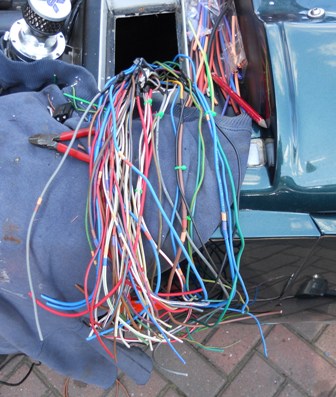
There are a lot of wires once you start cutting

Speed Matters | S Series | Top of Page | What's New | My Stuff