
White dimples in fresh paintjob on fibreglass
Discussion


Hi folks,
Just had some paintwork on my TVR where I had lacquer peel - sanded back, prepped and sprayed. It looks great, but I have noticed that standing directly above the bootlid I can see some pinprick dimples where the paint doesn't seem to have taken and you can see white from underneath. They are pretty small and insignificant but on a flat panel they are a bit annoying, and there are 4 or 5 of them. Am I being unreasonable taking it back and asking them to respray that panel? It's a bootlid so it can be removed and painted separately. I have tried to get photos but it's almost impossible to get them in focus
Just had some paintwork on my TVR where I had lacquer peel - sanded back, prepped and sprayed. It looks great, but I have noticed that standing directly above the bootlid I can see some pinprick dimples where the paint doesn't seem to have taken and you can see white from underneath. They are pretty small and insignificant but on a flat panel they are a bit annoying, and there are 4 or 5 of them. Am I being unreasonable taking it back and asking them to respray that panel? It's a bootlid so it can be removed and painted separately. I have tried to get photos but it's almost impossible to get them in focus
Just been out to have a closer look - there's probably getting on for 10 of these little dimples, most but not all of which have the paint broken. Is there any reason why this would happen? Is it likely to be preparation or contamination? I can't see it on any other sprayed panels and I think they removed the bootlid.
Is this likely to be the sort of thing a bodyshop will hold their hands up and do it, or will they shrug and say "it's the best we can get it" or "what are you moaning about?"


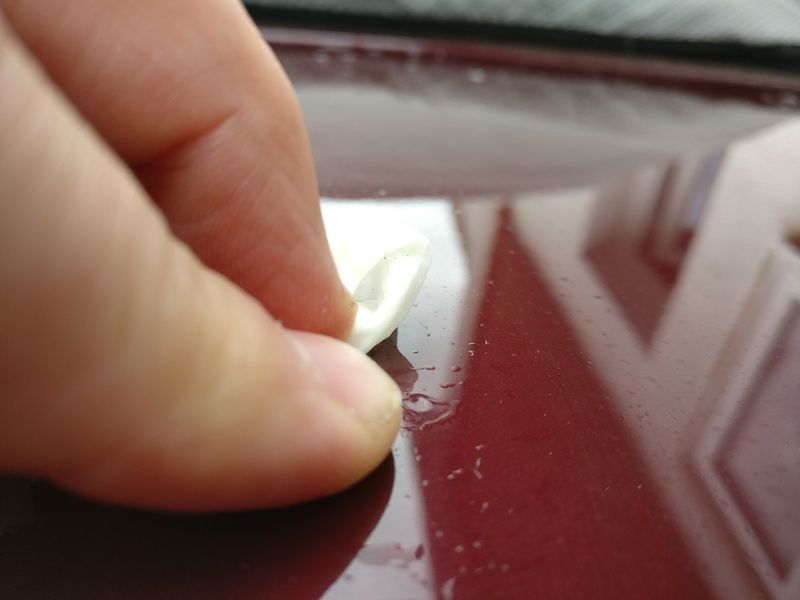

Is this likely to be the sort of thing a bodyshop will hold their hands up and do it, or will they shrug and say "it's the best we can get it" or "what are you moaning about?"


Edited by NiceCupOfTea on Tuesday 30th May 11:31
Have a look through this with particular regard to pinholes.
http://www.glasurit.com/uk/advice-paint-defects
Fisheye due to contamination by grease or silicones is another possible.
The white in the bottom of yours MIGHT be polish/polishing compound.
http://www.glasurit.com/uk/advice-paint-defects
Fisheye due to contamination by grease or silicones is another possible.
The white in the bottom of yours MIGHT be polish/polishing compound.
NiceCupOfTea said:
Thanks for that - so it's not unreasonable that I should be asking for it to be repainted? Is "pinholes" the correct term? Just would like to make sure I am reasonably confident when talking to the paintshop!
'Pinhole' and 'Fisheyes' are correct terms. Look through the link & Google the terms 
Don't know if it would work on your colour & they would need to deal with the white at the bottom but I've had a lot of success just putting a drop of 2k clearcoat onto them, baking it & then flatting with 2000 grade wet & dry used wet before machine polishing.
Once the surface is level they can be very hard - or impossible - to find even when you know exactly where they were.
Once the surface is level they can be very hard - or impossible - to find even when you know exactly where they were.
yup, fish eyes. My Cerbera was painted 3 times before the finish was right. The painter was not sure if it was some contamination in his premises or on the car within the gel coat. It was thoroughly decontaminated each time but the buggers would not go away. In the end and after the third go we were down to half a dozen in inconspicuous places, he filled them by hand and wet flatted and polished the paint again and the result was perfect.
Took it in today and he reckoned it was bits of polish that had somehow reacted with the paint. He tried to flat it back but it was never going to work (you can see that the paint surface drops down) so I have had to book it back in (3 weeks). These things happen and I guess he is busy but I wish he had been able to squeeze it in as I had intended to put the car up for sale...
You'll never flat those down to get rid of them, they're too deep. Trust me, I've tried! Frankly I'm surprised he even attempted to.
I suspect the white at the bottom may be polishing compound.
As I said earlier I'd have tried removing the white stuff - if it is compound or polish then I would use & expect brake cleaner to remove it without damaging the paint (DON'T use thinners) - or just colouring it with the original paint applied with a piece of fine wire followed by a drop of clearcoat then bake, flat, polish.
As most of what I do is outside, I do need to remove foreign bodies from the paint from time to time & these, whilst expensive, are worth their weight in gold. Think very very fine wire with lots of barbs:
https://www.fastmovertoolsuk.com/smart-repair-tool...
I suspect the white at the bottom may be polishing compound.
As I said earlier I'd have tried removing the white stuff - if it is compound or polish then I would use & expect brake cleaner to remove it without damaging the paint (DON'T use thinners) - or just colouring it with the original paint applied with a piece of fine wire followed by a drop of clearcoat then bake, flat, polish.
As most of what I do is outside, I do need to remove foreign bodies from the paint from time to time & these, whilst expensive, are worth their weight in gold. Think very very fine wire with lots of barbs:
https://www.fastmovertoolsuk.com/smart-repair-tool...
Edited by paintman on Wednesday 31st May 21:38
paintman said:
Don't know if it would work on your colour & they would need to deal with the white at the bottom but I've had a lot of success just putting a drop of 2k clearcoat onto them, baking it & then flatting with 2000 grade wet & dry used wet before machine polishing.
Once the surface is level they can be very hard - or impossible - to find even when you know exactly where they were.
Question : doesnt clearcoat need to be applied to paint before the previous coat has been baked - to avoid peeling off at a later date?Once the surface is level they can be very hard - or impossible - to find even when you know exactly where they were.
IME on my own work I've spotted surface defects such as these during the bake or immediately after when flatting prior to final polish.
I have yet to have any issues dealing with them as I have described.
I learnt very early that trying to flat them out was a mistake as going through the clear to the colour coat is almost inevitable. That or an even bigger depression.
I have yet to have any issues dealing with them as I have described.
I learnt very early that trying to flat them out was a mistake as going through the clear to the colour coat is almost inevitable. That or an even bigger depression.
Edited by paintman on Thursday 1st June 19:45
Gassing Station | Bodywork & Detailing | Top of Page | What's New | My Stuff