
Red car turning pink
Discussion


Its the UV attacking the clear coat, its very common on red cars.
The long term solution is they need respraying with a new coat of clear which will then last for the next 10-15yrs, but on average you're talking about £300 ish per panel thats affected.
You can machine polish and it will sort the problem as a temp fix, but it will return, most likely in a couple of months, maybe a bit longer until the sun comes back next spring.
If you machine polish you are looking at removing the top comprised clear coat lacquer, but remember the lacquer is a finite amount of microns thick so you don't want to be removing too much thats undamaged as it will soon burn through.
If you want to attack it, clean it well first, then wipe it well with a IPA alcohol wipe, often called panel wipe. Then use a DA polisher as a DIY option, get a firm foam pad, use a heavy cutting compound. Do a section 2ft by 2ft, you only want a couple of pea drop sized blobs. Low speed, heavy pressure, keep it moving across vertically then horizontally, check with your hand that you are not generating too much heat. Once you've done a few passes use a clean cloth to wipe the residue and dust off and you should be left with a dull finish but smooth without the chalky oxidisation.
Next move to a medium cutting compound, increase the speed and use less pressure and repeat.
Finally use a soft foam pad and a fine polish, increase the speed again and don't use any pressure.
Each step is removing the scratches you made with the previous step. You should be left with a deep red shine again BUT it will return!
There are a million different compounds, polishes, and opinions that people will have, but the principle is the same, the heavy abrasive compound is removing the compromised, oxidised clear coat, but it leaves its own scratch marks as a result, the next step then removes the previous scratch marks with finer marks until you are left with the polished finish.
Most paint is less than 100 microns in total, thats primer, base and clear, the oxidisation has already destroyed a lot of that so ultimately you can make it look better but once that clear coat lacquer is compromised and rubbed through to the base coat its gone, and is never coming back unless you respray it. The good news is modern lacquers have a lot more UV protection nowadays, so it's a one off respray job.
Just of note - I'm getting a lot of these through at the moment as a result of Covid when cars where parked on a drive in the same direction all the time with the sun attacking the same panels relentlessly. For future prevention, change the direction its parked on the drive or street, and park under shade if you have a red car!
Edited by DaveF-SkinnysAutos on Saturday 7th November 17:05
Paulprior said:
Great response Dave, thank you ?
On the DA sanders I see 6 to 20mm throw, is there a preference for large areas ?, also, just to do this one job do I need one of the expensive models or something basic ?
Ok, we are going to get into a messy world now with no right answers! Everyone has their own opinions on what's best in the detailing world, and its full of 'magic bean' salesmen, but.....On the DA sanders I see 6 to 20mm throw, is there a preference for large areas ?, also, just to do this one job do I need one of the expensive models or something basic ?
The gold standard DIY machine is the DAS 6 readily available if you google it, and no doubt there will be some Black Friday offers in the coming weeks, its sort of the default DIY machine, middle of the road throw, not the cheapest, but not stupid money either. It's been around a long time and isn't a cheap TEMU special. There are two models, the cheaper one you will see is 9mm throw I think, its badged as the introductory machine, then they do a slightly more expensive one which I think they call the PRO, its a 15mm throw. The 15mm is the sweet spot really, but you will achieve good results with 9mm, its just a bit more work on your part, but equally more forgiving on the edges.
To be clear, you don't want a DA sander, thats a different beast, you want a DA machine polisher.
Just remember, the UV properties of the clear coat are compromised, it's on its last legs, it will eventually start to peel in sections. Polishing will bring back a really nice red again, but it has no ability to resist future UV so the newly polished section will oxidise again, you can put a ceramic coat on the top and that will fingers crossed give you 12-24 months, if you just polish its 3-4 months.
I do this for a living, I want to be clear, the only long term solution is new lacquer, but you will improve it if you want to have a play with cutting and polishing.
My 90's Saab 900 suffered with this - I did discover one wing had been resprayed with no clearcoat & the polishing cloth went pink very quickly!
I did it all by hand with Farecla G3 & it did clean up, but as you say it's always coming back.
It wasn't as bad as this Renault I photographed a few years back in France - the surface had gone completely & was rough to the touch.
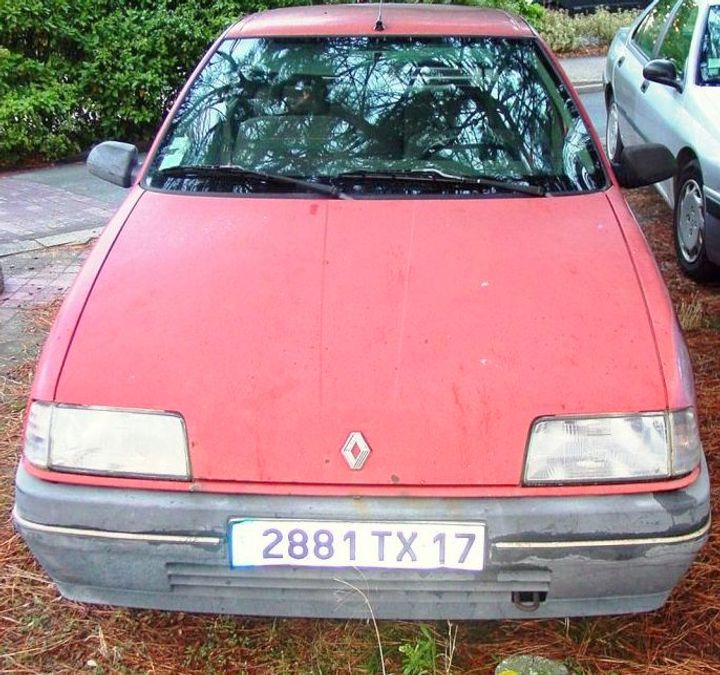
Good luck with it!
I did it all by hand with Farecla G3 & it did clean up, but as you say it's always coming back.
It wasn't as bad as this Renault I photographed a few years back in France - the surface had gone completely & was rough to the touch.
Good luck with it!


Thanks again guys, very informative and helpful, DaveF, what would you recommend for a ceramic coat that could be reasonable applied by a newbie to ceramics but with reasonable patience??, and Belle427, the 3 in 1 appeals to the lazier side of me, what grade of pad would you use ??, I will pass on the hand job🤣🤣
Paulprior said:
Thanks again guys, very informative and helpful, DaveF, what would you recommend for a ceramic coat that could be reasonable applied by a newbie to ceramics but with reasonable patience??, and Belle427, the 3 in 1 appeals to the lazier side of me, what grade of pad would you use ??, I will pass on the hand job??
Its difficult as you don't want to buy lots of different products, but my fear with a 3in1 is that the oxidisation will suck up a lot of the lubricating oils in polishes, and in a 3in1, that means the finer abrasive wont get a chance to work before it clogs your pad from the initial coarser abrasives.How bad is it, any photos? It it chalky, or just faded?
My view would be medium pad and medium polish and see what results you get, that way you are only buying one product. My recommendation would be Menderza medium cut, it has a lot of lubricating oils, which will help it cut and not clog, but equally, it needs a good wipe down with IPA after if you are going to put a sealant over the top to remove those oils. An alternative is Koch Chemie F6.01, its got a water based lubricant so better for sealants after, what you see at the end of polishing is what you get, there isn't any polishing oils enhancing the gloss. There are hundreds out there, but professionally, they are my two go to's, but others have more product knowledge than me. Menzerna is my favourite, unless I'm applying a ceramic coat after.
If after a medium its either still rough and pink, or its now red but not very shiny, then you would either need a heavier cut, or a finer polish, but overall a medium should give you a good idea of what's possible without burning through too much clear coat thats left, or costing too much.
I would bow to Belle427s knowledge in the detailing aspect, but maybe look at Gtechiq C2 sealant, its a DIY product so very easy to apply, it doesn't last as long as a full ceramic, but its so easy to apply you can do it every month to keep it topped up. It's middle ground as ultimately you are only holding back the tide. It's also reasonably priced and will give it back some UV protection. It will bond nicely to the Koch Chemie products, but you need to give it a good clean first if you've gone for the Menzerna product.
Im just a keen weekend warrior thats learnt what products are good and bad, Im no expert on paint correction though.
I suppose the final protection depends on if your looking after it regularly or want something that lasts a year or two.
A lot of the spray on wipe off ceramic type products are very good and can be applied to a whole car in less than 30 minutes, some will last a few months too.
I suppose the final protection depends on if your looking after it regularly or want something that lasts a year or two.
A lot of the spray on wipe off ceramic type products are very good and can be applied to a whole car in less than 30 minutes, some will last a few months too.
Ok,
As I first stressed, this is not a cure, you need to respray it, but on the basis that you want to have a play, I'd recommend the C2 after, its supposed to be six months protection, but thats on top of good lacquer, if you topped it up regularly you're going to give it a fighting chance, but thats only if there is any clear left on there, if its a chalky red, the whole clear is compromised already.
The more expensive option is a proper ceramic coat, and the only real long term semi DIY/Professional option there is the GTechniq CSL and EXO5 mix, but it needs to be applied indoors, strictly following the instructions to the letter and then it needs to stay dry and indoors for at least 12hrs after, and its a lot more expensive.
What's your thoughts on single stage red Dave?, I've done a couple of cars with it for friends, both cars live outside
and have been wearing their single stage red for 5 and 6 years respectively, no issues at all with fading over that time
and the paint still looks lovely and fresh. Well looked after and regularly polished right enough.
and have been wearing their single stage red for 5 and 6 years respectively, no issues at all with fading over that time
and the paint still looks lovely and fresh. Well looked after and regularly polished right enough.
Master Of Puppets said:
What's your thoughts on single stage red Dave?, I've done a couple of cars with it for friends, both cars live outside
and have been wearing their single stage red for 5 and 6 years respectively, no issues at all with fading over that time
and the paint still looks lovely and fresh. Well looked after and regularly polished right enough.
Single stage is great for many solid colours, it will obviously have the UV protection all the way through the paint, albeit, my understanding is the oxidisation is the effect of the UV on the red pigment in particular, but you cant really blend it, so you have to paint a complete panel, and therefore it needs to be an exact colour match where its edge to edge with an adjoining panel. and have been wearing their single stage red for 5 and 6 years respectively, no issues at all with fading over that time
and the paint still looks lovely and fresh. Well looked after and regularly polished right enough.
Modern base and clear just gives the bodyshop an easier flow, that red shade of single stage can only be used on that car, whereas the 5ltrs of clear is used on every car and you only mix up a bit of base for the car you are working on. Also, once it's mixed, any leftover has to be thrown away, whereas base can be poured back in the tin. So absolutely, it's more to do with bodyshop economics.
Belle427 said:
You should get 3 months at least out of the gtechniq C2 mentioned so try it out, maybe more if you use their shampoo too.
Yes, it's so easy to apply and doesn't need that 12hr window, it's also cheap, I think it's worth a try rather than an expensive full ceramic coat. They say 6 months, but if you reapplied every two or three when it's washed it's probably about as good as you are going to get?Yes a lot of them require meticulous prep to get the claimed protection length but as you say they are so easy to apply that it's not really an issue.
Some can be used as a drying aid too which makes it even easier but this can clog your drying towel.
Also I'm not sure if the protection would be as good as putting it on a dry panel.
I use Bilt Hamber touch on now as it's so easy but doubt it has much in the way of UV protection.
Some can be used as a drying aid too which makes it even easier but this can clog your drying towel.
Also I'm not sure if the protection would be as good as putting it on a dry panel.
I use Bilt Hamber touch on now as it's so easy but doubt it has much in the way of UV protection.
Gassing Station | Bodywork & Detailing | Top of Page | What's New | My Stuff