
Advice on starting Triumph Spitfire project
Discussion


Posting on here as the Triumph forum seems pretty dead and looking for general advice really. Been left with my sons half-finished Spitfire project (he's gone back to Uni) and wanting some advice on starting it for the first time in 20 years.
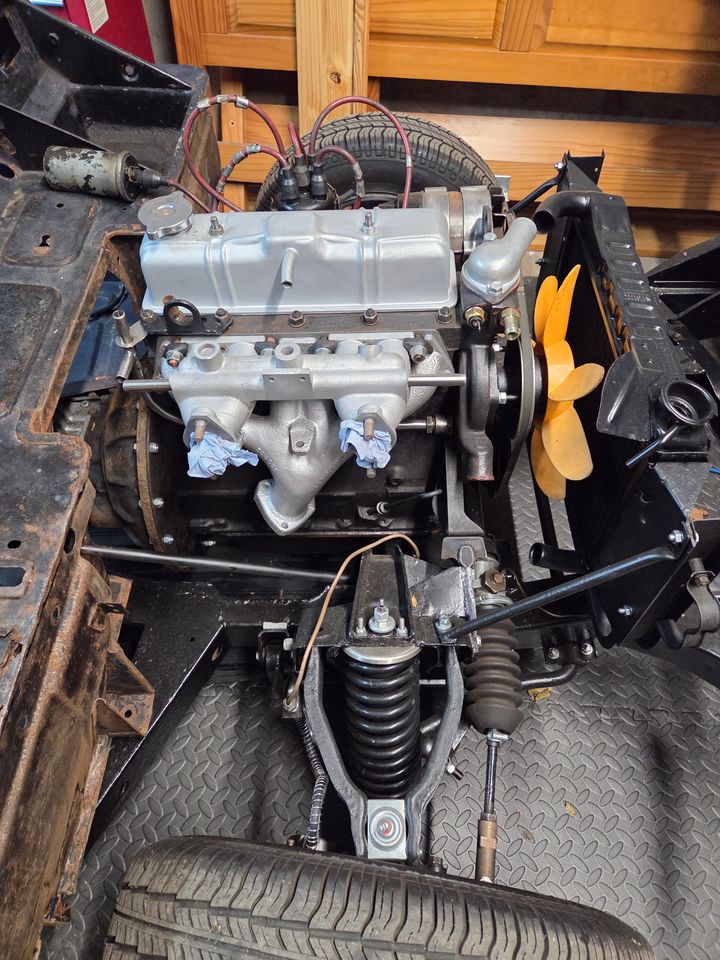
Car was bought 18 months ago as a project for him to tinker with but he threw a lot of new parts at it. Its a 1972 1.3. We bought it with a reconditioned engine and gearbox. Car had been laid up for the last 20 years as two previous owners had given up, and I know how they feel!.
However, the engine and gearbox were checked over, and are fine, refitted to a reconditioned chassis with a re-cored radiator. Fresh oil in.
I wondering what the minimum is that I could do on my own to attach to the engine and see if it turns over?
We have all the old parts and some reconditioned. Fuel tank is good, disconnected, and stored in the boot. There is a good exhaust system with it, again, not attached, pre paint. Obviously no hydraulics. The car is bolted onto the chassis, so will roll outdoors if the weather ever lets up. Noise is not an issue if I fire it up for a minute, as I have no close neighbours. Longer and I would want to fit the exhaust, probably.
I have all the old electrics removed and much of it is in reasonable condition, certainly for getting the engine running.
The car is waiting for welding in a month or two so I don't want to start bolting a lot of stuff on that will have to be removed later, before the bulkhead is welded and paint applied.
So I am thinking at least:-
Coolant hoses and fill the rad.
Rig up a spare battery, larger size, but enough to turn it over.
Obtain a gasket set and refit the carbs
Which other electrics to fit/best way of rigging them to start?
Fuel hoses
Sorry about the camera angles but I'm in a rented barn and access is tight.
Dizzy is original and unknown.
Carbs just dismounted as the hoses fell apart.
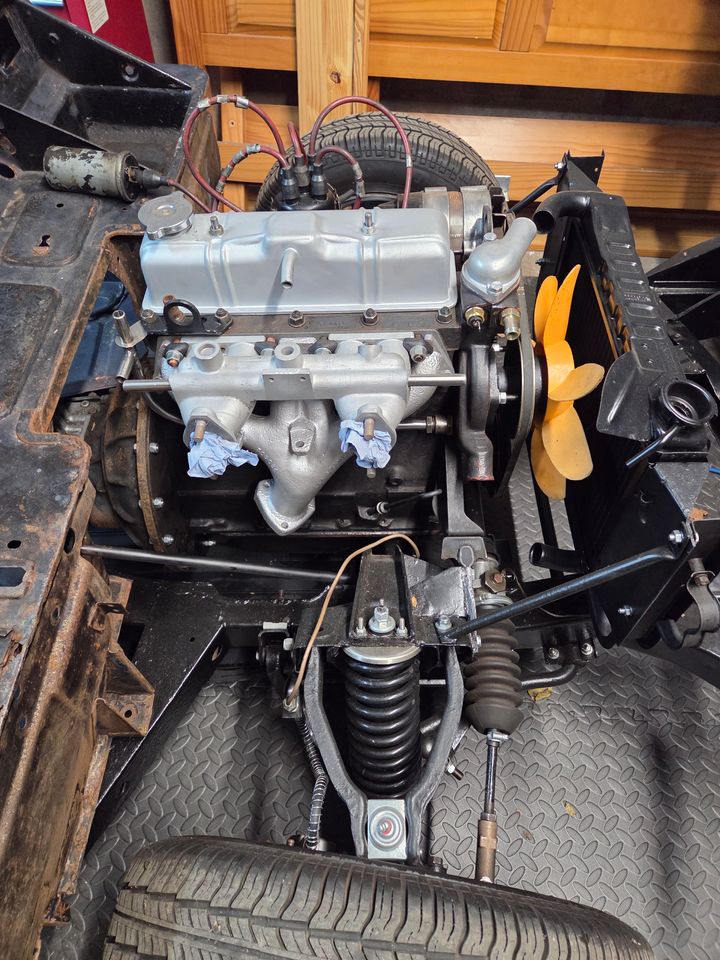
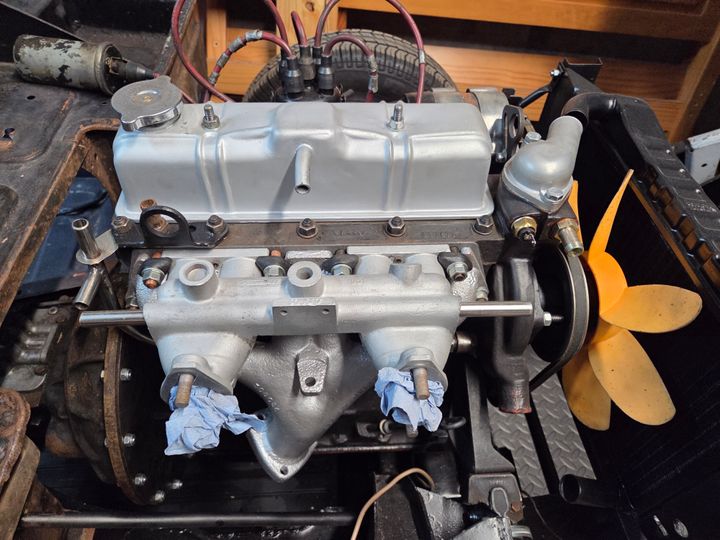
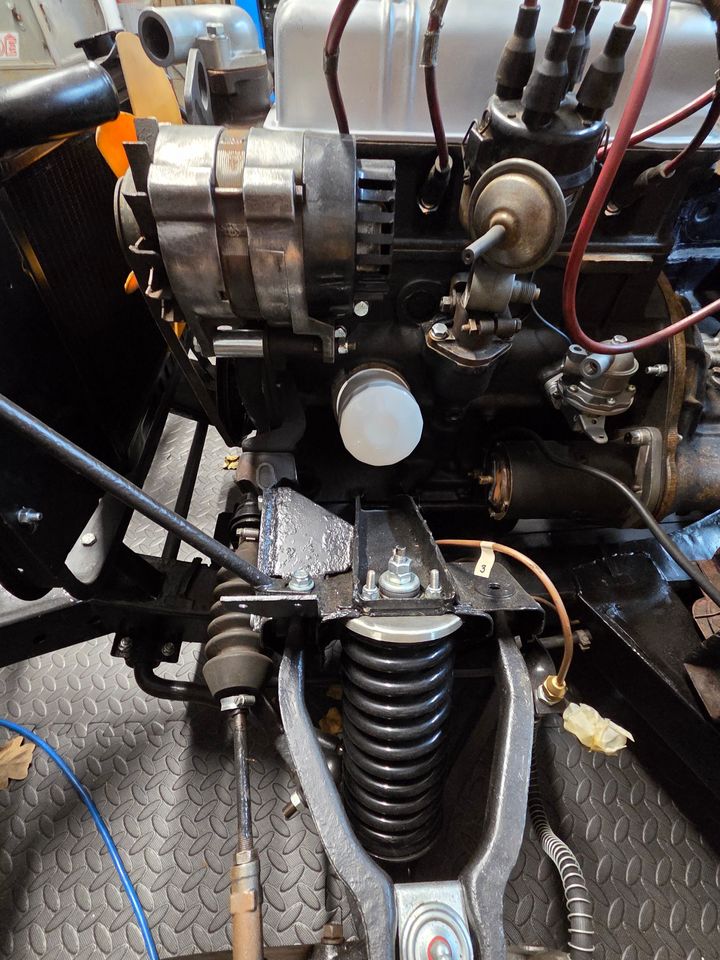
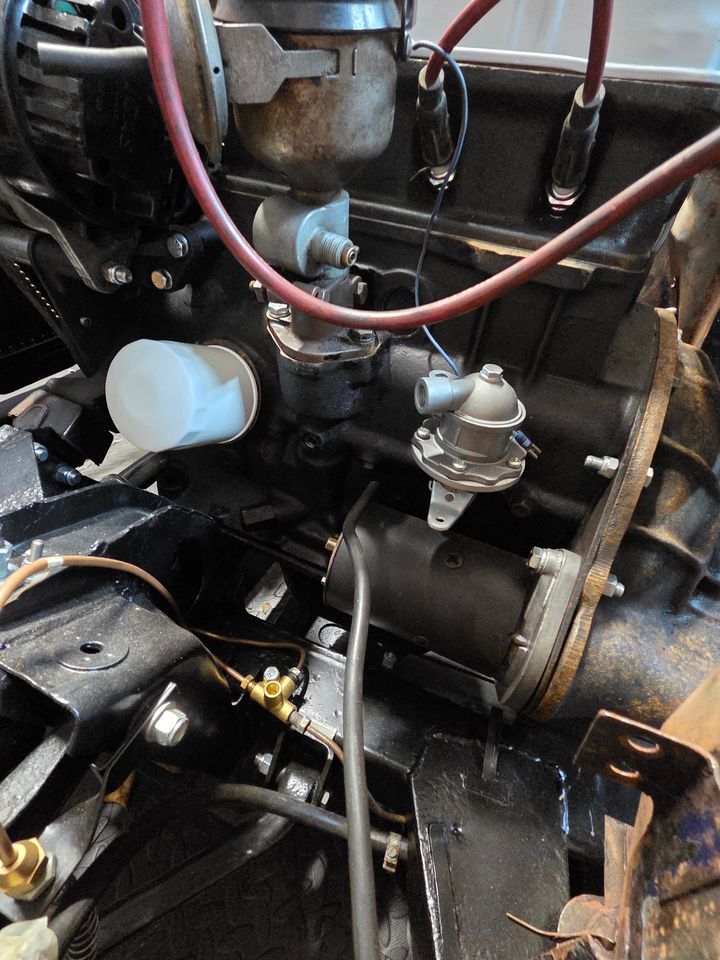
Car was bought 18 months ago as a project for him to tinker with but he threw a lot of new parts at it. Its a 1972 1.3. We bought it with a reconditioned engine and gearbox. Car had been laid up for the last 20 years as two previous owners had given up, and I know how they feel!.
However, the engine and gearbox were checked over, and are fine, refitted to a reconditioned chassis with a re-cored radiator. Fresh oil in.
I wondering what the minimum is that I could do on my own to attach to the engine and see if it turns over?
We have all the old parts and some reconditioned. Fuel tank is good, disconnected, and stored in the boot. There is a good exhaust system with it, again, not attached, pre paint. Obviously no hydraulics. The car is bolted onto the chassis, so will roll outdoors if the weather ever lets up. Noise is not an issue if I fire it up for a minute, as I have no close neighbours. Longer and I would want to fit the exhaust, probably.
I have all the old electrics removed and much of it is in reasonable condition, certainly for getting the engine running.
The car is waiting for welding in a month or two so I don't want to start bolting a lot of stuff on that will have to be removed later, before the bulkhead is welded and paint applied.
So I am thinking at least:-
Coolant hoses and fill the rad.
Rig up a spare battery, larger size, but enough to turn it over.
Obtain a gasket set and refit the carbs
Which other electrics to fit/best way of rigging them to start?
Fuel hoses
Sorry about the camera angles but I'm in a rented barn and access is tight.
Dizzy is original and unknown.
Carbs just dismounted as the hoses fell apart.
Looks like a decent project, and I'm sure will be quite rewarding! The owners club (TSSC) used to be a good resource, but I suspect the interweb now has countless 'how to' videos for anything you'll need to do.
tms996 said:
Anything other than a fuel line from a can or the tank needed?
It's going to be very loud when it fires and you might get a few tongues of flame if it's very rich / on the overrun. But mostly be mindful of the fire risk with jury-rigged fuel lines. It can go wrong in a fraction of a second. 
Were I you (and I've co-restored a 1966 Spitfire) I'd follow Huntsman's advice but also have a fire extinguisher in-hand when you try. Don't stand on the intake side when you first start it -- they can and DO backfire flames when not run for a long time! Don't ask how I know  but take my word for it.
PS> The Triumph channel here isn't too busy as most of us are on the tr-register, sideways or club Triumph forums.
but take my word for it.PS> The Triumph channel here isn't too busy as most of us are on the tr-register, sideways or club Triumph forums.
Steve-B said:
Were I you (and I've co-restored a 1966 Spitfire) I'd follow Huntsman's advice but also have a fire extinguisher in-hand when you try. Don't stand on the intake side when you first start it -- they can and DO backfire flames when not run for a long time! Don't ask how I know but take my word for it.
PS> The Triumph channel here isn't too busy as most of us are on the tr-register, sideways or club Triumph forums.
Sports Six surely for the little Triumphs, I assume they have a forum too. but take my word for it.PS> The Triumph channel here isn't too busy as most of us are on the tr-register, sideways or club Triumph forums.
Yertis said:
Steve-B said:
Were I you (and I've co-restored a 1966 Spitfire) I'd follow Huntsman's advice but also have a fire extinguisher in-hand when you try. Don't stand on the intake side when you first start it -- they can and DO backfire flames when not run for a long time! Don't ask how I know but take my word for it.
PS> The Triumph channel here isn't too busy as most of us are on the tr-register, sideways or club Triumph forums.
Sports Six surely for the little Triumphs, I assume they have a forum too. but take my word for it.PS> The Triumph channel here isn't too busy as most of us are on the tr-register, sideways or club Triumph forums.
Thanks for the advice so far.
Spent the day sorting boxes and dropped a crate of rusty scrap at the tip, after sorting out space in the garage.
If the welding quotes turn out to be too expensive, I may just get it running and sell it on.
My son randomly bought various parts so I'd like to fit as many as possible, that don't massively hamper the welding. At the moment the electrics need sorting out as I have 3 boxes of looms which I hope work out to front, middle/dash and rear. But regrettably the previous owner who dismantled it all years ago simply chopped through many of the wire and didn't unscrew anything if it was "difficult", i.e. rusty or stuck. So the challenge is finding out which bits are good and junk the rest.
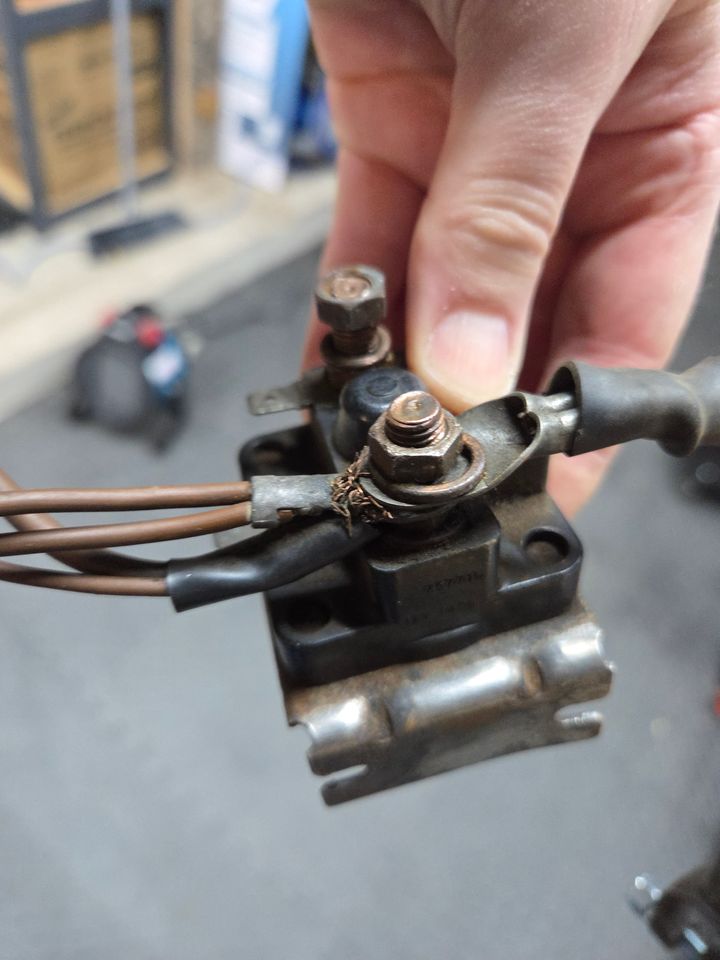
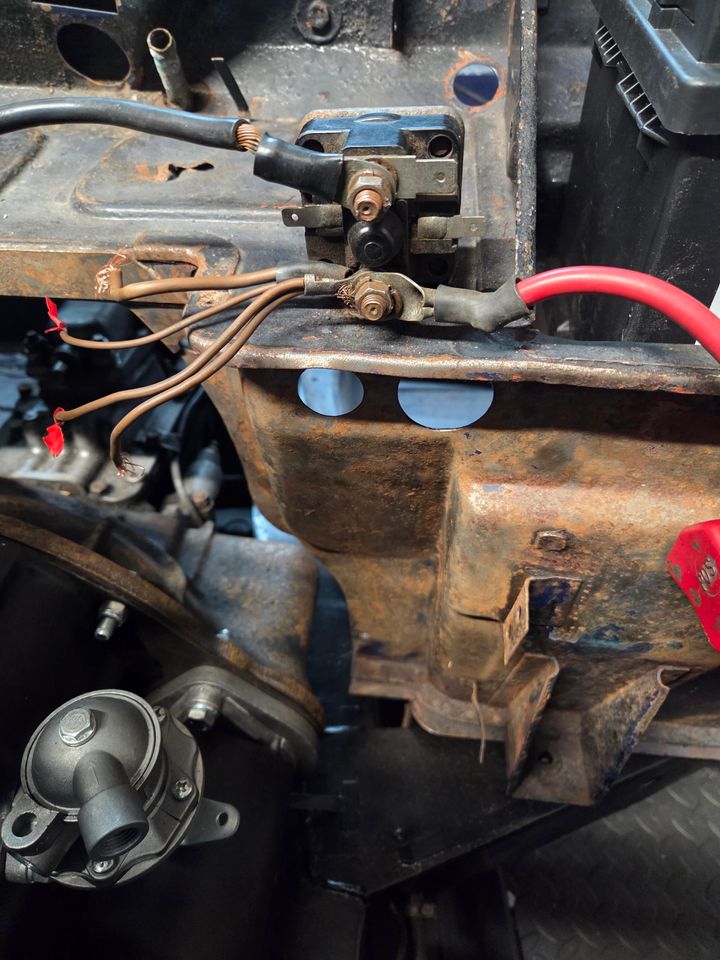
Not sure if the solenoid is duff either. From what I have seen in the manual and on a forum, I thought the battery positive was from the top feed and the starter off the bottom. trying a refit today of it didn't allow any of the cables to reach and it appears to be upside down. I thought the lower half was switched feed for the starter, so why is the heavy positive connected?
Thanks for the suggestions re Triumph forums/club - any particular one recommended?
Spent the day sorting boxes and dropped a crate of rusty scrap at the tip, after sorting out space in the garage.
If the welding quotes turn out to be too expensive, I may just get it running and sell it on.
My son randomly bought various parts so I'd like to fit as many as possible, that don't massively hamper the welding. At the moment the electrics need sorting out as I have 3 boxes of looms which I hope work out to front, middle/dash and rear. But regrettably the previous owner who dismantled it all years ago simply chopped through many of the wire and didn't unscrew anything if it was "difficult", i.e. rusty or stuck. So the challenge is finding out which bits are good and junk the rest.
Not sure if the solenoid is duff either. From what I have seen in the manual and on a forum, I thought the battery positive was from the top feed and the starter off the bottom. trying a refit today of it didn't allow any of the cables to reach and it appears to be upside down. I thought the lower half was switched feed for the starter, so why is the heavy positive connected?
Thanks for the suggestions re Triumph forums/club - any particular one recommended?
spitsfire said:
It's going to be very loud when it fires and you might get a few tongues of flame if it's very rich / on the overrun. But mostly be mindful of the fire risk with jury-rigged fuel lines. It can go wrong in a fraction of a second.
Maybe don't sit on the front wheel to play with the carbs then 
Nice project, my first car was a '76 Spitfire 1500 and, for some reason (warped flange?) I spent many an hour sitting on the front wheel changing the gasket between exhaust manifold and downpipe which failed regularly.
tms996 said:
Not sure if the solenoid is duff either. From what I have seen in the manual and on a forum, I thought the battery positive was from the top feed and the starter off the bottom. trying a refit today of it didn't allow any of the cables to reach and it appears to be upside down. I thought the lower half was switched feed for the starter, so why is the heavy positive connected?
Thanks for the suggestions re Triumph forums/club - any particular one recommended?
That's incorrectly wired/the manual and forums are correct.Thanks for the suggestions re Triumph forums/club - any particular one recommended?
Battery +ve and the brown (un-fused live) wires connect to the top big stud. Only the feed to the starter motor connects to the lower one.
Wired in correctly now and I get the solid 'clunk' on the solenoid when i close the spade terminal to the live. But nothing from the starter. I'm worried someone has damaged the post or the wiring inside when it was mounted. I did bench test the pair and left the best one for my son to fit, but I'm not sure he appreciated how fragile some parts can be. Getting nothing off the starter when crossing the solenoid posts and pretty sire the earth is good, so may have to remove it.
Start by checking for 12v between the lower post and battery -ve when you trigger the solenoid, that will tell you if it's failed internally or actually the starter motor that's duff.
And is the engine earth cable in place? From memory somewhere in one of the boxes you should have a ~1m long braded, non-insulated cable with a single ring connector at one end and a second ring about 10cm from a battery terminal clamp at the other end. Obviously the terminal clamp goes on the battery -ve post, then the nearest ring goes to the nut wellded to the outside battery box butteress. From there the braded cable runs around the back of the battery box, through the gaps at the base of the butteresses, along the top of the bulkhead for a bit, then just off the front and down so the final ring can be attached to one of the bellhousing bolds on the starter motor side of the engine.
If you don't have that bellhousing earth you'll have starting issues as a minimum and often a fire waiting to happen. A classic one when this is missed os from things like the choke cable to end up carrying the full starter motor load!
And is the engine earth cable in place? From memory somewhere in one of the boxes you should have a ~1m long braded, non-insulated cable with a single ring connector at one end and a second ring about 10cm from a battery terminal clamp at the other end. Obviously the terminal clamp goes on the battery -ve post, then the nearest ring goes to the nut wellded to the outside battery box butteress. From there the braded cable runs around the back of the battery box, through the gaps at the base of the butteresses, along the top of the bulkhead for a bit, then just off the front and down so the final ring can be attached to one of the bellhousing bolds on the starter motor side of the engine.
If you don't have that bellhousing earth you'll have starting issues as a minimum and often a fire waiting to happen. A classic one when this is missed os from things like the choke cable to end up carrying the full starter motor load!
//j17 said:
Start by checking for 12v between the lower post and battery -ve when you trigger the solenoid, that will tell you if it's failed internally or actually the starter motor that's duff.
And is the engine earth cable in place? From memory somewhere in one of the boxes you should have a ~1m long braded, non-insulated cable with a single ring connector at one end and a second ring about 10cm from a battery terminal clamp at the other end. Obviously the terminal clamp goes on the battery -ve post, then the nearest ring goes to the nut wellded to the outside battery box butteress. From there the braded cable runs around the back of the battery box, through the gaps at the base of the butteresses, along the top of the bulkhead for a bit, then just off the front and down so the final ring can be attached to one of the bellhousing bolds on the starter motor side of the engine.
If you don't have that bellhousing earth you'll have starting issues as a minimum and often a fire waiting to happen. A classic one when this is missed os from things like the choke cable to end up carrying the full starter motor load!
Just to illustrate what //j17 has written.And is the engine earth cable in place? From memory somewhere in one of the boxes you should have a ~1m long braded, non-insulated cable with a single ring connector at one end and a second ring about 10cm from a battery terminal clamp at the other end. Obviously the terminal clamp goes on the battery -ve post, then the nearest ring goes to the nut wellded to the outside battery box butteress. From there the braded cable runs around the back of the battery box, through the gaps at the base of the butteresses, along the top of the bulkhead for a bit, then just off the front and down so the final ring can be attached to one of the bellhousing bolds on the starter motor side of the engine.
If you don't have that bellhousing earth you'll have starting issues as a minimum and often a fire waiting to happen. A classic one when this is missed os from things like the choke cable to end up carrying the full starter motor load!
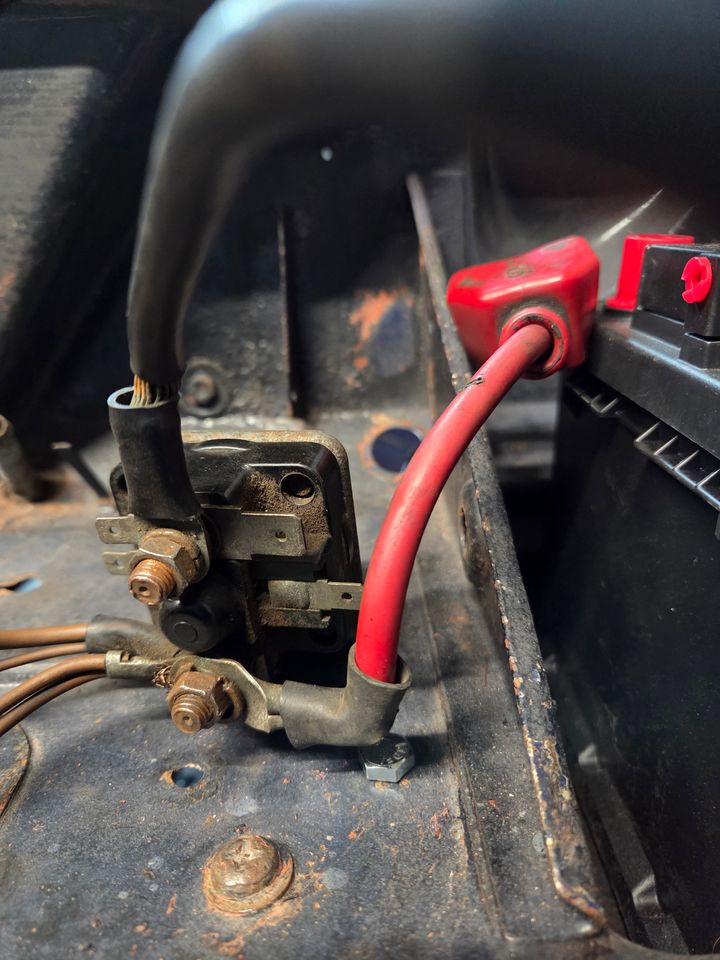
This is the best picture I can find at the moment of mine.
You can see the engine earth cable running up beside the solenoid and its connection to the bodywork to the right of the battery.
tms996 said:
Thanks I've just found another earthing cable which is just as you both described, braided, rather than the uninsulated one I had fitted.
So the end needs to go on one of the starter motor mounting bolts into the bell housing to earth it. I'll get it on later and check. Thanks
Just popped into the garage to check and mine is bolted to a bolt on the bell housing adjacent to the starter motor bolts. So the end needs to go on one of the starter motor mounting bolts into the bell housing to earth it. I'll get it on later and check. Thanks
Gassing Station | Classic Cars and Yesterday's Heroes | Top of Page | What's New | My Stuff