
Idiot question - glue
Discussion


On a complete whim I bought a Tamiya model of my bike (Honda Blackbird).
http://www.emodels.co.uk/plastic-kits/tamiya-honda...
I havent' done a model since I was about 8 years old and even then made a right b ks of it
Do I just use normal super-glue of some description from B&Q or is there some fancy/better/more appropriate glue I should use for a better finish??
Any other tips/abuse also welcome.
Thanks.
http://www.emodels.co.uk/plastic-kits/tamiya-honda...
I havent' done a model since I was about 8 years old and even then made a right b
ks of it Do I just use normal super-glue of some description from B&Q or is there some fancy/better/more appropriate glue I should use for a better finish??
Any other tips/abuse also welcome.
Thanks.
dave_s13 said:
rhinochopig said:
It should say in the instructions RTFM 
It's normally liquid poly that you use for most kits though.
Can you link to something, "liquid poly" means nothing to me???It's normally liquid poly that you use for most kits though.
Oh and I've not got the manual to Fooking read at the mo!!
Model is in the post.http://www.emodels.co.uk/plastic-kits/humbrol-28ml...
Humbrol and Tamiya amongst other make it.
Edited by rhinochopig on Monday 28th May 13:00
Edited by rhinochopig on Monday 28th May 13:03
A bit more research required before you start the kit I think, have you thought about how you'll paint it?
This is the best glue to use, but there are cheaper versions around.
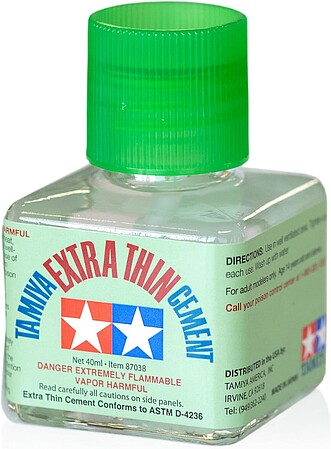
There are different glues for different jobs as well, super glue will come in handy as will epoxy (araldite or similar). The poly cement will melt the two parts together making a very strong bond, almost like welding for plastic. Superglue and epoxy will just set hard and won't damage any of the plastic if you need to remove it.
This is the best glue to use, but there are cheaper versions around.
There are different glues for different jobs as well, super glue will come in handy as will epoxy (araldite or similar). The poly cement will melt the two parts together making a very strong bond, almost like welding for plastic. Superglue and epoxy will just set hard and won't damage any of the plastic if you need to remove it.
Edited by Big Fat Fatty on Monday 28th May 12:57
rhinochopig said:
dave_s13 said:
rhinochopig said:
It should say in the instructions RTFM
It's normally liquid poly that you use for most kits though.
Can you link to something, "liquid poly" means nothing to me???It's normally liquid poly that you use for most kits though.
Oh and I've not got the manual to Fooking read at the mo!!
Model is in the post.For a beginner I'd suggest the thicker tube glue. Squeeze some out and apply it with a cocktail stick. It stays where it's put and dries quicker. I always use it without any problem:

The vast bulk of plastic model kits are made from polystyrene plastic. The standard cement that is used to "glue" this material is commonly referred to as "polystyrene cement".
In actual fact, "polystyrene cement" is neither a cement nor glue. It is a type of solvent which actually dissolves the polystyrene plastic wherever it is applied. When two pieces of plastic on which one surface has been applied are mated, the dissolving plastic actually melds the two pieces together.
Polystyrene cement comes in a number of forms -
tube
liquid (in a bottle)
Liquid in a dispenser with a needle applicator
The tube version is the one most of us grew up with. It is thick and viscous and can get very "stringy". Tube cement usually ensures a strong bond but can be messy and any wayward blobs of cement can damage parts of the model surface which will need repairing.
Liquid poly cement is better. It is thinner and easier to apply. This is normally done with a brush. Often the brush is attached to the inside of the bottle. Because it is being applied with a brush, it is easier to place the cement accurately and there is less chance of damaging adjoining surfaces.
Dispensers with applicators are a relatively recent innovation and are the best (in my opinion) way of applying polystyrene cement.
Here are some examples of polystyrene cements -
Tube -

Liquid in a bottle -

Dispenser with applicator -

There are other polystyrene cement manufacturers out there. In the UK, Humbrol is probably the best known - along with Revell.
If you are trying to glue disimilar materials - such as polystyrene plastic to white metal, or white metal to photo-etch, or acetate plastic to polystyrene, that is where other glues need to be used.
These are usually -
cyanocrylate - i.e. "super glue"
or
white PVA type glues (similar to Evo Stick wood glue)
or
two part epoxy type glues
Hope all that helps.
In actual fact, "polystyrene cement" is neither a cement nor glue. It is a type of solvent which actually dissolves the polystyrene plastic wherever it is applied. When two pieces of plastic on which one surface has been applied are mated, the dissolving plastic actually melds the two pieces together.
Polystyrene cement comes in a number of forms -
tube
liquid (in a bottle)
Liquid in a dispenser with a needle applicator
The tube version is the one most of us grew up with. It is thick and viscous and can get very "stringy". Tube cement usually ensures a strong bond but can be messy and any wayward blobs of cement can damage parts of the model surface which will need repairing.
Liquid poly cement is better. It is thinner and easier to apply. This is normally done with a brush. Often the brush is attached to the inside of the bottle. Because it is being applied with a brush, it is easier to place the cement accurately and there is less chance of damaging adjoining surfaces.
Dispensers with applicators are a relatively recent innovation and are the best (in my opinion) way of applying polystyrene cement.
Here are some examples of polystyrene cements -
Tube -
Liquid in a bottle -
Dispenser with applicator -
There are other polystyrene cement manufacturers out there. In the UK, Humbrol is probably the best known - along with Revell.
If you are trying to glue disimilar materials - such as polystyrene plastic to white metal, or white metal to photo-etch, or acetate plastic to polystyrene, that is where other glues need to be used.
These are usually -
cyanocrylate - i.e. "super glue"
or
white PVA type glues (similar to Evo Stick wood glue)
or
two part epoxy type glues
Hope all that helps.
Now you have the right stuff there's another more specialised glue you might like to try for clear parts and other uses
Your local model shop will almost certainly stock "Canopy Glue" it is a PVA glue which dries a bit stronger (I find) than normal PVA and will help glue many dis-similar plastics very firmly in short drying time (Mine is Formula 560 Canopy Glue, made in the USA by Pacer)
At the Cosford model show I helped a mate stick a broken upper spar to his model ship's mast with it
Even with the weight of some rigging holding it back the glue soon set so we could leave it alone
As it is for aircraft canopies it dries perfectly transparent too, an added bonus
Good luck with your model, do remember us and show us how you are getting on
There are many people here who will help and advise if you get "a moment of uncertainty", been there...
Your local model shop will almost certainly stock "Canopy Glue" it is a PVA glue which dries a bit stronger (I find) than normal PVA and will help glue many dis-similar plastics very firmly in short drying time (Mine is Formula 560 Canopy Glue, made in the USA by Pacer)
At the Cosford model show I helped a mate stick a broken upper spar to his model ship's mast with it
Even with the weight of some rigging holding it back the glue soon set so we could leave it alone
As it is for aircraft canopies it dries perfectly transparent too, an added bonus
Good luck with your model, do remember us and show us how you are getting on
There are many people here who will help and advise if you get "a moment of uncertainty", been there...
Forum | Scale Models | Top of Page | What's New | My Stuff