
Airfix 1/72 Curtiss P-40 Kittyhawk IA
Discussion


This is a kit I picked up on a whim when shopping in W H Smiths a few weeks ago. It is the venerable Airfix kit which dates back to the mid/late 1960s and is really well past its sell-by date by now. Indeed, Airfix have just released a brand new-tool version of the P-40 Tomahwk which is light years ahead of this offering. I think there might be a new-tool Kittyhawk on the way - but that only spurs me on to finish this one.
The first task was to completely remove all the overscale rivet detail and raised panel lines. This actually was done one evening sitting in front of the telly.
I decided not to rescribe engraved panel lines as I am increasingly coming to the conclusion that ALL panel line detail is unnecessary in 1/72 scale or smaller.
There is very little in the way of cockpit detail. The pilot gets a generic "L" shaped (and completely inaccurate) seat to sit on. There is no instrument panel nor is there any sidewall detail. However, there is a gun sight.
With this lack of detail in mind, I painted the pilot and popped him on his perch. For a bit of difference, I have him in his RAF shirt sleeves rather than wearing any sort of jacket. Most pilots flying in North Africa left their jackets off because of the intense heat.
Once all the above was sorted, I assembled the fuselage and filled the gaps - of which there were very few, surprisingly. The cockpit was masked and glued on using Pacer PVA glue.
Two queries have arisen in the colour schemes of the 112 Squadron Kittyhawk IAs.
Was the scalloped panel behind the cockpit painted with the cockpit interior colour or was it painted with the external camouflage colours? I have seen drawings and models which show both options. In period pictures - even quite good colour shots - aren't clear enough to verify this. My hunch is that they were the external colours and that is what I am going with.
The second query centres on whether this particular Kittyhawk (AK772/GA-Y) had yellow leading edges to the wings. Colour pictures of sister aircraft in the squadron all show these yellow leading edges. The only half decent picture of GA-Y is black and white but is not clear enough to show if the leading edge of the wing is yellow or not. Even though the Airfix instructions don't show yellow leading edges, I'm going to assume that it did have them.
I wanted to experiment with obtaining tonal differences in the camouflage colours as these aircraft faded extensively in the harsh sunlight of the North African theatre of operations. I have preshaded the model in a fairly random pattern i.e. I'm not attempting to pre-shade panel lines in any way. I have also sprayed some random white patches.
I'm not sure what the effect will be but I am treating this build as a bit of an experiment.
Where I'm currently at -

The first task was to completely remove all the overscale rivet detail and raised panel lines. This actually was done one evening sitting in front of the telly.
I decided not to rescribe engraved panel lines as I am increasingly coming to the conclusion that ALL panel line detail is unnecessary in 1/72 scale or smaller.
There is very little in the way of cockpit detail. The pilot gets a generic "L" shaped (and completely inaccurate) seat to sit on. There is no instrument panel nor is there any sidewall detail. However, there is a gun sight.
With this lack of detail in mind, I painted the pilot and popped him on his perch. For a bit of difference, I have him in his RAF shirt sleeves rather than wearing any sort of jacket. Most pilots flying in North Africa left their jackets off because of the intense heat.
Once all the above was sorted, I assembled the fuselage and filled the gaps - of which there were very few, surprisingly. The cockpit was masked and glued on using Pacer PVA glue.
Two queries have arisen in the colour schemes of the 112 Squadron Kittyhawk IAs.
Was the scalloped panel behind the cockpit painted with the cockpit interior colour or was it painted with the external camouflage colours? I have seen drawings and models which show both options. In period pictures - even quite good colour shots - aren't clear enough to verify this. My hunch is that they were the external colours and that is what I am going with.
The second query centres on whether this particular Kittyhawk (AK772/GA-Y) had yellow leading edges to the wings. Colour pictures of sister aircraft in the squadron all show these yellow leading edges. The only half decent picture of GA-Y is black and white but is not clear enough to show if the leading edge of the wing is yellow or not. Even though the Airfix instructions don't show yellow leading edges, I'm going to assume that it did have them.
I wanted to experiment with obtaining tonal differences in the camouflage colours as these aircraft faded extensively in the harsh sunlight of the North African theatre of operations. I have preshaded the model in a fairly random pattern i.e. I'm not attempting to pre-shade panel lines in any way. I have also sprayed some random white patches.
I'm not sure what the effect will be but I am treating this build as a bit of an experiment.
Where I'm currently at -
Thanks for the advice. I'm not too worried if this doesn't turn out that great. It's a bit of an experiment.
I'm going to muck the thing up quite a bit after the decals are on. In fact, the fuselage roundels of the real GA-Y had a touch of overspray on them so it is obvious that the aircraft was repainted in the field and none too carefully at that. The fuselage serial decal has a green background which shows that the original earth/green colours were replaced by earth/mid-stone in theatre.
This is the real one -

I'm going to muck the thing up quite a bit after the decals are on. In fact, the fuselage roundels of the real GA-Y had a touch of overspray on them so it is obvious that the aircraft was repainted in the field and none too carefully at that. The fuselage serial decal has a green background which shows that the original earth/green colours were replaced by earth/mid-stone in theatre.
This is the real one -
I'd almost say don't bother. There are much better 1/72 P-40Es around - notably the Academy one. I bought it on a whim as a piece of modelling nostalgia.
It's almost there and I shoul;d finish it over the weekend. I'm at the weathering stage now.
The Revell P-51D is also a clunker that should be withdrawn or replaced. Revell re-released it very recently - which is a pity. Again, I'd go with the Academy or perhaps the 1970s Heller version, which is not bad for its age. Airfix have also re-released their ancient P-51D which is best avoided too.
I hestitate to recommend Hasegawa kits at the moment due to their outrageous prices.
It's almost there and I shoul;d finish it over the weekend. I'm at the weathering stage now.
The Revell P-51D is also a clunker that should be withdrawn or replaced. Revell re-released it very recently - which is a pity. Again, I'd go with the Academy or perhaps the 1970s Heller version, which is not bad for its age. Airfix have also re-released their ancient P-51D which is best avoided too.
I hestitate to recommend Hasegawa kits at the moment due to their outrageous prices.
Eric Mc said:
I'd almost say don't bother. There are much better 1/72 P-40Es around - notably the Academy one. I bought it on a whim as a piece of modelling nostalgia.
It's almost there and I shoul;d finish it over the weekend. I'm at the weathering stage now.
The Revell P-51D is also a clunker that should be withdrawn or replaced. Revell re-released it very recently - which is a pity. Again, I'd go with the Academy or perhaps the 1970s Heller version, which is not bad for its age. Airfix have also re-released their ancient P-51D which is best avoided too.
I hestitate to recommend Hasegawa kits at the moment due to their outrageous prices.
It's almost there and I shoul;d finish it over the weekend. I'm at the weathering stage now.
The Revell P-51D is also a clunker that should be withdrawn or replaced. Revell re-released it very recently - which is a pity. Again, I'd go with the Academy or perhaps the 1970s Heller version, which is not bad for its age. Airfix have also re-released their ancient P-51D which is best avoided too.
I hestitate to recommend Hasegawa kits at the moment due to their outrageous prices.
I wasn't thinking of building it. Just that by coincidence I'd got one. I occasionaly buy the old kit boxings out of nostalgia.
Apparently Airfix are about to release a new 1:72 Mustang.

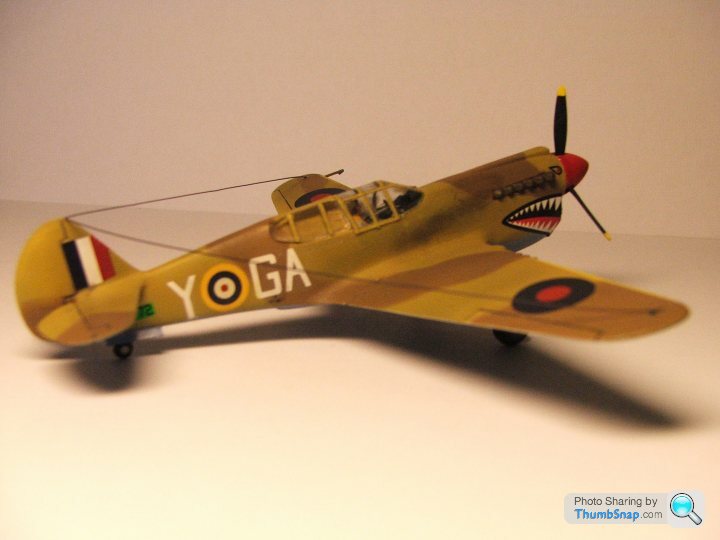
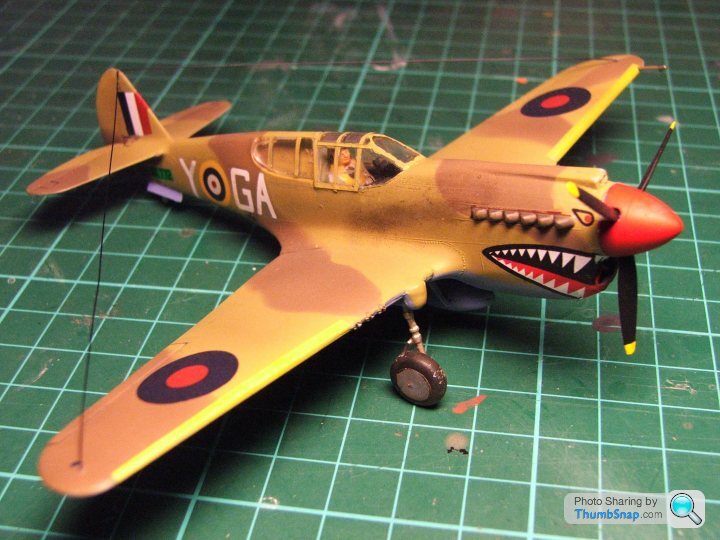
I enjoy a battle.
Yes, the aircraft were originally delivered in the standard day fighter scheme of the time, dark green and dark earth - although the shades were a bit odd as the Americans used a version supplied by Dupont, which was not the same as the stanard UK version. The green was overpainted with mid-stone in North Africa. Airfix reflect this by givung the serial decal a green background - although the green is far too bright.
Yes, the aircraft were originally delivered in the standard day fighter scheme of the time, dark green and dark earth - although the shades were a bit odd as the Americans used a version supplied by Dupont, which was not the same as the stanard UK version. The green was overpainted with mid-stone in North Africa. Airfix reflect this by givung the serial decal a green background - although the green is far too bright.
Eric Mc said:
I enjoy a battle.
Yes, the aircraft were originally delivered in the standard day fighter scheme of the time, dark green and dark earth - although the shades were a bit odd as the Americans used a version supplied by Dupont, which was not the same as the stanard UK version. The green was overpainted with mid-stone in North Africa. Airfix reflect this by givung the serial decal a green background - although the green is far too bright.
So, in that case what I was thinking was wouldn't the rear screen panels be covering green rather than sand? Yes, the aircraft were originally delivered in the standard day fighter scheme of the time, dark green and dark earth - although the shades were a bit odd as the Americans used a version supplied by Dupont, which was not the same as the stanard UK version. The green was overpainted with mid-stone in North Africa. Airfix reflect this by givung the serial decal a green background - although the green is far too bright.
Or did they remove the panels specifically to paint behind them?
ETA, looking at the B&W photo you posted, they are clearly not the same shade as the serial background, so it makes sense they would be sand coloured I suppose?
No real idea. I looked at colour shots taken of 112 Squadron P-40s and I just couldn't tell whether the scalloped areas were Interior Green, Dark Green or Sand/Mid-Stone.
So I opted for the camouflage colour rather than the interior colour. I'm sure those perspex panels would have come out quite easily so they should not have been a major hindrance ina repaint.
The example at Hendon is a later model which doesn't have that cockpit canopy layout so that was of no help to me when I had a look at it a few weeks ago.

If that recently discovered example found in Egypt makes its way back to the UK, we may find out for sure
So I opted for the camouflage colour rather than the interior colour. I'm sure those perspex panels would have come out quite easily so they should not have been a major hindrance ina repaint.
The example at Hendon is a later model which doesn't have that cockpit canopy layout so that was of no help to me when I had a look at it a few weeks ago.
If that recently discovered example found in Egypt makes its way back to the UK, we may find out for sure

Forum | Scale Models | Top of Page | What's New | My Stuff