
Discussion


Just by way of info, I set the time of my Oris Aquis Date on July 1st to BST using my iPhone.
It gets worn everyday and set on the bedside table overnight.
It was fully serviced on 3rd October 2018 by Watch Doctors in Tring.
It is currently running at -10 seconds which, as I type on 17th July, seems pretty impressive at less than a loss of one second per day. Certainly better than my old Sub which gained 3-4 seconds a day (serviced by Rolex). My Navitimer is a little better.
I don't know how that compares to more expensive stuff, or brands like Omega, but that's not too shabby in my book.
What's typical gain/loss?
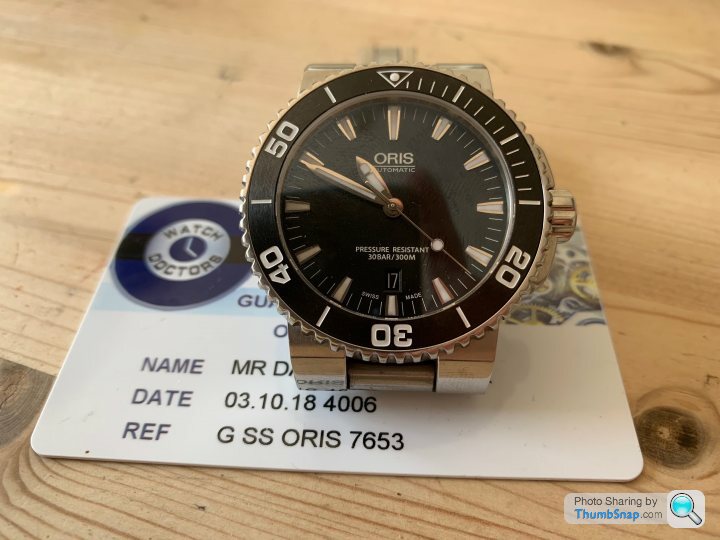
It gets worn everyday and set on the bedside table overnight.
It was fully serviced on 3rd October 2018 by Watch Doctors in Tring.
It is currently running at -10 seconds which, as I type on 17th July, seems pretty impressive at less than a loss of one second per day. Certainly better than my old Sub which gained 3-4 seconds a day (serviced by Rolex). My Navitimer is a little better.
I don't know how that compares to more expensive stuff, or brands like Omega, but that's not too shabby in my book.
What's typical gain/loss?
Pretty good, I’d be happy with that. I do like Oris as a brand, and the Aquis as a model.
In order to attain ‘Chronometer’ status in Switzerland, the COSC institute requires all movements submitted to it by manufacturers for independent testing to achieve a maximum daily time loss or gain of between -4/+6 seconds (this is an average measured over 10 days & 5 positions). For various reasons I don’t get overly excited by COSC certification, and some perhaps wouldn’t deem that as being especially accurate, but still.
Other manufacturers further add to the COSC pass, or have their own entirely separate standards & tests - Omega’s METAS ‘Master Chronometer’ standard allows a daily rate of between 0 to +5 seconds, and Rolex’s ‘Superlative Chronometer’ between -2/+2 daily.
However, any proper discussion re accuracy really needs to take account of both the accuracy/consistency of the time reference used (and a mobile can be lacking in that regard), plus variance across positions.
In order to attain ‘Chronometer’ status in Switzerland, the COSC institute requires all movements submitted to it by manufacturers for independent testing to achieve a maximum daily time loss or gain of between -4/+6 seconds (this is an average measured over 10 days & 5 positions). For various reasons I don’t get overly excited by COSC certification, and some perhaps wouldn’t deem that as being especially accurate, but still.
Other manufacturers further add to the COSC pass, or have their own entirely separate standards & tests - Omega’s METAS ‘Master Chronometer’ standard allows a daily rate of between 0 to +5 seconds, and Rolex’s ‘Superlative Chronometer’ between -2/+2 daily.
However, any proper discussion re accuracy really needs to take account of both the accuracy/consistency of the time reference used (and a mobile can be lacking in that regard), plus variance across positions.
That’s very good indeed.
The thing is, no one should buy an automatic wristwatch for its accuracy. It is however a nice thing to have if you get one that’s well-regulated.
My Seiko Prospex is currently at -1.5 secs/day.
I got my Vostok Amphibian to +5/day which was pretty good for a cheapy.
The thing is, no one should buy an automatic wristwatch for its accuracy. It is however a nice thing to have if you get one that’s well-regulated.
My Seiko Prospex is currently at -1.5 secs/day.
I got my Vostok Amphibian to +5/day which was pretty good for a cheapy.
Edited by Barchettaman on Wednesday 17th July 14:53
For what purpose do us plebs need to know the time to an accuracy of less than a minute? C19th railwaymen excepted, who gives a winged excrement?
A chronometer spec watch will drift -28/+42 seconds over a week if it's right at the edge of its spec. Who cares?
5 minute accuracy is good enough for daily life. Over five weeks, in the absolute worst case, your chronometer could be 2mins 20 seconds slow or 3mins 30 fast.
I'd suggest that if this accuracy is a problem for you, or resetting your watch every five weeks is too much effort, then you should be wearing a quartz. It's not as if access to an accurate time source is an issue any more.The inaccuracy of mechanicals is part of their charm.
Being a watchy, I change my watch almost as frequently as my underwear (I buy new watches far more frequently than new underwear and have way more of the former!) Accuracy of my watches isn't noticeable, let alone having a detrimental impact on my life.
A chronometer spec watch will drift -28/+42 seconds over a week if it's right at the edge of its spec. Who cares?
5 minute accuracy is good enough for daily life. Over five weeks, in the absolute worst case, your chronometer could be 2mins 20 seconds slow or 3mins 30 fast.
I'd suggest that if this accuracy is a problem for you, or resetting your watch every five weeks is too much effort, then you should be wearing a quartz. It's not as if access to an accurate time source is an issue any more.The inaccuracy of mechanicals is part of their charm.
Being a watchy, I change my watch almost as frequently as my underwear (I buy new watches far more frequently than new underwear and have way more of the former!) Accuracy of my watches isn't noticeable, let alone having a detrimental impact on my life.
For me, it’s one measure of quality.
I agree extreme accuracy isn’t crucial to the majority in everyday life, and likewise I rarely wear a watch for longer than a couple of consecutive days, so it’s a moot point largely.
I also don’t get hung-up on accuracy – when you think what these mechanisms have to deal with on a daily basis, and over the years, accuracy to a few seconds per day is admirable to my mind.
However, I do have a great appreciation for accuracy in certain watches – as a self-confessed geek, I admire the engineering features that allow a movement to keep superior time, or the fact that the watchmaker has clearly hand-regulated the cased watch so that it performs to its best on the customer’s wrist.
Others maybe appreciate the watch history, or fine finishing, or complications, or materials used, or rarity, or design etc. etc. – accuracy is just one of many aspects that can be validly appreciated in this hobby.
I agree extreme accuracy isn’t crucial to the majority in everyday life, and likewise I rarely wear a watch for longer than a couple of consecutive days, so it’s a moot point largely.
I also don’t get hung-up on accuracy – when you think what these mechanisms have to deal with on a daily basis, and over the years, accuracy to a few seconds per day is admirable to my mind.
However, I do have a great appreciation for accuracy in certain watches – as a self-confessed geek, I admire the engineering features that allow a movement to keep superior time, or the fact that the watchmaker has clearly hand-regulated the cased watch so that it performs to its best on the customer’s wrist.
Others maybe appreciate the watch history, or fine finishing, or complications, or materials used, or rarity, or design etc. etc. – accuracy is just one of many aspects that can be validly appreciated in this hobby.
UnclePat said:
For me, it’s one measure of quality.
I agree extreme accuracy isn’t crucial to the majority in everyday life, and likewise I rarely wear a watch for longer than a couple of consecutive days, so it’s a moot point largely.
I also don’t get hung-up on accuracy – when you think what these mechanisms have to deal with on a daily basis, and over the years, accuracy to a few seconds per day is admirable to my mind.
However, I do have a great appreciation for accuracy in certain watches – as a self-confessed geek, I admire the engineering features that allow a movement to keep superior time, or the fact that the watchmaker has clearly hand-regulated the cased watch so that it performs to its best on the customer’s wrist.
Others maybe appreciate the watch history, or fine finishing, or complications, or materials used, or rarity, or design etc. etc. – accuracy is just one of many aspects that can be validly appreciated in this hobby.
I agree.I agree extreme accuracy isn’t crucial to the majority in everyday life, and likewise I rarely wear a watch for longer than a couple of consecutive days, so it’s a moot point largely.
I also don’t get hung-up on accuracy – when you think what these mechanisms have to deal with on a daily basis, and over the years, accuracy to a few seconds per day is admirable to my mind.
However, I do have a great appreciation for accuracy in certain watches – as a self-confessed geek, I admire the engineering features that allow a movement to keep superior time, or the fact that the watchmaker has clearly hand-regulated the cased watch so that it performs to its best on the customer’s wrist.
Others maybe appreciate the watch history, or fine finishing, or complications, or materials used, or rarity, or design etc. etc. – accuracy is just one of many aspects that can be validly appreciated in this hobby.
That the design & manufacturing team managed to produce a mechanical timepiece that in volume meets COSC or better spec. is something I appreciate.
That my 50 year old COSC spec.'d watch probably hasn't performed to those spec.s for the majority of it's life doesn't bother me, neither does the fact that I probably didn't set it accurately in the first place.
Ironically the only chronometer I own is a Rado Diastar with a faceted sapphire crystal. Ironic because the crystal makes it damn near impossible to see exactly where the second hand actually is.
mikeveal said:
For what purpose do us plebs need to know the time to an accuracy of less than a minute? C19th railwaymen excepted, who gives a winged excrement?
A chronometer spec watch will drift -28/+42 seconds over a week if it's right at the edge of its spec. Who cares?
5 minute accuracy is good enough for daily life. Over five weeks, in the absolute worst case, your chronometer could be 2mins 20 seconds slow or 3mins 30 fast.
I'd suggest that if this accuracy is a problem for you, or resetting your watch every five weeks is too much effort, then you should be wearing a quartz. It's not as if access to an accurate time source is an issue any more.The inaccuracy of mechanicals is part of their charm.
Being a watchy, I change my watch almost as frequently as my underwear (I buy new watches far more frequently than new underwear and have way more of the former!) Accuracy of my watches isn't noticeable, let alone having a detrimental impact on my life.
Agreed, except it's 4 minute accuracy that's important as traffic wardens wait (or pretend to) until 4 minutes past the time your parking meter expired before giving you a ticket!A chronometer spec watch will drift -28/+42 seconds over a week if it's right at the edge of its spec. Who cares?
5 minute accuracy is good enough for daily life. Over five weeks, in the absolute worst case, your chronometer could be 2mins 20 seconds slow or 3mins 30 fast.
I'd suggest that if this accuracy is a problem for you, or resetting your watch every five weeks is too much effort, then you should be wearing a quartz. It's not as if access to an accurate time source is an issue any more.The inaccuracy of mechanicals is part of their charm.
Being a watchy, I change my watch almost as frequently as my underwear (I buy new watches far more frequently than new underwear and have way more of the former!) Accuracy of my watches isn't noticeable, let alone having a detrimental impact on my life.
Most decent movements can be regulated to within a second a day, but it's dependent on knowing the temperatures the watch sits at when on a bedside table and during daily use. Although low thermal expansion materials are used for the hair spring and balance, they are still affected by temperature variations, and as 1 second a day is an accuracy of 99.999% then just a 0.001% change in material properties will cause a 1 second variation. Quartz watches are far less sensitive to temperatures because they oscillate at something like 32,000 cycles per second instead of the 8 cycles of a mechanical watch (or 10 if it's a Rolex) and quartz, being a rock, isn't very temperature sensitive.
Lorne said:
Wounder why they reduced the zenith 10 beats per sec to 8 as the faster rate would be good marketing.
Almost certainly for greater longevity of both power reserve and also servicing intervals - the higher beat-rate requires more mainspring power if a suitable reserve is to be achieved, which also places the gear train under greater stress & wear. Dropping it to 8 bps was a compromise between durability/longevity & accuracy.
I’ve seen accounts of Zenith 36,000 servicing where the movement tends to ‘chew’ itself and produces wear debris.
However, given Rolex extensively modified the Zenith movement in other ways, it’s probable that any accuracy loss from reducing the bps was compensated for in other ways.
For all that Rolex market shrewdly & heavily, they equally concentrate upon a combination of durability, practicality, precision & reliability. I don’t think they’d retain & trumpet the 10 bps thing if it both compromised the movement in other ways and was properly associated more with another manufacturer (Zenith) than Rolex.
UnclePat said:
Lorne said:
Wounder why they reduced the zenith 10 beats per sec to 8 as the faster rate would be good marketing.
Almost certainly for greater longevity of both power reserve and also servicing intervals - the higher beat-rate requires more mainspring power if a suitable reserve is to be achieved, which also places the gear train under greater stress & wear. Dropping it to 8 bps was a compromise between durability/longevity & accuracy.
I’ve seen accounts of Zenith 36,000 servicing where the movement tends to ‘chew’ itself and produces wear debris.
However, given Rolex extensively modified the Zenith movement in other ways, it’s probable that any accuracy loss from reducing the bps was compensated for in other ways.
For all that Rolex market shrewdly & heavily, they equally concentrate upon a combination of durability, practicality, precision & reliability. I don’t think they’d retain & trumpet the 10 bps thing if it both compromised the movement in other ways and was properly associated more with another manufacturer (Zenith) than Rolex.
Gassing Station | Watches | Top of Page | What's New | My Stuff