
Is this a lead pipe?
Discussion


Been doing a bit of detective work in my 1948 bungalow - my main stop valve is in the loft. The water main comes in the side of my bungalow and then travels up some boxed in section - in the loft it's copper pipe.
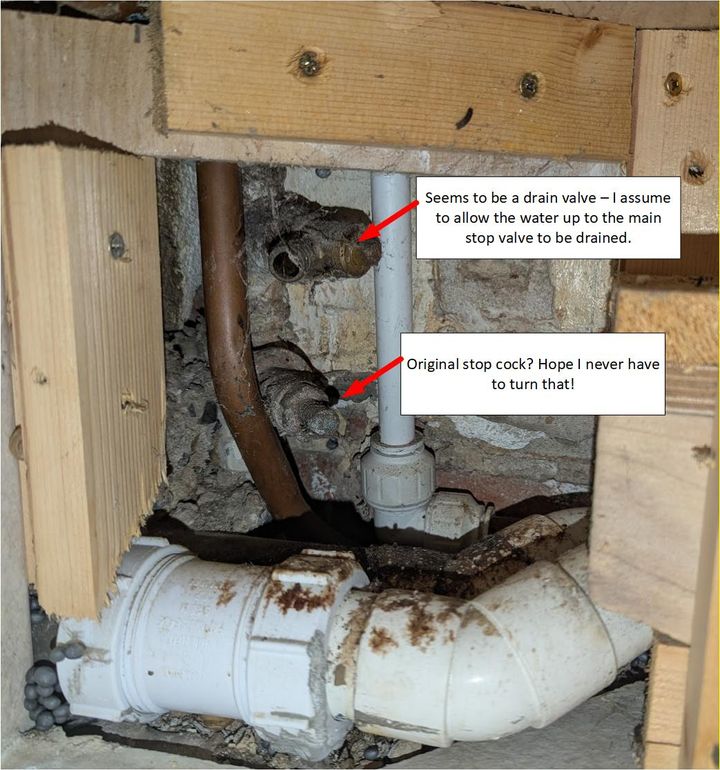
The access to the pipe that goes into the loft is very bad, and i'm wondering if it's lead. I'm pretty certain the supply to the house is black plastic form the 70s - 90s as i had a collapsed sewer and we saw a black water pipe then. This is a general view of the situation:
The access is very tricky. The pipe seems to come up out of concrete. This is best angle I can get on it:
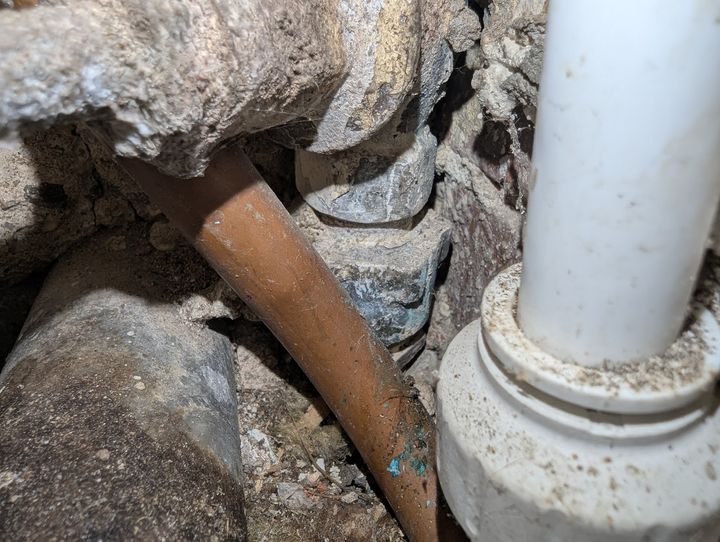
My main concern is whether the pipe into the house is lead or not. i.e. the builders ran the plastic pipe to the tricky bit that's covered in a concrete and then attached the plastic to that, then attached copper once in the house.
From 'the internet' I have determined that normally there is a big blob of lead on a lead joint (which unless it's buried in the concrete is not the case here) or there is a 'lead lock' system which this looks a bit like maybe?
Anyone able to put my mind at rest (two young kids!).
The access to the pipe that goes into the loft is very bad, and i'm wondering if it's lead. I'm pretty certain the supply to the house is black plastic form the 70s - 90s as i had a collapsed sewer and we saw a black water pipe then. This is a general view of the situation:
The access is very tricky. The pipe seems to come up out of concrete. This is best angle I can get on it:
My main concern is whether the pipe into the house is lead or not. i.e. the builders ran the plastic pipe to the tricky bit that's covered in a concrete and then attached the plastic to that, then attached copper once in the house.
From 'the internet' I have determined that normally there is a big blob of lead on a lead joint (which unless it's buried in the concrete is not the case here) or there is a 'lead lock' system which this looks a bit like maybe?
Anyone able to put my mind at rest (two young kids!).
ewanjp said:
Been doing a bit of detective work in my 1948 bungalow - my main stop valve is in the loft. The water main comes in the side of my bungalow and then travels up some boxed in section - in the loft it's copper pipe.
The access to the pipe that goes into the loft is very bad, and i'm wondering if it's lead. I'm pretty certain the supply to the house is black plastic form the 70s - 90s as i had a collapsed sewer and we saw a black water pipe then. This is a general view of the situation:
The access is very tricky. The pipe seems to come up out of concrete. This is best angle I can get on it:
My main concern is whether the pipe into the house is lead or not. i.e. the builders ran the plastic pipe to the tricky bit that's covered in a concrete and then attached the plastic to that, then attached copper once in the house.
From 'the internet' I have determined that normally there is a big blob of lead on a lead joint (which unless it's buried in the concrete is not the case here) or there is a 'lead lock' system which this looks a bit like maybe?
Anyone able to put my mind at rest (two young kids!).
In the top photo, the pipe on the left is copper, the pipe on the right looks like it is plastic.The access to the pipe that goes into the loft is very bad, and i'm wondering if it's lead. I'm pretty certain the supply to the house is black plastic form the 70s - 90s as i had a collapsed sewer and we saw a black water pipe then. This is a general view of the situation:
The access is very tricky. The pipe seems to come up out of concrete. This is best angle I can get on it:
My main concern is whether the pipe into the house is lead or not. i.e. the builders ran the plastic pipe to the tricky bit that's covered in a concrete and then attached the plastic to that, then attached copper once in the house.
From 'the internet' I have determined that normally there is a big blob of lead on a lead joint (which unless it's buried in the concrete is not the case here) or there is a 'lead lock' system which this looks a bit like maybe?
Anyone able to put my mind at rest (two young kids!).
Is that the question you were asking?
Sounds a bit of an odd set up. With access being difficult it may be easier to just run in a new pipe and cap off the existing one.
What's covering the existing pipe? Splashed concrete??
What's covering the existing pipe? Splashed concrete??
RGG said:
From the photo, it looks like it.
The test - scrape a small gouge with something sharp ( a chisel) and it will reveal a shiny grey / silver surface.
It could be a combination of lead and galvanised steel components.
Go very carefully esp. if the covering is splattered concrete - concrete is stiff and lead is soft.The test - scrape a small gouge with something sharp ( a chisel) and it will reveal a shiny grey / silver surface.
It could be a combination of lead and galvanised steel components.
No the pipe at the back.
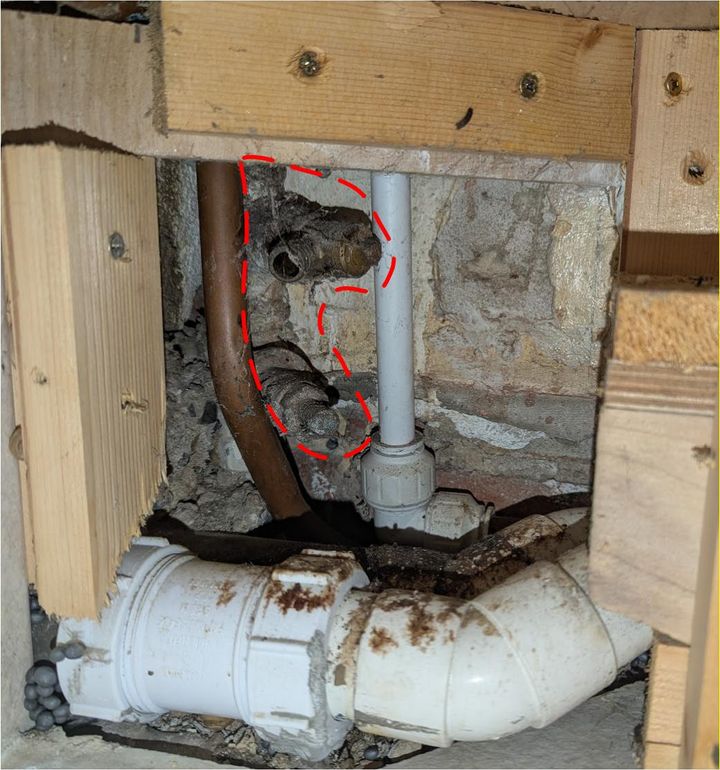
I know the pipe going up to the loft is copper as I can reach the other end of it.
I can't get to the pipe that is coming out of the concrete (as it's in concrete) to scratch it to check for lead. All I can see is this bottom nut assembly - I'm wondering if any plumbers recognise it as the led lock system I guess.
I know the pipe going up to the loft is copper as I can reach the other end of it.
I can't get to the pipe that is coming out of the concrete (as it's in concrete) to scratch it to check for lead. All I can see is this bottom nut assembly - I'm wondering if any plumbers recognise it as the led lock system I guess.
Fastpedeller said:
bimsb6 said:
Are you sure its still in use? I m sure most plumbers won t remove the old stuff just bypass it .
That's a good point - Could a sample of the water be tested to measure lead content? That would surely be pretty conclusiveewanjp said:
No the pipe at the back.
I know the pipe going up to the loft is copper as I can reach the other end of it.
I can't get to the pipe that is coming out of the concrete (as it's in concrete) to scratch it to check for lead. All I can see is this bottom nut assembly - I'm wondering if any plumbers recognise it as the led lock system I guess.
Dunno, it looks as though it's got lagging on it. Can you clear the lagging off and then you might see what it is. I wonder if it's mild steel (barrel)?I know the pipe going up to the loft is copper as I can reach the other end of it.
I can't get to the pipe that is coming out of the concrete (as it's in concrete) to scratch it to check for lead. All I can see is this bottom nut assembly - I'm wondering if any plumbers recognise it as the led lock system I guess.
But, as someone said it may be obsolete and bypassed.
I'm pretty certain it's still in use. I think the copper pipe and plastic pipe are related to the hot water tank / hot / toilet / shower water system which is immediately adjacent.
I've contacted thames water for a water test but i'm not sure they will do it based on online comments. If I were remodelling the bathroom then it'd be a no brainer to swap it out / properly investigate it. As it is it's in a tiled boxed in section with a 25cm square access point at the bottom.
There is a decent chance that it is black plastic Alkathene pipe - when the supply pipe was replaced they could have run that in. It does seem to have some hessian stuff coming out the bottom.
I've contacted thames water for a water test but i'm not sure they will do it based on online comments. If I were remodelling the bathroom then it'd be a no brainer to swap it out / properly investigate it. As it is it's in a tiled boxed in section with a 25cm square access point at the bottom.
There is a decent chance that it is black plastic Alkathene pipe - when the supply pipe was replaced they could have run that in. It does seem to have some hessian stuff coming out the bottom.
ewanjp said:
I'm pretty certain it's still in use. I think the copper pipe and plastic pipe are related to the hot water tank / hot / toilet / shower water system which is immediately adjacent.
I've contacted thames water for a water test but i'm not sure they will do it based on online comments. If I were remodelling the bathroom then it'd be a no brainer to swap it out / properly investigate it. As it is it's in a tiled boxed in section with a 25cm square access point at the bottom.
There is a decent chance that it is black plastic Alkathene pipe - when the supply pipe was replaced they could have run that in. It does seem to have some hessian stuff coming out the bottom.
Could you get a 'private' water test without involving Thames Water? If TW find a problem (I'd think unlikely) they may 'condemn' and get their people in to replace and give you a bill? I think that's unlikely - just speculating on worst case. If you get a private test and levels are ok, then no problem, if levels are higher than permitted/safe, you could maybe compare to a sample from a modern building having no possibility of lead pipes. A private test may not be very expensive and probably more speedy than involving TW.I've contacted thames water for a water test but i'm not sure they will do it based on online comments. If I were remodelling the bathroom then it'd be a no brainer to swap it out / properly investigate it. As it is it's in a tiled boxed in section with a 25cm square access point at the bottom.
There is a decent chance that it is black plastic Alkathene pipe - when the supply pipe was replaced they could have run that in. It does seem to have some hessian stuff coming out the bottom.
Good idea i'll look into a private test if no immediate joy with TW.
The only silver lining to this is that it they have been hounding me to have a compulsory meter fitted, which they say must be inside. They apparently don't fit them in lofts so I assume i'll go onto an assessed charge which will be cheaper than my current bill.
The only silver lining to this is that it they have been hounding me to have a compulsory meter fitted, which they say must be inside. They apparently don't fit them in lofts so I assume i'll go onto an assessed charge which will be cheaper than my current bill.
ewanjp said:
Good idea i'll look into a private test if no immediate joy with TW.
The only silver lining to this is that it they have been hounding me to have a compulsory meter fitted, which they say must be inside. They apparently don't fit them in lofts so I assume i'll go onto an assessed charge which will be cheaper than my current bill.
Why is it compulsory? New occupier? They might just fit the meter in the footpath.The only silver lining to this is that it they have been hounding me to have a compulsory meter fitted, which they say must be inside. They apparently don't fit them in lofts so I assume i'll go onto an assessed charge which will be cheaper than my current bill.
It's difficult to see whether the copper pipe has been connected to the external water supply?
Or. if it is still indeed the lead system we can see in the photo?
I don't know if you have worked that one out?
If not, an easy diagnostic test would be to run the water system inside the house with a screwdriver pressing onto each pipe in turn and listening for flow.
RGG said:
It's difficult to see whether the copper pipe has been connected to the external water supply?
Or. if it is still indeed the lead system we can see in the photo?
I don't know if you have worked that one out?
If not, an easy diagnostic test would be to run the water system inside the house with a screwdriver pressing onto each pipe in turn and listening for flow.
Are you sure it is a lead system - it's not got the big bulge of lead and the connector doesn't look like the photos i found online for a lead lock system. If you're a plumber / have experience then you might have answered my question. I'm pretty certain it's live - it goes up to the plumbing in the loft - it's a straight run and i can see the other end. The copper pipe is nothing to do with the inlet.Or. if it is still indeed the lead system we can see in the photo?
I don't know if you have worked that one out?
If not, an easy diagnostic test would be to run the water system inside the house with a screwdriver pressing onto each pipe in turn and listening for flow.
ewanjp said:
Compulsory because it's a water stressed area. No idea why inside not out - the letters i've received just say that unfortauntely it's not possible to fit outside so we're going to stick one in your kitchen where your water enters (where mine doesn't!)
OK. Whichever way you look at it the area in your second photo in the OP is a bit of a mess and will only get worse if they fit a water meter in there. I think that you either let them do what they will (and they might even replace the lead pipe) but unlikely to be ideal. Or you sort out the area properly which will mean breaking out a bit of concrete and possibly you channel into the loft. The latter will take some time and mony but have a beeter result; depends what you have the stomach for, and money of course.TA14 said:
OK. Whichever way you look at it the area in your second photo in the OP is a bit of a mess and will only get worse if they fit a water meter in there. I think that you either let them do what they will (and they might even replace the lead pipe) but unlikely to be ideal. Or you sort out the area properly which will mean breaking out a bit of concrete and possibly you channel into the loft. The latter will take some time and mony but have a beeter result; depends what you have the stomach for, and money of course.
Agree I need to sort it in time. They won't try and fit a water meter in there - they don't damage your home. If they can't fit one easily they put you on an assessed charge (based on the number of bedrooms in your house) and charge you the average use of a metered customer (this is better than an metered charge as it's cheaper and unmetered!).Simpo - yeah unfortunately the bit of pipe i'd need to scratch is buried in concrete. Really I need someone who is familiar with 70s/80s lead fittings and can tell me if that bottom fitting looks like a lead lock connector.
Forums | Homes, Gardens and DIY | Top of Page | What's New | My Stuff