
Replacement Vacuum battery
Discussion


Huzzah said:
I fitted an Amazon battery to a dyson. It's been fine. Original charger though.
I thought it was knockoff chargers that were the real problem.
Some 'battery packs' have quite a lot of charging electronics in them.I thought it was knockoff chargers that were the real problem.
I have some ebay Li Ion batteries which I don't leave charging in the house unsupervised.
OEM.
There will be multiple 18650 cells in the vac battery.
In the vid below Adam Savage (Myth Busters) teams up with some quality battery nerds to CT scan these batteries.
They find that the lack of quality control in the no-name cells means they rarely perform as advertised, whilst a surprisingly high percentage had internal faults which make them hazardous.
There will be multiple 18650 cells in the vac battery.
In the vid below Adam Savage (Myth Busters) teams up with some quality battery nerds to CT scan these batteries.
They find that the lack of quality control in the no-name cells means they rarely perform as advertised, whilst a surprisingly high percentage had internal faults which make them hazardous.
It's easy to virtue signal about buying genuine stuff, but the 'genuine' battery was probably a bit crap if it's failed already.
Paying over the odds to get the exact same piece of rubbish can be a flawed strategy.
More so if it's a 'spare part' that's been languishing in a warehouse for months.
Manufacturers of consumer goods might well be buying a lot of second-rate cells.
Whereas an aftermarket replacement might have anything from Panasonic cells downwards.
There are an awful lot of Lithium batteries out there and relatively few catch fire.
You're probably more likely to trip over the vacuum and break your neck than to be burned to death by its battery.
Which is to say, not very likely at all!
Paying over the odds to get the exact same piece of rubbish can be a flawed strategy.
More so if it's a 'spare part' that's been languishing in a warehouse for months.
Manufacturers of consumer goods might well be buying a lot of second-rate cells.
Whereas an aftermarket replacement might have anything from Panasonic cells downwards.
There are an awful lot of Lithium batteries out there and relatively few catch fire.
You're probably more likely to trip over the vacuum and break your neck than to be burned to death by its battery.
Which is to say, not very likely at all!
Byker28i said:
The other thing if it's a Dyson is you can get replacement adaptors without batteries, that allow you to plug in power tool batteries instead
This. If you've got dewalt/makita/milwaukee/whatever, the batteries are far better quality than the s te Dyson provide - so an adaptor makes it a better vac.
 grumbas said:
Thread hijack, has anyone had long term success with the battery adapters?
I've got a stack of 5ah Dewalt batteries but whenever I've looked at the Amazon reviews there are normally several suggesting the adapter has killed an otherwise fine battery.
Not specifically with a vacuum, but often the cause can be people pushing the battery well past the "low power" point. That's a bad thing, and can kill batteries. Some systems have the protection in the battery (Makita I believe) and some in the power tool (de walt I believe). So if you fit e.g. a dewalt battery to a naive tool, you can push it too far. The adapters aren't the problem (I have several), just make sure the users don't push the tools when the batteries get low.I've got a stack of 5ah Dewalt batteries but whenever I've looked at the Amazon reviews there are normally several suggesting the adapter has killed an otherwise fine battery.
biggiles said:
grumbas said:
Thread hijack, has anyone had long term success with the battery adapters?
I've got a stack of 5ah Dewalt batteries but whenever I've looked at the Amazon reviews there are normally several suggesting the adapter has killed an otherwise fine battery.
Not specifically with a vacuum, but often the cause can be people pushing the battery well past the "low power" point. That's a bad thing, and can kill batteries. Some systems have the protection in the battery (Makita I believe) and some in the power tool (de walt I believe). So if you fit e.g. a dewalt battery to a naive tool, you can push it too far. The adapters aren't the problem (I have several), just make sure the users don't push the tools when the batteries get low.I've got a stack of 5ah Dewalt batteries but whenever I've looked at the Amazon reviews there are normally several suggesting the adapter has killed an otherwise fine battery.
Reviving batteries very much depends on how much management was built in. It can get very complicated reworking them.
A battery being cheap doesn't mean it's junk - Lidl can knock out a 4Ah one with Samsung cells and a proper BMS at retail for £25, so other people can too.
Vacuum ones can be slightly more complicated- on my one at least *all* the electronics are in the battery including power level controls. Yet no cell balancing...
A battery being cheap doesn't mean it's junk - Lidl can knock out a 4Ah one with Samsung cells and a proper BMS at retail for £25, so other people can too.
Vacuum ones can be slightly more complicated- on my one at least *all* the electronics are in the battery including power level controls. Yet no cell balancing...
biggiles said:
grumbas said:
Thread hijack, has anyone had long term success with the battery adapters?
I've got a stack of 5ah Dewalt batteries but whenever I've looked at the Amazon reviews there are normally several suggesting the adapter has killed an otherwise fine battery.
Not specifically with a vacuum, but often the cause can be people pushing the battery well past the "low power" point. That's a bad thing, and can kill batteries. Some systems have the protection in the battery (Makita I believe) and some in the power tool (de walt I believe). So if you fit e.g. a dewalt battery to a naive tool, you can push it too far. The adapters aren't the problem (I have several), just make sure the users don't push the tools when the batteries get low.I've got a stack of 5ah Dewalt batteries but whenever I've looked at the Amazon reviews there are normally several suggesting the adapter has killed an otherwise fine battery.
grumbas said:
Thread hijack, has anyone had long term success with the battery adapters?
I've got a stack of 5ah Dewalt batteries but whenever I've looked at the Amazon reviews there are normally several suggesting the adapter has killed an otherwise fine battery.
I have a Dewalt adaptor for a Dyson, and I always use the Dewalt batteries on 'normal' Dyson power rather than max just to be on the safe side.I've got a stack of 5ah Dewalt batteries but whenever I've looked at the Amazon reviews there are normally several suggesting the adapter has killed an otherwise fine battery.
As others have said, the power tool batteries are massively superior in terms of reliability and capacity to the rubbish that Dyson churn out and charge a fortune for. The Dyson ones I had lasted barely a year before they were unusable.
Of course, the ultimate solution is to get a Henry!
I’m on my second replacement Dyson battery, first replacement lasted three and a half years before it developed the same issue as the original battery which lasted 5 years.
At £30 every three or four years I’m happy to keep replacing them as long as the actual Dyson lasts.
Interestingly, they claim to have greater capacity each time I replace them. No idea if that’s marketing rubbish, or actually using higher capacity cells over time.
Both replacements from Amazon.
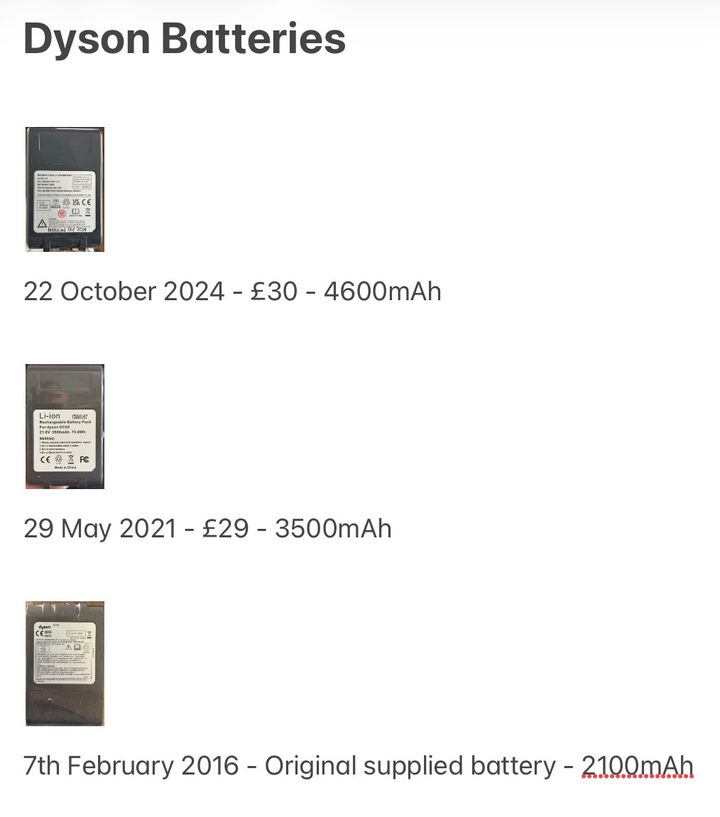
At £30 every three or four years I’m happy to keep replacing them as long as the actual Dyson lasts.
Interestingly, they claim to have greater capacity each time I replace them. No idea if that’s marketing rubbish, or actually using higher capacity cells over time.
Both replacements from Amazon.
GoodDoc said:
I m on my second replacement Dyson battery, first replacement lasted three and a half years before it developed the same issue as the original battery which lasted 5 years.
At £30 every three or four years I m happy to keep replacing them as long as the actual Dyson lasts.
Interestingly, they claim to have greater capacity each time I replace them. No idea if that s marketing rubbish, or actually using higher capacity cells over time.
Both replacements from Amazon.
Have you been running the same Dyson since 2016? Very impressive if so!At £30 every three or four years I m happy to keep replacing them as long as the actual Dyson lasts.
Interestingly, they claim to have greater capacity each time I replace them. No idea if that s marketing rubbish, or actually using higher capacity cells over time.
Both replacements from Amazon.
Forums | Homes, Gardens and DIY | Top of Page | What's New | My Stuff