
Outside sockets tripping
Discussion


There are two possibilities:
There is a fault, so it's doing its job
There is no fault, it's broken.
You could try replacing it, but odds are, it's working and there is a fault you need to find.
As it never resets, it's a permanent fault not a hard to pin down intermittent nightmare.
Wet is the prime suspect, but also damage to cables.
If it's just a couple of outdoor sockets, consider getting a sparks to replace everything rather than sod about with old stuff.
The parts to do it 'new and proper' may not be much, and you can waste a lot of hours diagnosing old junk that was marginal in the first place.
There is a fault, so it's doing its job
There is no fault, it's broken.
You could try replacing it, but odds are, it's working and there is a fault you need to find.
As it never resets, it's a permanent fault not a hard to pin down intermittent nightmare.
Wet is the prime suspect, but also damage to cables.
If it's just a couple of outdoor sockets, consider getting a sparks to replace everything rather than sod about with old stuff.
The parts to do it 'new and proper' may not be much, and you can waste a lot of hours diagnosing old junk that was marginal in the first place.
OutInTheShed said:
There are two possibilities:
There is a fault, so it's doing its job
There is no fault, it's broken.
You could try replacing it, but odds are, it's working and there is a fault you need to find.
As it never resets, it's a permanent fault not a hard to pin down intermittent nightmare.
Wet is the prime suspect, but also damage to cables.
If it's just a couple of outdoor sockets, consider getting a sparks to replace everything rather than sod about with old stuff.
The parts to do it 'new and proper' may not be much, and you can waste a lot of hours diagnosing old junk that was marginal in the first place.
If I turn the power off in the consumers unit the switch resets, as soon as the power goes on it trips.There is a fault, so it's doing its job
There is no fault, it's broken.
You could try replacing it, but odds are, it's working and there is a fault you need to find.
As it never resets, it's a permanent fault not a hard to pin down intermittent nightmare.
Wet is the prime suspect, but also damage to cables.
If it's just a couple of outdoor sockets, consider getting a sparks to replace everything rather than sod about with old stuff.
The parts to do it 'new and proper' may not be much, and you can waste a lot of hours diagnosing old junk that was marginal in the first place.
Replacing the outside stuff isn't as straightforward as I'd like. An armoured cable from the house, under a path then 40-50m up the garden to a couple of exterior sockets.
Huzzah said:
If I turn the power off in the consumers unit the switch resets, as soon as the power goes on it trips.
Replacing the outside stuff isn't as straightforward as I'd like. An armoured cable from the house, under a path then 40-50m up the garden to a couple of exterior sockets.
Unless you are happy testing continuity on a 240v circuit you are limited to getting a man out or throwing in a new RCD yourself assuming you can be entirely sure you aren’t working on a live circuit when you do it.Replacing the outside stuff isn't as straightforward as I'd like. An armoured cable from the house, under a path then 40-50m up the garden to a couple of exterior sockets.
trickywoo said:
Huzzah said:
If I turn the power off in the consumers unit the switch resets, as soon as the power goes on it trips.
Replacing the outside stuff isn't as straightforward as I'd like. An armoured cable from the house, under a path then 40-50m up the garden to a couple of exterior sockets.
Unless you are happy testing continuity on a 240v circuit you are limited to getting a man out or throwing in a new RCD yourself assuming you can be entirely sure you aren t working on a live circuit when you do it.Replacing the outside stuff isn't as straightforward as I'd like. An armoured cable from the house, under a path then 40-50m up the garden to a couple of exterior sockets.
Just get an electrician in. It would take them no time at all to identify the fault, if there are a limited number of outlets on the circuit.
I also vote for something wet/damaged.
Is it literally the outdoor socket and nothing else? I've seen outbuildings with lighting on the same circuit. Outdoor lighting often leaks and trips.
Failing that the socket itself could be damaged even if it's dry. Outdoor sockets get a different standard of care to indoor one in my experience and live a much harder life.
If you are determined to sort it yourself, pop the socket off and see if it still trips. That'll answer that question.
Is it literally the outdoor socket and nothing else? I've seen outbuildings with lighting on the same circuit. Outdoor lighting often leaks and trips.
Failing that the socket itself could be damaged even if it's dry. Outdoor sockets get a different standard of care to indoor one in my experience and live a much harder life.
If you are determined to sort it yourself, pop the socket off and see if it still trips. That'll answer that question.
Baldchap said:
I also vote for something wet/damaged.
Is it literally the outdoor socket and nothing else? I've seen outbuildings with lighting on the same circuit. Outdoor lighting often leaks and trips.
Failing that the socket itself could be damaged even if it's dry. Outdoor sockets get a different standard of care to indoor one in my experience and live a much harder life.
If you are determined to sort it yourself, pop the socket off and see if it still trips. That'll answer that question.
That's not a bad idea thx.Is it literally the outdoor socket and nothing else? I've seen outbuildings with lighting on the same circuit. Outdoor lighting often leaks and trips.
Failing that the socket itself could be damaged even if it's dry. Outdoor sockets get a different standard of care to indoor one in my experience and live a much harder life.
If you are determined to sort it yourself, pop the socket off and see if it still trips. That'll answer that question.
I'm not adverse to calling electricians, just trying to find one that responds to calls would be a start!
I have a similar issue with two external armoured cables on separate RCBs , one will trip and the other is perfect. I've disconnected everything from the tripping circuit and it still trips.... in the end I ran everything off the non tripping RCB (about 5 years ago) .. I'm sure the tripping RCB is more sensitive than the other , either that or the armoured cable is damaged, one day I'll swop them over  .
.
.GasEngineer said:
Disconnect the sockets in turn, make the ends of the cable safe and try resetting. If it still trips without the sockets connected it will be the cable or the breaker. At least you will have eliminated the sockets.
Another possible approach is to disconnect all of the sockets and then, making sure there are no loose wires touching anything, try to reset the breaker. If the breaker resets you know the cable to the first socket is good. If it won't reset your fault is on that cable. If the breaker does reset then switch off, reconnect the first socket and switch on again. If it's not obvious which is the first socket you can find it using a voltmeter. If the breaker resets the socket is good and any cable leading away from that socket is also good.
Continue like this round the system until the breaker won't hold. Then you know where to look more closely for your fault. If you are careful, methodical and patient you should be able to narrow things down.
I had a problem like this some years ago and it must have been an insulation fault on the cable, so I replaced that cable rather than trying dig up many metres to find the fault. In any event, if you replace a whole cable it avoids introducing more potential weak spots such as junction boxes. As someone has already said, it's entirely possible there's water getting into an existing underground junction box.
Thanks all.
Only 2 x sockets no lights on the circuit. I've disconnected each socket in turn, switch still trips.
This junction is suspect, but the wires seem to be potted in resin so it'd need to be cut off. (Beyond my skills etc I think)
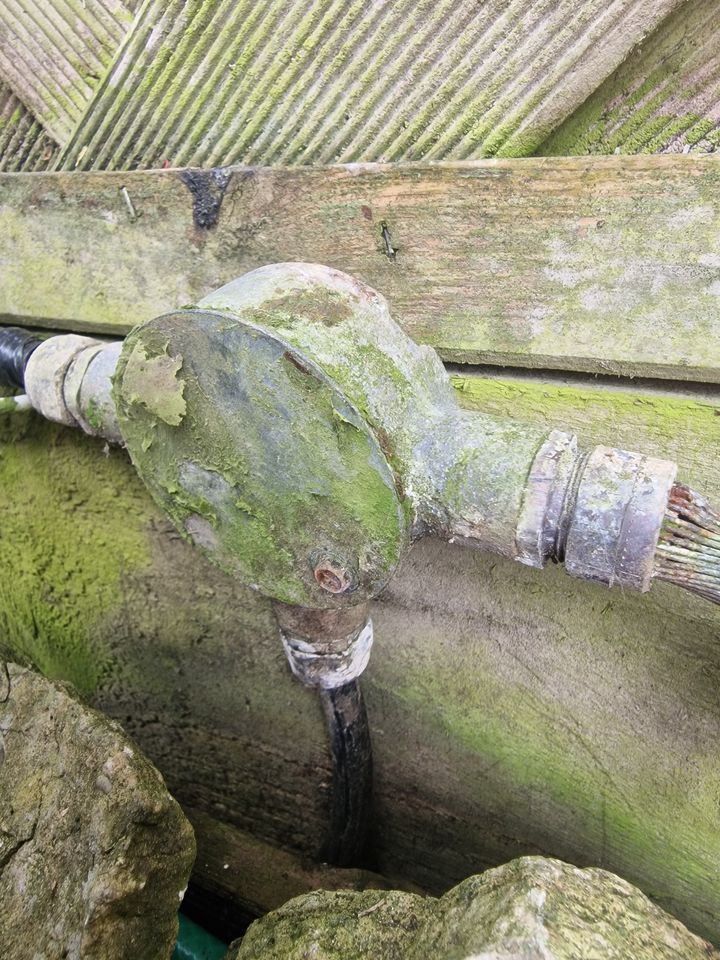
I think I'll swap the RCD to eliminate that.
Only 2 x sockets no lights on the circuit. I've disconnected each socket in turn, switch still trips.
This junction is suspect, but the wires seem to be potted in resin so it'd need to be cut off. (Beyond my skills etc I think)
I think I'll swap the RCD to eliminate that.
Edited by Huzzah on Friday 10th April 10:32
The Three D Mucketeer said:
I have a similar issue with two external armoured cables on separate RCBs , one will trip and the other is perfect. I've disconnected everything from the tripping circuit and it still trips.... in the end I ran everything off the non tripping RCB (about 5 years ago) .. I'm sure the tripping RCB is more sensitive than the other , either that or the armoured cable is damaged, one day I'll swop them over .
Let's hope the duff one is the one which trips and not the one which fails to trip... .This thread illustrates people's lack of methodical testing strategy.
A cable with some sockets on the end is a simple system, with a finite number of elements which can be possibly faulty.
The requirements for a cable are pretty simple, it must have continuity of each conductor and isolation between conductors and from the outside world.
An electrician or person with the right knowledge and test meters can check those things. The proper way is not just to see if the cable trips a 30mA breaker, but to know that the cable has no significant leakage at a higher test voltage. So a proper meter will tell you whether it's good, bad or marginal.
If the cable itself tests OK, then move on to other elements.
But really, anyone without a clear understanding and a plan should leave it well alone.
OutInTheShed said:
The Three D Mucketeer said:
I have a similar issue with two external armoured cables on separate RCBs , one will trip and the other is perfect. I've disconnected everything from the tripping circuit and it still trips.... in the end I ran everything off the non tripping RCB (about 5 years ago) .. I'm sure the tripping RCB is more sensitive than the other , either that or the armoured cable is damaged, one day I'll swop them over .
Let's hope the duff one is the one which trips and not the one which fails to trip... .This thread illustrates people's lack of methodical testing strategy.
A cable with some sockets on the end is a simple system, with a finite number of elements which can be possibly faulty.
The requirements for a cable are pretty simple, it must have continuity of each conductor and isolation between conductors and from the outside world.
An electrician or person with the right knowledge and test meters can check those things. The proper way is not just to see if the cable trips a 30mA breaker, but to know that the cable has no significant leakage at a higher test voltage. So a proper meter will tell you whether it's good, bad or marginal.
If the cable itself tests OK, then move on to other elements.
But really, anyone without a clear understanding and a plan should leave it well alone.
Edited by The Three D Mucketeer on Friday 10th April 10:44
OutInTheShed said:
As it never resets, it's a permanent fault
Yep.Get an electrician to do it - fiddling with house electrics is a hugely risky business. I lost an outbuilding to fire many years ago due to an electrical fault in a fusebox - quite dramatic and 3 fire engines turned up. The fire service did a full post mortem and it was the fusebox.
Forum | Homes, Gardens and DIY | Top of Page | What's New | My Stuff