
Carpenters opinion on mitre corner - outdoor handrail
Discussion


Part of a large job is installing balustrades and a timber handrail.
The wood being used is Sapele. Current the mitres are s t and just butted up against each other. Pic below. The work will be redone so no real issue apart from I'm getting pissed off.
Please tell me how the mitres should be done? I want them cut neatly and butted up against each other with some kind of internal fixing keeping them tight together. Sure wood moves a bit but does this stop us doing this?
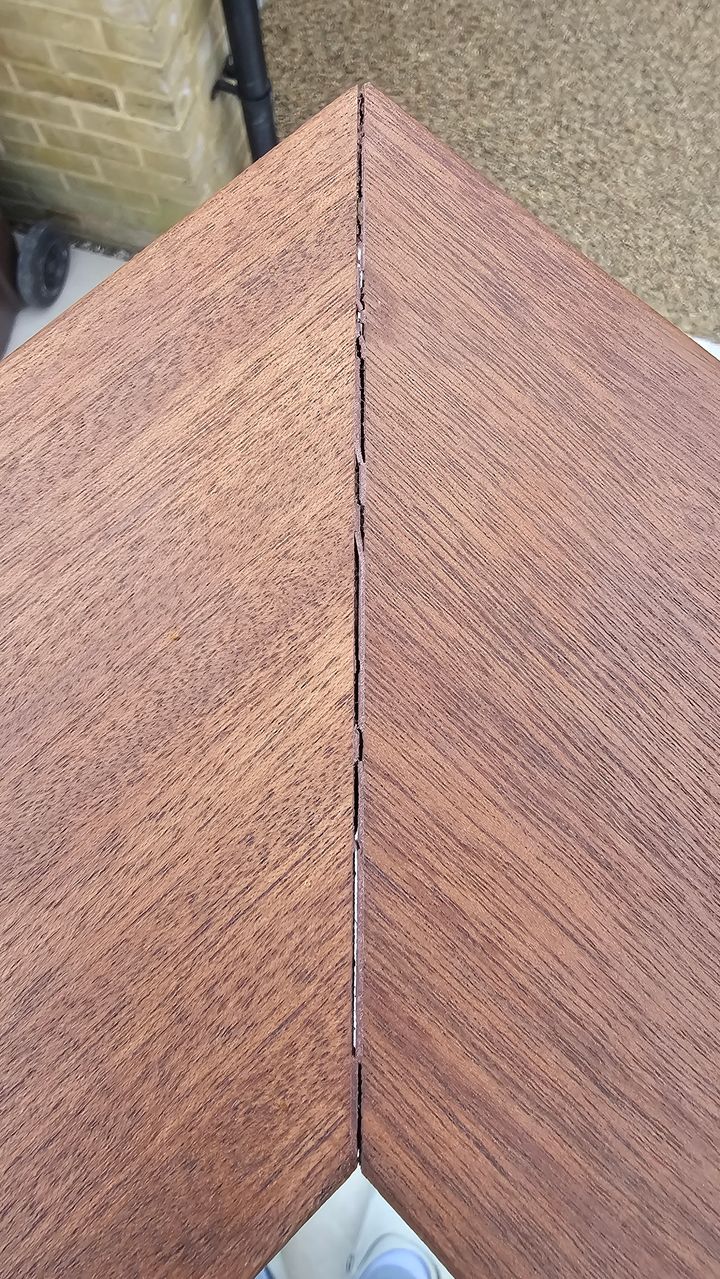
The wood being used is Sapele. Current the mitres are s
t and just butted up against each other. Pic below. The work will be redone so no real issue apart from I'm getting pissed off.Please tell me how the mitres should be done? I want them cut neatly and butted up against each other with some kind of internal fixing keeping them tight together. Sure wood moves a bit but does this stop us doing this?
2ono said:
I'm no carpenter, but could you not use a biscuit joint on that and then glue it? I only know what it is as a carpenter friend of mine showed my his box of biscuits and his fancy FesTool biscuit cutting thing.
Thanks. That's my mind of thought too.Like you though, this isn't my day job and I'm seeking a diverse set of viewpoints on whether what I'm seeking is achievable, without a 5mm expansion gap that I'm now told I need! I think that'll look gash (filled or otherwise) and if it's filled surely it'll still pull apart if the wood moves anyway?!
Is there anything about the installation environment that's forcing it to not be a perfect matching cut? Angles are off/unequal hence the cut face not being the same length each side, unles the timber didnt start the same width..
Also not obvious why it needed filling unless was cut cock-eyed.
Is there a hidden face or is it all exposed? Is it being preassembled or done in-situ?
Lamello do a fancy magnetic concealed screw fixing for when you need tight joints and glue & clamps can't do it.
Also not obvious why it needed filling unless was cut cock-eyed.
Is there a hidden face or is it all exposed? Is it being preassembled or done in-situ?
Lamello do a fancy magnetic concealed screw fixing for when you need tight joints and glue & clamps can't do it.
It's wood outside: it's bound to expand & contract so can the other end of each piece have a gap? They could try routing a dogbone into the underside:
https://www.amazon.co.uk/Kitchen-WORKTOP-Connectin...
Biscuits are more for getting two pieces level, although they do provide something better than a flat face for glueing.
https://www.amazon.co.uk/Kitchen-WORKTOP-Connectin...
Biscuits are more for getting two pieces level, although they do provide something better than a flat face for glueing.
Something like this underneath perhaps: https://www.ebay.co.uk/itm/154374726711
But you're expecting internal standards of perfection outdoors so prepare to be disappointed eventually.
ETA beaten to it!
But you're expecting internal standards of perfection outdoors so prepare to be disappointed eventually.
ETA beaten to it!
Lamello Clamex like https://www.axminstertools.com/lamello-clamex-p-14... or Invis might be better? Fully internal.
The worktop clamps take a lot of depth in the material & aren't rustproof for outdoors. Unless you use the ones for a compact worktop which are nice and small.
The worktop clamps take a lot of depth in the material & aren't rustproof for outdoors. Unless you use the ones for a compact worktop which are nice and small.
I'd suggest you should ensure there's no stress on the actual glued mitre if you want that to work.
Like take the stress on a metal plate underneath.
Alternatively rout the gap up to 4mm or something and caulk with a polyurethane or similar sealant.
I
Depends whether you want it to look tarty for its first season, or functional and OK for a few years.
Like take the stress on a metal plate underneath.
Alternatively rout the gap up to 4mm or something and caulk with a polyurethane or similar sealant.
I
Depends whether you want it to look tarty for its first season, or functional and OK for a few years.
Fitting a brass dovetail key would be best: https://www.youtube.com/watch?v=-f7gowKTW-c
You could have the best mitre in the world when installed, but it may have gaps a week later when it’s outside, this also applies internally but to a lessor extent. Timber shrinks and expands, especially in wet and sunny weather. Glueing the mitre will help but there's not a lot you can do to prevent shrinkage.
Little Lofty said:
You could have the best mitre in the world when installed, but it may have gaps a week later when it s outside, this also applies internally but to a lessor extent. Timber shrinks and expands, especially in wet and sunny weather. Glueing the mitre will help but there's not a lot you can do to prevent shrinkage.
you can either design the joint to accommodate shrinkage, e.g. flexible caulking, or you can design the assembly so that the inevitable shrinkage doesn't stress the joint. You might do that for instance by allowing the wooden component to move, not fixing the other end.But yes, screwing a wooden thing with joints to a strong rigid steel thing and then thermal/humidity cycling it, is only going to have one outcome.
Personally I think it's a naff waste of hardwood.
Forum | Homes, Gardens and DIY | Top of Page | What's New | My Stuff