
2019 BMW i8 Roadster | UK Review
A folding soft-top and chassis improvements make the i8 an even more compelling package...

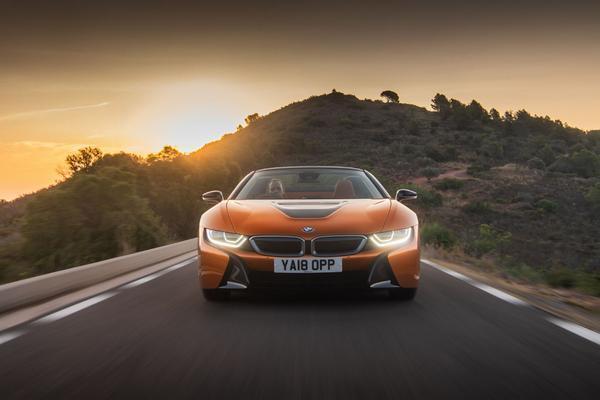
Its design may be four years old now (six if you include the 2012 concept), but walking up to a BMW i8 still feels like stepping out of a time machine into 2085. Those out-of-this-world looks have not aged a day, making the car as unique a proposition now as it was on the day of its 2014 launch.
Nevertheless, the i8 never managed to earn itself all-encompassing sports car status in the ensuing years. As much as we wanted to love it all the way around, it just doesn't quite do the compelling sports car bit as well as, say, the Porsche 911. That could be about to change, however, with the arrival of a string of updates that have been introduced to make the i8 more fun to drive. They're due on the coupe soon, but for now they're exclusive to this new variant, the i8 Roadster.
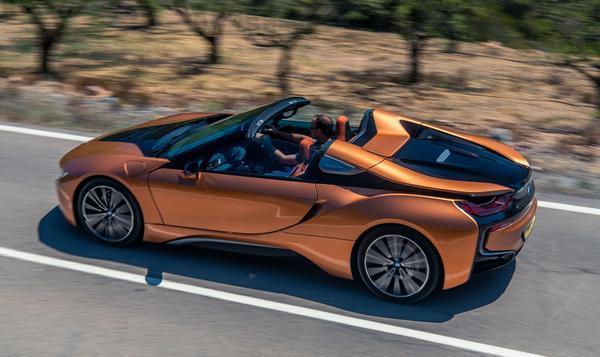
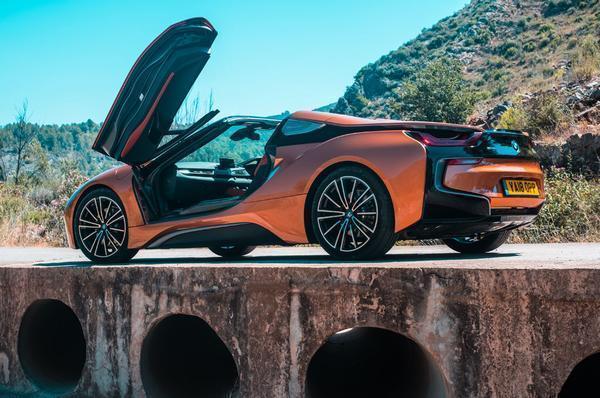
First thing's first, the design. BMW has not harmed the futuristic styling of its hybrid two-door one bit by lopping the roof off its carbon fibre passenger cell. The Roadster is a feast for the eyes with the top down, flaunting a pair of rear buttresses that serve to hide the rollover protection but more importantly blend seamlessly with its slender two-door silhouette. The number of smartphone flashes and pointing fingers directed at PH during testing suggest the electric folding soft-top model could be an even better poster boy for BMW than its coupe sibling. But that's not really why we're here...
Convention tells us to expect flex, rattles and added weight in a convertible version of a sports car, although the use of carbon fibre tubs has made this less of a certainty in recent years. The BMW i8's carbon cell was designed from the offset with a roof, though, so its engineers have had to beef up the sills of the passenger cell, add extra panels in the rear suspension and use specially designed struts for the front and rear axles to compensate for the missing lid. What you're left with is a convertible that's 60kg heavier than its coupé sibling and, in theory, able to mask the gaping hole on its head with added muscle down below.

But it can't - not entirely anyway. Aside from the obvious differences, like a breeze over your noggin, you are conscious of some very slight - and we mean so slight that you need to have the radio off and probably be riding over a speed bump - creaks in the structure. The car itself still feels taut and there's no feeling of twisting, but vertical movements do seem to encourage a teenie bit of flex beneath those dihedral doors.
Laterally, however, the changes made to the i8 have made the Roadster actually feel sharper than the coupe. BMW has added firmer roll bars and altered the electrically assisted steering map so the car is keener to turn in and provides more feedback when you lean the chassis' weight over its outside front. While much better, the steering resistance is still too light when at the straight ahead so can feel disconcerting at the first high-speed turn, but it now loads up quickly as the Roadster pitches - there is a small amount of body roll - onto its outside tyres.
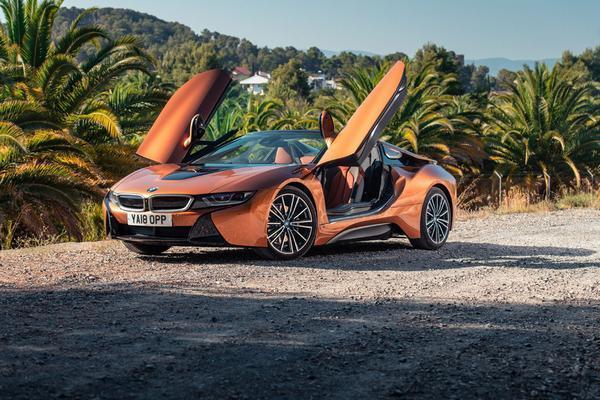
The Roadster's retuned stability control systems allow for more playfulness in such circumstances, but you'll want to switch them off if you so wish to discover newfound throttle adjustability. Far from lairy, it's a welcome addition to an otherwise planted all-wheel drive experience. The ride is firm but not brittle in Sport mode, although it's a shame that you still can't put the powertrain in Sport and leave the chassis in its Normal setting, because in that mode it feels well suited to British tarmac.
Even with these dynamic improvements, it's still the i8's petrol-electric power source that dominates the experience. Knocking the gear selector to the left turns the digital instrument cluster displays red and projects a horizontal crescent of a rev bar onto the windscreen via the head-up display. In this mode, the turbocharged 1.5-litre three-cylinder engine that's mounted just behind you has a deep, digital tone. It's orchestrated by the sound of high pressure air being forced through intake pipes, as well as the deep, bassy thud of gear shifts when you click between the wheel mounted paddles to swiftly swap cogs in the six-speed Steptronic automatic. The petrol-fed triple delivers 231hp, while the car's front-mounted electric motor, audible as a whine that increases in pitch like a rally car's straight-cut gearbox, injects a further 143hp - (12hp more than before) via a two-speed gearbox. Together, these power sources provide your right foot with a combined 374hp and 420lb ft of torque, which is by no means class-leading - but enough to latch the i8 Roadster onto the horizon and winch it towards you with convincing haste.
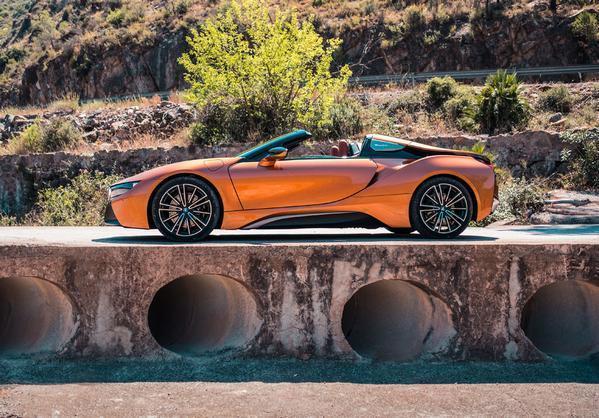
What you're experiencing is not entirely authentic - or at least the sound isn't, because much of the car's satisfying tone is augmented through the speakers. But, in a car with such a futuristic, high-tech aura, it feels like less of a crime. Like those miming 1980s pop stars that didn't even bother to bring a microphone on stage, the latest i8 doesn't attempt to hide its added digital enhancements. Instead, it flaunts them, and this is obvious in the way the engine's tone changes far more drastically than its performance when the car is switched between its drive modes. Click back to Normal and the motor sounds more like a conventional triple. Leave the car to run on electric and you're back in a spaceship...
The combination - and the unashamed extolling of its part-electric virtues - means the latest i8 easily retains its unique charm in the segment. With extra power delivered alongside 33ish miles of range thanks to a larger battery capacity (34Ah, up fro 20Ah), the car is now even more usable in full electric mode. So while it still can't match a 911 for outright driving thrills, there's something completely unparalleled on offer here - and that counts double for the Roadster. The i8 has always been about delivering a distinct experience, and in that regard, it still can't be touched. It remains imperfect, of course - a fact brought home to roost everytime the battery runs dry while you're still out enjoying it - but BMW's vision of the future remains among the most irresistible.
SPECIFICATION - BMW i8 ROADSTER
Engine: 1,499cc 3-cyl turbo plus lithium-ion battery pack and electric motor
Transmission: Six-speed automatic, four-wheel drive
Power (hp): 374 (combustion engine 231@5,800rpm, electric motor 143@4,800rpm)
Torque (lb ft): 420 (combustion engine 236@3,700rpm, electric motor 184@0rpm)
0-62mph: 4.6 seconds
Top speed: 155mph
Weight: 1,595kg (EU)
MPG: 141.2 (NEDC combined)
CO2: 46g/km
Price: £124,645 excluding Government ULEV £2,500 grant (£135,075 as tested including £2,750 i interior design Accaro pack, £1,600 carbon fibre interior trim finisher, £500 20-inch bi-colour i alloy wheels, £85 eDrive exterior sound speaker, £5,100 BMW Laserlights £235 Apple CarPlay and £160 online entertainment).



I suppose its target market is urban commuters who don't need to take anything much to work with them?
I want to like these things, but think they are totally flawed.
Interesting looking, CF tub, funky doors and reasonable economy.
However, no luggage space, massively complicated (lots to go wrong), no (good natural) noise, too heavy, too expensive, chronic depreciation ......
It is neither a great sports car nor an electric car.
It is a compromised engineers hot pot.
The i8 is a £100k+ sports car that’s outclassed dynamically by hot hatches. If that’s not a joke I don’t know what is.
It’s not pretty, it’s not quick, it’s not practical.
It’s one party trick is that it can do 30 miles on electric, just what the world needs - another electric car for very wealthy people to trade for a new one every 5 minutes.
50% depreciation after 3 years for sports cars in this sector is not good, prices have leveled now. That V12 Vantage is a much better proposition!!!
With the complexity of these things and correspondingly high future repair bills, I can see these being economical write offs when things start going wrong out of warranty and repair bills approach vehicle value..
Most garages struggle with relatively simple car fixes these days, taking one of these in for a major fix, no chance.
It doesn't have the eco credentials of a pure EV and can't perform as a proper sports car.
As it is, the massive complexity make it a risky used proposition so the depreciation is terrible.
Also 60kg weight penalty for the convertible and it still flexes? I'd have hoped for better integrity from the carbon tub.
The i8 is a £100k+ sports car that’s outclassed dynamically by hot hatches. If that’s not a joke I don’t know what is.
It’s not pretty, it’s not quick, it’s not practical.
It’s one party trick is that it can do 30 miles on electric, just what the world needs - another electric car for very wealthy people to trade for a new one every 5 minutes.
 tting out a 911 from it's rear bumper.
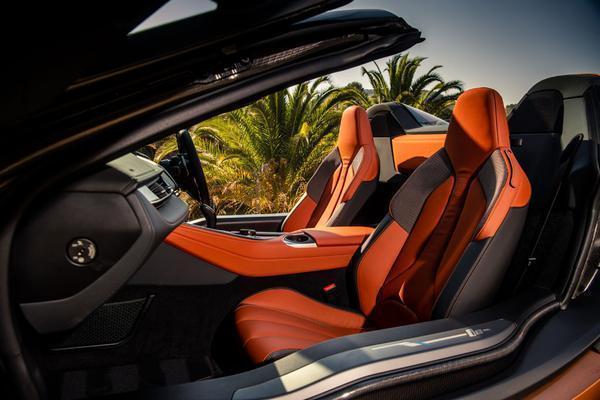
The interior is a little old-.fashioned, but still not so bad.
Would I buy one, no, not even for commuting (I'd prefer something small for that).
I am glad BMW make it, though. They don't often make interesting or pretty cars, so it shows that they can. I wonder how well it would sell if it was purely petrol-powered and 30k cheaper?
Are the looks, the drivetrain, or the price putting buyers off?
There is nothing stylish about this car unless you judge style in just being different.[/b]
I'd love to see what the reaction to it would be if it was ICE only with that peak power output and weight.
I suspect the 911 drives rather better, though.
I had an extended drive in one and loved it. However, the drivers window doesn't go down all the way and there's nowhere for your right arm to rest inside. This one flaw was what stopped me buying one.
Forums | General Gassing | Top of Page | What's New | My Stuff