
Citroen 2CV | Spotted
New Porsches not really your thing? How about a little liberté, égalité, fraternité?

Having gone down the expensive and complicated route with my last two spotteds (in the shape of a Jaguar XJ6 and Bentley Continental R Mulliner), I thought it would be nice to find something simpler. And what could be simpler than a Citroën 2CV? I can tell you, actually: a Citroën 2CV without any side windows. The good news, before people pile in with comments about originality, is that the advert says the original doors are included, but these breezy, bespoke items, with leather-bound tops to rest your elbows on, look like they add, not take away, from the 2CV's rudimentary charm. Providing it's not winter, that is. I'm just thinking wistfully of a warm summer's day and winding back the roof for the full, sensory, alfresco experience. And you know what? I'm feeling happier already.
2CV production dates back 1948 and this 1959 example is one of the last of the original 'ripple bonnet' models. After that, in 1960, the bonnet design was changed to five ribs running from front to rear; that lasted until 1990, when 2CV production ended at the 3.8-million mark. An incredible run, when you think about it. Especially for a car conceived before the outbreak of WW2 to draw French peasant-farmers away from their horse-drawn cart and drag them, kicking and screaming, into the twentieth century. But, like many utilitarian devices through the years, including the Land Rover and G-Wagon, it ended up becoming the chic plaything of the city set, with a little help from James Bond, of course. That made it an icon like the Volkswagen Beetle and kept it alive long-after its conceived sell-by date.
It's not hard to see why it endured. If cars are about freedom and fun, then the 2CV has to be the distillation of that. Supercars are all about limits you can never achieve - on the road, at least - so in any rational universe can be considered redundant. Driving a 2CV is quite the opposite. It becomes a game that involves being as close to the limit as possible almost everywhere, because you'll never be travelling much over 40mph. And with just 375cc and 9hp to get you there, the skill is plotting the path of least resistance through twisting, hedgerow-lined country lanes and maintaining momentum at all cost. That's proper fun, I promise.

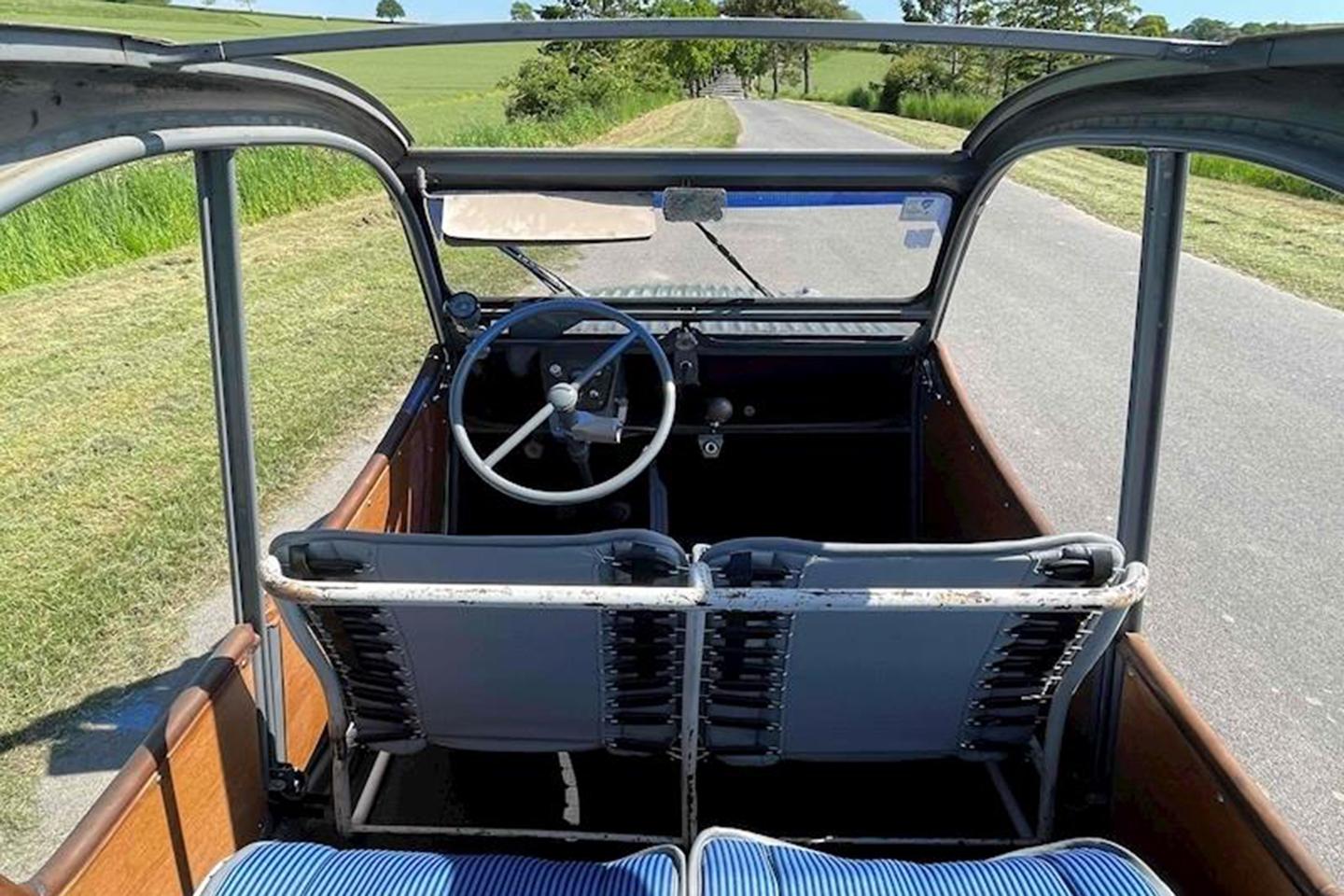
And we always talk about feel and sensation in cars: in a 2CV you cannot get away from sensations - although we're not just confining them to feelsome steering and the like. When you have a car as skeletal as the 2CV, sensations are coming at you thick and fast from everywhere. That is why I am really drawn to the alterations on this car, which mean you're even less isolated (which previous to seeing it I hadn't thought possible) from the outside and all its sights and smells as you make your way slowly along.
Of course, there is a modicum of comfort involved, too: as everyone knows, the design brief for the 2CV's suspension was that it should be absorbent enough to carry a tray of eggs across an unploughed field - and not break any. Another target was that it should travel 95 miles on a gallon of petrol (well, whatever the metric equivalent is), although I must say, I've never tested that. Or the egg test, come to think about it.
If you ever needed more proof that the 2CV, with its glorious lack of speed, is something to chase, then look at Andrew Frankel and Chris Harris. They both have access to the 'best' cars on the planet, and both having an early, first-gen 2CV like this one, sitting in their garage. Honestly, I don't think you can go wrong with this car. If it falls apart you can rebuild it for a pound and, instead of worrying about other cars parking too close, just park up with sign that says 'hit me' - one or two more dents would smarten it up no end. And all that for less than the price of a Hyundai i10... Seriously, what are you waiting for?
SPECIFICATION | CITROEN 2CV
Engine: 375cc, air-cooled twin, naturally aspirated
Transmission: 4-speed manual, front-wheel drive
Power (hp): not much
Torque (lb ft): barely any
CO2: N/A
MPG: 95 (targeted)
Recorded mileage: TBC
Year registered: 1959
Price new: less than a horse (maybe)
Yours for: £10,750


PS - new Porsches are indeed my thing. Strange presumption that If you like this, you don’t like fast new cars.
My first car was a Renault 6 with the same 2CV push pull gear shift.
I remember driving my BMW E36 hard through some very twisty mountain roads in the South of France a long time ago, just keeping up with a 2CV, it's driver looking relaxed with probably a gauloise between his lips. His car was leaning around the bends like a motorbike.
A local doctor had one which he used sometimes for emergency response, had a green light he could stick to the roof bar, seeing that driven at speed was very impressive
PS - new Porsches are indeed my thing. Strange presumption that If you like this, you don’t like fast new cars.
But....I shudder at the crumple zone

Had it been side on, then it would have been very messy.
The only thing that had more sharp endges on the inside was my S3 Lightweight - be like a frog in a blender.

Was a great car, but not ideal in the college car park as people used to stanley knife the roof!

Depsite having no power I remember it as being really good on the brakes - the inboard discs up front did a great job. (Because when your 18 with a similar number of hp then being late on the brakes is the only thing you have when maintaining progress!
 )
Will probably have another one day.
I bought one for my (now) wife who ran it through her uni years. One night it died: the previous owner had suffered a fanbelt failure but never replaced it. As the fan belt also drove the alternator, the battery couldn't charge so the car was running all its ignition just from the battery, which was accumulating overnight. The steering became heavy one day - a quick call to a specialist resulted in us driving it, slowly, to a scrapyard as the chassis had snapped. Apparently the steering column was the only object giving it any structural rigidity. It didn't want to die - it caught fire on the way to the scrappie.
Would I have another? Oh yes.
I sort of understand the appeal of these. But only as something you might buy for £200 for one summer.
By any measure these are utter rubbish: slow, flimsy, roly-poly handling and not very comfortable. And yet... 3.8 million were made, nobody that drives one says it wasn't fun, they're reliable (despite what I said above), they're economical and you can roll the roof back like a sardine tin.
I've often holidayed in France. Each time I come back wanting a 2CV or a Renault 4.
Forums | General Gassing | Top of Page | What's New | My Stuff