
Driverless cars to be trialled in... Milton Keynes
They'll be remote controlled from an office - but beats a Prius anyday
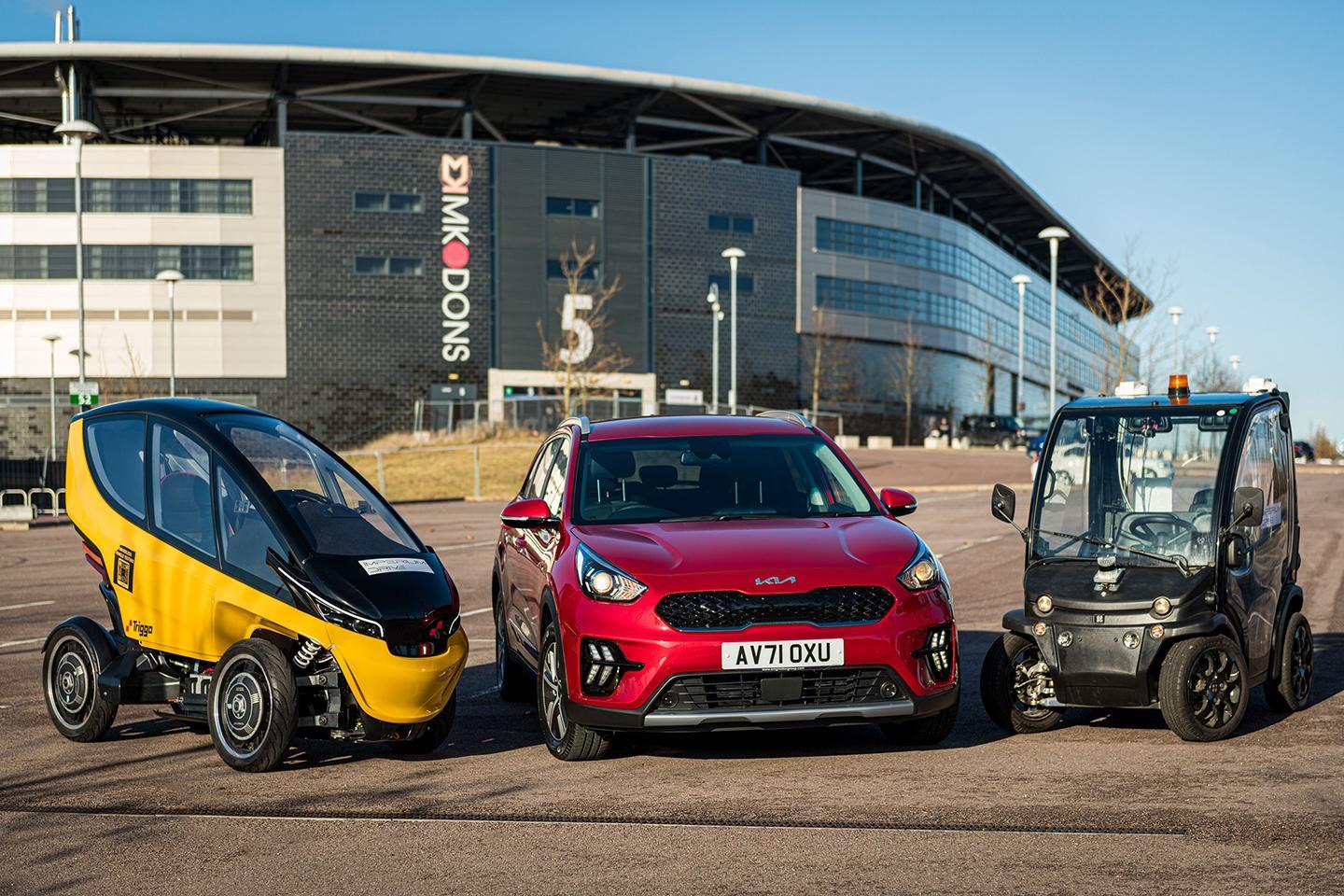
When you dream of the future of motoring, the driverless-car opportunities, the luxury of being picked up and driven completely effortlessly to your location, the destination is usually somewhere exotic, high-flying, luxurious. Not... Milton Keynes. The mecca of corporate headquarters, roundabouts, and that oddly placed indoor snow slope.
But MK, as the cool kids call it, is proving popular to the tech boffins of the world. Have you seen those little supermarket robots that patrol the streets delivering milk and bread by just the power of GPS? Gets the Just Eat cyclists off the road for a bit at least.
Now, British start-up Imperium Drive has started its trials of 'Fetch' - a car-hailing service that, instead of shipping out a Prius, sends a driverless car to pick you up. Well, we say 'driverless' - they're actually remote controlled by a driver back at the office. Like the driving theory test, but a bit more critical. To start with, there'll also be a stand-by driver in the cars, just in case.
MK is the perfect location for this due to its grid-type layout, acting as a Pacman-style base for sending cars up, down, left or right. Fetch is currently operating on private routes, but Imperium Drive aim to have the remote-controlled service fully operational by the second half of 2022.
Koosha Kaveh, CEO of Imperium Drive, said: "For many people, public transport is cheap but inconvenient, while ride-hailing and taxis are convenient but also expensive. Our goal is to make on-demand door-to-door transport more cost-effective and convenient than every alternative, even privately owned cars."
The company will work with car manufacturers to embed the software and operation into "a variety of vehicles", from small city cars to, supposedly, "commercial vehicles for highway driving." We'll pass on that one for now - just get us home from the pub safely, okay?


I’m not surprised this is being trailed in Milton Keynes. The town has led the way for EV charging infrastructure. The road layout will be easier for testing than most cities. It is about as close as you can get to the American grid system in this country. With added round abouts.
Also, the delivery robots that started in MK are now operating in my area of Northampton. Perhaps we’ll have driverless taxis here in the near future.
Our estate was part of the UK pilot of the delivery robots about 4 years ago and they're an everyday sight now. Here's a pic of a gaggle (not sure what the collective is) during first lockdown, lined up outside the local Co-Op waiting to fulfil orders. Cute, aren't they?

In theory they're great. In practice, the algorithms they use to determine how to cross roads and avoid obstructions (including moving ones, like pedestrians), are somewhat dim-witted. Here's a few in a Mexican standoff, trying to work out how to avoid each other*:

My point is, given the larger size, higher speed and greater value of cargo (ie, people), how safe are these things going to be and how are other road users legally protected in the event of impact?
*We actually had to intervene here, moving the one second-nearest the camera manually to break the deadlock.
Our estate was part of the UK pilot of the delivery robots about 4 years ago and they're an everyday sight now. Here's a pic of a gaggle (not sure what the collective is) during first lockdown, lined up outside the local Co-Op waiting to fulfil orders. Cute, aren't they?
In theory they're great. In practice, the algorithms they use to determine how to cross roads and avoid obstructions (including moving ones, like pedestrians), are somewhat dim-witted. Here's a few in a Mexican standoff, trying to work out how to avoid each other*:
My point is, given the larger size, higher speed and greater value of cargo (ie, people), how safe are these things going to be and how are other road users legally protected in the event of impact?
*We actually had to intervene here, moving the one second-nearest the camera manually to break the deadlock.
At a previous employer we had a customer showroom area in which the management had placed one of those robot vacuum cleaners. It would come out at different times of the day, do its thing, and then return to base to empty itself and recharge.
One slow day a few of us were in the room when it came out of its little base station and went about its work. A colleague decided to repeatedly stand in front of it to block its path, waiting until it had turned to avoid him, then blocking it again before it had chance to move.
The poor thing started spinning round on the spot. He got out of the way expecting it to recover and carry on, but it just sat there, spinning in circles until its battery went flat.
Once word got out, torturing the vacuum cleaner became the office sport.
People like us will be the first to go when AI takes over.
My point is, given the larger size, higher speed and greater value of cargo (ie, people), how safe are these things going to be and how are other road users legally protected in the event of impact?
I wish them all the best and the tech is coming, but I will stick with uber thanks.
Upon trip completion, the remote vehicle operator will take over and navigate the car remotely to the next user or the base.
Our estate was part of the UK pilot of the delivery robots about 4 years ago and they're an everyday sight now. Here's a pic of a gaggle (not sure what the collective is) during first lockdown, lined up outside the local Co-Op waiting to fulfil orders. Cute, aren't they?
In theory they're great. In practice, the algorithms they use to determine how to cross roads and avoid obstructions (including moving ones, like pedestrians), are somewhat dim-witted. Here's a few in a Mexican standoff, trying to work out how to avoid each other*:
My point is, given the larger size, higher speed and greater value of cargo (ie, people), how safe are these things going to be and how are other road users legally protected in the event of impact?
*We actually had to intervene here, moving the one second-nearest the camera manually to break the deadlock.
There's already a thread going on this!
They can now, apparently, be programmed to play music once they arrive at your front door, although it's mostly ABBA hits.
To their credit, these are completely autonomous, navigating by GPS with no human input except for loading & unloading. These "driverless cars" that need to be driven remotely don't appear even to offer a reduction in required manpower. I used to scoff at the idea of the robots until I broke my leg 3 years ago, when they suddenly became the best thing ever. I'm not yet sure what the advantages of this latest venture are.
Same in my mind for drones. If it turned out to work ok and people adopted it en-mass, the sky would turn black with the sheer number of them needed to carry the demand.
A technically interesting solution no doubt, but I just don't see the problem they are attempting to solve and some considerable downsides in the event they did actually get adopted at any sort of viable scale.
Driverless cars take up as much roadspace as any other car, would get as much utilisation as a taxi with a driver (if keeping wheels moving and removing the need for a personal car is the motivation), are clearly less efficient at road space use as pretty much any other sort of mass public transport, will be necessarily slow for safety reasons, will do nothing to prevent those so inclined to trash them inside if there is no 'driver' to consider.
As for the food robots, look at the image, one small trial and there's a traffic jam of them for probably a tiny handful of deliveries. Imagine any sort of mass take-up, the congestion would be manic given each individually don't seem to be able to hold much more than a couple of baskets of goods, never mind a weekly shop with bog rolls and bottled water. So people would still need to go to the store or get home delivery.
Same in my mind for drones. If it turned out to work ok and people adopted it en-mass, the sky would turn black with the sheer number of them needed to carry the demand.
A technically interesting solution no doubt, but I just don't see the problem they are attempting to solve and some considerable downsides in the event they did actually get adopted at any sort of viable scale.
These cars (and the delivery robots) are not the end solution - they are the beginning of a solution.
It's unrealistic to expect someone to come out off the bounce with a driverless car - it needs to be done in phases with the end result being driverless transport. In terms of what problem that is trying to solve, well it's fairly obvious.
The delivery robots' goal isn't to ultimately create something to deliver everyone's weekly groceries either. What it is, is a practical rollout of autonomous tech that can be learned from and adapted in future applications.
I'm sure that, in the mid-1980s, you would have pointed out how this was cumbersome, had an iffy signal and a crap battery life. You couldn't imagine everyone in the world carrying such a device around, nor what problem it was solving - we had phones at home and public phones if you needed to make a call on the move. Look where we are 40 years later.

Same in my mind for drones. If it turned out to work ok and people adopted it en-mass, the sky would turn black with the sheer number of them needed to carry the demand.
A technically interesting solution no doubt, but I just don't see the problem they are attempting to solve and some considerable downsides in the event they did actually get adopted at any sort of viable scale.
They can fit a surprising amount in: easily a weekly shop for an elderly couple, for example. Also takeaways: they're insulated, so your curry arrives hot and your ice cream cold (not in the same robot, obviously).
They ARE a novelty, and we CAN manage without them (as we did for hundreds of years).
For clarity, the queue in the picture I posted above was due to high demand (people not wanting to enter a shop in lockdown) and quickly dissipated. Lead times for me vary between 20-45 minutes, depending how busy they are. I'm about half a mile away from the Co-Op / takeaways and they travel just faster than walking pace, so from order to receipt is usually just quicker than if I walked there and back.

https://youtu.be/wp-vgjEyo0g
Forums | General Gassing | Top of Page | What's New | My Stuff