
BMW i8 | PH Spotted
A lot of car for the money? Or yesterday's news

I wouldn’t say I am the world’s biggest BMW i8 fan. It’s not quite the sports car I wanted it to be, but it has always provided a level of interest - and when you consider they now start at around the £45k mark, it does add another dimension to the allure. I think it now qualifies for that oft-used phrase: that’s a lot of car for the money. It is, isn’t it?
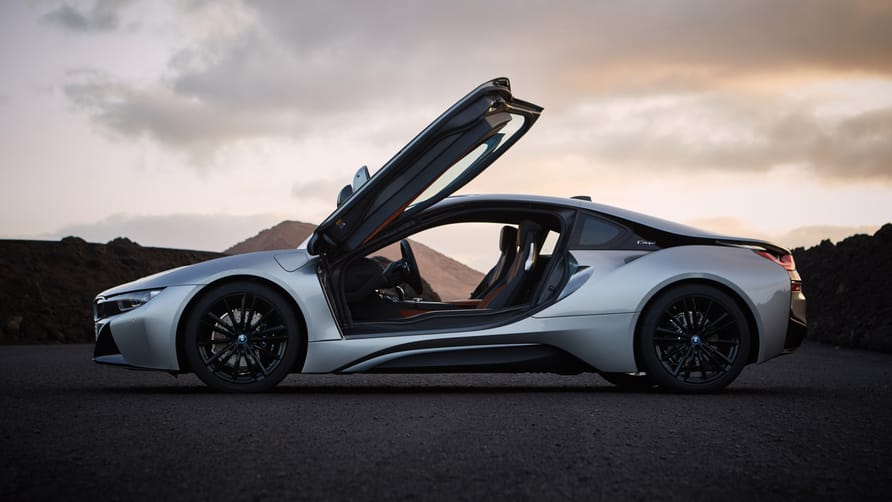
I remember the first time I drove an i8, back in 2014. They’d just been released, and people would stop and stare. I remember waiting at a set of traffic lights and watching in the rear-view mirror as the elderly lady and gentleman in the car behind discussed its various slashes and openings – I could see them describing them with vivid arm movements. It was a nice moment, to see a car getting people talking.
It’s probably lost a bit of its gawp factor over the years, but I reckon that’s well worth trading for the £55,000 or so it’s lost in depreciation. And while it’s lacking the element of surprise these days, I’ve no doubt it’s unique form will still turn heads. All these years on and I still cannot fathom whether it’s pretty, but it’s one of those cars that demands you observe it closely. And when you do, you are rewarded by another crevice or seam that you hadn’t seen before. If only BMW’s current design efforts could manage to be this compelling.


Those concept-car looks were backed up, of course, by its futuristic powertrain. Except it wasn’t that futuristic really, when you think about it. It was just different. Yes, it had 200kg of lithium-ion batteries powering an electric motor, but that wasn’t unheard of back then. Also, mounted transversely amidships, was the 1.5-litre B38 triple. This is an engine we now know so well from the Mini, although, to be fair, the i8 was the first car to use it before it found its way into those Oxford-built city cars. There were two gearboxes to crystallise all the power sources into one homogeneous force, and it was forceful. 362hp at 5,800rpm, and 420lb ft of muscle meant it was up there on pace with the 911s of the day. 0-62mph took just 4.4 seconds and it would hit an electronically limited top speed of 155mph.
On the flip side, it also had some official stats that 911 owners could only dream about: 134.5mpg and 49g/km of CO2. Obviously those numbers were pretty meaningless in the real world, but as long as you kept the 7.1kWh battery topped up (11.6kWh in later versions) it would sip fuel where a Carrera 2 would glug. And it was a great achievement by the engineers to keep the i8’s kerb weight at a relatively sensible 1,535kg, despite the multifaceted equipment lurking beneath its panels. Most of the weight saving came from the use of interesting materials normally found in car’s much pricier than the i8, including a carbon and aluminium chassis and carbon reinforced plastic body panels.
Why wasn’t it the sports car I’d hoped for? Well, it was prone to some early onset understeer and the steering was too light and lacking feel. The i8 managed to feel a little less agile and lacking the composure of a 911 Carrera 2. That didn’t stop it from being an effective weapon if you wanted to carve up the country at great speed. It just lacked the depth of tactility to qualify as a true sports car – it always felt more like a luxurious sporting GT to me. But you got the bonus of being able to whiz through town in silence for around 15 miles – if you were gentle with the accelerator. That combination still makes sense today. We covered the leggiest example in the classifieds a couple of months ago but here's one at a franchise dealer with hardly any miles and only one previous owner for £47k. Hold onto it for long enough, and who's to say it won't be another future classic?
Specification | BMW i8
Engine: 1,499cc, three cylinders, turbocharged plus electric motor
Transmission: 6-speed automatic, four-wheel drive
Power (hp): 360 (combined)
Torque (lb ft): 236 (engine), 184 (motor)
MPG: 134.5
CO2: 49g/km
First registered: 2015
Recorded mileage: 25,000
Price new: £99,895
Yours for: £47,000


 That's the one.
Pretty much no range as an electric car.
Performance that's no better than similar-priced ICE sports cars.
A 1.5 3-cylinder turbocharged engine - which can't be particularly exciting even with the electric motor.
Awkward, overstyled looks - subjective, admittedly.
Not particularly great residuals vs. something like a 911, of which a lower spec 2015 car is still nearly £70,000.
Cheap tax/fuel but is that really that big of a factor for the sort of people buying a car like this - especially those who bought new.
Aside from 'because it's a bit different' (which is a perfectly valid reason to be fair) why would actively buy one of these?
Maybe I'm missing something or maybe you have to drive it to 'get' it.
They still turns heads I reckon, and it was certainly unique and different, and BMW deserve credit for that I think.
- it's a 3cylinder as opposed to a 4-pot
- top speed / mpg mix up prev. stated
I've had one since new in 2015.
Pros:
- cheap to run, nothing to tax, I've averaged 48mpg since new, it's goes from Inverness to Aberdeen via the Lecht every week (a route which is best described the opposite of a dual carriageway)
- comfy on a long run
- won't rust (on the outside), plenty MCS components will (and are - living in NW Scotland and being driven 365)
- quick enough for road driving, loads of punch for nipping past slow traffic
- can stuff a couple child seats in the back
- if you are caught out (driving without the sprogs), the chassis balance is superbly neutral
Cons:
- understeer, would be nice if Alpina etc. could offer an aftermarket set of wider wheels. Perhaps geometry plays a little hand, but 215 up front is too narrow particularly in cold wet conditions. If you have one my experience is, change from Bridgestone Potenza to P Zero which last just as long and have more grip when you need it.
- 3cylinder. Whilst it's fine & I'm of the opinion BMW were ahead of the game on this, if it had 6cylinder or even a 4pot and wider wheels it would have hit the sports car mark, where so many feel incl. myself it didn't.
Overall:
Cheap to run, reliable car that still looks and performs well against modern machinery. Whilst I had planned to change it, thinking of keeping it long term given delay to an electric car on order. Frankly the i8 is just a good car for every day swift driving and who knows as the article suggests, perhaps in 10 years that massive depreciation seen (like any 6 fig. BMW) may claw back some ground. A great second hand buy so long as you've no track day ambitions.
Amended in my original comment. Cheers, Lee.
Forums | General Gassing | Top of Page | What's New | My Stuff