
Honda Prelude | Spotted
Clean looks, VTEC power and rear-wheel steering makes this Prelude interesting in so many ways...

I’ve been driving a few cars with rear-wheel steering recently – most recently, many Range Rovers from the big ‘un to the latest Sport last week. That, plus seeing a Mk5 Honda Prelude last weekend while I was in Nottingham, reminded me just what a handsome and interesting car it is. It made this one jump right out of the screen when I was perusing the classifieds this morning. And my first thought was "Is that a salvage car?" A car being sold on after an unfortunate heavy hit with a kerb that had broken the rear control arm. I just couldn’t compute that the Prelude’s rear-wheel steering turned the back wheels that much. I mean, look at it. That’s an amazing angle.
The Prelude’s innovative RWS appeared first on the Mk3 that ran from 1987-91. It wasn’t a huge hit in Europe but the home market loved it. According to reports, Honda expected take-up of 30 per cent in Japan but, in the end, 80 per cent of Japanese buyers opted for RWS in the car’s first year of production. Apparently it helped the Prelude blitz the competition in Road & Track’s slalom test, completing the course at an average speed of 65.5mph – and seeing off the challenge from Porsche and Ferrari as well.
Unlike today’s systems, which are electric, Honda’s first RWS system was all mechanical. There was shaft running from the steering rack at the front to a box on the back axle that operated the rear track control arms and turned the wheels. The steering angle and direction was controlled by a planetary gearbox. It still worked along the same principles as today’s systems, though. When small steering inputs were applied, it boosted high-speed stability by moving the rear wheels in the same direction as the fronts by up to 1.5 degrees. When more steering lock was added (if the steering wheel was turned past 246 degrees) the system would steer the rear wheels at up to 5.3 degrees in the opposite direction to the fronts, cutting the turning circle by about 10 per cent.
There were other manufacturers doing similar things, of course. Honda beat Mazda by a matter of weeks when the latter launched RWS on its 626 and MX-6. Mitsubishi, Nissan and Toyota all came up with their equivalents at around the same time as well. It was almost as if the Japanese manufacturers were spying on each other, but they wouldn’t have been doing that, would they? Surely it was all just a happy coincidence rather than espionage?
That said, Mitsubishi’s and Nissan’s RWS was more advanced. Those versions had no mechanical link between the front and rear steering systems and, instead, used computer controlled hydraulic actuators to move the rear wheels. And by 1991, when the Mk4 Prelude arrived, Honda had emulated that set-up and gone further. Its new system used a computer to direct the rear wheels using an electric motor, which, in effect, is the same system we see on modern cars.

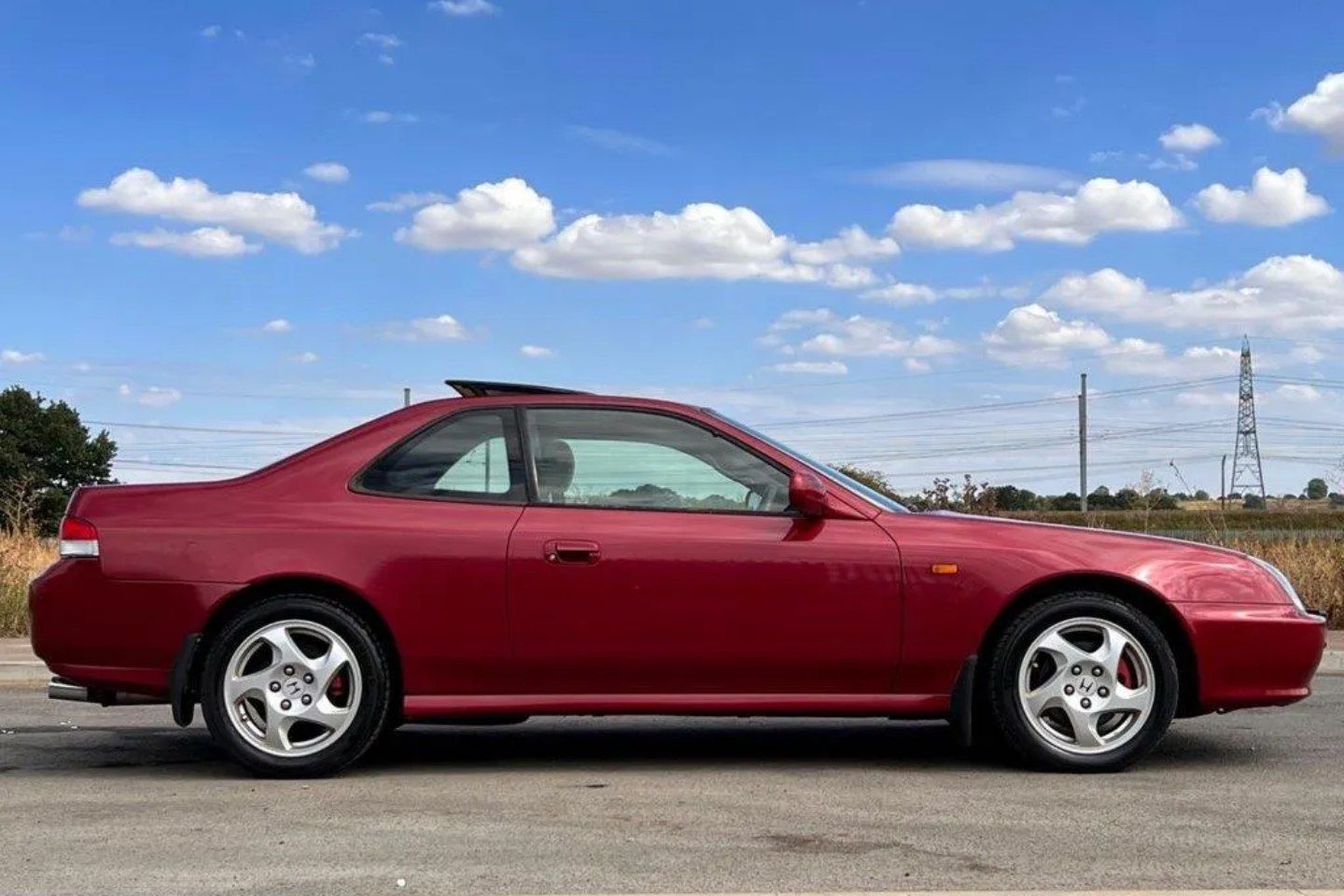
Every version of the Prelude has a certain stylistic appeal as far as I am concerned: the original, for its classic 70s look; the oh-so-80s theme of the Mk2 and Mk3; and the cohesive curves of the 90s Mk4. But there is something about the Mk5 that wins out. I think it's because this is one of those rare pieces of design that’s left pure and simple. It was the work of Manabu Konaka, who had joined Honda’s design department in 1990 and, by 1996, he was lead designer for the Mk5 Prelude. There’s a hint of NSX-R in the Mk5’s headlight design, but otherwise it's thoroughly original and fuss free. Is there anything you can point to, from its nose to its tail, that looks unnecessary, over designed or out of place?
Along with its sublime looks and the fascination of the extreme angles produced by its rear-wheel steering, there’s also a VTEC motor lurking under the bonnet. Here it’s the H22A5, which isn’t quite as pokey as the 212hp H22A7 red-top in the Accord Type R, but it's not far off that high watermark. It can still muster up a healthy 185hp, and on the way to producing that power it’ll rev to a glorious 7,000-plus RPM. Yes, I know it’s attached to a four-speed auto, but with classic cars – especially rare ones; it seems just 173 2.2 VTIs are taxed in the UK right now – you can’t always have everything you desire. And the gearbox is not enough to quell my desire for this car. What say you?
Specification | Honda Prelude 2.2 VTI
Engine: 2,157cc, four-cylinder, naturally aspirated
Transmission: four-speed automatic, front-wheel drive
Power (hp): 185 @ 7,000rpm
Torque (lb ft): 152lb ft @ 5,300rpm
CO2: 248g/km
MPG: 27.2
Recorded mileage: 70,000
Year registered: 1998
Price new: N/A
Yours for: £7,995



Honda are a strange company. One minute they produce a car that is a hit styling wise and the next they pull back and produce something bland. The 1991 Civic was lovely and svelte and it took 20 years for them to emerge from the doldrums with the stormtrooper helmet 9th gen. They should learn to evolve the styling of their cars more. Same with the Jazz. The previous 3 gens are quite nice for shopping trolleys, yet the current 4th gen defines bland on wheels.
Type S really is the version to have. 217bhp or something like that.
I found out recently that my 2002 hrv has a kind of rear steering, where it toes in automatically around corners. I got to say, in general, hondas always feel like a fun drive.
Trouble is, when the VTEC system wasn't doing its stuff, frankly, it felt sluggish. I decided I didn't want to drive everywhere bouncing off the rev limiter and so bought a Mazda MX-6 instead. Never regretted this decision.
I had no idea what car it actually was until I went over to have a close look at it.
I remember being very underwhelmed by the looks of the Mk 5 Prelude when it came out. I just looked dull and bland by comparison to the Mk 4.
I agree with others who have said how good, and well-engineered, Honda's cars generally were back then. I test drove a Civic VTi in 1996 which was the first Honda I'd ever driven and I thought it was really nice and properly sorted. It had over 150 horsepower I think, which was quite a lot back then for a hatchback. I ended up buying a new Megane Coupe 16v instead but I thought the Civic was nicer than the other hot hatches that I tested around the same time.
And the Mazda MX-6 was a really nice-looking car too. Good decision!
"Interesting" car! And yes, along with Bristols, a great favourite of LJKS.
Agree that the earlier pop-up lights versions were more stylish.

JayEmm recently did a video on one
https://www.youtube.com/watch?v=6EJZeyVuBlM
"Interesting" car! And yes, along with Bristols, a great favourite of LJKS.
Agree that the earlier pop-up lights versions were more stylish.
And the weird sensation you mention whilst sitting in the back going around a roundabout makes me think there was something wrong with that particular example?
Indeed the late great LJKS loved these as well as Bristols (the car…) and was moved to write:
“ The very first thing one might notice about the Prelude is its wanton simplicity. There are no bump strips on the body side. The lamps are oblongs. There is no feature-line at the c-pillar to rear wing. The grille is a slat. And then you look again.
First, the bonnet line is very nearly, but not quite so flat as to suggest – suggest – it is inclined in a way opposite to one’s expectations. The window line’s lower edge is slightly curved and not dead straight like the two nearly-parallel lines on the body side. Those lamps aren’t square but very, very slightly oblong and make the front look narrower than it might be, offsetting the horizontal slat.
The boot is slightly higher than it might be so that there is not one line from front lamp to the rear. There is a small amount of noise in all the order and plain-ness. I can’t help feeling all of this was deliberate. Your eye never settles but roams over the shape, resting here and there and moving on.”
Nuff said…
I always thought the MK5 was ugly and bloated by compairson. It somehow looks too long and the front bonnet and angle of the headlights looks all wrong, a bit like an Alfa 166. They do look a bit better in Motegi spec however with the body kit and bigger wheels.
I can't say that a boggo spec burgundy automatic Preulude MK5 has any appeal to me.
Trouble is, when the VTEC system wasn't doing its stuff, frankly, it felt sluggish. I decided I didn't want to drive everywhere bouncing off the rev limiter and so bought a Mazda MX-6 instead. Never regretted this decision.
"Interesting" car! And yes, along with Bristols, a great favourite of LJKS.
Agree that the earlier pop-up lights versions were more stylish.
And the weird sensation you mention whilst sitting in the back going around a roundabout makes me think there was something wrong with that particular example?
Indeed the late great LJKS loved these as well as Bristols (the car…) and was moved to write:
“ The very first thing one might notice about the Prelude is its wanton simplicity. There are no bump strips on the body side. The lamps are oblongs. There is no feature-line at the c-pillar to rear wing. The grille is a slat. And then you look again.
First, the bonnet line is very nearly, but not quite so flat as to suggest – suggest – it is inclined in a way opposite to one’s expectations. The window line’s lower edge is slightly curved and not dead straight like the two nearly-parallel lines on the body side. Those lamps aren’t square but very, very slightly oblong and make the front look narrower than it might be, offsetting the horizontal slat.
The boot is slightly higher than it might be so that there is not one line from front lamp to the rear. There is a small amount of noise in all the order and plain-ness. I can’t help feeling all of this was deliberate. Your eye never settles but roams over the shape, resting here and there and moving on.”
Nuff said…
Forums | General Gassing | Top of Page | What's New | My Stuff