
Axe set to fall on Ford Fiesta in 2023
Has it come to this?

We’ve become increasingly accustomed to topsy-turvy occurrences in the headlong rush to electrification. Car manufacturers, beset by a requirement for wholesale change, are doing (or at the very least seriously considering) things they previously wouldn’t have dreamed of implementing. Lotus is building a vast, electrically-powered SUV. McLaren will soon follow suit. Mercedes-AMG is abandoning the V8. BMW is designing cars blindfolded. We’re through the looking glass, people.
If additional evidence were needed that up is down and black is white, you only need to consider the idea that Ford is expected to imminently announce the downfall of the Fiesta - perhaps as soon as next year. This is from Rob Gill at The Sun, a man who could justly claim to be as close to the manufacturer’s pulse as anyone else, and is reportedly based on comments made by company insiders that reiterate the need for a ‘reset of Ford’s portfolio DNA’ - i.e. one focused on SUVs and electric vehicles.
While such a move would hardly be unprecedented (let’s not forget Ford has already killed off the Mondeo and, in time, will do the same to the Focus) it is already being treated as seismic shock in the industry - and with good reason. The Fiesta wasn’t just a popular and long-running supermini, but also the top-selling car in Britain from 2009 to 2020. The Sun says 4.8m Fiestas have been sold in five decades on sale, and there are few cars that can claim to feature in so many personal car histories. Matt Bird’s mum owned one. Cam Tait still does.


Assuming it is true though, Ford will likely point to the unimpeachable logic behind its decision. For one thing, the Fiesta’s popularity has categorically slipped. Its maker now sells more examples of the Puma than it does Fiesta; even more damningly, the much newer Vauxhall Corsa is leagues ahead of it. Let’s not forget either that Ford has been building the current Fiesta since 2017 - and its similar-looking predecessor launched in 2008. This is a car already approaching the end of its life cycle in Mk8 format.
Moreover, the best indication of its demise beyond the tacit agreement of unnamed sources, is that there is nothing in the pipeline to replace the Fiesta. As The Sun notes, there was time for Ford to develop a successor ahead of 2030, but, like a supertanker in the Channel, the firm has already changed tack - ‘people want high-riding crossovers — and we play to win’ - and is busy fulfilling a promise it has already made to introduce four all-new battery-powered cars by 2024. None of them, it seems, will fit the template of a conventional supermini.
There is also the oft-mentioned fact of the Fiesta’s profitability: prodigious sales figures aside, it never made Ford a prodigious amount of money. As they tend to be with small cars, its margins were notoriously thin. That isn’t the case with the Puma, and certainly won’t be with the EVs to come. Question is, can any of them realistically expect to replace the Fiesta in the nation’s affection? Ford would like to think so - after all, its back catalogue is stuffed with other household names that were triumphantly superseded. But in reality, it is likely to find the next decade much choppier than the previous five. Expect more details soon.



a), postpone the ban on ICE cars until some further future point in time.
or
b), accept that there won't be enough electric cars or other vehicles produced to meet our transport needs by 2030 and accept that the costs of these cars will be unsustainable to the average consumer. That is of course assuming our National Grid can cope with the additional load of going full electric, when there is already talk of energy shortages this winter. The only way to significantly ramp up grid capacity fairly quickly in the short term whilst we wait for new nuclear to come on-line (10 years +) would be to burn more natural gas and other fossil fuels.
We'll have petrol and diesel for a long time yet. The eco targets were not realistic.
Im not sure why small cars are not profitable? Expensive labour? Complexity required by the ever more and ever tighter legislation?
I may be getting old, but is it any wonder we have a low growth economy when the legislation sucks the blood out of everything and makes it so damn expensive and complicated to do things?
a), postpone the ban on ICE cars until some further future point in time.
or
b), accept that there won't be enough electric cars or other vehicles produced to meet our transport needs by 2030 and accept that the costs of these cars will be unsustainable to the average consumer. That is of course assuming our National Grid can cope with the additional load of going full electric, when there is already talk of energy shortages this winter. The only way to significantly ramp up grid capacity fairly quickly in the short term whilst we wait for new nuclear to come on-line (10 years +) would be to burn more natural gas and other fossil fuels.
I may be getting old, but is it any wonder we have a low growth economy when the legislation sucks the blood out of everything and makes it so damn expensive and complicated to do things?
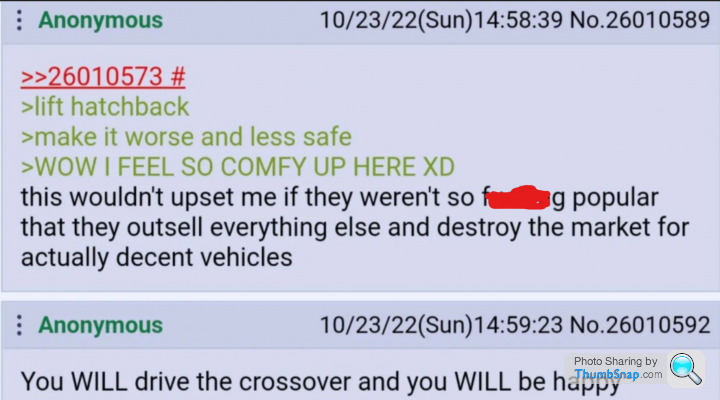
As for Ford, they've been moving towards SUVs for years. No more Mondeo, the Galaxy/S-Max are almost gone. When they can sell the Ecosport and Puma to Fiesta buyers for more money, why keep it around?
The margins are always higher on bigger cars, so amazingly, in this world where we are supposed to be saving resources and increasing efficiency the powers that be are making it much much worse by forcing what is basically data gathering, tracking and control technology on us no one needs or asked for. All this does is make cars more expensive, bigger and heavier.
Forums | General Gassing | Top of Page | What's New | My Stuff