
Is the most efficient car the one you already own?
Discussion


In terms of carbon emissions and cost?
If you made an honest attempt to reduce your mileage as best as is practicable in 2023 and just never bought another car, would this not be more efficient for the planet and your wallet then buying new and ever more efficient cars for the rest of your life?
Although if everyone did that, the car industry would quickly collapse and millions would be without a job…
jimmy156 said:
In terms of carbon emissions and cost?
If you made an honest attempt to reduce your mileage as best as is practicable in 2023 and just never bought another car, would this not be more efficient for the planet and your wallet then buying new and ever more efficient cars for the rest of your life?
Although if everyone did that, the car industry would quickly collapse and millions would be without a job…
No, 85% of a petrol car's lifetime CO2 emissions come from the fuel you burn when using it.If you made an honest attempt to reduce your mileage as best as is practicable in 2023 and just never bought another car, would this not be more efficient for the planet and your wallet then buying new and ever more efficient cars for the rest of your life?
Although if everyone did that, the car industry would quickly collapse and millions would be without a job…
Old cars usually go to the scrapheap because they are uneconomical to repair or maintain, how are you proposing to replace those?

Environment - this is the most in-depth exploration I've seen: https://youtu.be/L2IKCdnzl5k. Conclusion is that keeping your car is often worse for the environment than buying something that's far more efficient. Switching from a non-hybrid ICE to an averagely-efficient EV is probably a no-brainer in the UK.
Cost - dependent on future resale value, your mileage x efficiency, maintenance costs, how much is VED, and also the opportunity cost of loss of bank/investment interest (>3% currently easy). Very personal.
Cost - dependent on future resale value, your mileage x efficiency, maintenance costs, how much is VED, and also the opportunity cost of loss of bank/investment interest (>3% currently easy). Very personal.
Edited by Grrbang on Sunday 26th March 20:56
GT9 said:
No, 85% of a petrol car's lifetime CO2 emissions come from the fuel you burn when using it.
Old cars usually go to the scrapheap because they are uneconomical to repair or maintain, how are you proposing to replace those?
Whats the lifetime though? Compared to the frequency with which most buy a new car? 5 years, 10, 20? How many new cars might someone have bought in that time with the associated carbon impact?Old cars usually go to the scrapheap because they are uneconomical to repair or maintain, how are you proposing to replace those?
New cars don’t have a 0 Carbon emmisions to run, event electric ones.
Yes, you’d have to suck up some bigger repair bills then you might otherwise. But if you were reducing your mileage as much as possible, perhaps this wouldn’t be that burdensome?
jimmy156 said:
Whats the lifetime though? Compared to the frequency with which most buy a new car? 5 years, 10, 20? How many new cars might someone have bought in that time with the associated carbon impact?
New cars don’t have a 0 Carbon emmisions to run, event electric ones.
Yes, you’d have to suck up some bigger repair bills then you might otherwise. But if you were reducing your mileage as much as possible, perhaps this wouldn’t be that burdensome?
You may have to caveat this with your age. In my early thirties then the picture will be different to someone twice my age. In any case what is the point? The answer is no unless you basically add loads of restrictions to your life so I’m not sure what point you are going at. New cars don’t have a 0 Carbon emmisions to run, event electric ones.
Yes, you’d have to suck up some bigger repair bills then you might otherwise. But if you were reducing your mileage as much as possible, perhaps this wouldn’t be that burdensome?
jimmy156 said:
Whats the lifetime though? Compared to the frequency with which most buy a new car? 5 years, 10, 20? How many new cars might someone have bought in that time with the associated carbon impact?
New cars don’t have a 0 Carbon emmisions to run, event electric ones.
Yes, you’d have to suck up some bigger repair bills then you might otherwise. But if you were reducing your mileage as much as possible, perhaps this wouldn’t be that burdensome?
Depending on your grid mix, carbon break even is anywhere from approx 20-50k miles. If your ICE car has already exceeded this mileage, then it’s doing more harm than good compared to a BEV. So you would need to reduce you mileage so much that there would be little point in even owning/using an ICE vehicle anymore. So yes, that is better for the environment. Question is could your lifestyle cope with that?New cars don’t have a 0 Carbon emmisions to run, event electric ones.
Yes, you’d have to suck up some bigger repair bills then you might otherwise. But if you were reducing your mileage as much as possible, perhaps this wouldn’t be that burdensome?
GT9 said:
jimmy156 said:
In terms of carbon emissions and cost?
If you made an honest attempt to reduce your mileage as best as is practicable in 2023 and just never bought another car, would this not be more efficient for the planet and your wallet then buying new and ever more efficient cars for the rest of your life?
Although if everyone did that, the car industry would quickly collapse and millions would be without a job…
No, 85% of a petrol car's lifetime CO2 emissions come from the fuel you burn when using it.If you made an honest attempt to reduce your mileage as best as is practicable in 2023 and just never bought another car, would this not be more efficient for the planet and your wallet then buying new and ever more efficient cars for the rest of your life?
Although if everyone did that, the car industry would quickly collapse and millions would be without a job…
Old cars usually go to the scrapheap because they are uneconomical to repair or maintain, how are you proposing to replace those?
Assuming a robust economic plan, the Sachsenring factory could have been instructed to produce the required number of new cars for the certain number of years and then to scale back at the point where supply balanced demand. From then on there would be a need to make a small number of complete new cars to replace write-offs and to account for population growth, but the majority of effort would go on making spares for those already in circulation.
Whilst consumer choice would be somewhat curtailed (although things are going that way in the private sector as it happens) by having only one model of car, the impact might well be lower.
The Trabant is only an example. We all know they weren't the cleanest running cars, but the same principle could have been followed with a more advanced four stroke engine.
dvs_dave said:
Depending on your grid mix, carbon break even is anywhere from approx 20-50k miles. If your ICE car has already exceeded this mileage, then it’s doing more harm than good compared to a BEV. So you would need to reduce you mileage so much that there would be little point in even owning/using an ICE vehicle anymore. So yes, that is better for the environment. Question is could your lifestyle cope with that?
So if you did 10k a year in your old petrol car, you could potentially be doing less harm to the environment than someone who gets a new Tesla every 3-5 years? I guess the best thing would be to buy a BEV and then run that forever / for as long as possible without changing i.
jimmy156 said:
Whats the lifetime though? Compared to the frequency with which most buy a new car? 5 years, 10, 20? How many new cars might someone have bought in that time with the associated carbon impact?
New cars don’t have a 0 Carbon emmisions to run, event electric ones.
Yes, you’d have to suck up some bigger repair bills then you might otherwise. But if you were reducing your mileage as much as possible, perhaps this wouldn’t be that burdensome?
The fallacy is that most people buy new cars.New cars don’t have a 0 Carbon emmisions to run, event electric ones.
Yes, you’d have to suck up some bigger repair bills then you might otherwise. But if you were reducing your mileage as much as possible, perhaps this wouldn’t be that burdensome?
In any one year 4 times as many used cars are sold than new cars.
There is a never-ending theme on PH that everyone buys new every few years, and presumably junks the car after that....
No, it gets sold and someone else uses it.
The number of owner's that any particular car has is invisible to the planet, it only cares what mileage the car covers in its lifetime.
It doesn't matter either if it's the same group of people buying new every few years, because the group that will buy the secondhand car is 4 times larger.
For the purposes of studying this on a macro-scale, the accepted average lifetime is assumed to be 125,000 miles over something like 15 years.
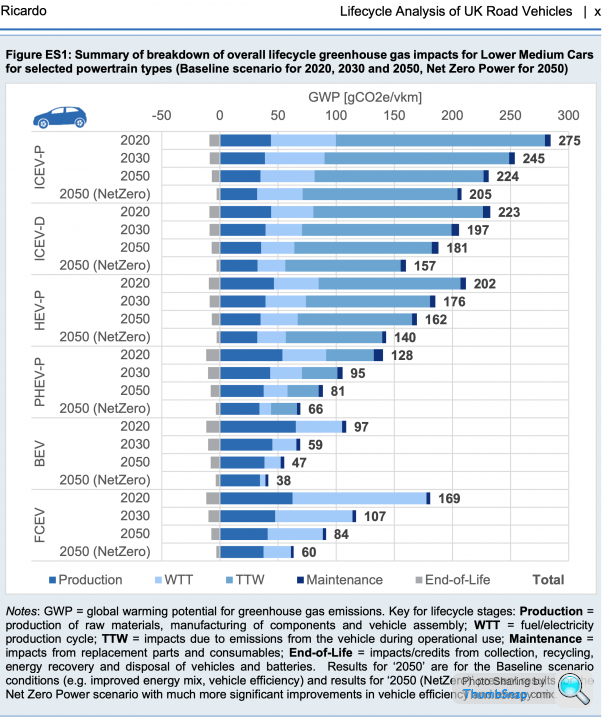
Here is an extract from the government's own report examining this very question, produced in 2021 by Ricardo PLC.
The car with the lowest overall lifetime footprint is a battery electric car, and it doesn't matter if you look at it today or in 25 years, the outcome is the same, just that the EV gets far better with the passage of time.
We reached the tipping point on this in the UK some time ago.
I know, not what you wanted to read.
jimmy156 said:
So if you did 10k a year in your old petrol car, you could potentially be doing less harm to the environment than someone who gets a new Tesla every 3-5 years?
I guess the best thing would be to buy a BEV and then run that forever / for as long as possible without changing i.
No, because each new EV theoretically displaces an ICE from the global fleet at the end of its useful life. It’s irrelevant on an individual owner basis as that individual purchasing a new EV passes their old one into the used market where it continues to produce way less emissions than its ICE equivalent, also until the end of its useful life. It’s all about the vehicle’s service life.I guess the best thing would be to buy a BEV and then run that forever / for as long as possible without changing i.
The worst thing from an environmental perspective that you can do is to replace an end of useful life ICE with a new ICE instead of a BEV. And even then, running an ICE past 50k (grid mix dependent) is theoretically doing more harm to the environment than replacing it with an equivalent BEV, assuming that BEV is going to used for more than 50k miles.
Missy Charm said:
We all know they weren't the cleanest running cars, but the same principle could have been followed with a more advanced four stroke engine.
You are missing the point thought, in that it is not possible to meaningfully decarbonise car ownership without stopping the consumption of fossil fuels.The only viable pathway for 9 out of 10 cars is to use a battery, ideally charged from a wind turbine or nuclear power plant.
In absence of fully renewable electricity, a natural-gas fired centralised power station will get you about halfway there due the the much higher thermal efficiency of the centralised power-plant compared to a typical car engine operating a typical drive cycle. It does need to be combined with a means of recovering the car's kinetic energy though, i.e. regenerative braking.
If you can also design the car to be streamlined by closing off as many cooling apertures and avoiding the need to package a large lump of iron under the bonnet, then things get even better. Which means you don't want to be carrying the inefficient fuel-burning device in the car that produces a whole heap of waste heat. You get the picture...
jimmy156 said:
In terms of carbon emissions and cost?
If you made an honest attempt to reduce your mileage as best as is practicable in 2023 and just never bought another car, would this not be more efficient for the planet and your wallet then buying new and ever more efficient cars for the rest of your life?
Although if everyone did that, the car industry would quickly collapse and millions would be without a job…
Save the planet, buy a new £80k EV weighing over 2.5t. At the same time let's dismantle all the infrastructure associated with petrol and install a completely new one. If you made an honest attempt to reduce your mileage as best as is practicable in 2023 and just never bought another car, would this not be more efficient for the planet and your wallet then buying new and ever more efficient cars for the rest of your life?
Although if everyone did that, the car industry would quickly collapse and millions would be without a job…
If they really wanted to save the planet they would encourage people to have less kids so we have less rampant consumption + immediately dismantle all industries building stuff from new and instead encourage re-use and repair what we already own. Not a lot of incoming taxes associated with that so perhaps not

TX.
Terminator X said:
Save the planet, buy a new £80k EV weighing over 2.5t. At the same time let's dismantle all the infrastructure associated with petrol and install a completely new one.
If they really wanted to save the planet they would encourage people to have less kids so we have less rampant consumption + immediately dismantle all industries building stuff from new and instead encourage re-use and repair what we already own. Not a lot of incoming taxes associated with that so perhaps not
TX.
And are you willing to drastically reduce your mileage as well to play your part? If they really wanted to save the planet they would encourage people to have less kids so we have less rampant consumption + immediately dismantle all industries building stuff from new and instead encourage re-use and repair what we already own. Not a lot of incoming taxes associated with that so perhaps not
TX.
If not, then luckily there is a technology that allows you to drive almost unlimited mileage without changing much of the environmental impact of that choice.
dvs_dave said:
No, because each new EV theoretically displaces an ICE from the global fleet at the end of its useful life. It’s irrelevant on an individual owner basis as that individual purchasing a new EV passes their old one into the used market where it continues to produce way less emissions than its ICE equivalent, also until the end of its useful life. It’s all about the vehicle’s service life.
The worst thing from an environmental perspective that you can do is to replace an end of useful life ICE with a new ICE instead of a BEV. And even then, running an ICE past 50k (grid mix dependent) is theoretically doing more harm to the environment than replacing it with an equivalent BEV, assuming that BEV is going to used for more than 50k miles.
Makes sense!The worst thing from an environmental perspective that you can do is to replace an end of useful life ICE with a new ICE instead of a BEV. And even then, running an ICE past 50k (grid mix dependent) is theoretically doing more harm to the environment than replacing it with an equivalent BEV, assuming that BEV is going to used for more than 50k miles.
GT9 said:
The fallacy is that most people buy new cars.
In any one year 4 times as many used cars are sold than new cars.
There is a never-ending theme on PH that everyone buys new every few years, and presumably junks the car after that....
No, it gets sold and someone else uses it.
The number of owner's that any particular car has is invisible to the planet, it only cares what mileage the car covers in its lifetime.
It doesn't matter either if it's the same group of people buying new every few years, because the group that will buy the secondhand car is 4 times larger.
For the purposes of studying this on a macro-scale, the accepted average lifetime is assumed to be 125,000 miles over something like 15 years.
Here is an extract from the government's own report examining this very question, produced in 2021 by Ricardo PLC.
The car with the lowest overall lifetime footprint is a battery electric car, and it doesn't matter if you look at it today or in 25 years, the outcome is the same, just that the EV gets far better with the passage of time.
We reached the tipping point on this in the UK some time ago.
I know, not what you wanted to read.
Not really, I was genuinely pondering the concept. I am surprised by how quickly the crossover point occurs (from the video linked earlier)In any one year 4 times as many used cars are sold than new cars.
There is a never-ending theme on PH that everyone buys new every few years, and presumably junks the car after that....
No, it gets sold and someone else uses it.
The number of owner's that any particular car has is invisible to the planet, it only cares what mileage the car covers in its lifetime.
It doesn't matter either if it's the same group of people buying new every few years, because the group that will buy the secondhand car is 4 times larger.
For the purposes of studying this on a macro-scale, the accepted average lifetime is assumed to be 125,000 miles over something like 15 years.
Here is an extract from the government's own report examining this very question, produced in 2021 by Ricardo PLC.
The car with the lowest overall lifetime footprint is a battery electric car, and it doesn't matter if you look at it today or in 25 years, the outcome is the same, just that the EV gets far better with the passage of time.
We reached the tipping point on this in the UK some time ago.
I know, not what you wanted to read.
Looks like we all need to transition to a BEV and then keep that for the long run so we can stop mining for battery related metals and just recycle the batteries for when the cars are too old to be useful.
I still can't quite get my head around replacing working, serviceable stuff with a new "thing" being environmentally friendly, but it looks like in the case of an ICE car Vs a BEV it actually is... Just need to solve my off street parking issue then!
jimmy156 said:
Not really, I was genuinely pondering the concept. I am surprised by how quickly the crossover point occurs (from the video linked earlier)
Looks like we all need to transition to a BEV and then keep that for the long run so we can stop mining for battery related metals and just recycle the batteries for when the cars are too old to be useful.
I still can't quite get my head around replacing working, serviceable stuff with a new "thing" being environmentally friendly, but it looks like in the case of an ICE car Vs a BEV it actually is... Just need to solve my off street parking issue then!
Well, I meant from the perspective that many of us on here like our ICE cars, including me. Looks like we all need to transition to a BEV and then keep that for the long run so we can stop mining for battery related metals and just recycle the batteries for when the cars are too old to be useful.
I still can't quite get my head around replacing working, serviceable stuff with a new "thing" being environmentally friendly, but it looks like in the case of an ICE car Vs a BEV it actually is... Just need to solve my off street parking issue then!
The right approach is to let the exist ICE fleet see out its days but not replace any of those with more ICEs.
That will increase the number of EVs on the road, and give the second hand car market access to more choice of EVs.
Despite it seeming illogical to some, if a typical used car buyer likes the idea of an EV but can't afford one today, they should be fully supportive of the ICE ban.
Forums | General Gassing | Top of Page | What's New | My Stuff