
potential energy vehicle
Discussion


We've been set an engineering team building exercise to get a 500G mass as far as possible using only stored energy in the mass i.e not rubber bands, pressurised water etc. Dimension limits are a max of a meter cubed box. initial ideas are a pulley system linked to an axel using gravity to act on the mass and this rotates around the axel to apply the torque. any other ideas will be appreciated, people may of done this before seems to be a popular exercise?
motorsportbeng said:
We've been set an engineering team building exercise to get a 500G mass as far as possible using only stored energy in the mass i.e not rubber bands, pressurised water etc. Dimension limits are a max of a meter cubed box. initial ideas are a pulley system linked to an axel using gravity to act on the mass and this rotates around the axel to apply the torque. any other ideas will be appreciated, people may of done this before seems to be a popular exercise?
1. Put the 500g mass into the meter cubed box.2. Take the aforementioned box to top of the tallest structure you have ready access to.
3. Drop box from the top of aforementioned structure.
4. Measure distance from box end position and top of the structure.
Doesn't appear to break any of the rules you listed so job jobbed.

clarkey328is said:
Look at how grandfather clocks work perhaps, it's a similar theory to yours but there may be some efficiencies you could pinch from the design of them. Having said that, they don't have to produce much torque.
Big Pendulum, Wheels that only rotate in one direction, Start it swinging, Job Jobbed.Should move forwards for half of each stroke and (assuming the wheels roll well) lose very little in inefficiency. It won't be fast, but should keep going for a long time.
(assuming I've not made some big cock-up in the physics of the thing)
Assuming you're limited to GPE rather than having the ability to use it as a rotating inertia, I'd probably just drive the axle by wrapping a rubber band or somesuch around it, and using the mass to turn it via a pulley from the maximum amount of height you can get.
Bear in mind that to get the most distance it will require some form of declutching so it can coast after the mass has reached its minimum height, and thus rolling resistance will be important.
Friction between the band and axle will be critical, so you might need a pulley on the axle itself to increase the contact area
Some propulsion would be lost towards the end as the band unwinds, so it might not be the best way, perhaps a chain and sprocket might work.
ETA - Rubber band would be good, as it will allow you to pre-load it so you get some extra welly... just don't let the wheels go in front of the teacher once you've set it up
ETAA - Just read the OP properly, rubber bands are off the menu, which is a shame
Bear it in mind though, if you can get any pre-load anywhere it might yield a significant sneaky advantage
Bear in mind that to get the most distance it will require some form of declutching so it can coast after the mass has reached its minimum height, and thus rolling resistance will be important.
Friction between the band and axle will be critical, so you might need a pulley on the axle itself to increase the contact area
Some propulsion would be lost towards the end as the band unwinds, so it might not be the best way, perhaps a chain and sprocket might work.
ETA - Rubber band would be good, as it will allow you to pre-load it so you get some extra welly... just don't let the wheels go in front of the teacher once you've set it up
ETAA - Just read the OP properly, rubber bands are off the menu, which is a shame
Bear it in mind though, if you can get any pre-load anywhere it might yield a significant sneaky advantage
Edited by The Wookie on Thursday 17th March 16:45
Mr Will said:
Big Pendulum, Wheels that only rotate in one direction, Start it swinging, Job Jobbed.
Should move forwards for half of each stroke and (assuming the wheels roll well) lose very little in inefficiency. It won't be fast, but should keep going for a long time.
(assuming I've not made some big cock-up in the physics of the thing)
Erm well if it used the potential energy properly I would have thought it would stop swinging on the first pass Should move forwards for half of each stroke and (assuming the wheels roll well) lose very little in inefficiency. It won't be fast, but should keep going for a long time.
(assuming I've not made some big cock-up in the physics of the thing)
I think it's still a good idea though
I assume, with it being potential energy of 500G, you could move the mass from the top of the cube to the bottom and convert that movement into forward motion, say 500G of marbles driving a little one of these:
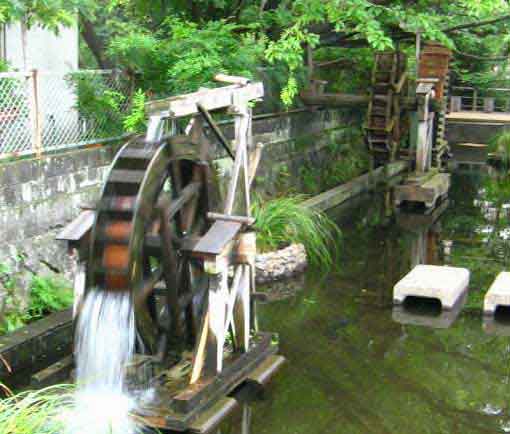
I don't think it will be particularly efficient though, but you should be able to easily manage the travel of the marbles mechanically with an interruption design
Is it allowable to eject the marbles that have driven through the drive system so that the remaining marbles have less mass to propel?
I don't think it will be particularly efficient though, but you should be able to easily manage the travel of the marbles mechanically with an interruption design
Is it allowable to eject the marbles that have driven through the drive system so that the remaining marbles have less mass to propel?
 king homework.


With a finite energy availible, this all comes down to 2 interelated things, which is ti get the highest effective drive ratio and the lowest friction (to enable that drive ratio to move the vehicle)
For example, lets say you drive ratio is 100 to 1, so the mass drops 1m, and you vehicle moves 100m. thats great, but that same drive ratio drops the tractive effort down to 5g only (500g/100). So, for it to work, your static friction must be less than 5g.
Basically, design the lowest friction system you can, then experiment with increasing the drive ratio to the highest value that will "JUST" start the device moving.
Also,as mentioned, ensure that the drive ratio tends to infinity as the mass hits the bottom stop, so you can use all of the vehicles inertial stored KE to roll to a stop and gain some more distance.
For example, lets say you drive ratio is 100 to 1, so the mass drops 1m, and you vehicle moves 100m. thats great, but that same drive ratio drops the tractive effort down to 5g only (500g/100). So, for it to work, your static friction must be less than 5g.
Basically, design the lowest friction system you can, then experiment with increasing the drive ratio to the highest value that will "JUST" start the device moving.
Also,as mentioned, ensure that the drive ratio tends to infinity as the mass hits the bottom stop, so you can use all of the vehicles inertial stored KE to roll to a stop and gain some more distance.
Have a high L shaped structure with two axles, wind string around the back axle up to the top and over a bar at the top of the L shaped, hang the mass off this, as it falls it will unwind and spin the axle. To improve it use a cone shape on the rear axle with the string unwinding from the thin end first then moving upto the fatter end, this will act as a CVT. Constrain the falling mass so it drops diagonally to the front of the L along the hyportenuse, this will give you maximum travel. We managed about 16 forward metres using this but it didnt go completely straight, actual distance was about 25 metres! Design spec was only 2!
Forums | General Gassing | Top of Page | What's New | My Stuff