
Carspreading could lead to extra 2,600 crash deaths a year
Discussion


https://www.theguardian.com/environment/2026/jun/2...
Some snippets:
"The findings come as research shared exclusively with the Guardian shows potential SUV buyers are undeterred by warnings that they are more likely to kill pedestrians." but at least those deaths will include some children.
"The extra resources needed to move the cars [over those if they were 'right-sized'] would equate to an extra 100m barrels of oil imports and 22.5 terawatt hours of electricity."
I expect some of those issues - especially the deaths - will be from those vehicles being the wrong size for our roads, and, ironically, from all the extra bloat caused by all those active and passive safety aids that are forced on us now.
Some snippets:
"The findings come as research shared exclusively with the Guardian shows potential SUV buyers are undeterred by warnings that they are more likely to kill pedestrians." but at least those deaths will include some children.
"The extra resources needed to move the cars [over those if they were 'right-sized'] would equate to an extra 100m barrels of oil imports and 22.5 terawatt hours of electricity."
I expect some of those issues - especially the deaths - will be from those vehicles being the wrong size for our roads, and, ironically, from all the extra bloat caused by all those active and passive safety aids that are forced on us now.
By citing cars with smaller footprints, you're asking drivers to downsize, which won't work without an incentive/penalty. People want bigger cars because of the safety and perceived value. It's also a very Britisher thing, as much as people deny it, to keep up with the Jones's and have a #premium SUV.
Sure some people might have a 6+ people in their family and a pooch, but most 4+ an average dog families could cope most of the time in a Golf/Focus Estate. But a Golf/Focus Estate isn't #premium #BMW #Audi #Mercedes #Porsche #M/S/AMG.
But would the public pay £45K for a Focus Estate EV compared to a bloated SUV?
Sure some people might have a 6+ people in their family and a pooch, but most 4+ an average dog families could cope most of the time in a Golf/Focus Estate. But a Golf/Focus Estate isn't #premium #BMW #Audi #Mercedes #Porsche #M/S/AMG.
But would the public pay £45K for a Focus Estate EV compared to a bloated SUV?
This is annoying.
From that meta-analysis;
"Do sports utility vehicles (SUVs) and light truck vehicles (LTVs) cause more severe injuries to pedestrians and cyclists than passenger cars in the case of a crash? A systematic review and meta-analysis"
https://pmc.ncbi.nlm.nih.gov/articles/PMC12911616/...
So - the real conclusion of that analysis should be that American market trucks and SUVs pose that increase in risk to pedestrians and cyclists.
Is this conclusion applicable to European market vehicles? Well, here is an EU briefing paper on how risky it would be to recognise the US LTV/SUV standards as equivalent:
https://etsc.eu/briefing-on-risks-to-the-eu-vehicl...
I hold no candle for w kpanzers, but this narrative is dishonest.
From that meta-analysis;
"Do sports utility vehicles (SUVs) and light truck vehicles (LTVs) cause more severe injuries to pedestrians and cyclists than passenger cars in the case of a crash? A systematic review and meta-analysis"
https://pmc.ncbi.nlm.nih.gov/articles/PMC12911616/...
So - the real conclusion of that analysis should be that American market trucks and SUVs pose that increase in risk to pedestrians and cyclists.
Is this conclusion applicable to European market vehicles? Well, here is an EU briefing paper on how risky it would be to recognise the US LTV/SUV standards as equivalent:
https://etsc.eu/briefing-on-risks-to-the-eu-vehicl...
EU said:
The US government under President Trump is pursuing an aggressive trade policy towards the European Union, threatening tariffs of 25% on cars and other goods.
ETSC understands that the US has expressed a desire for US and EU vehicles to be considered as ‘equivalent’, enabling US-market vehicles to be sold in the European Union without meeting the EU’s own standards.
This would be a catastrophic mistake, and the consequences would be measured in the deaths of men, women and children on EU roads.
The EU and US have developed their separate vehicle safety standards over several decades, based on local traffic conditions, their particular fleet makeup and the regulatory environment. These all have a role in the overall level of safety.
ETSC believes that the top priority with regard to vehicle safety is that the highest standards are maintained and there is no opportunity now or in the future to weaken them, or delay tighter standards.
Road safety trends in the US and EU
Since 2013, road deaths in the EU have decreased by 16%.[1] Higher vehicle safety standards are a key driver of this improvement.
In the US, over the same period road deaths have increased by 25%.[2] While there are likely to be multiple causes for this increase, the transition to larger, heavier SUVs and light trucks, as well as weaker vehicle safety requirements has played a key role.
Are EU and US standards equivalent?
ETSC was a stakeholder consulted on vehicle safety issues during negotiations for TTIP during the Obama administration. Our analysis at that time concluded that EU and US standards are not equivalent. [3]
A study commissioned by the car industry found that EU models were, on average, 33% safer in terms of risk of a serious injury in common front-side crashes. [4]
There are no pedestrian protection requirements in the United States
A fundamental difference in policy approach between the two markets is that EU vehicle safety policy takes account of all road users, not just those protected inside motor vehicles.
The EU has had pedestrian protection requirements affecting vehicle front end design for cars and vans since the mid-2000s, which have been upgraded in the years since. [5] The United States has no such requirements.
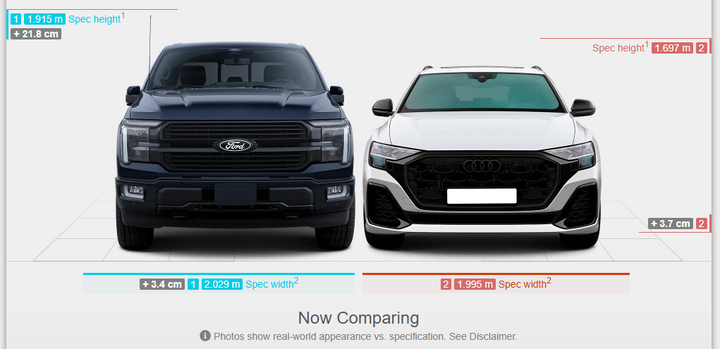
Finally, I'll just leave this here. America's biggest selling LTV, and an obnoxiously large European SUV (Audi Q8)ETSC understands that the US has expressed a desire for US and EU vehicles to be considered as ‘equivalent’, enabling US-market vehicles to be sold in the European Union without meeting the EU’s own standards.
This would be a catastrophic mistake, and the consequences would be measured in the deaths of men, women and children on EU roads.
The EU and US have developed their separate vehicle safety standards over several decades, based on local traffic conditions, their particular fleet makeup and the regulatory environment. These all have a role in the overall level of safety.
ETSC believes that the top priority with regard to vehicle safety is that the highest standards are maintained and there is no opportunity now or in the future to weaken them, or delay tighter standards.
Road safety trends in the US and EU
Since 2013, road deaths in the EU have decreased by 16%.[1] Higher vehicle safety standards are a key driver of this improvement.
In the US, over the same period road deaths have increased by 25%.[2] While there are likely to be multiple causes for this increase, the transition to larger, heavier SUVs and light trucks, as well as weaker vehicle safety requirements has played a key role.
Are EU and US standards equivalent?
ETSC was a stakeholder consulted on vehicle safety issues during negotiations for TTIP during the Obama administration. Our analysis at that time concluded that EU and US standards are not equivalent. [3]
A study commissioned by the car industry found that EU models were, on average, 33% safer in terms of risk of a serious injury in common front-side crashes. [4]
There are no pedestrian protection requirements in the United States
A fundamental difference in policy approach between the two markets is that EU vehicle safety policy takes account of all road users, not just those protected inside motor vehicles.
The EU has had pedestrian protection requirements affecting vehicle front end design for cars and vans since the mid-2000s, which have been upgraded in the years since. [5] The United States has no such requirements.
I hold no candle for w
kpanzers, but this narrative is dishonest.RichardHMorris said:
I expect some of those issues - especially the deaths - will be from those vehicles being the wrong size for our roads, and, ironically, from all the extra bloat caused by all those active and passive safety aids that are forced on us now.
I wouldn't really say that's true. I've just bought a Renault 5 E-Tech, it's smaller overall then any car I've owned in the last 18 years, but has way more safety tech.I mean yeah, compare it an original 5 and it's much larger, but I know which one I'd rather have an accident in.
The argument for SUVs isn't a safely one at all. It might be 'perceived' safety, but it's mostly a fashion thing.
Edited by framerateuk on Wednesday 24th June 16:46
drmike37 said:
It literally says that they don t expect these results to generalise to the EU.
It s just the Guardian writing stuff that they know their target audience wants to hear.
Yep. Just the Guardian doing what the Guardian does. I wouldn’t trust any of their reporting when it comes to cars. It s just the Guardian writing stuff that they know their target audience wants to hear.
Dave Hedgehog said:
what evidence do they use to get more deaths? I would expect a large surface area would spread the energy over the body, especially as frontal areas of cars are supposed to be designed to reduce injury to pedestrians
Once you get hit by anything over 20mph it becomes problematic, a larger car has more surface area to hit you with so bigger cars are a problem.If only carspreading lead to carparkspacespreading.
Many cars have got too big, but I'm not convinced that they will carry on getting bigger forever.
The big change in recent years is that the car for the stereotypical "school run mum" has gone from being a Fiesta to what historically would be described as a large family car, meaning nearly all the cars on the road are now large, rather than just some of them.
Something about the size of a current VW Tiguan or Kia Sportage is probably getting close to the size limit I think a default "car" for non car people will become. Anything larger than that takes more thought and planning to use on smaller UK roads and in car parks and driveways based on its size than most drivers can be bothered with. Using something like a pickup or a Transit van as an every day car takes quite a bit more effort when it comes to fitting through gaps, parking etc.
The Americans, with their massive roads, huge suburban houses with wide driveways, and parking spaces you could park a London Routemaster bus in don't have that limitation.
The big change in recent years is that the car for the stereotypical "school run mum" has gone from being a Fiesta to what historically would be described as a large family car, meaning nearly all the cars on the road are now large, rather than just some of them.
Something about the size of a current VW Tiguan or Kia Sportage is probably getting close to the size limit I think a default "car" for non car people will become. Anything larger than that takes more thought and planning to use on smaller UK roads and in car parks and driveways based on its size than most drivers can be bothered with. Using something like a pickup or a Transit van as an every day car takes quite a bit more effort when it comes to fitting through gaps, parking etc.
The Americans, with their massive roads, huge suburban houses with wide driveways, and parking spaces you could park a London Routemaster bus in don't have that limitation.
I dont see why this is a surprise.
There was a thread on here years ago, where (from memory)a posters brother and his wife were killed, leaving a toddler orphaned, when iirc a Range Rover crossed onto their side of the road and hit their focus head on.
At the time I thought (but didnt say, obvs, would be rather insensitive) that if that driver had been in something 'normal' that those two people could still be alive.
Taking that to it's extreme, in an accident the responsible parties choice of vehicle could be the difference between them going to prison for 'death by' vs a simple careless driving prosecution, if that.
Yeah I know - every accident is different, can't live like that etc etc and to an extent I agree, evidenced by that I am dailying a 37yr old car with no ABS/airbags/anything on the basis of 'I'll try not to crash then'.
We were parked up a while ago and an FF Range Rover parked next to us. My Daughters head was at eye level with the door handles. If we get hit by one, they'll be picking us up with a sponge.
Hadn't seen that size compare website before. It also explains why I cant see a fking thing if I am followed by one or one is coming the other way.
There was a time when the Volvo estate was considered a big car, that a family of 4 or 5 could fit everything they needed into...
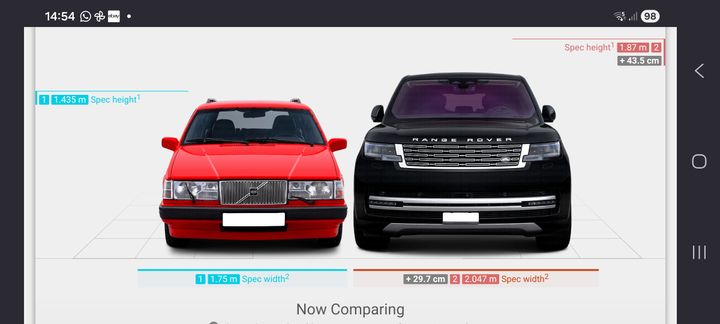
(940 is basically the same as my 740, that isn't on the site)
There was a thread on here years ago, where (from memory)a posters brother and his wife were killed, leaving a toddler orphaned, when iirc a Range Rover crossed onto their side of the road and hit their focus head on.
At the time I thought (but didnt say, obvs, would be rather insensitive) that if that driver had been in something 'normal' that those two people could still be alive.
Taking that to it's extreme, in an accident the responsible parties choice of vehicle could be the difference between them going to prison for 'death by' vs a simple careless driving prosecution, if that.
Yeah I know - every accident is different, can't live like that etc etc and to an extent I agree, evidenced by that I am dailying a 37yr old car with no ABS/airbags/anything on the basis of 'I'll try not to crash then'.
We were parked up a while ago and an FF Range Rover parked next to us. My Daughters head was at eye level with the door handles. If we get hit by one, they'll be picking us up with a sponge.
Hadn't seen that size compare website before. It also explains why I cant see a f
king thing if I am followed by one or one is coming the other way.There was a time when the Volvo estate was considered a big car, that a family of 4 or 5 could fit everything they needed into...
(940 is basically the same as my 740, that isn't on the site)
drmike37 said:
It literally says that they don t expect these results to generalise to the EU.
It s just the Guardian writing stuff that they know their target audience wants to hear.
Quite - along with their own study of lying about the applicability of the meta-analysis, asking drivers whether they care, wringing hands that they don't, and concluding that they need to be forced to.It s just the Guardian writing stuff that they know their target audience wants to hear.
Comes from a UK institution, and a UK professor mostly interested in pushing UK policies intended to curtail car use, though.
https://www.lshtm.ac.uk/aboutus/people/goodman.ann...
Blib said:
Tax cars on size of area covered. High footprint = high tax.
I can comfortably get 4 six foot plus adults into my Hyundai Inster Cross with room for stuff in the boot. The Inster is the same size as a Fiat Panda.
They already do, it's called fuel duty!I can comfortably get 4 six foot plus adults into my Hyundai Inster Cross with room for stuff in the boot. The Inster is the same size as a Fiat Panda.
Edited by Blib on Wednesday 24th June 14:14
Realistically driving something longer makes little difference day to day (I don't generally need to park it on the street). I drive a 5.2m long Mitsubishi pickup, I can also get 4 adults into it but I have room for a tonne of logs in the back.
Buy what suits you, just because you have no need for a 4x4 doesn't mean others are only buying them for vanity reasons.
Dave Hedgehog said:
what evidence do they use to get more deaths? I would expect a large surface area would spread the energy over the body, especially as frontal areas of cars are supposed to be designed to reduce injury to pedestrians
"A meta-study of existing safety research earlier this year found that if an adult pedestrian was struck by an SUV, they were 44% more likely to be killed than if the vehicle was a smaller car. This rose to 82% higher for children."https://pubmed.ncbi.nlm.nih.gov/40300846/
Forums | General Gassing | Top of Page | What's New | My Stuff