
Williams Hybrid Flywheel
Discussion


Evening all - wondering if anyone could shed any light on the following pub question: does the Williams Hybrid Flywheel system exert a gyroscopic effect on the car that would be noticeable from the drivers seat? Do the engineers have to alter the setup to take this into effect, or is the device sufficiently lightweight that this isn't an issue - I assume the unit is orientated such that the flywheel is parallel to the track to lower the CoG.
Cheers for any insight
TheHoof.
Cheers for any insight
TheHoof.
Not sure but I have a feeling it used a pair of contra rotating flywheels which effectively cancelled each other out gyroscopically.
It's never been used in anger though AFAIK, and this year they're using either the standard Renault KERS or their own variation of it, not flywheel KERS
It's never been used in anger though AFAIK, and this year they're using either the standard Renault KERS or their own variation of it, not flywheel KERS
Video here, doesn't mention dual flywheels so I might be wrong on that but shows how it would work
http://www.youtube.com/watch?v=ZnKhE5T4Re8
http://www.youtube.com/watch?v=ZnKhE5T4Re8
Any rotating object will exert gyroscopic forces, based on its inertia, speed and the accelerating you put it through.
The way to reduce them is to make something with low inertia, and spin it very very quickly. That way you get lots of stored energy (speed squared times inertia) but comparatively low gyroscopic forces.
As for whether the driver can feel it or not, the flywheel hybrids I work with don't have a noticeable effect, but I don't know enough about the Williams speed/inertia to comment on whether or not it will be noticeable.
In the grand scheme of things, modern cars have pretty high polar moments of inertia, so the forces associated with yawing the car vs yawing the flywheel make the flywheel gyroscopic forces fairly insignificant (in our systems at least, like I said I can't comment on Williams.)
Eta I was thinking of a road car, not sure what a racecar PMoI is, but the drivers in our Motorsport project are very happy with how the car feels with the system fitted, so I doubt there is anything negative introduced by our flywheel!
The way to reduce them is to make something with low inertia, and spin it very very quickly. That way you get lots of stored energy (speed squared times inertia) but comparatively low gyroscopic forces.
As for whether the driver can feel it or not, the flywheel hybrids I work with don't have a noticeable effect, but I don't know enough about the Williams speed/inertia to comment on whether or not it will be noticeable.
In the grand scheme of things, modern cars have pretty high polar moments of inertia, so the forces associated with yawing the car vs yawing the flywheel make the flywheel gyroscopic forces fairly insignificant (in our systems at least, like I said I can't comment on Williams.)
Eta I was thinking of a road car, not sure what a racecar PMoI is, but the drivers in our Motorsport project are very happy with how the car feels with the system fitted, so I doubt there is anything negative introduced by our flywheel!
Edited by Nick1point9 on Saturday 25th February 20:59
Any rotating object will exert gyroscopic forces, based on its inertia, speed and the accelerating you put it through.
The way to reduce them is to make something with low inertia, and spin it very very quickly. That way you get lots of stored energy (speed squared times inertia) but comparatively low gyroscopic forces.
As for whether the driver can feel it or not, the flywheel hybrids I work with don't have a noticeable effect, but I don't know enough about the Williams speed/inertia to comment on whether or not it will be noticeable.
In the grand scheme of things, modern cars have pretty high polar moments of inertia, so the forces associated with yawing the car vs yawing the flywheel make the flywheel gyroscopic forces fairly insignificant (in our systems at least, like I said I can't comment on Williams.)
Eta I was thinking of a road car, not sure what a racecar PMoI is, but the drivers in our Motorsport project are very happy with how the car feels with the system fitted, so I doubt there is anything negative introduced by our flywheel!
The way to reduce them is to make something with low inertia, and spin it very very quickly. That way you get lots of stored energy (speed squared times inertia) but comparatively low gyroscopic forces.
As for whether the driver can feel it or not, the flywheel hybrids I work with don't have a noticeable effect, but I don't know enough about the Williams speed/inertia to comment on whether or not it will be noticeable.
In the grand scheme of things, modern cars have pretty high polar moments of inertia, so the forces associated with yawing the car vs yawing the flywheel make the flywheel gyroscopic forces fairly insignificant (in our systems at least, like I said I can't comment on Williams.)
Eta I was thinking of a road car, not sure what a racecar PMoI is, but the drivers in our Motorsport project are very happy with how the car feels with the system fitted, so I doubt there is anything negative introduced by our flywheel!
Edited by Nick1point9 on Saturday 25th February 20:59
Been watching NetGeo Megafactories by any chance? 
The Williams flywheel is mounted vertically in the F1 car, so the gyroscopic effect would be in pitch not yaw. It's centrally mounted as well so I'm guessing the effect of lift/downforce at the front/rear would be minimal? Or it could be easily cured by two contra rotating flywheels, which is what gets my bet.
But yeah, if there is no counter-balancing, a gyroscopic effect would surely exist. How light must the system be? I mean, ever picked up a external HDD and twisted it around while it's spinning? Similar to old WWI fighters like Sopwith Camels and Pups with rotary engines that made the planes fast to turn the same way as the engine rotates and slow to turn the opposite way the engine rotates.
You do have to wonder, if Schumi drove for Williams you'd bet they'd have 2 flywheels mounted horizonally and they'd turn one off depending on which corner you were about to turn into.
The Williams flywheel is mounted vertically in the F1 car, so the gyroscopic effect would be in pitch not yaw. It's centrally mounted as well so I'm guessing the effect of lift/downforce at the front/rear would be minimal? Or it could be easily cured by two contra rotating flywheels, which is what gets my bet.
But yeah, if there is no counter-balancing, a gyroscopic effect would surely exist. How light must the system be? I mean, ever picked up a external HDD and twisted it around while it's spinning? Similar to old WWI fighters like Sopwith Camels and Pups with rotary engines that made the planes fast to turn the same way as the engine rotates and slow to turn the opposite way the engine rotates.
You do have to wonder, if Schumi drove for Williams you'd bet they'd have 2 flywheels mounted horizonally and they'd turn one off depending on which corner you were about to turn into.
Edited by mattikake on Sunday 26th February 02:04
The system only has a single flywheel unit.
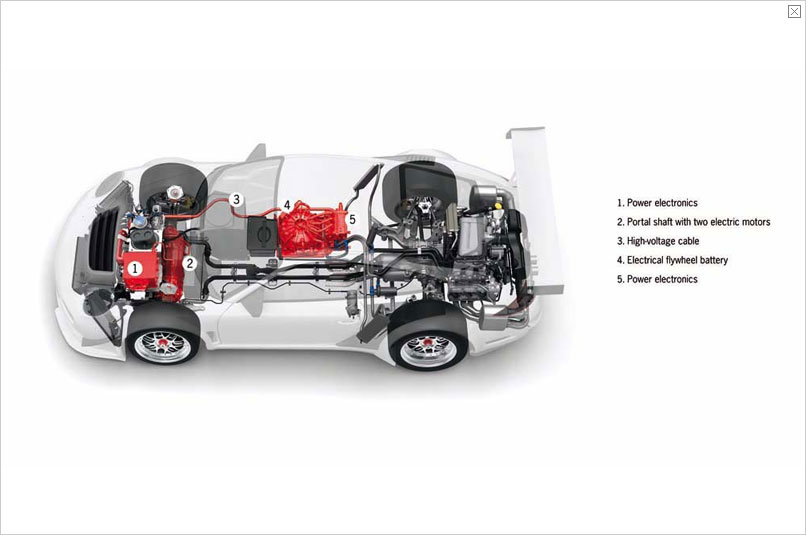
As mentioned the orientation of the rotational axis of the flywheel is cruical in a car with low inetia. In the F1 application there is a noticable gyroscopic progression, and the unit is mounted to mimise these effects under normal chassis G loadings. They are most certainly "noticable" to the drivers. In the 911 motorsport application the extra mass and slower chassis accelerations result in no noticable extra chassis loadings under normal circumstances.
As mentioned the orientation of the rotational axis of the flywheel is cruical in a car with low inetia. In the F1 application there is a noticable gyroscopic progression, and the unit is mounted to mimise these effects under normal chassis G loadings. They are most certainly "noticable" to the drivers. In the 911 motorsport application the extra mass and slower chassis accelerations result in no noticable extra chassis loadings under normal circumstances.
mattikake said:
Been watching NetGeo Megafactories by any chance?
The Williams flywheel is mounted vertically in the F1 car, so the gyroscopic effect would be in pitch not yaw. It's centrally mounted as well so I'm guessing the effect of lift/downforce at the front/rear would be minimal? Or it could be easily cured by two contra rotating flywheels, which is what gets my bet.
But yeah, if there is no counter-balancing, a gyroscopic effect would surely exist. How light must the system be? I mean, ever picked up a external HDD and twisted it around while it's spinning? Similar to old WWI fighters like Sopwith Camels and Pups with rotary engines that made the planes fast to turn the same way as the engine rotates and slow to turn the opposite way the engine rotates.
You do have to wonder, if Schumi drove for Williams you'd bet they'd have 2 flywheels mounted horizonally and they'd turn one off depending on which corner you were about to turn into.
There isn't a flywheel in the Williams F1 car?!The Williams flywheel is mounted vertically in the F1 car, so the gyroscopic effect would be in pitch not yaw. It's centrally mounted as well so I'm guessing the effect of lift/downforce at the front/rear would be minimal? Or it could be easily cured by two contra rotating flywheels, which is what gets my bet.
But yeah, if there is no counter-balancing, a gyroscopic effect would surely exist. How light must the system be? I mean, ever picked up a external HDD and twisted it around while it's spinning? Similar to old WWI fighters like Sopwith Camels and Pups with rotary engines that made the planes fast to turn the same way as the engine rotates and slow to turn the opposite way the engine rotates.
You do have to wonder, if Schumi drove for Williams you'd bet they'd have 2 flywheels mounted horizonally and they'd turn one off depending on which corner you were about to turn into.
Edited by mattikake on Sunday 26th February 02:04
Edited by Adam205 on Sunday 26th February 18:56

mattikake said:
But yeah, if there is no counter-balancing, a gyroscopic effect would surely exist. How light must the system be? I mean, ever picked up a external HDD and twisted it around while it's spinning? Similar to old WWI fighters like Sopwith Camels and Pups with rotary engines that made the planes fast to turn the same way as the engine rotates and slow to turn the opposite way the engine rotates.
Like I said above its all about polar moment of inertia. If the car has a high polar moment of inertia then the flywheel inertia will make up a small part of yawing/pitching/rolling the car and will therefore have minimal effect.Remember the engine and gearbox will have some gyroscopic forces too, but you never hear drivers complaining that the car turns in better one way than the other.
Edited by Nick1point9 on Monday 27th February 08:13
weyland yutani said:
I assumed Porsche had developed their own system for the new 918, very pleased to learn in the Mega Factories doc that they're using the Williams Hybrid System. That's a huge coup for the team/business.
I have a feeling Audi are using it in the R18H (or whatever its called)? LocoBlade said:
Not sure but I have a feeling it used a pair of contra rotating flywheels which effectively cancelled each other out gyroscopically.
It's never been used in anger though AFAIK, and this year they're using either the standard Renault KERS or their own variation of it, not flywheel KERS
As Loco said, I suspect it did have some unwanted gyroscopics, and that probably had a bearing on the fact a flywheel based KERS system was neverraced in F1. They tested it, but it was never raced. Who's system they used last year I don't know. I suspect they are now selling the system via Hybrid Power to try and recoup some of the huge development cash that went into it.It's never been used in anger though AFAIK, and this year they're using either the standard Renault KERS or their own variation of it, not flywheel KERS
Flybrid was used last year with mixed success at Le Mans by Hope Polevision - a small Swiss privateer team
I am fascinated by the fact that it has to rotate in a vacuum as the air resistance would heat the wheel up and cause warping at the high speeds... typically more than 70.000 rpm
This is the warning sticker for the car (as per regs)

I am fascinated by the fact that it has to rotate in a vacuum as the air resistance would heat the wheel up and cause warping at the high speeds... typically more than 70.000 rpm
This is the warning sticker for the car (as per regs)
Edited by Great Dane on Monday 27th February 09:02

Great Dane said:
Flybrid was used last year with mixed success at Le Mans by Hope Polevision - a small Swiss privateer team
I am fascinated by the fact that it has to rotate in a vacuum as the air resistance would heat the wheel up and cause warping at the high speeds... typically more than 70.000 rpm
This is the warning sticker for the car (as per regs)
"only" 60 000 rpm I'm afraid.I am fascinated by the fact that it has to rotate in a vacuum as the air resistance would heat the wheel up and cause warping at the high speeds... typically more than 70.000 rpm
This is the warning sticker for the car (as per regs)
Edited by Great Dane on Monday 27th February 09:02
Even then the surface speed is about mach 2, putting into context how important it is not to have too many air molecules to bump into.
I seem to remember reading that, with the current low limits on energy levels for KERS in F1, batteries make more sense than the flywheel systems as they are easier to package.
However, with the new regs in 2014, with much more KERS power available, the flywheels are likely to be more common as the weight v power storage is more in their favour.
The Porsche is supposed to function very well with this system
However, with the new regs in 2014, with much more KERS power available, the flywheels are likely to be more common as the weight v power storage is more in their favour.
The Porsche is supposed to function very well with this system
The new Audi Le Mans R18 hybrid cars are using the Williams Hybrid system as well (guess not so surprising with them being VAG as well). Sorry on it over at Autosport:
http://www.autosport.com/news/report.php/id/97739
Forums | General Motorsport | Top of Page | What's New | My Stuff