
Historic motor sport question?
Discussion


chevronb37 said:
I would say Shelsley Walsh.
Circuits tend to be a joined in a loop hence the term circuit  That's a hill climb course.
Donington is the oldest after Brooklands.
Although Brands Hatch first held a race in 1928 it was a grass track, with the proper surface laid after WWII. But Donington was constructed in 1931, as the first purpose built road course that wasn't an oval. (<-- added this bit to stop the pedants reiterating rather annoyingly and nasally that Brooklands was the first despite we already knowing that).
Edited by FourWheelDrift on Monday 19th January 23:04

FourWheelDrift said:
chevronb37 said:
I would say Shelsley Walsh.
Circuits tend to be a joined in a loop hence the term circuit That's a hill climb course.Donington is the oldest after Brooklands.
Although Brands Hatch first held a race in 1928 it was a grass track, with the proper surface laid after WWII. But Donington was constructed in 1931, as the first purpose built road course that wasn't an oval. (<-- added this bit to stop the pedants reiterating rather annoyingly and nasally that Brooklands was the first despite we already knowing that).

Yeah, if you are being circuit specific, Donington is your answer. Shelsley Walsh has the longest continuous motor racing history of any racing venue in the world, to my knowledge. Shamefully I've never been. Such a shame that Donington languished for so many years - it was Britain's biggest store for military vehicles after the war and only (and I mean only) Tom Wheatcroft could've saved it. Thank God he did.
I would also add that Brooklands is quite the most spectacular place. I visited last year for the first time and found it deeply moving and quite emotional. The banking is so haunting. The sheer size of it takes your breath away, especially when compared to Rockingham, which is comparatively tiny. We should consider oursleves very lucky that it is still accessible at all.
I would also add that Brooklands is quite the most spectacular place. I visited last year for the first time and found it deeply moving and quite emotional. The banking is so haunting. The sheer size of it takes your breath away, especially when compared to Rockingham, which is comparatively tiny. We should consider oursleves very lucky that it is still accessible at all.
chevronb37 said:
Yeah, if you are being circuit specific, Donington is your answer. Shelsley Walsh has the longest continuous motor racing history of any racing venue in the world, to my knowledge. Shamefully I've never been. Such a shame that Donington languished for so many years - it was Britain's biggest store for military vehicles after the war and only (and I mean only) Tom Wheatcroft could've saved it. Thank God he did.
I would also add that Brooklands is quite the most spectacular place. I visited last year for the first time and found it deeply moving and quite emotional. The banking is so haunting. The sheer size of it takes your breath away, especially when compared to Rockingham, which is comparatively tiny. We should consider oursleves very lucky that it is still accessible at all.
Totally aggree, I was at Brooklands on Sunday, just find it so sad that a lot of it has been turned into an industural estate! Thank god now there not allowed to break up any more of it I would also add that Brooklands is quite the most spectacular place. I visited last year for the first time and found it deeply moving and quite emotional. The banking is so haunting. The sheer size of it takes your breath away, especially when compared to Rockingham, which is comparatively tiny. We should consider oursleves very lucky that it is still accessible at all.

FourWheelDrift said:
History carved through for commercialism.

f k me, i didn't realise it looked like that now.
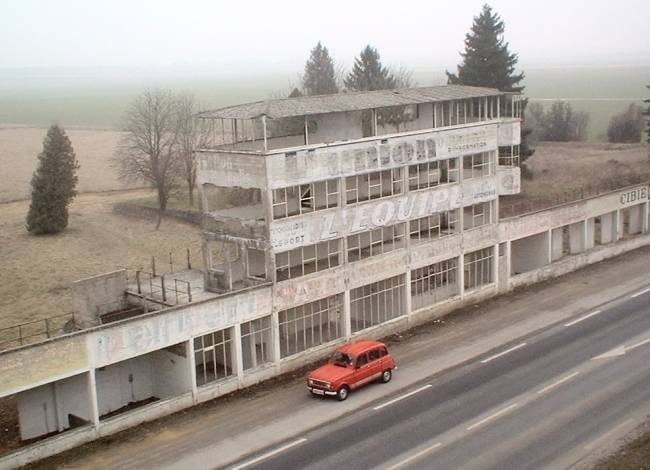
 But as for circuits of the world, i'm sure there were many circuits built elsewhere in the world between the wars. When was Monza built? Or that track outside Paris, forget the name now. Montlhery?
The 'Ring, that was built in 1927.
Montlhery was built in '24. http://en.wikipedia.org/wiki/Autodrome_de_Montlh%C...
Some of the early circuits in date order.
Milwaukee Mile 1903 (dirt track, paved in 1954) - complete
Brooklands 1907 - wrecked
Indianapolis Motor Speedway 1909 - complete
Sitges Terramar (Spain) 1922 - complete if in bad condition
Monza - 1922-1923 - complete. Oval in bad condition
Road race courses.
Isle of Man TT course 1907 - still held.
Le Mans 1923 - still held.
Milwaukee Mile 1903 (dirt track, paved in 1954) - complete
Brooklands 1907 - wrecked
Indianapolis Motor Speedway 1909 - complete
Sitges Terramar (Spain) 1922 - complete if in bad condition
Monza - 1922-1923 - complete. Oval in bad condition
Road race courses.
Isle of Man TT course 1907 - still held.
Le Mans 1923 - still held.
The reason why Britain built a purpose built race track as early as 1907 was because no motor spoort was allowed on public roads. Mr Lock-King, who owned the site, was concerned that motor car technology would languish in Britain without home grown competition and the ability to test machinery under extreme conditions. He built the track at Brooklands out of his private funds to provide such a facility.
In reality, Brooklamds was pretty much finished by 1939. Its early 20th Century concrete was beginning to crack and disintegrate even then and the track was suffering from severe subsidence in places. That famous picture of John Cobb "flying" in the 1 ton Railton shows what the "bumps" could do to a car.
Don't forget that Brooklands was also a centre of aviation as well. By the start of WW2, most of the site was owned by Vickers-Armstrong and the area had to be amended to allow bigger aircraft and more hangars and test buildings to be erected. It was these works which finally killed off the venue as a race circuit. By the time the war ended, the track had already been torn up in places and built on.
The oldest "racing" site in the British Isles is actually the Phoenix Park in Dublin. Unlike Britain, other parts of the UK DID allow racing on public roads. Ireland (then fully part of the UK), the Isle of Man and the Channel Islands had no road racing restrictions. The 1903 Gordon Bennet trophy races were held in Ireland and some of the racing was held at the Phoenix Park. Motor racing still goes on at this avenue, although quite a few circuit layouts have been used oover the years.
In reality, Brooklamds was pretty much finished by 1939. Its early 20th Century concrete was beginning to crack and disintegrate even then and the track was suffering from severe subsidence in places. That famous picture of John Cobb "flying" in the 1 ton Railton shows what the "bumps" could do to a car.
Don't forget that Brooklands was also a centre of aviation as well. By the start of WW2, most of the site was owned by Vickers-Armstrong and the area had to be amended to allow bigger aircraft and more hangars and test buildings to be erected. It was these works which finally killed off the venue as a race circuit. By the time the war ended, the track had already been torn up in places and built on.
The oldest "racing" site in the British Isles is actually the Phoenix Park in Dublin. Unlike Britain, other parts of the UK DID allow racing on public roads. Ireland (then fully part of the UK), the Isle of Man and the Channel Islands had no road racing restrictions. The 1903 Gordon Bennet trophy races were held in Ireland and some of the racing was held at the Phoenix Park. Motor racing still goes on at this avenue, although quite a few circuit layouts have been used oover the years.
Edited by Eric Mc on Tuesday 20th January 07:10
Donington may have been a pre-war racing venue, but very little of the original course follows the current track. The original pits were roughly where the current Melbourne loop is and the original Melbourne hairpin was much further on (I think the concrete is still there) and there was a wicked bump (where the pre-war Mercs & Auto Unions would take off) on the return road to Redgate, which was then a left-hander. Hollywood was in a wood. The track passed under the ornamental arch of Starkeys bridge, not under the modern section beside it, and also through the farmyard, which is beside the museum. None of the curves at the airport end are original either.
Another pre and post-war circuit was Crystal Palace, home of the "London Grand Prix"!
Another pre and post-war circuit was Crystal Palace, home of the "London Grand Prix"!
Forums | General Motorsport | Top of Page | What's New | My Stuff