
Trumpet length
Discussion


Hi,
Please can anyone tell me the original trumpet lengths for the standard 4.0 1996 Chimaera?
I have searched here for original dimensions, but no joy.
My plenum and trumpet base are currently off and I am not sure if mine have been shortened already by a previous owner.
They obviously sit at different depths and mine are all 100mm long.
Please can anyone tell me the original trumpet lengths for the standard 4.0 1996 Chimaera?
I have searched here for original dimensions, but no joy.
My plenum and trumpet base are currently off and I am not sure if mine have been shortened already by a previous owner.
They obviously sit at different depths and mine are all 100mm long.
Edited by rdl001 on Monday 16th December 21:51


phazed said:
Is it, slightly more power at higher rpm but the trade-off is slightly less torque?
Yes on a more standard engine the basic rule of thumb is Shorter and wider trumpets for bhp but that’s not much available below 3000 rpm
Longer narrower trumpets as in the 38 mm ones as shown above for more torque lower down at the expense of a bit of bhp at the top of the Rev range.
It comes down to more than just these though.
State of engine health etc will have a baring on any results.
My 4.6 uses the standard trumpets as I like lots of torque where I want it on the roads,,, 1000-4000 revs. It simply promotes air speed where the larger ones provide a big dollop of air, it’s all a trade off between air speed and air mass.
It’s important to note like big cams, slowing the air speed down doesn’t always promote the best road manners at slow engine speeds, I like my car to burble as well as fly so I trade off that extra power for power at slower speeds,, I’m getting old

The oft quoted maxim of short for power long for torque is flawed. If you look back through some of my induction length threads in the engine section you can see a few instances where adding significant length raised the peak power considerably. There's not a lot of length changing to be had in the rover plenum anyway, either shorter or longer, so any change is going to be limited.
The spacing between the top of the trumpets and the plenum top come no where near to the rule of thumb used for air filters on bell mouths where the minimum distance to the back plate was 1.5 times the inlet tube size, but it would make for a very tall plenum. I guess the nearest we would find out is if a plenum spacer added extra airflow with a bit more headroom above the trumpets.
I'm still keen to try a Thor inlet with its way longer runners...
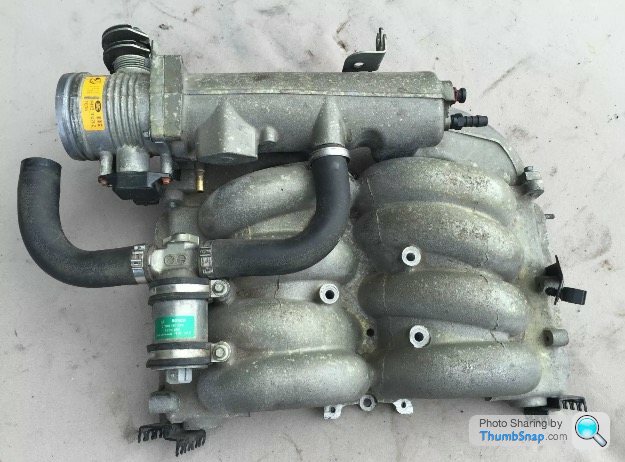
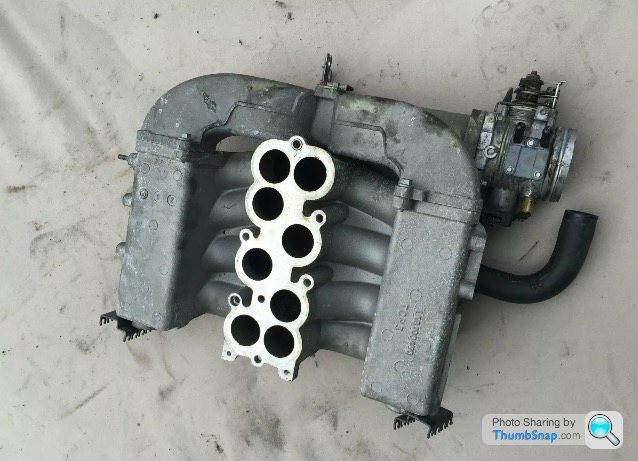
I'm convinced for 95% of everyday driving it'll give really pleasing characteristics, but of course long runners are nothing new....

The 14CUX plenum and inlet setup is early fuel injection thinking with very short runners, by the late 80's it was already old hat as engineers found new ways to return to the proven long runner arrangement while still keeping a low bonnet line.
By the mid/late 1980's Porsche already had all this worked out, heres a 1988 Porsche 928 inlet manifold ...

And in the early 90's Audi were putting this on their V8s....

A Chevy LS inlet manifold is the the ultimate interpretation of the same long runner principle...

Of course it's not just a case of longer is better, it's all about pulse wave tuning, but no one has done this kind of thing for years...

It seems pretty clear early 80's fuel injection inlet manifold design thinking favoured the straignt shot runner idea over length, this was soon replaced with a return to increasing runner lenth, and of course to get the length while keeping the overall height of the inlet manifold low you need either a looping design as with the Thor......

Or the cross over design we see in all modern V8 inlet manifold designs, in this case as used on the Ford Coyote engine...

The truth is everyone building naturally aspirated V8s these days ie Audi, Chevrolet, Ford, Lexus, Mercedesect ect ect all go with cross over/tunnel ram designs to get the longest runners they can in the smallest space possible, heres the inlet manifold from the Porsche Cayenne V8.

The nearest we can get to this more modern longer runner thinking for very little money is definitely the Thor inlet manifold, you can really see how much longer the runners are in this shot where a throttle body has been added to each bank seperated plenum supported runner pair setup .....

So in the absense of the modern thinking Porsche, Chevy, Ford, Audi ect ect ect tunel type crossed over long runner inlet for the Rover V8 the Thor is the best we can get,
So forget shortening your trumpets (velocity stacks to use the correct term) I'd put money on the Thor inlet making for a lovely driving TVR producing heaps more torque where you want it most, and as the old Rover V8 in 95% of our TVRs runs out of puff long before it reaches 6,000rpm I really don't think it'll restrict top end either.
I'm convinced for 95% of everyday driving it'll give really pleasing characteristics, but of course long runners are nothing new....
The 14CUX plenum and inlet setup is early fuel injection thinking with very short runners, by the late 80's it was already old hat as engineers found new ways to return to the proven long runner arrangement while still keeping a low bonnet line.
By the mid/late 1980's Porsche already had all this worked out, heres a 1988 Porsche 928 inlet manifold ...
And in the early 90's Audi were putting this on their V8s....
A Chevy LS inlet manifold is the the ultimate interpretation of the same long runner principle...
Of course it's not just a case of longer is better, it's all about pulse wave tuning, but no one has done this kind of thing for years...
It seems pretty clear early 80's fuel injection inlet manifold design thinking favoured the straignt shot runner idea over length, this was soon replaced with a return to increasing runner lenth, and of course to get the length while keeping the overall height of the inlet manifold low you need either a looping design as with the Thor......
Or the cross over design we see in all modern V8 inlet manifold designs, in this case as used on the Ford Coyote engine...
The truth is everyone building naturally aspirated V8s these days ie Audi, Chevrolet, Ford, Lexus, Mercedesect ect ect all go with cross over/tunnel ram designs to get the longest runners they can in the smallest space possible, heres the inlet manifold from the Porsche Cayenne V8.
The nearest we can get to this more modern longer runner thinking for very little money is definitely the Thor inlet manifold, you can really see how much longer the runners are in this shot where a throttle body has been added to each bank seperated plenum supported runner pair setup .....
So in the absense of the modern thinking Porsche, Chevy, Ford, Audi ect ect ect tunel type crossed over long runner inlet for the Rover V8 the Thor is the best we can get,
So forget shortening your trumpets (velocity stacks to use the correct term) I'd put money on the Thor inlet making for a lovely driving TVR producing heaps more torque where you want it most, and as the old Rover V8 in 95% of our TVRs runs out of puff long before it reaches 6,000rpm I really don't think it'll restrict top end either.
If your considering going down the slippery slope of shortened trumpets etc then I’d leave well alone, that’s coming from someone who has spent the best part of £5000 on their engine to gain around 40 bhp.
Save your money for a larger capacity lump or just go for a low psi turbo install from the start.
Save your money for a larger capacity lump or just go for a low psi turbo install from the start.
Belle427 said:
If your considering going down the slippery slope of shortened trumpets etc then I’d leave well alone, that’s coming from someone who has spent the best part of £5000 on their engine to gain around 40 bhp.
Save your money for a larger capacity lump or just go for a low psi turbo install from the start.
You haven't detailed what you had done, but it's long been accepted that about 100 pounds per hp is what it averages out as for rv8 tuning, and has been for the last couple of decades. What were you expecting ? 40hp for 5k sounds like you got normal value for money to me for rv8 NA tuning ?Save your money for a larger capacity lump or just go for a low psi turbo install from the start.
spitfire4v8 said:
You haven't detailed what you had done, but it's long been accepted that about 100 pounds per hp is what it averages out as for rv8 tuning, and has been for the last couple of decades. What were you expecting ? 40hp for 5k sounds like you got normal value for money to me for rv8 NA tuning ?
Not really moaning as such but just using it as an example, I just wouldn’t choose to do it again.I went for Nice heads, larger plenum, ported inlet with shortened radiused trumpets and a decent cam.
Topped off with a Megasquirt conversion, not rolling roaded yet on the megasquirt but made about 260 Hp on the above with the 14cux.
Sadly I don’t know what it was before I started but it all but it didn’t feel down on power.
Edited by Belle427 on Wednesday 18th December 09:49
During the last 10 years of ownership I've tried to focus on all the sensilible stuff, brakes, suspension, engine management, LPG, chassis restoration ect ect.
I'm now thinking with all that sorted it could be time for some more performance, and it seems pretty clear the most cost effective way to do it is to add a turbo.
I'm thinking the low pressure kit is the safe way forward, it should bring my 4.0 litre upto 320hp and 360 ft/lbs making the car faster than even the average tuned 5.0 litre.
I'm also thinking with boost control my Canems output 2 PWM 3D map facility should make a low pressure turbo kit behave much like a Rotrex supercharger
I'm now thinking with all that sorted it could be time for some more performance, and it seems pretty clear the most cost effective way to do it is to add a turbo.
I'm thinking the low pressure kit is the safe way forward, it should bring my 4.0 litre upto 320hp and 360 ft/lbs making the car faster than even the average tuned 5.0 litre.
I'm also thinking with boost control my Canems output 2 PWM 3D map facility should make a low pressure turbo kit behave much like a Rotrex supercharger
Classic Chim said:
So would a Thor with a turbo added be some sort of holy grail, natural torque from the Thor and loads of bhp curtesy of the Turbo?
I'm afraid it doesnt work like that, go forced induction and manifold design becomes way less important as you're just shoving air down the egine's neck.
Forums | Chimaera | Top of Page | What's New | My Stuff