
Ignition Table Megasquirt
Discussion


would anyone be willing to share their ignition tables as with plenty of time on my hands im having a play around with tuning.
this is my current table which is a best guess at the moment, i plan to get it to a rolling road when things return to normal.
i probably need to add more in the cruise area so would welcome any comments.
Thanks.

this is my current table which is a best guess at the moment, i plan to get it to a rolling road when things return to normal.
i probably need to add more in the cruise area so would welcome any comments.
Thanks.
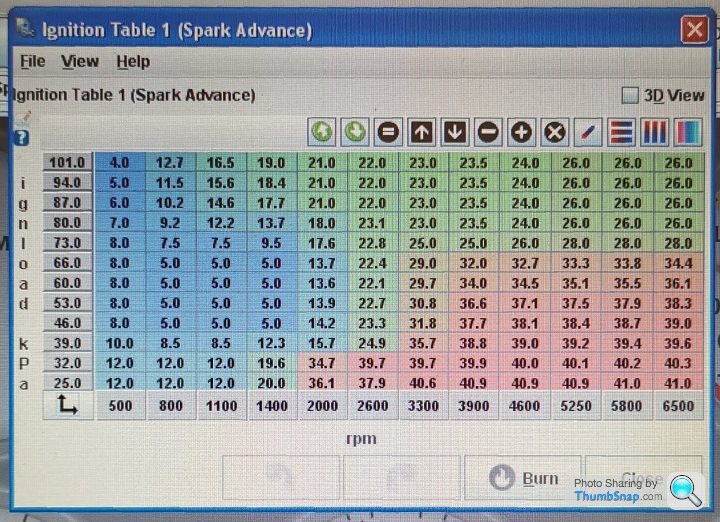
Ahh. The 5 deg area is just to reduce shunting. 5ltr, Stealth cam, intake mods.
I've just swapped out the Stealth for an 885 and hoping that area can be returned to normal. Also just rewired the injector loom for semi sequential.
The car's not back on the road yet, so none of the changes have been tried out. Looking forward to the day however.
Dougal.
I've just swapped out the Stealth for an 885 and hoping that area can be returned to normal. Also just rewired the injector loom for semi sequential.
The car's not back on the road yet, so none of the changes have been tried out. Looking forward to the day however.
Dougal.

Don't discount studying the Lucas distributor curve, people are often dismissive of distributor ignition systems but the truth they worked perfectly for many decades. Keep in mind the advance characteristics and timing numbers chosen for the distributor calibration were highly developed on a rolling road by very skilled development engineers, optimal timing numbers would have been found many years ago, however watch out for emissions strategies because this is where the engineer was forced to make compromises.
We know the distributor is fully advanced by 3,000rpm, however in high vacuum (low load) cruise conditions the vacuum advance unit will add upto 10 degrees of advance onto the mechanical advance timing number, so the Lucas engineers clearly worked out that at 3,000rpm at cruise the engine would deliver best economy at 28 degrees plus a further 10 degrees = 38 degrees.
A distributor is 2D, however add a vacuum advance unit and suddenly it gives you 3D ignition control, its actually the closest thing a standard TVR running a distributor has to the kind of 3D ignition management we enjoy with our aftermarket stand alone ECUs, so when people disconnect their vacuum advance they are actually taking a massive step backwards.
Here's my Canems petrol ignition table which may help?

Please note I am idling at 18 degrees which is what the engine wants, but it is not especially good for emissions, the standard distributor is set up to idle at 10 degrees but this is for emissions reasons only. The engine actually wants more timing for sure but 10 degrees will lower emissions, to make this work as you transition from idle to driving away ported vacuum was used. Basically with ported vacuum, the vacuum advance unit sees no vacuum whatsoever at idle, but as soon as you open the throttle the vacuum port on the throttle body switches from atmosphere to a full engine vacuum signal instantly adding 4-5 degrees of advance.
Suddenly you're at 15 degrees and much closer to the optimum number, but there's only so much vacuum being made by the engine as you pull away and the vacuum advance unit has its limitation on what it can add too, essentially its all a compromise you can dial our with your after market stand alone ECU. If you just started with an 18 degrees idle the engine will be happier and the transition to driving timing as you pull away can be far less abrupt, but emissions will suffer so you need to make your own choice about that one, personally I'll take a happy smooth engine over saving the dolphins all day long.
Also observe how I'm running 42 degrees of timing at cruise, this is effectively the 38 degrees the distributor (with vac advance) gives plus 4 degrees for even better fuel economy, like this I found I went from 28 mpg on cruise with the distributor to 31 mpg with the Canems system, the additional 4 degrees of timing made a whopping 10% improvement to fuel economy at 80mph on the motorway!

Other points to consider:
1. Every engine is a little different so will demand a unique ignition table to suit
2. Fuel economy aside, you'll only ever know you've dialed in the right timing numbers when you get the car on a rolling road, and I don't mean a WOT power run either. What to need to do is hold the engine in one load x rpm site and advance and retard your timing while watching engine power output change, the perfect timing number will produce peak torque. Now repeat this exercise on all the key load x rpm sites you spend most time in, this will take time, finally then and only then when all is spot on should you look to calibrate at WOT max engine speed and peak load
3. Don't just copy my ignition map, it is for my 4.0HC running a Stealth cam and no cats, for example keep in mind a 5.0 litre will typically run into detonation above 28 degrees at full load, so be careful not to run too much timing up the top of your table
4. At full load a distributor will do the job just as well as an aftermarket stand alone ECU, if the engine makes bets power up top at 28 degrees it doesn't care if its getting the 28 degrees from a fancy pants ECU or an old dizzy, 28 degrees is still 28 degrees
5. Before building your ignition table consider the scaling, this is key, start by driving the car and record what load sites the engine operates in most of the time. For example on our crowded roads you may well be surprised to discover just how much of your driving is spent with the engine at 45kPa at 1,650 - 2,000rpm, getting your scaling tight in this area will help you achieve a consistent timing number that does not bounce up & down
6. On the back of point 5, critical to achieving smooth engine behavior is avoiding big swings in timing numbers from cell to cell, tighter scaling in the the most commonly driven areas of the table can really help here but you will also want to smooth the topography which is why I have included a 3D representation of my table
7. Always keep in mind making best power is the easy bit, if the engine is getting somewhere between 28 - 32 degrees of timing and a 12.8:1 AFR at 5,500rpm and above under full load, the engine will make it's best power. The real skill is getting the engine to behave itself impeccably on a light training throttle at 1,750rpm as you modulate your road speed in 3rd gear through town, this area of engine operation will soon sort the men from the boys when it comes to mapping skills
8. A rolling road is a fantastic tool, but to polish your calibration you need to drive the car, driving introduces a myriad of scenarios that you simply can't replicate on the rollers
9. If you just put 22 degrees in every cell you'll be surprised just how well the car drives, this is the same as a locked-out distributor like we ran back in the day on race cars, obviously its not very efficient to do this but it will teach you just how fine you adjustments need to be when building your ignition table, when mapping an engine there is actually huge scope to make things worse not better so make all your changes in small reversible steps so if after testing they make things worse you can easily back out of that setting
10. Finally, and here's the fun bit, ignition timing will influence your AFRs, and fueling changes will demand different timing numbers, so it's a bit of a juggling game between to two. Finally watch out for errant idle valve behavior as this will have you chasing your tail for sure, as anyone who ever cut their teeth tuning carburetor fed engines will tell you vacuum leaks are your worse enemy, and an idle valve is just an ECU managed vacuum leak so it can play havoc with your calibration work!
We know the distributor is fully advanced by 3,000rpm, however in high vacuum (low load) cruise conditions the vacuum advance unit will add upto 10 degrees of advance onto the mechanical advance timing number, so the Lucas engineers clearly worked out that at 3,000rpm at cruise the engine would deliver best economy at 28 degrees plus a further 10 degrees = 38 degrees.
A distributor is 2D, however add a vacuum advance unit and suddenly it gives you 3D ignition control, its actually the closest thing a standard TVR running a distributor has to the kind of 3D ignition management we enjoy with our aftermarket stand alone ECUs, so when people disconnect their vacuum advance they are actually taking a massive step backwards.
Here's my Canems petrol ignition table which may help?
Please note I am idling at 18 degrees which is what the engine wants, but it is not especially good for emissions, the standard distributor is set up to idle at 10 degrees but this is for emissions reasons only. The engine actually wants more timing for sure but 10 degrees will lower emissions, to make this work as you transition from idle to driving away ported vacuum was used. Basically with ported vacuum, the vacuum advance unit sees no vacuum whatsoever at idle, but as soon as you open the throttle the vacuum port on the throttle body switches from atmosphere to a full engine vacuum signal instantly adding 4-5 degrees of advance.
Suddenly you're at 15 degrees and much closer to the optimum number, but there's only so much vacuum being made by the engine as you pull away and the vacuum advance unit has its limitation on what it can add too, essentially its all a compromise you can dial our with your after market stand alone ECU. If you just started with an 18 degrees idle the engine will be happier and the transition to driving timing as you pull away can be far less abrupt, but emissions will suffer so you need to make your own choice about that one, personally I'll take a happy smooth engine over saving the dolphins all day long.
Also observe how I'm running 42 degrees of timing at cruise, this is effectively the 38 degrees the distributor (with vac advance) gives plus 4 degrees for even better fuel economy, like this I found I went from 28 mpg on cruise with the distributor to 31 mpg with the Canems system, the additional 4 degrees of timing made a whopping 10% improvement to fuel economy at 80mph on the motorway!
Other points to consider:
1. Every engine is a little different so will demand a unique ignition table to suit
2. Fuel economy aside, you'll only ever know you've dialed in the right timing numbers when you get the car on a rolling road, and I don't mean a WOT power run either. What to need to do is hold the engine in one load x rpm site and advance and retard your timing while watching engine power output change, the perfect timing number will produce peak torque. Now repeat this exercise on all the key load x rpm sites you spend most time in, this will take time, finally then and only then when all is spot on should you look to calibrate at WOT max engine speed and peak load
3. Don't just copy my ignition map, it is for my 4.0HC running a Stealth cam and no cats, for example keep in mind a 5.0 litre will typically run into detonation above 28 degrees at full load, so be careful not to run too much timing up the top of your table
4. At full load a distributor will do the job just as well as an aftermarket stand alone ECU, if the engine makes bets power up top at 28 degrees it doesn't care if its getting the 28 degrees from a fancy pants ECU or an old dizzy, 28 degrees is still 28 degrees
5. Before building your ignition table consider the scaling, this is key, start by driving the car and record what load sites the engine operates in most of the time. For example on our crowded roads you may well be surprised to discover just how much of your driving is spent with the engine at 45kPa at 1,650 - 2,000rpm, getting your scaling tight in this area will help you achieve a consistent timing number that does not bounce up & down
6. On the back of point 5, critical to achieving smooth engine behavior is avoiding big swings in timing numbers from cell to cell, tighter scaling in the the most commonly driven areas of the table can really help here but you will also want to smooth the topography which is why I have included a 3D representation of my table
7. Always keep in mind making best power is the easy bit, if the engine is getting somewhere between 28 - 32 degrees of timing and a 12.8:1 AFR at 5,500rpm and above under full load, the engine will make it's best power. The real skill is getting the engine to behave itself impeccably on a light training throttle at 1,750rpm as you modulate your road speed in 3rd gear through town, this area of engine operation will soon sort the men from the boys when it comes to mapping skills
8. A rolling road is a fantastic tool, but to polish your calibration you need to drive the car, driving introduces a myriad of scenarios that you simply can't replicate on the rollers
9. If you just put 22 degrees in every cell you'll be surprised just how well the car drives, this is the same as a locked-out distributor like we ran back in the day on race cars, obviously its not very efficient to do this but it will teach you just how fine you adjustments need to be when building your ignition table, when mapping an engine there is actually huge scope to make things worse not better so make all your changes in small reversible steps so if after testing they make things worse you can easily back out of that setting
10. Finally, and here's the fun bit, ignition timing will influence your AFRs, and fueling changes will demand different timing numbers, so it's a bit of a juggling game between to two. Finally watch out for errant idle valve behavior as this will have you chasing your tail for sure, as anyone who ever cut their teeth tuning carburetor fed engines will tell you vacuum leaks are your worse enemy, and an idle valve is just an ECU managed vacuum leak so it can play havoc with your calibration work!
Have you had a look at the Microsquirt ignition table generator http://www.useasydocs.com/theory/spktable.htm
That was my starting point and only minor changes were made on the rolling road.
Dougal.
That was my starting point and only minor changes were made on the rolling road.
Dougal.
Dougal9887 said:
Have you had a look at the Microsquirt ignition table generator http://www.useasydocs.com/theory/spktable.htm
That was my starting point and only minor changes were made on the rolling road.
Dougal.
I didn't know about that so thanks. That was my starting point and only minor changes were made on the rolling road.
Dougal.
ChimpOnGas said:
Don't discount studying the Lucas distributor curve, people are often dismissive of distributor ignition systems but the truth they worked perfectly for many decades. Keep in mind the advance characteristics and timing numbers chosen for the distributor calibration were highly developed on a rolling road by very skilled development engineers, optimal timing numbers would have been found many years ago, however watch out for emissions strategies because this is where the engineer was forced to make compromises.
We know the distributor is fully advanced by 3,000rpm, however in high vacuum (low load) cruise conditions the vacuum advance unit will add upto 10 degrees of advance onto the mechanical advance timing number, so the Lucas engineers clearly worked out that at 3,000rpm at cruise the engine would deliver best economy at 28 degrees plus a further 10 degrees = 38 degrees.
A distributor is 2D, however add a vacuum advance unit and suddenly it gives you 3D ignition control, its actually the closest thing a standard TVR running a distributor has to the kind of 3D ignition management we enjoy with our aftermarket stand alone ECUs, so when people disconnect their vacuum advance they are actually taking a massive step backwards.
Here's my Canems petrol ignition table which may help?
Please note I am idling at 18 degrees which is what the engine wants, but it is not especially good for emissions, the standard distributor is set up to idle at 10 degrees but this is for emissions reasons only. The engine actually wants more timing for sure but 10 degrees will lower emissions, to make this work as you transition from idle to driving away ported vacuum was used. Basically with ported vacuum, the vacuum advance unit sees no vacuum whatsoever at idle, but as soon as you open the throttle the vacuum port on the throttle body switches from atmosphere to a full engine vacuum signal instantly adding 4-5 degrees of advance.
Suddenly you're at 15 degrees and much closer to the optimum number, but there's only so much vacuum being made by the engine as you pull away and the vacuum advance unit has its limitation on what it can add too, essentially its all a compromise you can dial our with your after market stand alone ECU. If you just started with an 18 degrees idle the engine will be happier and the transition to driving timing as you pull away can be far less abrupt, but emissions will suffer so you need to make your own choice about that one, personally I'll take a happy smooth engine over saving the dolphins all day long.
Also observe how I'm running 42 degrees of timing at cruise, this is effectively the 38 degrees the distributor (with vac advance) gives plus 4 degrees for even better fuel economy, like this I found I went from 28 mpg on cruise with the distributor to 31 mpg with the Canems system, the additional 4 degrees of timing made a whopping 10% improvement to fuel economy at 80mph on the motorway!
Other points to consider:
1. Every engine is a little different so will demand a unique ignition table to suit
2. Fuel economy aside, you'll only ever know you've dialed in the right timing numbers when you get the car on a rolling road, and I don't mean a WOT power run either. What to need to do is hold the engine in one load x rpm site and advance and retard your timing while watching engine power output change, the perfect timing number will produce peak torque. Now repeat this exercise on all the key load x rpm sites you spend most time in, this will take time, finally then and only then when all is spot on should you look to calibrate at WOT max engine speed and peak load
3. Don't just copy my ignition map, it is for my 4.0HC running a Stealth cam and no cats, for example keep in mind a 5.0 litre will typically run into detonation above 28 degrees at full load, so be careful not to run too much timing up the top of your table
4. At full load a distributor will do the job just as well as an aftermarket stand alone ECU, if the engine makes bets power up top at 28 degrees it doesn't care if its getting the 28 degrees from a fancy pants ECU or an old dizzy, 28 degrees is still 28 degrees
5. Before building your ignition table consider the scaling, this is key, start by driving the car and record what load sites the engine operates in most of the time. For example on our crowded roads you may well be surprised to discover just how much of your driving is spent with the engine at 45kPa at 1,650 - 2,000rpm, getting your scaling tight in this area will help you achieve a consistent timing number that does not bounce up & down
6. On the back of point 5, critical to achieving smooth engine behavior is avoiding big swings in timing numbers from cell to cell, tighter scaling in the the most commonly driven areas of the table can really help here but you will also want to smooth the topography which is why I have included a 3D representation of my table
7. Always keep in mind making best power is the easy bit, if the engine is getting somewhere between 28 - 32 degrees of timing and a 12.8:1 AFR at 5,500rpm and above under full load, the engine will make it's best power. The real skill is getting the engine to behave itself impeccably on a light training throttle at 1,750rpm as you modulate your road speed in 3rd gear through town, this area of engine operation will soon sort the men from the boys when it comes to mapping skills
8. A rolling road is a fantastic tool, but to polish your calibration you need to drive the car, driving introduces a myriad of scenarios that you simply can't replicate on the rollers
9. If you just put 22 degrees in every cell you'll be surprised just how well the car drives, this is the same as a locked-out distributor like we ran back in the day on race cars, obviously its not very efficient to do this but it will teach you just how fine you adjustments need to be when building your ignition table, when mapping an engine there is actually huge scope to make things worse not better so make all your changes in small reversible steps so if after testing they make things worse you can easily back out of that setting
10. Finally, and here's the fun bit, ignition timing will influence your AFRs, and fueling changes will demand different timing numbers, so it's a bit of a juggling game between to two. Finally watch out for errant idle valve behavior as this will have you chasing your tail for sure, as anyone who ever cut their teeth tuning carburetor fed engines will tell you vacuum leaks are your worse enemy, and an idle valve is just an ECU managed vacuum leak so it can play havoc with your calibration work!
Thank you, very interesting read.We know the distributor is fully advanced by 3,000rpm, however in high vacuum (low load) cruise conditions the vacuum advance unit will add upto 10 degrees of advance onto the mechanical advance timing number, so the Lucas engineers clearly worked out that at 3,000rpm at cruise the engine would deliver best economy at 28 degrees plus a further 10 degrees = 38 degrees.
A distributor is 2D, however add a vacuum advance unit and suddenly it gives you 3D ignition control, its actually the closest thing a standard TVR running a distributor has to the kind of 3D ignition management we enjoy with our aftermarket stand alone ECUs, so when people disconnect their vacuum advance they are actually taking a massive step backwards.
Here's my Canems petrol ignition table which may help?
Please note I am idling at 18 degrees which is what the engine wants, but it is not especially good for emissions, the standard distributor is set up to idle at 10 degrees but this is for emissions reasons only. The engine actually wants more timing for sure but 10 degrees will lower emissions, to make this work as you transition from idle to driving away ported vacuum was used. Basically with ported vacuum, the vacuum advance unit sees no vacuum whatsoever at idle, but as soon as you open the throttle the vacuum port on the throttle body switches from atmosphere to a full engine vacuum signal instantly adding 4-5 degrees of advance.
Suddenly you're at 15 degrees and much closer to the optimum number, but there's only so much vacuum being made by the engine as you pull away and the vacuum advance unit has its limitation on what it can add too, essentially its all a compromise you can dial our with your after market stand alone ECU. If you just started with an 18 degrees idle the engine will be happier and the transition to driving timing as you pull away can be far less abrupt, but emissions will suffer so you need to make your own choice about that one, personally I'll take a happy smooth engine over saving the dolphins all day long.
Also observe how I'm running 42 degrees of timing at cruise, this is effectively the 38 degrees the distributor (with vac advance) gives plus 4 degrees for even better fuel economy, like this I found I went from 28 mpg on cruise with the distributor to 31 mpg with the Canems system, the additional 4 degrees of timing made a whopping 10% improvement to fuel economy at 80mph on the motorway!
Other points to consider:
1. Every engine is a little different so will demand a unique ignition table to suit
2. Fuel economy aside, you'll only ever know you've dialed in the right timing numbers when you get the car on a rolling road, and I don't mean a WOT power run either. What to need to do is hold the engine in one load x rpm site and advance and retard your timing while watching engine power output change, the perfect timing number will produce peak torque. Now repeat this exercise on all the key load x rpm sites you spend most time in, this will take time, finally then and only then when all is spot on should you look to calibrate at WOT max engine speed and peak load
3. Don't just copy my ignition map, it is for my 4.0HC running a Stealth cam and no cats, for example keep in mind a 5.0 litre will typically run into detonation above 28 degrees at full load, so be careful not to run too much timing up the top of your table
4. At full load a distributor will do the job just as well as an aftermarket stand alone ECU, if the engine makes bets power up top at 28 degrees it doesn't care if its getting the 28 degrees from a fancy pants ECU or an old dizzy, 28 degrees is still 28 degrees
5. Before building your ignition table consider the scaling, this is key, start by driving the car and record what load sites the engine operates in most of the time. For example on our crowded roads you may well be surprised to discover just how much of your driving is spent with the engine at 45kPa at 1,650 - 2,000rpm, getting your scaling tight in this area will help you achieve a consistent timing number that does not bounce up & down
6. On the back of point 5, critical to achieving smooth engine behavior is avoiding big swings in timing numbers from cell to cell, tighter scaling in the the most commonly driven areas of the table can really help here but you will also want to smooth the topography which is why I have included a 3D representation of my table
7. Always keep in mind making best power is the easy bit, if the engine is getting somewhere between 28 - 32 degrees of timing and a 12.8:1 AFR at 5,500rpm and above under full load, the engine will make it's best power. The real skill is getting the engine to behave itself impeccably on a light training throttle at 1,750rpm as you modulate your road speed in 3rd gear through town, this area of engine operation will soon sort the men from the boys when it comes to mapping skills
8. A rolling road is a fantastic tool, but to polish your calibration you need to drive the car, driving introduces a myriad of scenarios that you simply can't replicate on the rollers
9. If you just put 22 degrees in every cell you'll be surprised just how well the car drives, this is the same as a locked-out distributor like we ran back in the day on race cars, obviously its not very efficient to do this but it will teach you just how fine you adjustments need to be when building your ignition table, when mapping an engine there is actually huge scope to make things worse not better so make all your changes in small reversible steps so if after testing they make things worse you can easily back out of that setting
10. Finally, and here's the fun bit, ignition timing will influence your AFRs, and fueling changes will demand different timing numbers, so it's a bit of a juggling game between to two. Finally watch out for errant idle valve behavior as this will have you chasing your tail for sure, as anyone who ever cut their teeth tuning carburetor fed engines will tell you vacuum leaks are your worse enemy, and an idle valve is just an ECU managed vacuum leak so it can play havoc with your calibration work!

angus337 said:
just realised mine is TPS based not kPa, So maybe not much help to you.
often wondered whether is worth switching to speed density and use MAP instead of TPS for tuning. Not sure on the pros and cons of the two methods.
Me either, a supposed ms guru chose to map mine on TPS but the more research I did pointed toward MAP being a no brainer for a road car.often wondered whether is worth switching to speed density and use MAP instead of TPS for tuning. Not sure on the pros and cons of the two methods.
Edited by angus337 on Saturday 25th April 17:59
Initially I was told TPS for a race car and MAP for a road car.
angus337 said:
just realised mine is TPS based not kPa, So maybe not much help to you, I often wondered whether is worth switching to speed density and use MAP instead of TPS for tuning.
Not sure on the pros and cons of the two methods.
Engine vacuum is an excellent representation of engine load, which is why it was used for decades by distributor manufacturers to add timing as an internal combustion engine experiences less and less load, during the first world war aircraft fuel economy was critical as fuel is weight, if you can make a plane fly further on the same amount of fuel, to fly the same distance you can carry less fuel fuel (weight).Not sure on the pros and cons of the two methods.
Engineers realised if the engine was under very little load you could get away with a lot more ignition advance, and the engine liked it too, less fuel was burnt so less fuel was needed to achieve the same range, and so weight was also saved. In the aircraft example, after climbing to cruising altitude, the pilot would manually increase the ignition timing by hand. You also see the same system on vintage cars, a lever was placed on the steering wheel to alow the skilled driver to adjust his ignition time as he drove along, by the early 1950's engineers had worked out how to make this system automatic using engine vacuum, enter stage left the vacuum advance unit.

In the below example the lower curve is pure mechanical advance, the upper curve is the maximum timing the vacuum advance unit adds when depression (vacuum) is at its highest in the inlet manifold. Think of the lower curve as the top of your aftermarket stand alone ECU ignition table and the upper curve as the bottom of your table.

For example in the above graph we can see the following:
1. The distributor is fully mechanically advanced at 28 degrees by 2,200rpm - The top of your ignition table
2. At just 2,200 rpm the vacuum advance under full vacuum (lowest engine load) is adding 14 degrees so the engine sees 42 degrees - The bottom of your ignition table
Vacuum advance units are actually quite crude, but they are very effective at adding timing where you can get away with it and economy gains can be enjoyed from more ignition advance, the trouble with vacuum advance units is they can be a bit on/off and the point they start to work must be carefully set.
On the standard Chimaera distributor arrangement ported vacuum is used so the vacuum advance unit doesn't see any vacuum signal until the throttle butterfly passes over the port on the the throttle body and the system switches from atmosphere to full manifold vacuum. The position of this port was carefully chosen by the designers of the ignition system, but its also why the throttle butterfly rest position is so important and why this TB rest position is part of the engine setup procedure laid out in the Land Rover factory workshop manual.
If the throttle butterfly rest position is set incorrectly the vacuum advance will see full manifold vacuum too late, or worse still too soon, if the system transitions to full manifold too soon, you will likely see a huge increase in ignition advance on a light throttle at low RPM, worse still if its right where you are modulating the throttle say driving on on a light throttle through town the system will violently and rapidly add and subtract as much as 10 degrees of timing.
This is why people see drivability improvements in the shunting zone when they disconnect their vacuum advance, the problem however is not the vacuum advance unit at all, the vacuum advance is actually your fuel economy friend, to disconnect it is to lose the one thing that brings a distributor close to an ECU managed ignition system. The real reason people see drivability improvements when disconnecting their vacuum advance is their throttle butterfly has been badly adjusted, so the vacuum advance is throwing way too much timing at the engine too early, and its adding and subtracting it rapidly as you drive through town modulating your road speed on a light throttle.
The following table shows what you want, basically a maximum of 21 degrees in the shunting zone.

And this table shows what happens when a Chimaera with a distributor has a badly adjusted throttle butterfly.

In this example the throttle butterfly has passed the ported vacuum port on the throttle body too soon, the vacuum advance unit suddenly sees full manifold vacuum and ignition timing jumps from 21 degrees to 31 degrees. Like this, and worse still, as the driver modulates road speed on a light throttle the butterfly is switching back & forth over the port, so if it was visible what you'd see is the numbers highlighted in yellow flashing back and forth between 21 (the ideal) & 31 degrees (way too much advance), no wonder progress becomes very jerky!
The way a vacuum advance adds and subtracts timing can be very violent, this image may help people get an idea of whats going on....
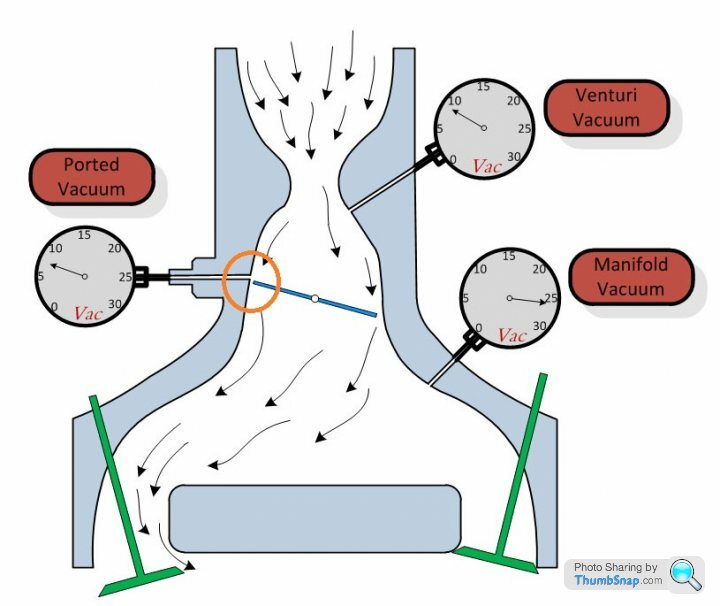
Distributor designers knew this so with the advent of the emissions based ported vacuum strategy came little balance chambers fitted in the vacuum line between the distributor and the port, these delay valves calmed the violent on off transition between atmosphere and full manifold vacuum, Land Rover adopted this idea in the form of LR Part No: ERC6997

These vacuum advance delay valves are very effective at calming the big swings in timing, but for some reason TVR often deemed ERC6997 unnecessary
 .
. If you add one to a distributor equipped Chimaera and set the throttle butterfly rest position to the book, the car will typically drive much smoother through town because the vacuum advance unit won't be violently adding and subtracting 10 degrees of timing on a light throttle, which is felt by the driver as very jerky progress, or what in TVR circles is known as the shunt!
With a stand alone ECU you don't have to worry about any of this as you can ramp up your vacuum advance effect in a super smooth way, from adding a maximum of two degrees or even no degrees at all at light load in the shunting zone, to adding 16 degrees at a 3,000 rpm light load cruise, this will deliver perfect drivability through town (21 degrees) and optimal fuel economy on the motorway (42 degrees), but the correct safe 28 degrees at the top of the table when you're accelerating at the same 3,000rpm (high load).
The reason I keep going back to distributor ignition systems on a topic that is asking for ECU ignition tables is because if you don't start by understanding how distributor ignition systems work, and why they function as they do, you really can't begin to hope to build a good ignition map. It's the same with the fuel side, cut your teeth on tuning carburetor fuel systems and you are are at a massive advantage when it comes to building your fuel tables.
At the end of the day engines are engines, carbs & distributors or ECU managed ignition and fuel systems it doesn't matter, the fundamental rules of tuning an internal combustion engine remain exactly the same, this was all worked out and very well understood over 50 years ago, so there's an awful lot we can learn from our grandfathers when we set out to map our fancy pants modern ECUs
It's because TPS is a poor indicator of engine load and therefore fuelling requirement.
On the road, you may well drive up a hill with say 15% throttle and back down without moving the throttle. The throttle position will be the same but the fuelling requirement will be different. If tuned by TPS you would require sufficient fuel to go uphill but this amount would be uneconomical coming down.
I know that some would say that the car would now be accelerating downhill on the same throttle opening and that load would therefore be the same, in practice I don't believe its the case as gravity will be helping the car down and hindering it up!
These issues are irrelevant in a race car and most will be on ITBs which give poor MAP at lower RPM.
On the road, you may well drive up a hill with say 15% throttle and back down without moving the throttle. The throttle position will be the same but the fuelling requirement will be different. If tuned by TPS you would require sufficient fuel to go uphill but this amount would be uneconomical coming down.
I know that some would say that the car would now be accelerating downhill on the same throttle opening and that load would therefore be the same, in practice I don't believe its the case as gravity will be helping the car down and hindering it up!
These issues are irrelevant in a race car and most will be on ITBs which give poor MAP at lower RPM.
Dougal9887 said:
It's because TPS is a poor indicator of engine load and therefore fuelling requirement.
On the road, you may well drive up a hill with say 15% throttle and back down without moving the throttle. The throttle position will be the same but the fuelling requirement will be different. If tuned by TPS you would require sufficient fuel to go uphill but this amount would be uneconomical coming down.
I know that some would say that the car would now be accelerating downhill on the same throttle opening and that load would therefore be the same, in practice I don't believe its the case as gravity will be helping the car down and hindering it up!
These issues are irrelevant in a race car and most will be on ITBs which give poor MAP at lower RPM.
Good post On the road, you may well drive up a hill with say 15% throttle and back down without moving the throttle. The throttle position will be the same but the fuelling requirement will be different. If tuned by TPS you would require sufficient fuel to go uphill but this amount would be uneconomical coming down.
I know that some would say that the car would now be accelerating downhill on the same throttle opening and that load would therefore be the same, in practice I don't believe its the case as gravity will be helping the car down and hindering it up!
These issues are irrelevant in a race car and most will be on ITBs which give poor MAP at lower RPM.

An opinion I agree with too!
However, I believe Joolz of Kits & Classics maps his well regarded Emerald RV8 TVR installs using TPS/RPM, and by all accounts gets very good results from it. What intrigues me is there's no question if he wanted to use a MaP sensor he could, and if he thought he worked better he would, a good quality NTK GM MaP sensor is only £40 so it's not a cost thing either

In the past I've seen him comment that adopting TPS/RPM makes mapping easier and a lot faster to get better results than a MaP based system, faster means cheaper for the customer of course. The Canems system uses a MaP sensor and the tables you get have a lot of cells, you might think this is better..... but is it really
Maybe all you really need for a super smooth driving RV8 TVR is a far more limited table and to use TPS? its not like its a very sophisticated engine and its only ever going to be on batch fired injection unless you fit a cam position sensor. Actually with my Canems system I can swap MaP for TPS in seconds, and I can easily reduce the table resolution simply by putting the same numbers in a block of adjacent cells, and or alter the table scaling. You can lower the resolution of a higher resolution table easily, but its impossible to make a low resolution table into a high resolution one.
One day I must experiment to see if TPS/RPM is any better or worse than MaP
Regards tuning the ignition table, this can only be fine tuned on a rolling road.
For each load cell you are looking for max torque. With the fuel load already set, max torque at any given load will also equal max economy as you are getting more 'bang for your buck'. If your table is reasonably close, any changes will be in single figure lb/ft, this is difficult to determine by seat of the pants driving.
Dougal.
For each load cell you are looking for max torque. With the fuel load already set, max torque at any given load will also equal max economy as you are getting more 'bang for your buck'. If your table is reasonably close, any changes will be in single figure lb/ft, this is difficult to determine by seat of the pants driving.
Dougal.
ChimpOnGas said:
Maybe all you really need for a super smooth driving RV8 TVR is a far more limited table and to use TPS? its not like its a very sophisticated engine and its only ever going to be on batch fired injection unless you fit a cam position sensor.
The batch fire versus sequential injection is an interesting point. Semi sequential is a half way house and works in the same sequence as wasted spark ignition.
I am about to find out if indeed it appears to have any perceivable benefit as I have now rewired the injectors for four pairs and will be modifying Megasquirt for 4 ignition channels.
The only catch here is that I have also swapped out the Stealth for an 885 which will make a comparison between the previous batch fire and semi sequential difficult, although I may be able to time the semi sequential to mimic batch for comparison purposes.
Dougal9887 said:
Regards tuning the ignition table, this can only be fine tuned on a rolling road.
For each load cell you are looking for max torque. With the fuel load already set, max torque at any given load will also equal max economy as you are getting more 'bang for your buck'. If your table is reasonably close, any changes will be in single figure lb/ft, this is difficult to determine by seat of the pants driving.
Dougal.
Spot on, see my point 2 above, and re-quoted below.For each load cell you are looking for max torque. With the fuel load already set, max torque at any given load will also equal max economy as you are getting more 'bang for your buck'. If your table is reasonably close, any changes will be in single figure lb/ft, this is difficult to determine by seat of the pants driving.
Dougal.
ChimpOnGas said:
2. Fuel economy aside, you'll only ever know you've dialed in the right timing numbers when you get the car on a rolling road, and I don't mean a WOT power run either. What to need to do is hold the engine in one load x rpm site and advance and retard your timing while watching engine power output change, the perfect timing number will produce peak torque. Now repeat this exercise on all the key load x rpm sites you spend most time in, this will take time, finally then and only then when all is spot on should you look to calibrate at WOT max engine speed and peak load
While Land Rover will have done a lot off rolling road time to get the distributor curve perfect, alterations to valve timing (camshaft design) and AFRs will change things and will likely undo all their good work. In the case of an RV8 TVR where the standard Range Rover/Disco fuel map was messed with a bit, and performance camshafts were deployed, there's a certain amount of 'opportunity for improvement' if you have a stand alone ECU.I stand to be corrected here but while we know TVR messed about with the 14CUX fueling a bit, I don't believe they recurved the Lucas distributor to suit their engine set ups.... much beyond retarding the timing by a few degrees that is.
To get the best ignition timing results you will definitely need a rolling road... and some skill, in the absence of both the aftermarket ECU can be your fast track ticket to an engine that behaves worse than if you'd just left it on the 14CUX/distributor and set the thing up correctly. The trouble is not many people know how to set the system up properly, throttle butterfly rest position and the TPS setting are just two examples where people get things very wrong, many an after market ECU has been added when all the owner needed to do was set his Lucas systems up correctly.
There's also a lot to be said for air flow meters as used on the much maligned 14CUX, an AFM measures the true mass of air which is actually what you really want to work with as air density changes with temperature, and elevation below or over sea level. In theory an AFM is therefore king of the load sensors, far better than MaP and infinitely better than TPS/RPM, I do know Dale Bladen favours using a Mustang AFM on his MegaSquirt installs for this reason and I suspect he gets very good results from it too

However even if you've set your 14CUX perfectly, what pushes people back to taking the aftermarket ECU path is the lack of tunability and the poor availability of quality parts especially the AFM, this delicate hot wire air mass sensor was never designed to sit roasting over a super hot exhaust manifold as it has to in a Griff or Chimaera, so after over 20 years of this punishment it's little wonder they peg out.
For these reasons alone I would never go back to the 14CUX and distributor, however these were high quality OEM components and if you get your TVR set up correctly on the original Lucas fuel and ignition systems there's no doubt it can be made to run beautifully.
Dougal9887 said:
ChimpOnGas said:
Maybe all you really need for a super smooth driving RV8 TVR is a far more limited table and to use TPS? its not like its a very sophisticated engine and its only ever going to be on batch fired injection unless you fit a cam position sensor.
The batch fire versus sequential injection is an interesting point. Semi sequential is a half way house and works in the same sequence as wasted spark ignition.
I am about to find out if indeed it appears to have any perceivable benefit as I have now rewired the injectors for four pairs and will be modifying Megasquirt for 4 ignition channels.
The only catch here is that I have also swapped out the Stealth for an 885 which will make a comparison between the previous batch fire and semi sequential difficult, although I may be able to time the semi sequential to mimic batch for comparison purposes.
1, Fully sequential injection
2. A far more sophisticated self learning/trimming ECU to control it
3. A vastly superior long runner inlet manifold
4. A camshaft carefully selected to match
If you've ever driven one of the last Range Rover's on the Thor setup and Bosch ECU you'll know they can be smooth as silk, Ok so the 4.6 only made 220hp in this dress but 220hp in a 1060kg sports car is still a lot, and the 260 ft/lbs the engine will make is more important anyway.
Forums | Chimaera | Top of Page | What's New | My Stuff