
Oil temperature, how hot?
Discussion


For those who have fitted oil temperature gauges what temperatures are you reading? I'm about to add an oil temperature gauge, currently seeking a price from craigauge (Caerbont Automotive Instruments) but also considering converting a coolant temperature gauge. The standard coolant gauge tops out at 120degC, will this be within the temperature range for daily driving, I rarely drive the car hard any more.
For info, it's a standard 4.0
For info, it's a standard 4.0
I had a dual gauge fitted to save having another hole drilled out as i have already got rid of the clock for a boost gauge, its a slightly different coloured face but you cant really tell unless you really get close and stare at it. I swapped the silver bezel/surround over on the clocks to match as mines a 98 car with silver surrounds, it is also a match/fit to the hole size. I used a Mocal Oil Temperature/Pressure 40-140C/0-100PSI Mechanical Gauge. Cost around £100.

When I had a small oil cooler I have seen temperatures up to 117°.
I then fitted a much larger cooler and it rarely goes above 107-108° . In fact when it reaches 105° I usually pull off the track.
Generally in the summer time the oil temperature follows the water temperature pretty accurately, maybe a degree or two above.
I then fitted a much larger cooler and it rarely goes above 107-108° . In fact when it reaches 105° I usually pull off the track.
Generally in the summer time the oil temperature follows the water temperature pretty accurately, maybe a degree or two above.
phazed said:
When I had a small oil cooler I have seen temperatures up to 117°.
I then fitted a much larger cooler and it rarely goes above 107-108° . In fact when it reaches 105° I usually pull off the track.
Generally in the summer time the oil temperature follows the water temperature pretty accurately, maybe a degree or two above.
I once asked this question and was told it can go upto about 120 degrees and above under extreme use but you wouldn't want it much higher. I then fitted a much larger cooler and it rarely goes above 107-108° . In fact when it reaches 105° I usually pull off the track.
Generally in the summer time the oil temperature follows the water temperature pretty accurately, maybe a degree or two above.
That's with an oil cooler,, I wonder if those of us without are running similar or slightly higher oil temps compared to water temps

I've often wondered about this because with an alley rad etc my car runs pretty cool, around 70-75 degrees most of the time, ( gauge) and that's often had me assuming the oil temp must be of a similar value.
I say gauge because when the car was at Powers for an MBE health check the gauge rises and falls but the Ecu sender is utterly constant and 88-90 degrees, for like 40 minutes!!!! I watched it stay stable for all that time as fans came on and off etc.
I read my gauge with a sense of it moves based on water speed and under bonnet temps but the Ecu sender sees a much more constant reading of around 75-88 based on road speed and weather.
Going by the Ecu sensor my oils probably around those temps or slightly higher.
Good info there Peter.

Edited by ClassicChimaera on Saturday 18th March 09:49
Thread resurrection.....
I installed an oil temp gauge with the sender located near the oil pressure sender where there's a plug stop.
I noticed the temp through regular spirited (but not daft) driving sees it rise to 110 to 120oC. I know this is high and am wondering where others installed their oil sender? Perhaps it's in a hot spot.
I installed an oil temp gauge with the sender located near the oil pressure sender where there's a plug stop.
I noticed the temp through regular spirited (but not daft) driving sees it rise to 110 to 120oC. I know this is high and am wondering where others installed their oil sender? Perhaps it's in a hot spot.
Edited by Chimp871 on Thursday 17th May 01:20
Chimp871 said:
Thread resurrection.....
I installed an oil temp gauge with the sender located near the oil pressure sender where there's a plug stop.
I noticed the temp through regular spirited (but not daft) driving sees it rise to 110 to 120oC. I know this is high and am wondering where others installed their oil sender? Perhaps it's in a hot spot.
I will be interested in this too. I am running out of places to stick the sender, but need to know my oil temps, and need it to be accurate.I installed an oil temp gauge with the sender located near the oil pressure sender where there's a plug stop.
I noticed the temp through regular spirited (but not daft) driving sees it rise to 110 to 120oC. I know this is high and am wondering where others installed their oil sender? Perhaps it's in a hot spot.
Edited by Chimp871 on Thursday 17th May 01:20
Gauge purchased from Caerbont a couple of months ago, and already installed in one of the extra holes in my replacement dash.
Dash swap happening in the next week or two, when my workload eases and we get a nice day like today, mid-teens temperature and no rain, as i will be working on it outside. Unfortunately not today, as I am already 90 miles from home and at work.
I will be getting someone who does know what he is doing (so not me!) to fit the sender and wire it in, before my next track day on 17th June.
Particularly relevant in my car as I do track days, have a turbo installed, and only run a relatively small oil cooler.
So ideas, ideally with photographic evidence, please guys.
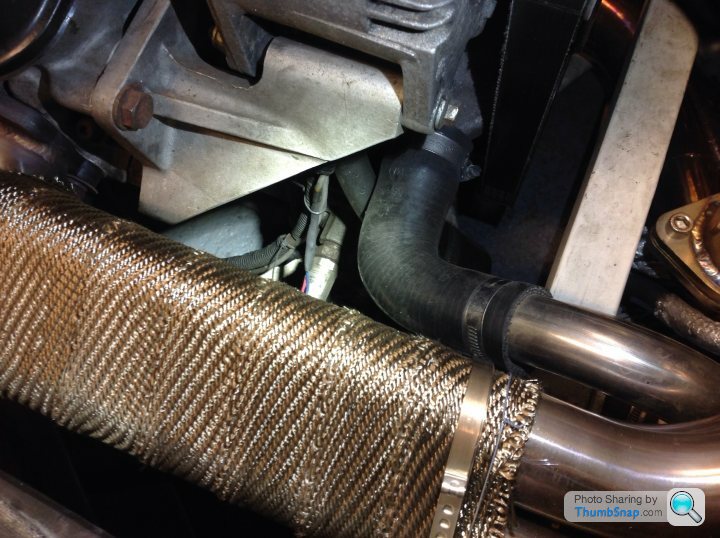
As OP I eventually bought a Caerbont guage an glad I did because I see temperatures up to 120degC, normal running around 110degC My sender is installed at the tapping off the filter housing. I believe that fitting to the sump would give an artificial low reading due to air cooling of the sum body around the bottom and cooling of the brass sender itself. If you are fitting this because you genuinely want to know the temperature then measuring the oil as it is delivered to the engine, i.e. pump / filter output is the only true reading
bobfather said:
As OP I eventually bought a Caerbont guage an glad I did because I see temperatures up to 120degC, normal running around 110degC
If your readings are correct I would recommend an oil cooler.At motorway speeds and slightly above, (for overtaking obviously) my oil temperature is around the 90°.
Only at track speeds does it ever get to 105 –107°.
phazed said:
If your readings are correct I would recommend an oil cooler.
Only at track speeds does it ever get to 105 –107°.
As said above the temperature you see is dependent on where the sender is. The reason I fitted it was because I was worried that the temperature could be too high. I use Castrol Edge 10w60 fully synth. According to their documentation this oil is good upto 150degC. Considering that I change the oil every year, that's around 2k miles, I'm assuming I'm okay at 110degC normal runningOnly at track speeds does it ever get to 105 –107°.
I was told some time ago that the oil efficiency rapidly decreases from 120 degrees and therefor temps should be kept below that when the engine is working hard.
I would think that 110 degrees at road speeds is fine but for me, keeping the temperatures reigned in is very important.
My choice of oil, (for what it's worth) is Shell Helix Ultra Racing 10-60.
I would think that 110 degrees at road speeds is fine but for me, keeping the temperatures reigned in is very important.
My choice of oil, (for what it's worth) is Shell Helix Ultra Racing 10-60.
I am also on Shell Helix 10w60 fully sympathetic, but might well change to Valvoline of a similar grade, as it costs not a lot more, has more zinc, and i can get it 3 miles from home (whereas I have to think ahead and order the Shell from Germany in 20 litre drums). That said, I too worry about high temps and regularly do track days.
On those days i am only off the throttle to hammer the brakes, so do see high water temperatures, even though both fans are going flat out. I therefore have to know the true oil temperature. It will be interesting to see how good the Caerbont gauge and supplied sender are. Phazed is on a Spa gauge, lots of digital readouts and flashing lights, but it at least gives the impression of being accurate. One always slightly wonders, perhaps unfairly, about the Caerbont gauges, which to me do seem to be a little like Welsh weather forecasting, which amounts to testing whether it is raining or not by running a dry finger over a sheep.
On those days i am only off the throttle to hammer the brakes, so do see high water temperatures, even though both fans are going flat out. I therefore have to know the true oil temperature. It will be interesting to see how good the Caerbont gauge and supplied sender are. Phazed is on a Spa gauge, lots of digital readouts and flashing lights, but it at least gives the impression of being accurate. One always slightly wonders, perhaps unfairly, about the Caerbont gauges, which to me do seem to be a little like Welsh weather forecasting, which amounts to testing whether it is raining or not by running a dry finger over a sheep.
QBee said:
I am also on Shell Helix 10w60 fully sympathetic, but might well change to Valvoline of a similar grade, as it costs not a lot more, has more zinc, and i can get it 3 miles from home (whereas I have to think ahead and order the Shell from Germany in 20 litre drums). That said, I too worry about high temps and regularly do track days.
On those days i am only off the throttle to hammer the brakes, so do see high water temperatures, even though both fans are going flat out. I therefore have to know the true oil temperature. It will be interesting to see how good the Caerbont gauge and supplied sender are. Phazed is on a Spa gauge, lots of digital readouts and flashing lights, but it at least gives the impression of being accurate. One always slightly wonders, perhaps unfairly, about the Caerbont gauges, which to me do seem to be a little like Welsh weather forecasting, which amounts to testing whether it is raining or not by running a dry finger over a sheep.
Even my neighbour must hear me laughing at this one :Laugh: On those days i am only off the throttle to hammer the brakes, so do see high water temperatures, even though both fans are going flat out. I therefore have to know the true oil temperature. It will be interesting to see how good the Caerbont gauge and supplied sender are. Phazed is on a Spa gauge, lots of digital readouts and flashing lights, but it at least gives the impression of being accurate. One always slightly wonders, perhaps unfairly, about the Caerbont gauges, which to me do seem to be a little like Welsh weather forecasting, which amounts to testing whether it is raining or not by running a dry finger over a sheep.
On a serious note talking to Dom about this a few years ago he said if fans are kicking in and off the oil should be around 100-105 in heavy traffic.
Easily 115 and regularly at 120 on track!
So if fans are staying on that’s a clear indication so you are right in getting this sorted and an accurate calibration.
I’d be inclined to somehow dip the actual oil with a thermometer of some kind to see how close the clock stays over various temps

If you're using mineral or semisynthetic then thermal degradation will start at lower temperatures. There was discussion here about the benefits of water coolers because they also preheat the oil. My coolant is at temperature after 3 miles, oil doesn't reach equalibrium for another 10 to 15 miles
bobfather said:
If you're using mineral or semisynthetic then thermal degradation will start at lower temperatures. There was discussion here about the benefits of water coolers because they also preheat the oil. My coolant is at temperature after 3 miles, oil doesn't reach equalibrium for another 10 to 15 miles
Definitely giving the water-style oil coolers a long hard stare, at least partly because they are long and tubular, so block less of the airflow. However, potentially adding even more heat to the water system seems unwise. Need to do more reading.My 2p..
What I am writing here is partly experience partly regurgitated info from experts which I don't claim to to be, most seems pretty common sense.
Unless an oil runs at ~100 degrees it wont burn of contaminants like water, fuel etc.
Oil is normally specified to run at this kind of temp so running it a lot cooler or hotter will likely lead to other problems, some small some quite significant. Worse case is probably bearing wear and all that brings in the best case scenario you will get poor fuel consumption and lower power.
Can an oil run happily at 120 degrees? the answer is it depends on the oil. if you run mineral or semi synth then at that kind of temp the oil will start to break down, if you run a good fully synth of the right grade it should be more than happy.
Oil temp should be read as the temp the oil goes into the engine on the exit of the oil pump, if you cant get that then sump temp should be very close, just tap the sump near the oil pickup away from the exhaust.
I replaced my clock with an oil temp gauge from CAI and My griff runs +-10 degrees around 100c when up to temp.
What I am writing here is partly experience partly regurgitated info from experts which I don't claim to to be, most seems pretty common sense.
Unless an oil runs at ~100 degrees it wont burn of contaminants like water, fuel etc.
Oil is normally specified to run at this kind of temp so running it a lot cooler or hotter will likely lead to other problems, some small some quite significant. Worse case is probably bearing wear and all that brings in the best case scenario you will get poor fuel consumption and lower power.
Can an oil run happily at 120 degrees? the answer is it depends on the oil. if you run mineral or semi synth then at that kind of temp the oil will start to break down, if you run a good fully synth of the right grade it should be more than happy.
Oil temp should be read as the temp the oil goes into the engine on the exit of the oil pump, if you cant get that then sump temp should be very close, just tap the sump near the oil pickup away from the exhaust.
I replaced my clock with an oil temp gauge from CAI and My griff runs +-10 degrees around 100c when up to temp.
QBee said:
Definitely giving the water-style oil coolers a long hard stare, at least partly because they are long and tubular, so block less of the airflow. However, potentially adding even more heat to the water system seems unwise. Need to do more reading.
They work really well in Lotus, they serve to warm the oil from cold. they also tend not to over cool in normal driving with the water thermostat system keeping it around 80degrees. Laminova is a good brand, but as you say it does ad load to the water system so maybe on a car like your with a turbo it needs a little more thought. Best bet is to get decent gauges so you know what you are working with.Another very relevant point is one I often point out to people trying to measure their coolant temperature. The temperature of these liquids is generated near the cylinders mainly due to combustion, in the case of oil there's also heating caused by friction. Other surfaces then cool the liquids so when talking about temperature you need to accept that it's a snapshot, the temperature will be hotter in some places and cooler in others. The sump acts as a cooler as it sits in a wind tunnel
Edited by bobfather on Thursday 17th May 16:49
Message Board | Chimaera | Top of Page | What's New | My Stuff