
14CUX FUEL MAP COMPARISONS
Discussion


Well after successfully writing a new fuel map to a new chip and running it in the car I can really feel a difference in the way the car performs in acceleration off a standing start and pickup through all the gears. It really does feel very much more responsive.
I will only have hard data to verify this once I've done a 1/4 mile drag strip run in full anger with all the extra weight gone and slicks on the back.
In the mean time I am doing a mpg check to see if that's affected, which I'm sure it is. Last years mpg checks ran out at average 19 mpg
In the mean time I would like to see how the new map compares to the old one and also how it compares to a standard 400 map
So I need a bit more help please.....
1. Does anyone have a std 400 map (or can you save me one via RoverGauge and send it to me)
2. How do I get a look at the 3 maps and moreover how can I get them into some sort of graphic form so I can visualise and compare each of the maps.
Looking forward to this and if anyone wants a new map burning let me know I have 8 more chips left (can get more if I need to)
I will only have hard data to verify this once I've done a 1/4 mile drag strip run in full anger with all the extra weight gone and slicks on the back.
In the mean time I am doing a mpg check to see if that's affected, which I'm sure it is. Last years mpg checks ran out at average 19 mpg
In the mean time I would like to see how the new map compares to the old one and also how it compares to a standard 400 map
So I need a bit more help please.....
1. Does anyone have a std 400 map (or can you save me one via RoverGauge and send it to me)
2. How do I get a look at the 3 maps and moreover how can I get them into some sort of graphic form so I can visualise and compare each of the maps.
Looking forward to this and if anyone wants a new map burning let me know I have 8 more chips left (can get more if I need to)
Pop me you address and Ill send you the .bin file. You can use Tunerpro to view the map in 3D, (select the map and then its the squiggly line icon) but the changes are quite hard to see. Heres a stock TVR cat map versus my non cat 3.9 map- I started with the cat map as a reference for 14.7: 1 then tweaked it to get what I wanted.


Good work Frank 
Obviously the 14CUX is only controlling fuel and you're now competing against the professionals who wrote the original fuel tables in the first place, but you may do well, what I can tell you is throwing fuel at an engine is quite an effective cure all.
The other elephant in the room is... whatever you do with the fuel if you don't also do something with when you start to burn it the real benefits are never going to be realised.
The one lesson we must all digest and accept is fuel & ignition work had in hand, change one without giving consideration to the other and your not only missing a trick, your missing the fundamentals of tuning an internal combustion engine.
What people are achieving now with the 14CUX is very encouraging, cracking the code and breaking the strangle hold one individual had on tweaking the 14CUx fuel only ECU can only be a good thing for those in our wonderful TVR community who want to keep their car original.
But my message to the 'keep it original guys' who I greatly respect BTW', is they must accept what every engine tuner has known for years... and that is............. power, economy and drivability is far more influenced by ignition timing that is is by how much or little fuel you add or subtract.
What I'm trying to say is... if the 'keep it original guys' combine their 14CUX tuning work with some improvements on the distributor based ignition side then they may well get very close to what an aftermarket engine management system delivers for very little outlay. while still keeping the engine bay looking completely stock.
To that end you may wish to keep one eye on this one?
https://www.pistonheads.com/gassing/topic.asp?h=0&...
Obviously the 14CUX is only controlling fuel and you're now competing against the professionals who wrote the original fuel tables in the first place, but you may do well, what I can tell you is throwing fuel at an engine is quite an effective cure all.
The other elephant in the room is... whatever you do with the fuel if you don't also do something with when you start to burn it the real benefits are never going to be realised.
The one lesson we must all digest and accept is fuel & ignition work had in hand, change one without giving consideration to the other and your not only missing a trick, your missing the fundamentals of tuning an internal combustion engine.
What people are achieving now with the 14CUX is very encouraging, cracking the code and breaking the strangle hold one individual had on tweaking the 14CUx fuel only ECU can only be a good thing for those in our wonderful TVR community who want to keep their car original.
But my message to the 'keep it original guys' who I greatly respect BTW', is they must accept what every engine tuner has known for years... and that is............. power, economy and drivability is far more influenced by ignition timing that is is by how much or little fuel you add or subtract.
What I'm trying to say is... if the 'keep it original guys' combine their 14CUX tuning work with some improvements on the distributor based ignition side then they may well get very close to what an aftermarket engine management system delivers for very little outlay. while still keeping the engine bay looking completely stock.
To that end you may wish to keep one eye on this one?
https://www.pistonheads.com/gassing/topic.asp?h=0&...
blitzracing said:
Pop me you address and Ill send you the .bin file. You can use Tunerpro to view the map in 3D, (select the map and then its the squiggly line icon) but the changes are quite hard to see. Heres a stock TVR cat map versus my non cat 3.9 map- I started with the cat map as a reference for 14.7: 1 then tweaked it to get what I wanted.
Thats brilliant I have tunerpro but cant find a 'new users' guide. Cant even open a bin file yet. Not sure i have set it up correctly.Have pm'd you also.
Cheers
ChimpOnGas said:
Good work Frank
......
To that end you may wish to keep one eye on this one?
https://www.pistonheads.com/gassing/topic.asp?h=0&...
Been watching that with interest. Is there a programmable distributor available ?......
To that end you may wish to keep one eye on this one?
https://www.pistonheads.com/gassing/topic.asp?h=0&...
https://www.123ignitionshop.com/gb/rover/102-123tu...
In intrigued to trys COG suggestion of running the non ported vacuum for more initial advance- I've already got a take off point from when I was playing with the Amethyst system. Job for when the wheels hit the road again.
In intrigued to trys COG suggestion of running the non ported vacuum for more initial advance- I've already got a take off point from when I was playing with the Amethyst system. Job for when the wheels hit the road again.
blaze_away said:
ChimpOnGas said:
Good work Frank
......
To that end you may wish to keep one eye on this one?
https://www.pistonheads.com/gassing/topic.asp?h=0&...
Been watching that with interest. Is there a programmable distributor available ?......
To that end you may wish to keep one eye on this one?
https://www.pistonheads.com/gassing/topic.asp?h=0&...

If you want to stick with the distributor, which I respect, just switch to applying the weak arsh and inconsistent emissions based ported vacuum signal applied to your vac advance unit, to a much stronger and more stable full manifold vacuum signal.
But watch the post, because StuVT (Stuart Knight) is kindly doing the testing for you... the results will either turn theory into reality, or ................ completely debunk it!
ChimpOnGas said:
blaze_away said:
ChimpOnGas said:
Good work Frank
......
To that end you may wish to keep one eye on this one?
https://www.pistonheads.com/gassing/topic.asp?h=0&...
Been watching that with interest. Is there a programmable distributor available ?......
To that end you may wish to keep one eye on this one?
https://www.pistonheads.com/gassing/topic.asp?h=0&...
If you want to stick with the distributor, which I respect, just switch to applying the weak arsh and inconsistent emissions based ported vacuum signal applied to your vac advance unit, to a much stronger and more stable full manifold vacuum signal.
But watch the post, because StuVT (Stuart Knight) is kindly doing the testing for you... the results will either turn theory into reality, or ................ completely debunk it!

blitzracing said:
It will be interesting to see if more idle advance will help smooth this out a bit.
Clearly it will, because I and others with after market engine management systems have proved it will. Indeed I can demonstrate the effects of altering idle ignition timing in seconds. As I dial in the changes in idle timing in real time with a few key strokes on my laptop, even a def man could identify the changes in idle quality... because not only is it audibly much better but vibration is dramatically reduced too.blitzracing said:
If you want to carefully add a couple of degrees of peak advance you can carefully grind a bit off the bob weight stops and leave the rest of the advance curve as it is.
If done with care, this can work well and is something I've done a few times when curving distributors, however what you really need if you're going to get into safely and properly curving a distributor, is professional distributor curving rig, here's one from Sun: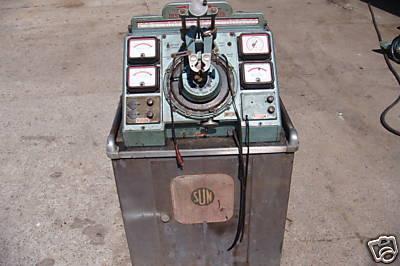
Keep in mind the current setup only gives 28-30 degrees of peak timing, when 35-36 degrees is what those of us with after market engine management systems have proved (on the dyno) is what the engine really wants. Remember Old Rover is a low compression engine which is why 35-36 degrees has also been proven to be completely detonation safe.
Another area for improvement centres around how steep your ignition curve is, ie how quickly the distributor adds timing and at what rate it adds it. From what I've seen the standard Land Rover distributor used on Chimaeras and Griffs received no modifications by TVR Power, the bog standard Land Rover curve was left untouched. This Land Rover curve is very flat and was clearly designed to work with a soft cam profile, the way it adds timing early on is extremely lethargic which is far from ideal.
The single canister coil Land Rover based ignition system also isn't the best, on our cars the spark can be even weaker because the wiring and earthing TVR inflicted on us can be a long way off optimal. Now consider what happens when you pull away from a stand still and before you build momentum.
At this moment the engine will immediately go under considerable load, this is because as you pull away you are trying to move a lot of weight that's sat still, think about bump starting a car (we've all done it), the hardest point is getting the damn thing rolling. However once you've gathered a bit of speed it becomes easier and easier to gather speed up to a point, what you're feeling is the same thing the engine must suffer.
Now consider that when a engine is subjected to load the other thing that will increase is cylinder pressures, the thing is making sparks becomes much harder as pressure increases which is why my ancient only Champion spark plug tester had a point where I could attach my airline to raise the pressure in the spark test chamber. My old Champion spark plug tester had a coil and points arrangement and a window into the sealed spark test chamber, you ran the coil then used a knob to slowly increase chamber pressure as you observed the spark. At low pressures the spark may be strong and bright, but add pressure and you can soon find yourself with no spark at all.
Because on our cars the spark is typically weakest at low rpm, and because cylinder pressures rise rapidly as you first pull away, this is the point when the system is most compromised, to help what you could really do with is adding some more advance early on. Inside your distributor it's the strength of those little springs and the mass of the bob weights that govern how quickly timing is added, so there may well also be some benefit in getting the Dremel out to shave a small amount of mass from the bob weights, and or fitting some slightly weaker springs.
As such three ways you can look to tune your ignition timing if you're running a distributor are:
1. As suggested by Blitz, progressively remove some material from the bob weight stops until the stock 28/30 degrees of total timing at 2,800rpm becomes the far more optimal 35/36 degrees at 2,800rpm and beyond
2. Carefully shave a small amount of mass from the bob weights, and or fit some slightly weaker bob weight springs
3. Switch from ported vacuum and apply a full vacuum signal to your vac advance unit
The correct combination of all three are very likely to give some real benefits, benefits close to certain elements(but not all) that are already being enjoyed by those ruining aftermarket engine management systems with 3D mappable ignition.
But caution is required!
While the switch from ported to full vacuum I'm promoting caries little danger, I would express extreme caution to anyone considering grinding away the bob weight stops and playing with how aggressive their curve is by removing mass from the bob weights themselves and or fitting lighter springs. Go just a fraction too far and you could easily end up with too much timing early on or 42 degrees plus of total timing, which is definitely too much, in both cases you'll be running the very real risk of engine damage from the violent effects of detonation.
That's why the only safe way to curve a distributor is to use a professional distributor curving machine, but if you you haven't got one you could always take the figures people with after market engine management systems have proven to be optimum, and get someone like the Distributor Doctor to curve your distributor for you on his rig.
For everyone else who just wants to see some benefits from something easy, safe and free to implement... I recommend experimenting with switching the standard ported vacuum signal applied to their vac advance unit to a nice consistent full vacuum signal.
Another cheap mod is to ditch the dreadfully inappropriate shrouded electrode NGK B7ECS plugs TVR fitted from new and replacing them with the far more suitable extended electrode NGK BPR6ES, or better still a set of BPR6EIX iridium plugs. In many ways because combustion it initiated more effectively the effects of a set BPR6EIX iridium plugs can be very similar to adding a couple of degrees of timing at idle and just as you pull away.... when both the ignition system is at it's weakest and cylinder pressures will monetarily rocket .
Obviously none of this will help much unless your entire ignition system is in tip top condition, which on Chims and Griffs it very often isn't due in part to those dreadful plug extenders failing, burnt HT leads and a poorly earthed coil ect. You are also strongly advised to eliminate every single vacuum leak for which there can be many, to this end I recommend people pay close attention to their crankcase breathing system

Edited by ChimpOnGas on Saturday 10th February 12:36
And I agree with the effects of the plugs suggested.
I’d ran the standard 7’s on Mbe to good effect but a big grough on start up.
Iridium tipped do indeed seem very good at lower revs for a clean burn and the car pulls off with minimal throttle but more grunt = less fuel
The 6 being a hotter plug, more engine heat goes into head area, gets hotter and possibly quicker as my 4.6 warms up in no time which is when it’s at it most uneconomical.
With a good cooling system on the move it’s easy to run these cars to cool and this helps keep some engine heat up, if the fans work correctly they are more than upto the job of cooling the car in traffic and keeping a stable 88 degrees engine temp.
As Ben at the end of the earth seems to have proved the cooling system must work well
I’d ran the standard 7’s on Mbe to good effect but a big grough on start up.
Iridium tipped do indeed seem very good at lower revs for a clean burn and the car pulls off with minimal throttle but more grunt = less fuel
The 6 being a hotter plug, more engine heat goes into head area, gets hotter and possibly quicker as my 4.6 warms up in no time which is when it’s at it most uneconomical.
With a good cooling system on the move it’s easy to run these cars to cool and this helps keep some engine heat up, if the fans work correctly they are more than upto the job of cooling the car in traffic and keeping a stable 88 degrees engine temp.
As Ben at the end of the earth seems to have proved the cooling system must work well
I simply removed enough off the bob wight stops to add two distributor degrees (4 engine degrees) at full mechanical advance. I then set it to 34' peak advance when the advance stopped as the rpm increased and have not introduced any knock at lower rpm. The lower part of the advance curve should remain as is as it was you have not altered the springs or bob weight mass significantly. TBH after the extreme messing about I was doing with the Amethyst, I never managed to induce any knock that could be detected with aftermarket knock sensors, so I think its pretty hard to push the RV8 to knock as long as you are sensible. Mind you the torque drops significantly before knock sets in so you would not tune on knock anyway even if you could detect it. The biggest issue is I don,t have any rolling road torque vs RPM for a stock dizzy curve vs a mapped system to show any real world improvements however nice all the theory.
I would not agree about the spark being compromised at low RPM- after all you have plenty of dwell time so the coils stored power is at maximum below about 4k- but above that the coil never gets enough time to reach its peak flux so the peak available HT drops of quite quickly. So at low rpm you have enough HT (up to 35kv is avalable when you need between about 10-15kv) to ignite whatever compression the spark plug may be under, but it becomes much more of an issue at WOT and peak RPM. The Lucas guys did not do a bad job of getting the maximum of of a single coil by keeping its primary DC resistance really low, so its current is high and the magnetic flux rises really quickly, that you need with a spark hungry v8.
I would not agree about the spark being compromised at low RPM- after all you have plenty of dwell time so the coils stored power is at maximum below about 4k- but above that the coil never gets enough time to reach its peak flux so the peak available HT drops of quite quickly. So at low rpm you have enough HT (up to 35kv is avalable when you need between about 10-15kv) to ignite whatever compression the spark plug may be under, but it becomes much more of an issue at WOT and peak RPM. The Lucas guys did not do a bad job of getting the maximum of of a single coil by keeping its primary DC resistance really low, so its current is high and the magnetic flux rises really quickly, that you need with a spark hungry v8.
Edited by blitzracing on Saturday 10th February 18:35
Edited by blitzracing on Saturday 10th February 18:43

Fancy a shootout between your single canister coil and my MSD coil packs then?
Trust me it's not just refresh rate at higher engine speeds where I'll win, seriously there's no contest everywhere, and I'd be pleased to prove it. Do make sure you study my comments on cylinder pressures and my old Champion airline fed spark plug tester first before you take on the challenge.
I wouldn't want to embarrass you
Trust me it's not just refresh rate at higher engine speeds where I'll win, seriously there's no contest everywhere, and I'd be pleased to prove it. Do make sure you study my comments on cylinder pressures and my old Champion airline fed spark plug tester first before you take on the challenge.
I wouldn't want to embarrass you
ChimpOnGas said:
Fancy a shootout between your single canister coil and my MSD coil packs then?
Trust me it's not just refresh rate at higher engine speeds where I'll win, seriously there's no contest everywhere, and I'd be pleased to prove it. Do make sure you study my comments on cylinder pressures and my old Champion airline fed spark plug tester first before you take on the challenge.
I wouldn't want to embarrass you
BUT- If you measure the voltages at the point of arc between a single coil, and multiple coils it will be exactly the same as its a function of spark gap and dieletric properties of the combustion chamber (compression and fuel related) and as you have 35kv peak available, the voltage will simply keep rising until the arc occurs, and even in the most extreme cases in the RV8 this will be a lot lower than that. The basic physics wont change if you have one coil or multiple coils until you take dwell period into account in which case multiple coil packs win hand down. Interesting idea a shoot out- you would have to quantify exactly what you where measuring- after all if you can ignite the mixture with a 1 millisecond spark- making a 6 millisecond burn time wont make any difference as the flame front is already established - so if he have an inadequate spark what will happen- the mixture wont ignite reliably, so worse case it will misfire, or best case the emissions will go up was the mixture has not burnt fully- these are figures you can measure that have real value. Simply looking at the lightning storm produced by a coil pack voltage wise or duration is of less value. I wont disagree that multiple coil packs are the preferred option, just don't underestimate the original system that has worked well enough for the last 20 years on this archaic engine.Trust me it's not just refresh rate at higher engine speeds where I'll win, seriously there's no contest everywhere, and I'd be pleased to prove it. Do make sure you study my comments on cylinder pressures and my old Champion airline fed spark plug tester first before you take on the challenge.
I wouldn't want to embarrass you

When I studied all this at college, measuring coil outputs was part of the Sun engine tuning machine training, we had engine test rigs you could wheel around the workshop, engines that ranged from stuff running a traditional canister coil to engines with coil packs on the new (at that time) wasted spark setup.
We were tasked with studying the firing line (power kV) measured in kilovolts which essentially represents the amount of voltage required to start a spark across the spark plug gap. The lesson being firing voltage must overcome secondary circuit resistance including HT cables (if present), rotor gap (if present), other elements like those dreadful Beru plug extenders used by Vauxhall at the time and of course TVR on our cars.... and finally the spark plug!
Lets not forget that the spark plug air gap will always be the highest point of resistance in the circuit unless there's a fault with another component within the ignition circuit, this is essentially the principle used by Sun to test and fault find a vehicle's ignition system.
What I can clearly remember seeing from all the single canister coil engine rigs was in the region of 25kv whereas the engines equipped with the coil packs served up a much healthier 40kv, this made quite an impression on me.
The next lesson came in the form of an ancient Champion spark plug testing machine that you connected an airline too, Champion gave you this feature to show how pressure makes a huge difference to the ability for a plug to make a spark. Wind up the pressure on the machine and you can stress test the plug to see the exact pressure the spark was extinguished, the irony was every time I ever put a new Champion plug against an NGK plug the NGK would always win, but that old Champion plug tester did come from a time when Champion were competing against the likes of Lodge who always made inferior plugs to Champion in the 50's & 60's.
The only other way to keep that plug sparking under pressure would be to wind up the power (KV), the old Champion machine couldn't do this but the Sun machine could so as I was on a work placement with the Ford restorer who owned said Champion plug tester I talked him into letting me taking it into college one day so we could see how long a simulated a 25kv canister coil derived spark would last when compared with this new fanlged coil pack derived 40kv spark as we wound the pressure up.
It was quite funny to see the old 60's Champion plug tester hooked up to an 80's Sun tester, but the experiment worked a treat, and proved without any shadow of a doubt the pressure needed to stop a 25kv canister coil generated spark was 25% lower than the pressure seen when we turned the Sun machine up to the 40kv and what we consistently recorded from our coil pack equipped rigs.
Even if you are getting 35kv from your single canister coil, which after all our tests with that Norwich City College Sum machine I very much doubt, it'll still be 5,000 volts lower than all the coil pack rigs we tested. Add this to the way TVRs are wired and the quality of earthing you typically see on our cars and I'd put money on seeing 25kv or less if you actually put a typical Chimaera on a good old Sun machine, I also bet you'll see a nice fat 40-45kv from my MSD coil packs.
Of course TVR got away with all this because the system worked Ok when everything was new; with good earths, a new battery, the charging system functioning correctly and absolutely everything on the ignition side (extenders, HT leads, ect ect) all spot on it worked Ok (ish), all this it should be said on what is essentially a very low compression engine by modern standards (low cylinder pressures). But because the system was already a bit on the marginal side from the outset, you only need something to be fractional off for it to start delivering issues.
These issues will manifest themselves as misfires, and the truth is tiny misfires are often very hard if not impossible to detect by ear, and especially on a multi-cylinder engine like a V8. All engines misfire because what a lot of people dont realise is no internal combustion engine (no matter how good) will fully ignite the air fuel mixture in the combustion chamber every time. What you're actuality trying to do is reduce the number of inevitable misfires because completely eliminating every single one is neigh on impossible.
If you want to improve shunting you need to reduce these misfires, and one of the best ways to do that is improve the ignition system and it's power output, and to that end my Champion spark plug tester and Sun machine tests proved without any argument a set of coil packs will always be significantly better than an old single canister coil setup, especially one trying to work with TVRs brilliant wiring efforts holding it back..
After that what also really helps is if you actually light the fire at the right time, and then make that fire easier to burn by ensuring the mixture is a little bit richer than the inappropriately lean 14.7:1 AFR the 14CUX imposes
We were tasked with studying the firing line (power kV) measured in kilovolts which essentially represents the amount of voltage required to start a spark across the spark plug gap. The lesson being firing voltage must overcome secondary circuit resistance including HT cables (if present), rotor gap (if present), other elements like those dreadful Beru plug extenders used by Vauxhall at the time and of course TVR on our cars.... and finally the spark plug!
Lets not forget that the spark plug air gap will always be the highest point of resistance in the circuit unless there's a fault with another component within the ignition circuit, this is essentially the principle used by Sun to test and fault find a vehicle's ignition system.
What I can clearly remember seeing from all the single canister coil engine rigs was in the region of 25kv whereas the engines equipped with the coil packs served up a much healthier 40kv, this made quite an impression on me.
The next lesson came in the form of an ancient Champion spark plug testing machine that you connected an airline too, Champion gave you this feature to show how pressure makes a huge difference to the ability for a plug to make a spark. Wind up the pressure on the machine and you can stress test the plug to see the exact pressure the spark was extinguished, the irony was every time I ever put a new Champion plug against an NGK plug the NGK would always win, but that old Champion plug tester did come from a time when Champion were competing against the likes of Lodge who always made inferior plugs to Champion in the 50's & 60's.
The only other way to keep that plug sparking under pressure would be to wind up the power (KV), the old Champion machine couldn't do this but the Sun machine could so as I was on a work placement with the Ford restorer who owned said Champion plug tester I talked him into letting me taking it into college one day so we could see how long a simulated a 25kv canister coil derived spark would last when compared with this new fanlged coil pack derived 40kv spark as we wound the pressure up.
It was quite funny to see the old 60's Champion plug tester hooked up to an 80's Sun tester, but the experiment worked a treat, and proved without any shadow of a doubt the pressure needed to stop a 25kv canister coil generated spark was 25% lower than the pressure seen when we turned the Sun machine up to the 40kv and what we consistently recorded from our coil pack equipped rigs.
Even if you are getting 35kv from your single canister coil, which after all our tests with that Norwich City College Sum machine I very much doubt, it'll still be 5,000 volts lower than all the coil pack rigs we tested. Add this to the way TVRs are wired and the quality of earthing you typically see on our cars and I'd put money on seeing 25kv or less if you actually put a typical Chimaera on a good old Sun machine, I also bet you'll see a nice fat 40-45kv from my MSD coil packs.
Of course TVR got away with all this because the system worked Ok when everything was new; with good earths, a new battery, the charging system functioning correctly and absolutely everything on the ignition side (extenders, HT leads, ect ect) all spot on it worked Ok (ish), all this it should be said on what is essentially a very low compression engine by modern standards (low cylinder pressures). But because the system was already a bit on the marginal side from the outset, you only need something to be fractional off for it to start delivering issues.
These issues will manifest themselves as misfires, and the truth is tiny misfires are often very hard if not impossible to detect by ear, and especially on a multi-cylinder engine like a V8. All engines misfire because what a lot of people dont realise is no internal combustion engine (no matter how good) will fully ignite the air fuel mixture in the combustion chamber every time. What you're actuality trying to do is reduce the number of inevitable misfires because completely eliminating every single one is neigh on impossible.
If you want to improve shunting you need to reduce these misfires, and one of the best ways to do that is improve the ignition system and it's power output, and to that end my Champion spark plug tester and Sun machine tests proved without any argument a set of coil packs will always be significantly better than an old single canister coil setup, especially one trying to work with TVRs brilliant wiring efforts holding it back..
After that what also really helps is if you actually light the fire at the right time, and then make that fire easier to burn by ensuring the mixture is a little bit richer than the inappropriately lean 14.7:1 AFR the 14CUX imposes
Edited by ChimpOnGas on Sunday 11th February 12:12
Message Board | Chimaera | Top of Page | What's New | My Stuff