
Clutch take up
Discussion


I looked at an early Chimaera (4 litre) a few days ago. All seemed ok with the possible exception of the clutch.
Take up is very abrupt.
There is no judder.
Gear selection is fine both from standstill and when on the move.
Clutch take up point is low on the pedal.
Pedal itself is not heavy in use.
No release bearing noise.
No clutch slip.
Any ideas or is this typical?
Take up is very abrupt.
There is no judder.
Gear selection is fine both from standstill and when on the move.
Clutch take up point is low on the pedal.
Pedal itself is not heavy in use.
No release bearing noise.
No clutch slip.
Any ideas or is this typical?

 it may just need bleeding or the pedal may need a slight adjustment on the pushrod both can make major changes
The hydraulic ratio between the master and slave cylinders is very very important, and it's quite common for people to fit the wrong bore slave because even some TVR Specialists have been supplying a slightly smaller bore slave which will invariably give a heavier clutch.
The correct pairing to achieve the correct all important hydraulic ratio is... an:
Obviously maintaining the correct rod length at both ends is critical too, when you buy a new master cylinder it's common for it to come with a rod, this will invariably be the wrong length so it's important to fit your original one, just remove the circlip and make the swap. Slave cylinders on the other hand seldom ever come with a rod, so it's really a non-issue.
If the ratio checks out fine and the clutch still feels odd, as Simon says I would start by bleeding the system, TVR mounted the Girling type master cylinder at an angle but it's actually designed to be mounted horizontally. TVR mostly got away with this error but the angle off of horizontal does mean the reservoir only holds a comically tiny amount of fluid, if the fluid level falls by even by a small amount you run the very real risk of exposing the feed port on full stroke.
The outcome of exposing the port is for the system to draw air, because of this reservoir capacity issue it's extremely common for a Chimaera hydraulic clutch system to contain at lease some air. What you typically find is the system has only drawn in a small amount of air, so mostly everything will still work acceptably, but the clutch may feel odd or it may fractional drag on full engagement especially when everything gets heat soaked.
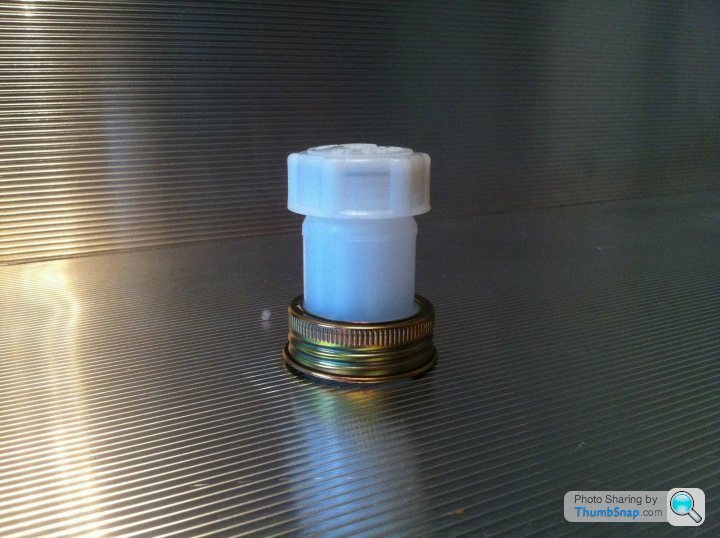
I've recently fitted one of these reservoir extenders which gives a bit more fluid capacity, so ultimately my hydraulic clutch system is a lot less likely to draw air.
Another issue can be that the dished area of the pressed steel clutch release arm can become fractured meaning the slave cylinder rod will pass through it, sometimes it's just a partial failure so the clutch will still work (sort of), but again it will feel very odd.
The final thing to check is the pedal rod itself, I found while my after market all metal Leven pedals look sexy when I adjusted my clutch pedal position so it feel right for me (I'm over 6'), the end of the threaded pedal rod met the bulkhead before I'd fully stroked the master cylinder, actually in my case it was the carpet stopping me achieving 100% full travel.
The bottom line is there are few things to check.
But If you have the correct master to slave cylinder hydraulic ratio, the system is completely free from air, the pedal and master cylinder is achieving full stroke, the correct master cylinder rod has been used, and finally the release arm hasn't been breached..... then the system will feel precise and be light enough for most.
Hope this helps, Dave.
The correct pairing to achieve the correct all important hydraulic ratio is... an:
- 0.7" master cylinder
- 1" slave cylynder
Obviously maintaining the correct rod length at both ends is critical too, when you buy a new master cylinder it's common for it to come with a rod, this will invariably be the wrong length so it's important to fit your original one, just remove the circlip and make the swap. Slave cylinders on the other hand seldom ever come with a rod, so it's really a non-issue.
If the ratio checks out fine and the clutch still feels odd, as Simon says I would start by bleeding the system, TVR mounted the Girling type master cylinder at an angle but it's actually designed to be mounted horizontally. TVR mostly got away with this error but the angle off of horizontal does mean the reservoir only holds a comically tiny amount of fluid, if the fluid level falls by even by a small amount you run the very real risk of exposing the feed port on full stroke.
The outcome of exposing the port is for the system to draw air, because of this reservoir capacity issue it's extremely common for a Chimaera hydraulic clutch system to contain at lease some air. What you typically find is the system has only drawn in a small amount of air, so mostly everything will still work acceptably, but the clutch may feel odd or it may fractional drag on full engagement especially when everything gets heat soaked.
I've recently fitted one of these reservoir extenders which gives a bit more fluid capacity, so ultimately my hydraulic clutch system is a lot less likely to draw air.
Another issue can be that the dished area of the pressed steel clutch release arm can become fractured meaning the slave cylinder rod will pass through it, sometimes it's just a partial failure so the clutch will still work (sort of), but again it will feel very odd.
The final thing to check is the pedal rod itself, I found while my after market all metal Leven pedals look sexy when I adjusted my clutch pedal position so it feel right for me (I'm over 6'), the end of the threaded pedal rod met the bulkhead before I'd fully stroked the master cylinder, actually in my case it was the carpet stopping me achieving 100% full travel.
The bottom line is there are few things to check.
But If you have the correct master to slave cylinder hydraulic ratio, the system is completely free from air, the pedal and master cylinder is achieving full stroke, the correct master cylinder rod has been used, and finally the release arm hasn't been breached..... then the system will feel precise and be light enough for most.
Hope this helps, Dave.
Message Board | Chimaera | Top of Page | What's New | My Stuff