
X308 XJR fuel pump link cables
Discussion


Can anyone tell me definitively, what are the plastic blocks in the fuel pump harness?
One is black, and the other white.
If I need to keep them, what is the best way to splice the wires?
I am using aftermarket pumps, so the plug is different.
I'm a bit nervous about electrical connections in a fuel tank, it doesn't seem right to me 😬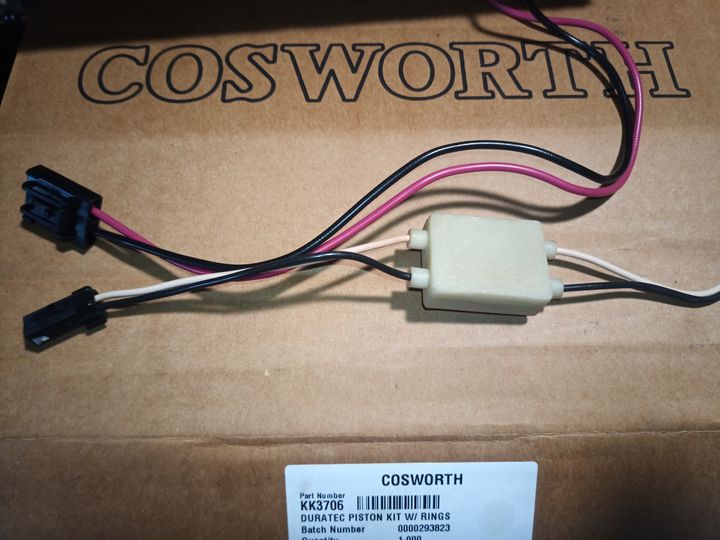
One is black, and the other white.
If I need to keep them, what is the best way to splice the wires?
I am using aftermarket pumps, so the plug is different.
I'm a bit nervous about electrical connections in a fuel tank, it doesn't seem right to me 😬
Sorry if I wasn't very clear. The black and white I refer to, are the small plastic blocks in the middle of the wires from the pump to the tank lid (only one tank on an X308 with two fuel pumps) I show the white one in my picture, the red and black wires are the new plug and cables that came with the new pump, which I have to splice in.
I've since found some information on the boxes, and they seem to be radio frequency suppression devices.
So probably best I keep them.
I'm thinking that solder and heat shrink isn't a good idea, sloshing around in fuel will probably create a hard spot in the wire, and cause a break in the future, so maybe a crimp and heat shrink after the surpression boxes?
I've since found some information on the boxes, and they seem to be radio frequency suppression devices.
So probably best I keep them.
I'm thinking that solder and heat shrink isn't a good idea, sloshing around in fuel will probably create a hard spot in the wire, and cause a break in the future, so maybe a crimp and heat shrink after the surpression boxes?
mickrick said:
Sorry if I wasn't very clear. The black and white I refer to, are the small plastic blocks in the middle of the wires from the pump to the tank lid (only one tank on an X308 with two fuel pumps) I show the white one in my picture, the red and black wires are the new plug and cables that came with the new pump, which I have to splice in.
I've since found some information on the boxes, and they seem to be radio frequency suppression devices.
So probably best I keep them.
I'm thinking that solder and heat shrink isn't a good idea, sloshing around in fuel will probably create a hard spot in the wire, and cause a break in the future, so maybe a crimp and heat shrink after the surpression boxes?
Ok. No problem. I feel like a complete idiot now because I owned an X308 XJR. I was sure it had two tanks but in my defence, it was nearly 26 years ago (one of the last X308's) and my memory isn't what it was I've since found some information on the boxes, and they seem to be radio frequency suppression devices.
So probably best I keep them.
I'm thinking that solder and heat shrink isn't a good idea, sloshing around in fuel will probably create a hard spot in the wire, and cause a break in the future, so maybe a crimp and heat shrink after the surpression boxes?

Glad you sorted it though.
mickrick said:
No problem, I'd still like some confirmation from someone who's electrical savvy that it's OK to crimp and heat shrink onto the original link wires inside the tank.
Here's the tank out of the car, with my furry helper and his toys.....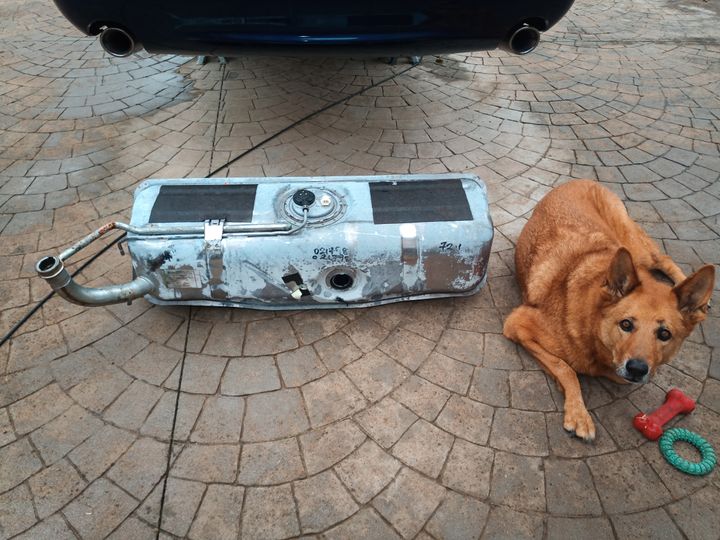
Solder and heat shrink would be a much better, more permanent and more reliable solution to crimping. Here's the tank out of the car, with my furry helper and his toys.....
mickrick said:
I don't think solder is a good Idea for automotive.
It creates a hard spot.
If the wire gets moved around with fuel sloshing about, the wire will fail where the solder finishes.
Just my opinion.
I suppose if I did solder it, I could cable tie a loop in the wire at the joint ?
There are plenty of soldered connections in vehicles, especially on PCB's but I take your point.It creates a hard spot.
If the wire gets moved around with fuel sloshing about, the wire will fail where the solder finishes.
Just my opinion.
I suppose if I did solder it, I could cable tie a loop in the wire at the joint ?
Soldering shouldn't be an issue though if you do it right. Splicing the cables together correctly to ensure a strong mechanical connection is the key. Then make sure you have enough heat to enable the solder to flow.
Edit: Google 'lineman splice' or 'splicing to NASA standards'.
Edited by CharlieAlphaMike on Tuesday 14th April 16:55
Edited by CharlieAlphaMike on Tuesday 14th April 17:27
I Should perhaps add that I qualified as an electrician and spent many years in the electrical industry (although I've been out of the industry for over 20 years now) but not in the automotive world. Soldered joints are used in HV and LV (high & low voltage) situations but as I said, you must ensure you have good mechanical integrity too.
Even when doing simple electrical jobs at home, for example when using a block connector in a light fitting or fitting a 13A plug to an appliance, I still prefer to apply some solder to the bare wires before connecting. I'm not suggesting you use a block connector in this situation of course.
HTH
Even when doing simple electrical jobs at home, for example when using a block connector in a light fitting or fitting a 13A plug to an appliance, I still prefer to apply some solder to the bare wires before connecting. I'm not suggesting you use a block connector in this situation of course.
HTH
CharlieAlphaMike said:
I Should perhaps add that I qualified as an electrician and spent many years in the electrical industry (although I've been out of the industry for over 20 years now) but not in the automotive world. Soldered joints are used in HV and LV (high & low voltage) situations but as I said, you must ensure you have good mechanical integrity too.
Even when doing simple electrical jobs at home, for example when using a block connector in a light fitting or fitting a 13A plug to an appliance, I still prefer to apply some solder to the bare wires before connecting. I'm not suggesting you use a block connector in this situation of course.
HTH
I have since found out that gasolene will eventually break down heat shrink.Even when doing simple electrical jobs at home, for example when using a block connector in a light fitting or fitting a 13A plug to an appliance, I still prefer to apply some solder to the bare wires before connecting. I'm not suggesting you use a block connector in this situation of course.
HTH
I had a chat with my employer about it, at work today.
We decided the best thing to do is use crimp connectors.
Apparently gasolene isn't conductive, hence the plugs in the tank not being sealed, which I found surprising.
So crimps it is. I'll make sure I secure them with cable ties so they can't move about.
Thank you for your input.

mickrick said:
I have since found out that gasolene will eventually break down heat shrink.
I had a chat with my employer about it, at work today.
We decided the best thing to do is use crimp connectors.
Apparently gasolene isn't conductive, hence the plugs in the tank not being sealed, which I found surprising.
So crimps it is. I'll make sure I secure them with cable ties so they can't move about.
Thank you for your input.
Ok. It's 100% your call of course but you can buy petrol/diesel resistant heat shrink I had a chat with my employer about it, at work today.
We decided the best thing to do is use crimp connectors.
Apparently gasolene isn't conductive, hence the plugs in the tank not being sealed, which I found surprising.
So crimps it is. I'll make sure I secure them with cable ties so they can't move about.
Thank you for your input.
mickrick said:
Any links? I see plenty of marine grade, but I failed on the petrol resistant.
I've never used this company and have no connection with them but maybe this is a starting point for you:https://hilltop-products.co.uk/hdr-25-diesel-and-f...
And there's some useful information here:
https://www.pmgcompanyonline.com/article/is-heat-s...
CharlieAlphaMike said:
I've never used this company and have no connection with them but maybe this is a starting point for you:
https://hilltop-products.co.uk/hdr-25-diesel-and-f...
And there's some useful information here:
https://www.pmgcompanyonline.com/article/is-heat-s...
Thank you Sir.https://hilltop-products.co.uk/hdr-25-diesel-and-f...
And there's some useful information here:
https://www.pmgcompanyonline.com/article/is-heat-s...
Hopefully someone will send to Spain.
mickrick said:
Thank you Sir.
Hopefully someone will send to Spain.
No problem. If you're in Spain and UK companies can't help, I'm sure a German company will be only too happy to ship to Spain Hopefully someone will send to Spain.
https://polytubes.de/en/fkm-heat-shrink-tubing/
Forums | Jaguar | Top of Page | What's New | My Stuff