
Exhaust Theory
Discussion


I've been mugging up on the principles of how V8 exhausts work and have got to the point where a little knowledge is a dangerous thing...
If I've understood correctly, the ultimate layout for performance is a cross-over system where the two inner cylinders from one bank join with the two outer cylinders from the other bank (and vice versa) in two separate 4 into 1 systems (with no balance pipe). All primary pipes being ideally of equal length. The benefit of this arrangement (as I understand it anyway) is that, with the standard firing order, the exhaust pulses are perfectly equally spaced which gives maximum performance.
Apparently this is how it is done on the Ford GT40, which was possible because there was room behind the engine at the back of the vehicle for all the plumbing (the famous "bunch of bananas" exhaust). On most other V8-engined cars, there isn't room to do it (pipes need to cross from one side of the engine to the other). However, it seems to me that Griffs and Chims are kind of similar to a GT40 in a reverse sort of way, in that the exhausts come forward to an area where there's quite a bit of space not available on "normal" cars.
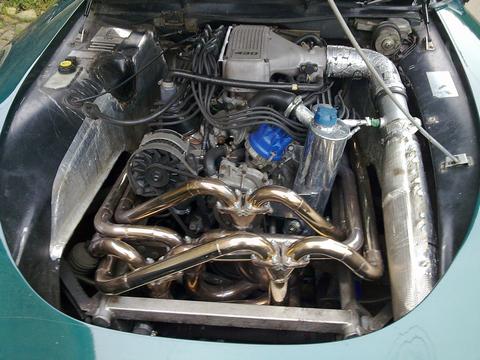
I have a hunch that it might be possible to create the cross-over arrangement in front of the engine with two downward-facing 4-into-1 unions and run two separate pipes all the way to the back. I've seen pictures of a very impressive equal-length arrangement made by Clive F, but it doesn't look like it combines the two inners from one bank with the two outers from the other so I don't think it's quite the same thing.
Anyone ever seen or attempted a cross-over arrangement, or know of any other pros and cons (apart from the undoubtedly high cost of getting one fabricated!)?
If I've understood correctly, the ultimate layout for performance is a cross-over system where the two inner cylinders from one bank join with the two outer cylinders from the other bank (and vice versa) in two separate 4 into 1 systems (with no balance pipe). All primary pipes being ideally of equal length. The benefit of this arrangement (as I understand it anyway) is that, with the standard firing order, the exhaust pulses are perfectly equally spaced which gives maximum performance.
Apparently this is how it is done on the Ford GT40, which was possible because there was room behind the engine at the back of the vehicle for all the plumbing (the famous "bunch of bananas" exhaust). On most other V8-engined cars, there isn't room to do it (pipes need to cross from one side of the engine to the other). However, it seems to me that Griffs and Chims are kind of similar to a GT40 in a reverse sort of way, in that the exhausts come forward to an area where there's quite a bit of space not available on "normal" cars.
I have a hunch that it might be possible to create the cross-over arrangement in front of the engine with two downward-facing 4-into-1 unions and run two separate pipes all the way to the back. I've seen pictures of a very impressive equal-length arrangement made by Clive F, but it doesn't look like it combines the two inners from one bank with the two outers from the other so I don't think it's quite the same thing.
Anyone ever seen or attempted a cross-over arrangement, or know of any other pros and cons (apart from the undoubtedly high cost of getting one fabricated!)?
Thanks Ukdj.
Dnb you're kind of right, but there are differences. The GT40 approach could be written as A = (2+3+5+8), B = (1+4+6+7) where A and B are separate systems all the way to the back of the car. Clive's system could be written as A = ((2+3)+(5+8)) + ((1+6)+(4+7)) where all 8 cylinders ultimately are combined into a single pipe (A). The critical thing is pairing the opposing cylinders 180 degrees apart on the crank, in particular to keep the exhaust pulses from 5 and 7 in separate pipes and likewise 8 and 4 - these are the two instances in the firing order where cylinders in the same bank fire one after the other.
I have no idea whether keeping the 2,3,5,8 and 1,4,6,7 cylinder combinations separate to the back of the vehicle would make any difference regarding the power increase. Maybe in Clive's system they are joined so far away from the exhaust ports that it might make no difference - certainly the power gains from his system are very impressive (not to mention that it looks fabulous ). I'm guessing it might make a difference to the sound though (I don't doubt either would be awesome!).
Clive, if you happen to spot this thread, it would be really good to hear your views on this.
Dnb you're kind of right, but there are differences. The GT40 approach could be written as A = (2+3+5+8), B = (1+4+6+7) where A and B are separate systems all the way to the back of the car. Clive's system could be written as A = ((2+3)+(5+8)) + ((1+6)+(4+7)) where all 8 cylinders ultimately are combined into a single pipe (A). The critical thing is pairing the opposing cylinders 180 degrees apart on the crank, in particular to keep the exhaust pulses from 5 and 7 in separate pipes and likewise 8 and 4 - these are the two instances in the firing order where cylinders in the same bank fire one after the other.
I have no idea whether keeping the 2,3,5,8 and 1,4,6,7 cylinder combinations separate to the back of the vehicle would make any difference regarding the power increase. Maybe in Clive's system they are joined so far away from the exhaust ports that it might make no difference - certainly the power gains from his system are very impressive (not to mention that it looks fabulous
). I'm guessing it might make a difference to the sound though (I don't doubt either would be awesome!).Clive, if you happen to spot this thread, it would be really good to hear your views on this.

I think the whole process works on the fact that the exhaust gas has both mass and velocity, so even when the exhaust valve closes the gas still has velocity out of the tail pipe, so the manifold area behind the last exhaust pulse has a pressure drop. Get the exhaust timing right, and this can be used to help draw out exhaust from another cylinder as the exhaust valve opens. Problem is this is gas velocity and volume dependent , so will only work some of the time at best.
hi Pete, hope this helps, ok so a firing order of 18436572,
The tuned manifold system has been designed to achieve equal spacings of the exhaust gas pulses within the secondary pipework by pairing together the primary pipes that fire an engine rotation apart ,
for example cylinder 1 fires then the crankshaft rotates a complete cycle before cylinder 6 fires.
This pair of primary pipes must be of equal length for the tuning to have
best effect.
Therefore, cylinder 2 is paired with cylinder 3, 8 with 5, 7 with 4 and then 6 with 1, so there are 8 primary pipes paired up to 4 secondary pipes, joining into 2 pipes with one of these coming from cylinders 2,3,5 and 8, and the other from 1,4,6 and 7 , then finally coming into one pipe and connecting to the main exhaust pipe.
your two outer cylinders on one bank being paired with the 2 inner cylinders from the other bank within the secondries going into the main exhaust. you swap over your injector wiring so the lambdas are reading the correct 4 cylinders being fed into the pipes.
The tuned manifold system has been designed to achieve equal spacings of the exhaust gas pulses within the secondary pipework by pairing together the primary pipes that fire an engine rotation apart ,
for example cylinder 1 fires then the crankshaft rotates a complete cycle before cylinder 6 fires.
This pair of primary pipes must be of equal length for the tuning to have
best effect.
Therefore, cylinder 2 is paired with cylinder 3, 8 with 5, 7 with 4 and then 6 with 1, so there are 8 primary pipes paired up to 4 secondary pipes, joining into 2 pipes with one of these coming from cylinders 2,3,5 and 8, and the other from 1,4,6 and 7 , then finally coming into one pipe and connecting to the main exhaust pipe.
your two outer cylinders on one bank being paired with the 2 inner cylinders from the other bank within the secondries going into the main exhaust. you swap over your injector wiring so the lambdas are reading the correct 4 cylinders being fed into the pipes.
when I get the time I will make a new system which will do away with a lot of the complicated pipework and just have 2off 4 into one systems, so 2358 into one and 1467 into the other, and 2 pipes merging into the exhaust, doing away with 4 off secondary pipes.
will be interesting to compare the benefits, improvements against the original system.
will be interesting to compare the benefits, improvements against the original system.
If you have a few quid spare, this is agreat read...
http://www.amazon.co.uk/Rovers-inside-Walkinshaws-...

Allan Scott's description of how TWR dealt with the various 'sub optimal' bits of the RV8 to get to a reliable 330+ bhp from 3500cc is epic.
Interesting section on exhaust tuning that aligns with the theory you've described, plus a load more on building race engines.
http://www.amazon.co.uk/Rovers-inside-Walkinshaws-...
Allan Scott's description of how TWR dealt with the various 'sub optimal' bits of the RV8 to get to a reliable 330+ bhp from 3500cc is epic.
Interesting section on exhaust tuning that aligns with the theory you've described, plus a load more on building race engines.



Doc Toad said:
If you have a few quid spare, this is agreat read...
http://www.amazon.co.uk/Rovers-inside-Walkinshaws-...
Allan Scott's description of how TWR dealt with the various 'sub optimal' bits of the RV8 to get to a reliable 330+ bhp from 3500cc is epic.
Interesting section on exhaust tuning that aligns with the theory you've described, plus a load more on building race engines.
Wonder how much of the knowledge was obtained from the use of this engine by Brabham.http://www.amazon.co.uk/Rovers-inside-Walkinshaws-...
Allan Scott's description of how TWR dealt with the various 'sub optimal' bits of the RV8 to get to a reliable 330+ bhp from 3500cc is epic.
Interesting section on exhaust tuning that aligns with the theory you've described, plus a load more on building race engines.


rev-erend said:
Wonder how much of the knowledge was obtained from the use of this engine by Brabham.
Sadly not much - the bscc and group 2 rules were pretty strict in limiting them to (homologated) production spec. They didn't even gain much from the TR8 rally cars development in group 4.Lots of detail in the book on how they interpreted the rules to their advantage though - especially in the inlet/lubrication mods that were allowed.
TWR were pretty agressive in this respect but they were the very model of responsibile racing compared to bmw and volvo in the 80's -especially when it came to homologation!
Turbo era killed off a great race car. No way they were going to hold their own against the RS500s
Would love an 80's Vitesse as a daily, but I suspect a mint one would be as much as a Griff these days (and infinitely more problematic to run!)
Aside from this matching of cylinders for balancing back pressure by input, the back pressure from the exhaust is often wrongly believed to be solely down to equal length pipe. In this case length may be almost irrelevant because the pipe diameter is so large.
Fluid dynamics is a very complex science but simplistically there are three relevant contributors to system back pressure. Length is a known issue but I'm sure you can recognise that if the pipe is a large diameter then a differing length will make very little difference to back pressure. Bends and the tightness of a radius is another contributor. There are many examples of equal length being achieved by multiple tight bends in some of the header pipes. This will not give the desired balance. The third is in-system differential pressure which this cylinder balance sounds like a solution to.
Length is only relevant if diameter is restrictive
Bends are always relevant, more so if the bends are tight
Fluid dynamics is a very complex science but simplistically there are three relevant contributors to system back pressure. Length is a known issue but I'm sure you can recognise that if the pipe is a large diameter then a differing length will make very little difference to back pressure. Bends and the tightness of a radius is another contributor. There are many examples of equal length being achieved by multiple tight bends in some of the header pipes. This will not give the desired balance. The third is in-system differential pressure which this cylinder balance sounds like a solution to.
Length is only relevant if diameter is restrictive
Bends are always relevant, more so if the bends are tight
Forums | Griffith | Top of Page | What's New | My Stuff