
National Speed limit.
Discussion


I have a question. There is a road near me (A54) that goes from 40mph to 50mph then to NSL single carriageway to NSL dual carriageway. It becomes less and less residential as the limit apparently increases.
The reverse is also true - coming off the NSL dual carriageway onto NSL single carriageway - then dropping to 50 then 40.
All of the traffic on this road treats the single carriageway limit as 60mph - however according to this diagram a single carriageway in a built up area with an NSL sign is in fact a 30mph limit.

This is the definition of a "built up area" based on street light spacing which this road would seem to match.
https://en.wikipedia.org/wiki/Built-up_area_(Highw...
So what is the score. Does the speed limit really go 40mph, 50mph, 30mph, 70mph (and vice versa)?
The reverse is also true - coming off the NSL dual carriageway onto NSL single carriageway - then dropping to 50 then 40.
All of the traffic on this road treats the single carriageway limit as 60mph - however according to this diagram a single carriageway in a built up area with an NSL sign is in fact a 30mph limit.
This is the definition of a "built up area" based on street light spacing which this road would seem to match.
https://en.wikipedia.org/wiki/Built-up_area_(Highw...
So what is the score. Does the speed limit really go 40mph, 50mph, 30mph, 70mph (and vice versa)?
Edited by Moonhawk on Tuesday 16th June 13:56
hornetrider said:
Moonhawk said:
however according to this diagram a single carriageway in a built up area with an NSL sign is in fact a 30mph limit.
Errrr. No it doesn't. 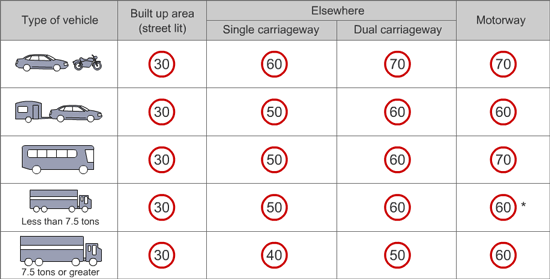
Also stated here
https://en.wikipedia.org/wiki/Road_speed_limits_in...
covboy said:
I think where there is a change of speed (street lights or not) there must be a change of speed signage – The 30 mph limit in built up areas with streetlights should always be signed when you come off another limit
Yes - there is no change in signage coming from the NSL dual carriageway onto the NSL single carriageway.But going in the other direction from the 50mph to the single carriageway NSL - there is a change in signage (i.e. from a numbered 50 to the black and white NSL sign).
Looking at it another way. You can turn directly onto the NSL single carriageway from a side road. Once on the single carriageway NSL road and seeing only the NSL sign and the streetlights - what would you assume the limit to be?
Edited by Moonhawk on Tuesday 16th June 14:11
Moonhawk said:
Yes - there is no change in signage coming from the NSL dual carriageway onto the NSL single carriageway.
But going in the other direction from the 50mph to the single carriageway NSL - there is a change in signage (i.e. from a numbered 50 to the black and white NSL sign).
Looking at it another way. You can turn directly onto the NSL single carriageway from a side road. Once on the single carriageway NSL road and seeing only the NSL sign and the streetlights - what would you assume the limit to be?
60mph. NSL sign on a single carriageway means precisely that regardless of street lights. If that road was indeed a 30mph limit then at the entry to the single carriageway from the side road there would be a 30 sign.But going in the other direction from the 50mph to the single carriageway NSL - there is a change in signage (i.e. from a numbered 50 to the black and white NSL sign).
Looking at it another way. You can turn directly onto the NSL single carriageway from a side road. Once on the single carriageway NSL road and seeing only the NSL sign and the streetlights - what would you assume the limit to be?
Edited by Moonhawk on Tuesday 16th June 14:11
covboy said:
If I see a NSL sign then NSL - Can't see the problem
This attitude has contributed to a lot of roads near me having limits lowered to 50mph enforced by average cameras. It isn't always safe or appropriate to drive at 60 if the limit is 60, just the same as it isn't always unsafe or unappropriate to drive faster than 70 on the motorway.SamR380 said:
covboy said:
If I see a NSL sign then NSL - Can't see the problem
This attitude has contributed to a lot of roads near me having limits lowered to 50mph enforced by average cameras. It isn't always safe or appropriate to drive at 60 if the limit is 60, just the same as it isn't always unsafe or unappropriate to drive faster than 70 on the motorway.I think what's confusing about the graphic in the OP is the inclusion of the NSL sign. If there were no sign there but some statement along the lines of "unless there are signs to say otherwise then the following limits apply..."
It's sort of representative of the hypothetical situation where you're dumped on a road, don't know the limit for whatever reason, then how do you work out the prevailing limit.
It's sort of representative of the hypothetical situation where you're dumped on a road, don't know the limit for whatever reason, then how do you work out the prevailing limit.
FiF said:
I think what's confusing about the graphic in the OP is the inclusion of the NSL sign. If there were no sign there but some statement along the lines of "unless there are signs to say otherwise then the following limits apply..."
It's sort of representative of the hypothetical situation where you're dumped on a road, don't know the limit for whatever reason, then how do you work out the prevailing limit.
At the risk of getting shouted at by a lot of people, I'd work on the basis that if lit it's a 30 limit unless otherwise stated. If unlit, then it's an NSL, unless otherwise stated. I'm not going to get my tape measure out for the spacing of the streetlights, but it's a decent rule of thumb. It's sort of representative of the hypothetical situation where you're dumped on a road, don't know the limit for whatever reason, then how do you work out the prevailing limit.
But isn't that the whole point of the OP? NSL on a street lit road is 30 mph.
The real Highway Code says
National speed limits
Type of vehicle Cars, motorcycles, car-derived vans and dual-purpose vehicles
Built-up areas mph (km/h) 30 (48)
So if you see an NSL sign it can still mean 30.
The real Highway Code says
National speed limits
Type of vehicle Cars, motorcycles, car-derived vans and dual-purpose vehicles
Built-up areas mph (km/h) 30 (48)
So if you see an NSL sign it can still mean 30.
speedking31 said:
But isn't that the whole point of the OP? NSL on a street lit road is 30 mph.
The real Highway Code says
National speed limits
Type of vehicle Cars, motorcycles, car-derived vans and dual-purpose vehicles
Built-up areas mph (km/h) 30 (48)
So if you see an NSL sign it can still mean 30.
Pedantry in the extreme. Technically, you're possibly correct, in reality this simply wouldn't happen. The real Highway Code says
National speed limits
Type of vehicle Cars, motorcycles, car-derived vans and dual-purpose vehicles
Built-up areas mph (km/h) 30 (48)
So if you see an NSL sign it can still mean 30.
LoonR1 said:
speedking31 said:
But isn't that the whole point of the OP? NSL on a street lit road is 30 mph.
The real Highway Code says
National speed limits
Type of vehicle Cars, motorcycles, car-derived vans and dual-purpose vehicles
Built-up areas mph (km/h) 30 (48)
So if you see an NSL sign it can still mean 30.
Pedantry in the extreme. Technically, you're possibly correct, in reality this simply wouldn't happen. The real Highway Code says
National speed limits
Type of vehicle Cars, motorcycles, car-derived vans and dual-purpose vehicles
Built-up areas mph (km/h) 30 (48)
So if you see an NSL sign it can still mean 30.
If there are street lights, then there will be start and end limit signs but no repeaters if it's 30.
Agreed with Loon's earlier comment, in the hypothetical situation of being dropped from space onto a road, which is the same as just losing track of the limit, (we all do it occasionally) then safest way is to determine what sort of road, lit or not, and then look for evidence that the limit is different from standard.
rb5er said:
If its 30 there will be signage.
Not really. I used to live in Manchester. I used to commute into the city centre from Ashton Under Lyne along Ashton New Road and on to Alan Turing way (a dual carriageway). This was all 30mph limit but had no speed limit signs whatsoever.Looking at google maps - that still appears to be the case on Alan Turing way - although there are now painted 30 symbols on the road and a couple of speed camera signs with the speed limit below just before it crosses the A635 (these must be fairly new - they certainly weren't there when I lived in the area ~10 years back). No large speed limit disks and no repeaters (other than the irregularly spaced speed camera signs mentioned above).
Alan Turing way is the only road I have ever been done for speeding (36mph).
But if you live in an area subject to 30 and your entire commute is along 30 (technically referred to as restricted roads see Sections 81 and 82 Road Traffic Regulation Act 1984) then you would never see a 30 limit sign, unless the road was unlit, in which case repeaters.
Read this, section 14 page 105 onwards
Please don't go rabbiting on about road names that none of us know about, I've just dropped onto a random section of Alan Turing way, road with a system of street lighting, so if it's 30 no repeaters.
edited to add the following. What's also confusing the issue is the reference by various posters, and the Highway Code sadly, to a road definition of built up area, when the legal definition is nothing to do with a built up area but the system of street lighting in place or not.
Read this, section 14 page 105 onwards
Please don't go rabbiting on about road names that none of us know about, I've just dropped onto a random section of Alan Turing way, road with a system of street lighting, so if it's 30 no repeaters.
edited to add the following. What's also confusing the issue is the reference by various posters, and the Highway Code sadly, to a road definition of built up area, when the legal definition is nothing to do with a built up area but the system of street lighting in place or not.
Edited by FiF on Tuesday 16th June 22:05
Moonhawk said:
rb5er said:
If its 30 there will be signage.
Not really. I used to live in Manchester. I used to commute into the city centre from Ashton Under Lyne along Ashton New Road and on to Alan Turing way (a dual carriageway). This was all 30mph limit but had no speed limit signs whatsoever.Looking at google maps - that still appears to be the case on Alan Turing way - although there are now painted 30 symbols on the road and a couple of speed camera signs with the speed limit below just before it crosses the A635 (these must be fairly new - they certainly weren't there when I lived in the area ~10 years back). No large speed limit disks and no repeaters (other than the irregularly spaced speed camera signs mentioned above).
Alan Turing way is the only road I have ever been done for speeding (36mph).
speedking31 said:
But isn't that the whole point of the OP? NSL on a street lit road is 30 mph.
The real Highway Code says
National speed limits
Type of vehicle Cars, motorcycles, car-derived vans and dual-purpose vehicles
Built-up areas mph (km/h) 30 (48)
So if you see an NSL sign it can still mean 30.
Like here?The real Highway Code says
National speed limits
Type of vehicle Cars, motorcycles, car-derived vans and dual-purpose vehicles
Built-up areas mph (km/h) 30 (48)
So if you see an NSL sign it can still mean 30.
https://www.google.co.uk/maps/@56.257779,-3.781529...
Funnily enough, I never got a ticket for passing the Gatso at 70mph...
Gassing Station | Speed, Plod & the Law | Top of Page | What's New | My Stuff