
Driving with a cracked windscreen
Discussion


Yesterday, after washing the car, a large crack across the windscreen appeared - annoying.
I have booked it in for replacement - National Windscreens need to have the car in to do the job as front facing cameras need to be recalibrated.
The crack is on the driver side and runs across the field of view, so obviously I shouldn't use it in the meantime. As far as driving it to the appointment on Saturday morning, am I correct to assume this is ok - like driving to an MOT appointment?
Fairly sure this is the case, but thought I'd ask you all!
Cheers
I have booked it in for replacement - National Windscreens need to have the car in to do the job as front facing cameras need to be recalibrated.
The crack is on the driver side and runs across the field of view, so obviously I shouldn't use it in the meantime. As far as driving it to the appointment on Saturday morning, am I correct to assume this is ok - like driving to an MOT appointment?
Fairly sure this is the case, but thought I'd ask you all!
Cheers
Mr Pointy said:
Why do you think it's illegal to drive it anyway? Yes it won't pass an MOT, but that doesn't mean you can't drive it to be repaired.
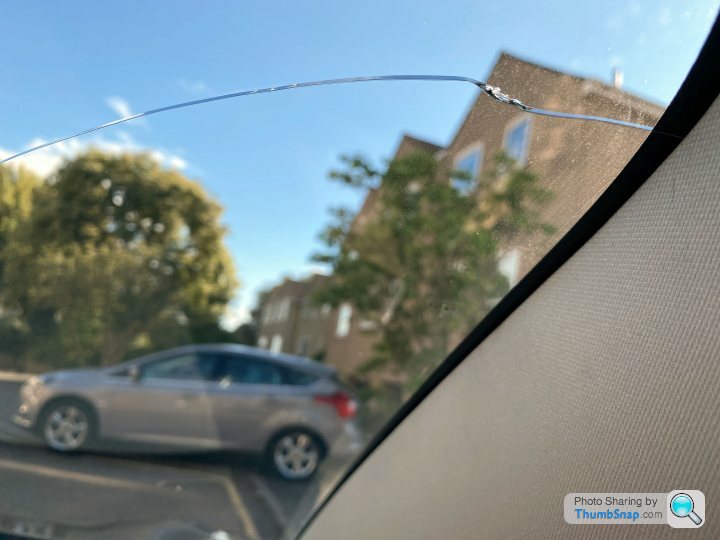
This is the crack - running along my eye line. As for driving it anyway, sites such as RAC suggest you could get stopped / fined / points. I guess if stopped when taking it in for replacement, showing the appointment email should suffice?
Avantime said:
I guess if stopped when taking it in for replacement, showing the appointment email should suffice?
As has been demonstrated above, you cannot accept the opinions of random nonentities on an internet forum as being "the law". So if you're stopped by the police, "A bloke on the internet said it would be OK" will not be adequate mitigation.So, it's down to you. Wouldn't bother me driving the car to get it repaired, but I am one of these internet random nonentities, so you cannot rely on me to offer any meaningful advice.
Edited by Sebring440 on Monday 7th June 15:50
https://www.gov.uk/government/publications/sticker...
The Government said:
Regulation 30 of the Road Vehicles (Construction and Use) Regulations 1986 (SI 1986 No. 1078 as amended) requires that:
(1) Every motor vehicle shall be so designed and constructed that the driver thereof while controlling the vehicle can at all times have a full view of the road and traffic ahead of the motor vehicle.
(2) Instead of complying with the requirement of paragraph (1) a vehicle may comply with Community Directive 77/649, 81/643, 88/366, 90/630 or, in the case of an agricultural motor vehicle, 79/1073.
(3) All glass or other transparent material fitted to a motor vehicle shall be maintained in such condition that it does not obscure the vision of the driver while the vehicle is being driven on a road.
In practice, the annual test will check that items placed in or stuck to the windscreen or surface damage, cracks or discolouration in the windscreen do not seriously obscure the vision of the driver. In order to better define what maybe permissible the windscreen is divided into zones:
Zone A is a vertical area 290mm wide, centred on the steering wheel and contained within the swept area of the windscreen (this area is 350mm wide on vehicles over 3.5 tonnes);
Zone B is the remainder of the swept area of the windscreen
For simplicity, surface damage, cracks or discolouration, are simply referred to as damage.
In Zone A, a single damaged area shall be contained within a 10mm diameter circle. A combination of minor damage areas shall not seriously restrict the drivers view. Windscreen stickers, or other obstructions, shall not encroach more than 10mm.
In Zone B, a single damaged area shall be contained within a 40mm diameter circle. Windscreen stickers, or other obstructions, shall not encroach more than 40mm.
Windscreen repairs shall be assessed the same as unrepaired damage and shall not restrict the driver’s vision.
Cracks passing through the swept area of the windscreen and reaching two points at the edge shall be deemed to render the windscreen insecure.
Items placed in, or stuck to, the windscreen could be stickers, pennants, satellite navigation monitors or decorations.
Original vehicle design features and drivers aids, such as sun visors, are allowed.
Vehicles that do not comply with the above could be construed to be in contravention of the legislation.
Additionally, Regulation 100 of The Road Vehicles (Construction and Use) Regulations 1986 (SI 1986 No. 1078 as amended) requires:
a motor vehicle, and all its parts and accessories;
the number of passengers carried, and the manner in which any passengers are carried in or on a vehicle; and
the weight, distribution, packing and adjustment of the load of a vehicle
to be at all times such that no danger is caused, or is likely to be caused, to any person in or on a vehicle or on a road.
Further to this, Section 40a of The Road Traffic Act 1988 (as amended by Section 8 of the Road Traffic Act 1991)Part II, Using a Vehicle in a Dangerous Condition, states that:
A person is guilty of an offence if he uses, or causes or permits another to use, a motor vehicle or trailer on the road when:
(a) the condition of the motor vehicle or trailer, or of its accessories or equipment, or
(b) the purpose for which it is used, or
(c) the number of passengers carried by it, or the manner in which they are carried, or
(d) the weight, position or distribution of its load, or the manner in which it is secured, is such that the use of the motor vehicle or trailer involves a danger of injury to any person
(1) Every motor vehicle shall be so designed and constructed that the driver thereof while controlling the vehicle can at all times have a full view of the road and traffic ahead of the motor vehicle.
(2) Instead of complying with the requirement of paragraph (1) a vehicle may comply with Community Directive 77/649, 81/643, 88/366, 90/630 or, in the case of an agricultural motor vehicle, 79/1073.
(3) All glass or other transparent material fitted to a motor vehicle shall be maintained in such condition that it does not obscure the vision of the driver while the vehicle is being driven on a road.
In practice, the annual test will check that items placed in or stuck to the windscreen or surface damage, cracks or discolouration in the windscreen do not seriously obscure the vision of the driver. In order to better define what maybe permissible the windscreen is divided into zones:
Zone A is a vertical area 290mm wide, centred on the steering wheel and contained within the swept area of the windscreen (this area is 350mm wide on vehicles over 3.5 tonnes);
Zone B is the remainder of the swept area of the windscreen
For simplicity, surface damage, cracks or discolouration, are simply referred to as damage.
In Zone A, a single damaged area shall be contained within a 10mm diameter circle. A combination of minor damage areas shall not seriously restrict the drivers view. Windscreen stickers, or other obstructions, shall not encroach more than 10mm.
In Zone B, a single damaged area shall be contained within a 40mm diameter circle. Windscreen stickers, or other obstructions, shall not encroach more than 40mm.
Windscreen repairs shall be assessed the same as unrepaired damage and shall not restrict the driver’s vision.
Cracks passing through the swept area of the windscreen and reaching two points at the edge shall be deemed to render the windscreen insecure.
Items placed in, or stuck to, the windscreen could be stickers, pennants, satellite navigation monitors or decorations.
Original vehicle design features and drivers aids, such as sun visors, are allowed.
Vehicles that do not comply with the above could be construed to be in contravention of the legislation.
Additionally, Regulation 100 of The Road Vehicles (Construction and Use) Regulations 1986 (SI 1986 No. 1078 as amended) requires:
a motor vehicle, and all its parts and accessories;
the number of passengers carried, and the manner in which any passengers are carried in or on a vehicle; and
the weight, distribution, packing and adjustment of the load of a vehicle
to be at all times such that no danger is caused, or is likely to be caused, to any person in or on a vehicle or on a road.
Further to this, Section 40a of The Road Traffic Act 1988 (as amended by Section 8 of the Road Traffic Act 1991)Part II, Using a Vehicle in a Dangerous Condition, states that:
A person is guilty of an offence if he uses, or causes or permits another to use, a motor vehicle or trailer on the road when:
(a) the condition of the motor vehicle or trailer, or of its accessories or equipment, or
(b) the purpose for which it is used, or
(c) the number of passengers carried by it, or the manner in which they are carried, or
(d) the weight, position or distribution of its load, or the manner in which it is secured, is such that the use of the motor vehicle or trailer involves a danger of injury to any person
Avantime said:
National Windscreens need to have the car in to do the job as front facing cameras need to be recalibrated.
The cameras are self calibrating. The standard process is a dynamic calibration which is to basically take the car for a spin for up to 20 miles for it to align itself. Glassman said:
The cameras are self calibrating. The standard process is a dynamic calibration which is to basically take the car for a spin for up to 20 miles for it to align itself.
Thanks Glassman - I'm guessing you're in the trade, so to speak?!Previously Tesla owners have had to book into Tesla service centres to get it done, but I think now there is a 'self calibration' in the service menu on the car (judging by online videos). Maybe they want it in to ensure correct fixing rather than outside.
Avantime said:
Thanks Glassman - I'm guessing you're in the trade, so to speak?!
Affirmative. Avantime said:
Previously Tesla owners have had to book into Tesla service centres to get it done, but I think now there is a 'self calibration' in the service menu on the car (judging by online videos). Maybe they want it in to ensure correct fixing rather than outside.
I think it's more to do with it being, a) an expensive part;
b) an expensive car;
c) a hefty screen for one bloke, even with a lifting apparatus (a second man would be better but they're probably stretched)
d) the base fitter is usually a bit more experienced but in any case, someone in the office is there to assist.
Just be sure to get them to confirm that everything works (and there's no damage to the car) before they turn a screw.
Glassman said:
I think it's more to do with it being,
a) an expensive part;
b) an expensive car;
c) a hefty screen for one bloke, even with a lifting apparatus (a second man would be better but they're probably stretched)
d) the base fitter is usually a bit more experienced but in any case, someone in the office is there to assist.
Just be sure to get them to confirm that everything works (and there's no damage to the car) before they turn a screw.
Shall do! It's not a massive screen - model 3 Performance, but still an expensive piece of glass! Seen a couple of damaged ones after screen change....a) an expensive part;
b) an expensive car;
c) a hefty screen for one bloke, even with a lifting apparatus (a second man would be better but they're probably stretched)
d) the base fitter is usually a bit more experienced but in any case, someone in the office is there to assist.
Just be sure to get them to confirm that everything works (and there's no damage to the car) before they turn a screw.
LordFlathead said:
Just drive it and if you get stopped "it just happened officer".. how are they going to prove it?
Dare I say, that would be my attitude also.I had this crack on my old E36 for months.

Had quite a few other issues making it uneconomical to put through the MOT so just left it.

Aren't Tesla supposed to have a self driving mode? Just send it off on its own.
In all seriousness, technically it is an offence, and would depend on how lenient the bobby that you encountered was feeling. Given the number of cars and vans I see driving around with cracked screens I would suspect that they are not bothered too much!
Personally I would drive it and not worry but as has been mentioned about, I am also a nonentity on the internet!
In all seriousness, technically it is an offence, and would depend on how lenient the bobby that you encountered was feeling. Given the number of cars and vans I see driving around with cracked screens I would suspect that they are not bothered too much!
Personally I would drive it and not worry but as has been mentioned about, I am also a nonentity on the internet!
Mr Pointy said:
Why do you think it's illegal to drive it anyway? Yes it won't pass an MOT, but that doesn't mean you can't drive it to be repaired.
The Road Vehicles (Construction and Use) Regulations 1986, No. 1078, Part II, E:30.—(1) Every motor vehicle shall be so designed and constructed that the driver thereof while controlling the vehicle can at all times have a full view of the road and traffic ahead of the motor vehicle.
(3) All glass or other transparent material fitted to a motor vehicle shall be maintained in such condition that it does not obscure the vision of the driver while the vehicle is being driven on a road.
Gassing Station | Speed, Plod & the Law | Top of Page | What's New | My Stuff