
Mobility scooters Road or pavement?
Discussion


Bloody hate 'em. I'm living in the middle of Chav-central where a mobility shop opened up last year and rents them out for circa £20 a week they're all over the place around here and 99% of the time being ridden by Fat chavs who's only disability is laziness (Or in some cases just for getting back from the pub on!)
Shouldn't be on the pavement OR the road in my opinion. Too slow to be on the road, and dangerous to pedestrians on the pavement - Especially when driven by an arrogant cock who thinks they have right of way!. Granted, my only experience of them has been either OAP's dawdling down the center of the road or Chavs flying at you down the pavement - So i'm fairly ignorant about their actual usefullness but surely if your really disabled a wheelchair is a better option?.
Shouldn't be on the pavement OR the road in my opinion. Too slow to be on the road, and dangerous to pedestrians on the pavement - Especially when driven by an arrogant cock who thinks they have right of way!. Granted, my only experience of them has been either OAP's dawdling down the center of the road or Chavs flying at you down the pavement - So i'm fairly ignorant about their actual usefullness but surely if your really disabled a wheelchair is a better option?.
There's a crazy old guy lives near my Dad who rides one. He seems to take the racing line through the corners on the road! Also living down the same road is a (rather tasty) mum who belts down the road and round the tight corners in her suv (kia sorento?).
Those two are going to meet head on one day and it's not going to be pretty.
Edit for spleeling
Those two are going to meet head on one day and it's not going to be pretty.
Edit for spleeling
Edited by mrtwisty on Thursday 20th January 07:22
Simples answer is: mobility scooter is intended to be used by a person who has limited mobility, to afford them the same/similar mobility as an able-bodied person. The question of 'pavement/footway or road/carriageway?' is not one answered by a straightforward always one or t'other. Rather, common sense should prevail. Mobility scooters should be seen as being replacements for walking, and as such, users should be confined to the footway where one exists, and it is of sufficient unobstructed width to allow the passage of said scooter. They cannot be banned from the roads because they have to be allowed to travel, as pedestrians are, where there are no footways/pavements, or to take to the road where any footway is obstructed by vehicles which are inconsiderately parked. IMHO the damned things should be limited to a maximum speed of 4mph, sh*t bust (for the safety of pedestrians), and any cantankerous old git who deliberately rides one on the road where there is a perfectly suitable footway should have his/her scooter taken away and destroyed. Keep the damned things off roads, especially those roads with higher speed limits/traffic volumes, or expect to see Darwin's Theory in action.
44 ton Articulated loads Shouldn't they be on a railway?,
Im sick of them taking all the road whilst overtaking cars parked half on the pavement, you would think they owned the roads.
Especial the ill maintained foreign ones driven by half asleep tourists with no road discipline who are beyond prosecution.
Have you ever taught those disabled scooter riders want to be put out of their misery that`s why they buy the dammed scooter in the first place?
Im sick of them taking all the road whilst overtaking cars parked half on the pavement, you would think they owned the roads.
Especial the ill maintained foreign ones driven by half asleep tourists with no road discipline who are beyond prosecution.
Have you ever taught those disabled scooter riders want to be put out of their misery that`s why they buy the dammed scooter in the first place?
froggie said:
44 ton Articulated loads Shouldn't they be on a railway?,
Im sick of them taking all the road whilst overtaking cars parked half on the pavement, you would think they owned the roads.
Especial the ill maintained foreign ones driven by half asleep tourists with no road discipline who are beyond prosecution.
One sincerely hopes you're taking the piss... unless every Tesco and Asda should have a branch line?Im sick of them taking all the road whilst overtaking cars parked half on the pavement, you would think they owned the roads.
Especial the ill maintained foreign ones driven by half asleep tourists with no road discipline who are beyond prosecution.
ShampooEfficient said:
froggie said:
44 ton Articulated loads Shouldn't they be on a railway?,
Im sick of them taking all the road whilst overtaking cars parked half on the pavement, you would think they owned the roads.
Especial the ill maintained foreign ones driven by half asleep tourists with no road discipline who are beyond prosecution.
One sincerely hopes you're taking the piss... unless every Tesco and Asda should have a branch line?Im sick of them taking all the road whilst overtaking cars parked half on the pavement, you would think they owned the roads.
Especial the ill maintained foreign ones driven by half asleep tourists with no road discipline who are beyond prosecution.
No Hgvs just central depos and small delivery vans.save all our broken pavings when the HGVs drive and park on them.lets face it theres just no room for them,
Lets face it Asda Tesco = unrivalled inconvenience
As far as the original post , Stones and glass houses come to mind.
froggie said:
ShampooEfficient said:
froggie said:
44 ton Articulated loads Shouldn't they be on a railway?,
Im sick of them taking all the road whilst overtaking cars parked half on the pavement, you would think they owned the roads.
Especial the ill maintained foreign ones driven by half asleep tourists with no road discipline who are beyond prosecution.
One sincerely hopes you're taking the piss... unless every Tesco and Asda should have a branch line?Im sick of them taking all the road whilst overtaking cars parked half on the pavement, you would think they owned the roads.
Especial the ill maintained foreign ones driven by half asleep tourists with no road discipline who are beyond prosecution.
No Hgvs just central depos and small delivery vans.save all our broken pavings when the HGVs drive and park on them.lets face it theres just no room for them,
Lets face it Asda Tesco = unrivalled inconvenience
As far as the original post , Stones and glass houses come to mind.
 hing constantly about customers' cars parked where they want to unload. They park on DYLs and across zebra zig-zags.
Goods in the UK used to be transported long distances by rail until Beeching - pressurised by the road transport lobby - closed down so much of the local network. Large loads were broken down in warehouses and depots and shipped to their final destinations in small, agile vans (e.g. the highly-versatile Scammell Scarab):
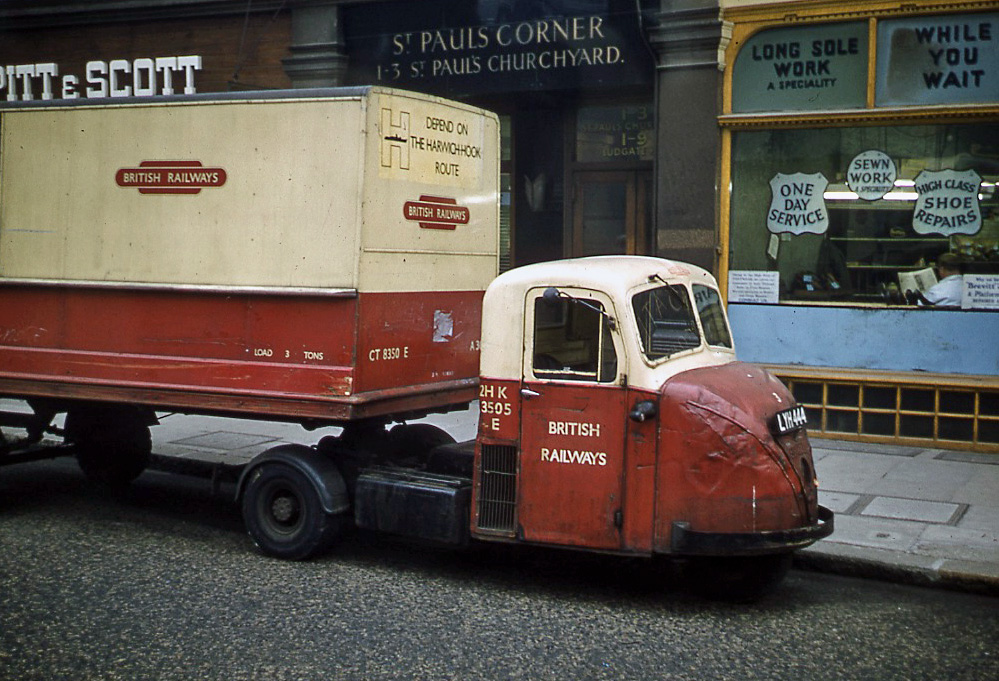
The system was fast, effective and provided much employment. It was integrated ... which is more than can be said now.
Streaky
streaky said:
Goods in the UK used to be transported long distances by rail until Beeching - pressurised by the road transport lobby - closed down so much of the local network. Large loads were broken down in warehouses and depots and shipped to their final destinations in small, agile vans (e.g. the highly-versatile Scammell Scarab):
He was a busy bloke, that Beeching. Judging by how many lorries there in Europe, he closed down all their railways too.heebeegeetee said:
streaky said:
Goods in the UK used to be transported long distances by rail until Beeching - pressurised by the road transport lobby - closed down so much of the local network. Large loads were broken down in warehouses and depots and shipped to their final destinations in small, agile vans (e.g. the highly-versatile Scammell Scarab):
He was a busy bloke, that Beeching. Judging by how many lorries there in Europe, he closed down all their railways too.As Streaky says, it used to be integrated. Buses would interlock with trains and it was the norm that wen getting off a train a bus, or selction of, would be there waiting for everyone. Roads were then left for local deliveries.
My local village is Rottingdean. It has a Tesco lite and a Co-op, both of which have deliveries at all times of the day done by artics. In rush hour the village can be brought to a standstill by lorries that have just a couple of items to unload. I understand their problems but they should be obliged to take the destination into consideration. An artic across a crossing is dangerous but that's where they park because anwhere else would mean the driver having to walk. Can't have that.
Despite the moans about how difficult it is to run HGVs they are heavily subsidised. Roads are generally built for lorries, not cars.
I don't know what the answer is apart from sorting the railways out. De-nationalisation of buses and trains is a disaster. It is costing us more now than it did before to keep trains running and most of that is to pay dividends. It was a political move, based on dogma and without any financial or convenience or efficiency motive.
Other countries have to depend on lorries because they didn't have our advantages. Various governments have ensured that we don't now either.
Derek Smith said:
heebeegeetee said:
streaky said:
Goods in the UK used to be transported long distances by rail until Beeching - pressurised by the road transport lobby - closed down so much of the local network. Large loads were broken down in warehouses and depots and shipped to their final destinations in small, agile vans (e.g. the highly-versatile Scammell Scarab):
He was a busy bloke, that Beeching. Judging by how many lorries there in Europe, he closed down all their railways too.As Streaky says, it used to be integrated. Buses would interlock with trains and it was the norm that wen getting off a train a bus, or selction of, would be there waiting for everyone. Roads were then left for local deliveries.
My local village is Rottingdean. It has a Tesco lite and a Co-op, both of which have deliveries at all times of the day done by artics. In rush hour the village can be brought to a standstill by lorries that have just a couple of items to unload. I understand their problems but they should be obliged to take the destination into consideration. An artic across a crossing is dangerous but that's where they park because anwhere else would mean the driver having to walk. Can't have that.
Despite the moans about how difficult it is to run HGVs they are heavily subsidised. Roads are generally built for lorries, not cars.
I don't know what the answer is apart from sorting the railways out. De-nationalisation of buses and trains is a disaster. It is costing us more now than it did before to keep trains running and most of that is to pay dividends. It was a political move, based on dogma and without any financial or convenience or efficiency motive.
Other countries have to depend on lorries because they didn't have our advantages. Various governments have ensured that we don't now either.
Fact is, as a nation we have gotten into the acceptability of debt to fund our chinese tvs and ipods and laptops and cameras and sofas and kitchens, and Sunday trading and all the rest of it, not to mention every other car being a porsche, audi or BMW; then we complain about the numbers of lorries on the road.
And that makes no sense whatsoever.
Having said that, to put freight on railways would need huge investments to changes in infrastructure. If we insisted that people travel by train though and take gazillions of cars off the road, far less investment would be needed 'cos people can take themselves to and from the train and place themselves on and off the train.
Derek Smith said:
De-nationalisation of buses and trains is a disaster. It is costing us more now than it did before to keep trains running and most of that is to pay dividends. It was a political move, based on dogma and without any financial or convenience or efficiency motive.
It was to comply with EU Directive 91/440 - which requires the 'liberalisation' of railways within the EU and for them to operate in a 'competitive market'; specifically to separate "the management of railway operation and infrastructure from the provision of railway transport services."heebeegeetee said:
If we insisted that people travel by train though and take gazillions of cars off the road, far less investment would be needed 'cos people can take themselves to and from the train and place themselves on and off the train.
A major problem with that on commuter routes into London is that they are operating at capacity during peak periods. No more trains can be accommodated safely; indeed, on the London approaches, there is often one train in each signalling block. Longer trains cannot be easily accommodated either, as many platforms are already too short (three on my line into London) for 10 and 12 carriage trains. And our loading gauge prevents us using double-decker trains. [As a bit of trivia, more people are moved by overground train into London every weekday morning in the space of two hours than took part in the entire Normandy landings over many weeks.] Then, as bus and rail timetables are not synchronised - outside London - by car is the only way many people can get to their 'local' railway station.When she lived at home, my daughter worked about ten miles away by road. To get to work by public transport would have involved a one mile walk, a rail journey of around two hours (part way to London and then back again) and a walk of some two miles. The earliest she would have arrived at work, catching the first train, was an hour after she was supposed to start. By bus it would have involved two changes, in two towns forming the other corners of an oblong, walks totalling about a mile, taken nearly two hours and got her to work an hour and 20 minutes late.
Streaky
streaky said:
[As a bit of trivia, more people are moved by overground train into London every weekday morning in the space of two hours than took part in the entire Normandy landings over many weeks.]
Streaky
To be fair, commuters take far fewer tanks with them, float a lot less and there are no gun emplacements firing at them. I accept the soldiers were a lot more comfortable though.Streaky
Edited by Derek Smith on Monday 24th January 11:18
The Freight haulag association has noticed a trend for goods to be delivered by the larger vans, rather then trucks as the operating costs are cheaper and there isnt *that** much difference in payload between the largest vans and the smaller trucks. Esecially when a lot of stuff issizxe, rather then weight dependant.
So we might see a return to smaller vans for local work, larger vehciles on the trunk roads.
So we might see a return to smaller vans for local work, larger vehciles on the trunk roads.
streaky said:
It was to comply with EU Directive 91/440 - which requires the 'liberalisation' of railways within the EU and for them to operate in a 'competitive market'; specifically to separate "the management of railway operation and infrastructure from the provision of railway transport services."
Indeed - as Derek says, political dogma 
JJ
Gassing Station | Speed, Plod & the Law | Top of Page | What's New | My Stuff