
10 Minute Battery Drain?
Discussion


I'm chalking this up to another lesson learnt but I thought is double check with you guys. Went out for a 30 minute blat on Friday then popped back home to pick up a few things before heading out again. I accidentally left the lights on whilst I went in the house and then found the battery too flat to turn the engine over. I'd left it for no more than 10 minutes!
Does that sound about right? It was fine after a jump start from my TT.
Does that sound about right? It was fine after a jump start from my TT.
I'd say that's normal. Battery is smallest they can get away with (to save weight) and the alternator too. Net result is that the battery can discharge quickly and can charge very slowly (sometimes not at all) if lights, screen, heater etc are all switched on. It is a good idea to keep a battery conditioner connected to makes sure you battery gets fully charged after a blat.
In my experience absolutely. When I picked my car up from Caterham I drove it back in the cold and rain + it was dark.
Most of the journey I was crawling along at barely more than idle with the heater, screen and lights on.
Pulled over half way through journey and the car would not restart as you have described.
RAC man stuck a battery pack on the car and identified that at idle with the lights on there was a net draw overall.
Lessons learnt:
- blats in the dark must be at pace
- worth getting a battery charger
Tom
Most of the journey I was crawling along at barely more than idle with the heater, screen and lights on.
Pulled over half way through journey and the car would not restart as you have described.
RAC man stuck a battery pack on the car and identified that at idle with the lights on there was a net draw overall.
Lessons learnt:
- blats in the dark must be at pace
- worth getting a battery charger
Tom
My banner battery died after a little over four years of use.
Being to busy at work to get up to CC Dartford & still wanting to get out for weekend blats, for some weeks I carried our 100ah caravan leisure battery around in the footwell & some jump leads. I was very speedy at starting the car with the jump battery & it ran fine if I kept driving fast!
Not to good for the power to weight ratio though.
Being to busy at work to get up to CC Dartford & still wanting to get out for weekend blats, for some weeks I carried our 100ah caravan leisure battery around in the footwell & some jump leads. I was very speedy at starting the car with the jump battery & it ran fine if I kept driving fast!
Not to good for the power to weight ratio though.
BertBert said:
Well I'd expect a fully charged banner to last longer than 10 mins with the lights on. Lights on is what 10-12 amps. The banner is about 35AH. So I think something is amiss. Either your battery wasn't very charged or it's on its way out.
Bert
Correct, assuming a headlamp bulb is 55 watts this is equivalent to 4.5 Amps x 2= 9 amps, side lights (including numberplate and instrument) as a guestimate is possibly of a total say around 14 amp/hour so 10 mins use would be about 2.3 ampsBert
Banner batteries are not bad batteries but are small and need routine maintenance treat them nicely and they seem to last 5-7 years
Edited by Toaster on Saturday 14th December 21:55
Toaster said:
Correct, assuming a headlamp bulb is 55 watts this is equivalent to 4.5 Amps x 2= 9 amps, side lights (including numberplate and instrument) as a guestimate is possibly of a total say around 14 amp/hour so 10 mins use would be about 2.3 amps
Banner batteries are not bad batteries but are small and need routine maintenance treat them nicely and they seem to last 5-7 years
It not that simple. The theoretical capacity isn't what's important - it is the ability to to produce cranking AMPS. To do this, it is the voltage that is important and a smaller capacity battery will hold voltage for a much shorter time under a given load - as per the graph (Shamelessly stolen from the internet) Banner batteries are not bad batteries but are small and need routine maintenance treat them nicely and they seem to last 5-7 years
Edited by Toaster on Saturday 14th December 21:55
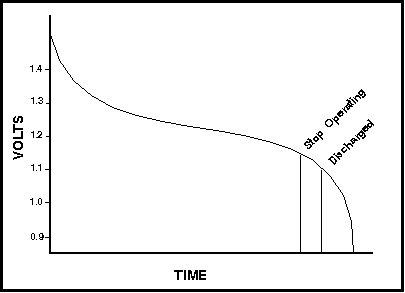
It is that first 10% of capacity that is often needed to start the car, and if you let the battery lose that, then starting can be a problem even though the theoretical capacity suggests there still 90% left.
It is that simple 2.3 Amps is less than 10% therefore a Battery in good condition and fully charged would not be affected by leaving the lights on for ten minutes Having said that it is sensible not to leave lights on (these are not your normal production cars So why treat them as if they are ) Most do not keep the battery in good condition and fully charged. ! So in someways what do you guys expect !
Discuss
Discuss
DCL said:
It is that first 10% of capacity that is often needed to start the car, and if you let the battery lose that, then starting can be a problem even though the theoretical capacity suggests there still 90% left.
I don't think it normally is. I think that the beauty of (wet) lead acid batteries is that they do keep an operating voltage well.There was an issue with the original KR500 on MBE with gel batteries. Many people like me fitted them rather than the banner. Then we had starting problems. The gel battery could crank really well, but the voltage was just too low for the MBE. On advice from Minister, I swapped back to a banner and it all was good. Started on the button every time.
Bert
Don't disagree, but most of the time you are using a fully charged battery to start the car and, all things working as they should, the battery should not discharge below 100% for any length of time. The point Tomwoodis and myself were hoping to make is that the battery can discharge, with the engine running, if load is high and the RPM is low. So it may not have been just 10 minutes discharge, but could have been 40 minutes depending on how fast the engine was running.
DCL said:
So it may not have been just 10 minutes discharge, but could have been 40 minutes depending on how fast the engine was running.
This is most likely the case, given that my run out was a functional one in traffic so the car wasn't run hard and I had the lights on the entire time.I'll be ordering a trickle-charger shortly.
DCL said:
if load is high and the RPM is low. So it may not have been just 10 minutes discharge, but could have been 40 minutes depending on how fast the engine was running.
I am not sure that is correct in that when you consider the gearing of a alternator it has a smallish pulley which means that its RPM is much higher than the given rpm of the engine look up the performance curve of an alternator you will find they are pretty efficient. whilst the load of a heated windscreen headlights fog lights etc may have an impact on re-charge time it is unlikely you are using so much power that the battery is discharging if it was the battery light would illuminate on the dashToaster said:
I am not sure that is correct in that when you consider the gearing of a alternator it has a smallish pulley which means that its RPM is much higher than the given rpm of the engine look up the performance curve of an alternator you will find they are pretty efficient. whilst the load of a heated windscreen headlights fog lights etc may have an impact on re-charge time it is unlikely you are using so much power that the battery is discharging if it was the battery light would illuminate on the dash
I can only tell you what the RAC mans' box of tricks showed when he hooked it up to my car having just restarted it. I saw the figures with my own eyes so have no reason to disbelieve him. He was very surprised to be honest and for that particular test it was just the headlights that were on if I remember correctly.Now it could be that I have a duff alternator that is underproducing but I suspect its more likely that its just the result of a small alternator and a small capacity battery. I suppose it could also be the battery itself not taking a charge very well too I suppose. The Banner batteries are known for being a bit iffy sometimes aren't they?
tomwoodis said:
I can only tell you what the RAC mans' box of tricks showed when he hooked it up to my car having just restarted it. I saw the figures with my own eyes so have no reason to disbelieve him. He was very surprised to be honest and for that particular test it was just the headlights that were on if I remember correctly.
Now it could be that I have a duff alternator that is underproducing but I suspect its more likely that its just the result of a small alternator and a small capacity battery. I suppose it could also be the battery itself not taking a charge very well too I suppose. The Banner batteries are known for being a bit iffy sometimes aren't they?
OK here goes the 7 is a small lightweight car, I suggest that the battery is 'good enough' in the main these cars have shortish irregular journeys compared to your everyday car, the battery is of smallish capacity but does the job, the alternator probably has a 60 amp output, Now it could be that I have a duff alternator that is underproducing but I suspect its more likely that its just the result of a small alternator and a small capacity battery. I suppose it could also be the battery itself not taking a charge very well too I suppose. The Banner batteries are known for being a bit iffy sometimes aren't they?
An under charged battery, or one that does not hold a full charge will affect its performance, add on top irregular use, short journeys, the possibility of connections that are not perfect will all also affect its performance.
Remember the following is Rotor speed of an alternator not the engine speed
https://www.google.co.uk/search?q=bosch+alternator...
Also particuarly If you have a K series as the battery is closer to the primaries
'Contrary to what most people think, high heat is more brutal on a car battery than extreme cold. Heat speeds up all chemical reactions. Because a car battery works by using a chemical reaction, motorists with older batteries might get stranded by premature failure during a relentless heat wave. High outside temperatures, combined with stop and go traffic on overheated pavements, can drive the under-hood temperatures to more than 200°F degrees. Factor in extra heavy electrical loads such as air conditioners, power windows, and stereo systems, and the dog days of summer can be deadly for a car battery.'
The above was taken from:
http://www.exide.com/us/en/product-solutions/trans...
I'm not sure what is the best course of action (if any) tbh. I'm working away at the moment so won't be with the car until the weekend again, so not sure if I've got a dodgy battery or not. This has given me lots of food for thought.
I've heard of quite a few people swapping the banners out for gel batteries. Given that my car will only ever be standing for 7-10 day max I'm not sure if I should need a battery conditioner or not?
I've heard of quite a few people swapping the banners out for gel batteries. Given that my car will only ever be standing for 7-10 day max I'm not sure if I should need a battery conditioner or not?
Why don't you you go out and test your own car at idle with a full electrical load - I think you might be surprised. Certainly my R400D doesn't charge the battery at idle and never has since new.
The alternator light on a alternator is just looking for a voltage being generated and not indicative of any current being generated. If the Battery needs a higher voltage (to charge it) than the alternator can manage (with the load) then there'll be a net discharge.
That's why most cars are spec'd with bigger alternators and batteries than the figures suggest you would ever need - they often need to overcome significant loads to charge the battery, or the time to charge the battery may be very short.
As discussed, Caterham have spec'd it all to be as light as possible so you need to be more careful than you would in your daily runner.
The alternator light on a alternator is just looking for a voltage being generated and not indicative of any current being generated. If the Battery needs a higher voltage (to charge it) than the alternator can manage (with the load) then there'll be a net discharge.
That's why most cars are spec'd with bigger alternators and batteries than the figures suggest you would ever need - they often need to overcome significant loads to charge the battery, or the time to charge the battery may be very short.
As discussed, Caterham have spec'd it all to be as light as possible so you need to be more careful than you would in your daily runner.
Edited by DCL on Tuesday 17th December 12:25
kalibre46 said:
I'm not sure what is the best course of action (if any) tbh. I'm working away at the moment so won't be with the car until the weekend again, so not sure if I've got a dodgy battery or not. This has given me lots of food for thought.
I've heard of quite a few people swapping the banners out for gel batteries. Given that my car will only ever be standing for 7-10 day max I'm not sure if I should need a battery conditioner or not?
Go for a conditioner, lots of varying factors associated with batteries but at least you will have a fully charged one out the outset. A banner on my cars last between 5-6 years seems a reasonable time span to me I've heard of quite a few people swapping the banners out for gel batteries. Given that my car will only ever be standing for 7-10 day max I'm not sure if I should need a battery conditioner or not?
Gassing Station | Caterham | Top of Page | What's New | My Stuff